

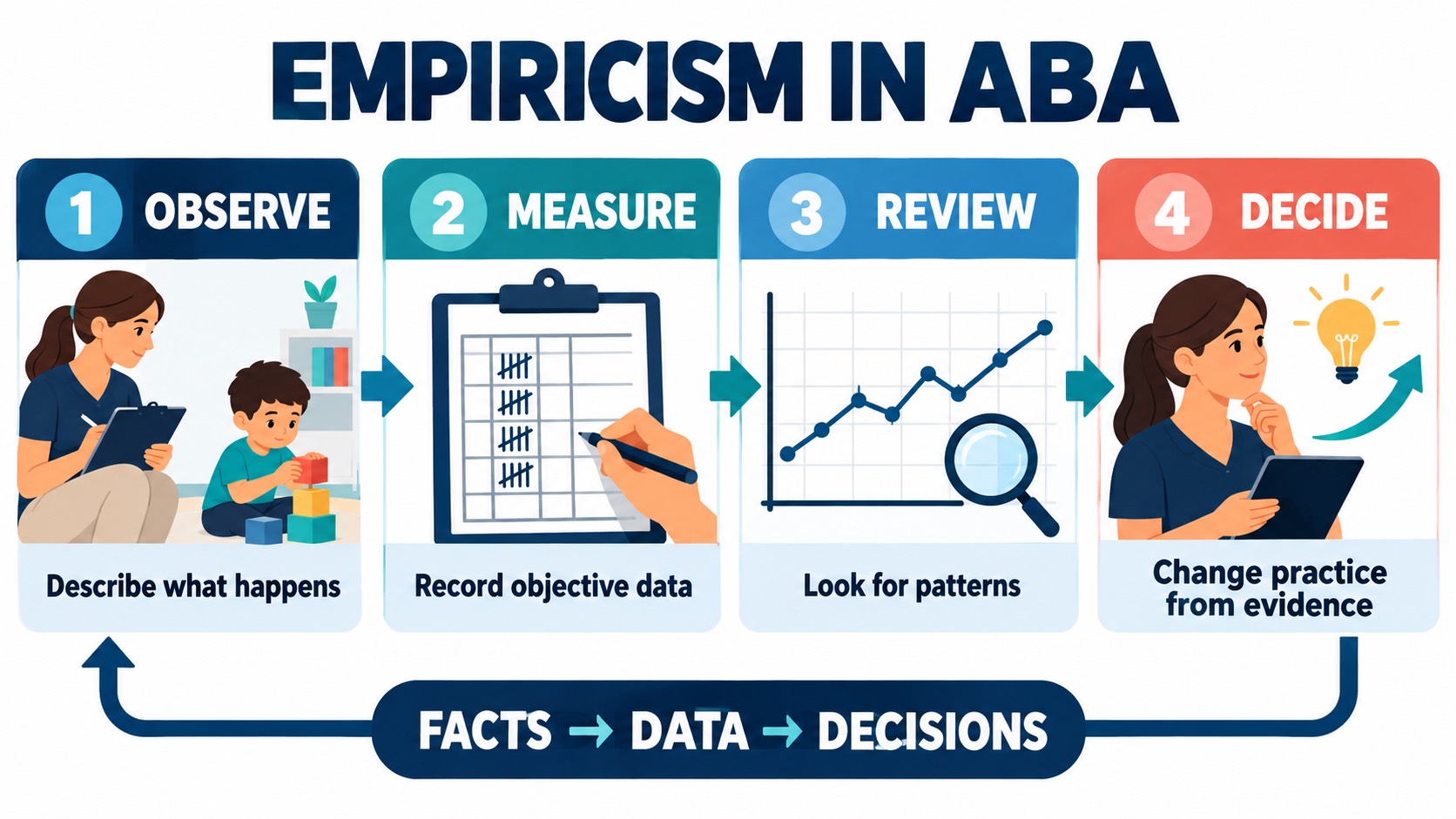
Empiricism in ABA is the commitment to building knowledge from objective observation, measurement, and data rather than intuition, tradition, or an untested explanation. In practice, empiricism means that a behavior analyst defines what is happening, collects evidence, examines the pattern, and lets the evidence guide the next decision.
This principle is easy to recognize in a BCBA exam question: the empiric answer calls for observable evidence, measurable outcomes, and a data review before accepting a conclusion. The BACB Test Content Outline, 6th edition places empiricism among the philosophical assumptions underlying the science of behavior analysis. The article explains the definition, gives applied examples, and compares empiricism with related assumptions.
What Is Empiricism in Applied Behavior Analysis?
Empiricism is the view that reliable knowledge should be grounded in events that can be observed, measured, and checked. In ABA, the focus is not on whether a practitioner has a strong impression; it is on whether the claim can be connected to observable behavior and environmental events. A statement such as “the learner is unmotivated” may be a starting hypothesis, but it does not tell the team what happened, how often it happened, or what evidence would support the conclusion.
An empirical approach translates the concern into observable questions. What task was presented? What response occurred? What was the latency, duration, frequency, or product? What consequence followed? Did the pattern repeat across sessions or settings? Which change in the intervention was associated with a measurable change in behavior? These questions make the claim open to confirmation, revision, or rejection.
| Type of statement | What it relies on | Empirical follow-up |
|---|---|---|
| “The learner does not care about the task.” | An interpretation of an internal state | Define task engagement and record behavior before, during, and after the task is presented |
| “The intervention is working.” | A general impression | Compare baseline and intervention data on the selected target dimension |
| “The learner leaves during writing.” | An observable event, but still incomplete | Define leaving, record its rate or latency, and identify the relevant context |
| “Five of six sessions met the mastery criterion.” | A defined measurement rule and recorded outcomes | Check whether the criterion, measurement, and decision rule are valid and reliable |
Empiricism does not mean that every important question can be answered instantly or that one data point proves a conclusion. It means that the team treats evidence as the basis for knowing and remains willing to revise a conclusion when better evidence appears.
Why Empiricism Matters in Behavior Analysis
ABA is an applied science. The targets are socially important behaviors, and the decisions can affect instruction, support, safety, and quality of life. Empiricism protects those decisions from being driven only by habit, authority, or a compelling story. It also makes professional work more transparent: another trained person can inspect the definition, measurement system, graph, and decision rule.
Empiricism supports several connected practices:
- Operational definitions: the team describes behavior in terms that can be observed and scored.
- Measurement: the team selects a dimension that answers the decision question rather than collecting convenient but irrelevant numbers.
- Visual analysis: the team examines level, trend, variability, immediacy, and overlap instead of relying on a single impression.
- Replication: the team checks whether a pattern appears again across people, settings, materials, or phases.
- Data-based decisions: the team changes, continues, or fades a procedure according to a preplanned rule and the observed results.
Empiricism also limits mentalism. A mentalistic label may describe a person in a way that sounds explanatory while leaving the environmental variables unspecified. An empirical analysis does not deny that a learner has private events; it requires the practitioner to distinguish what is directly observed from what is hypothesized and to identify what evidence supports the hypothesis.
Empirical Data and Data-Based Decision Making
Data become useful evidence only when the team knows what was measured and how the measurement was obtained. A graph cannot repair an unclear definition, an inconsistent observer, or a target dimension that does not match the question. Before drawing a conclusion, inspect the whole measurement chain: target, context, observer, procedure, score, and decision rule.
| Evidence question | What to document | Why it matters |
|---|---|---|
| What behavior was measured? | Operational definition, examples, nonexamples, and boundaries | Prevents different observers from scoring different events |
| Under what conditions? | Setting, task, materials, time, relevant antecedent and consequence | Shows whether the result generalizes beyond one narrow situation |
| How was it quantified? | Frequency, rate, duration, latency, interval, product score, or another dimension | Connects the score to the decision question |
| How trustworthy is the score? | Observer training, agreement checks, treatment integrity, and data-quality notes | Reduces the risk of acting on measurement error |
| What decision follows? | Predefined criterion for continuing, changing, or reviewing the procedure | Keeps decisions linked to evidence rather than hindsight |
For example, if a learner’s task completion rises from 40% to 80%, the team should ask what changed. Were the opportunities comparable? Was the task easier? Were prompts added? Did the scoring rule change? An empirical conclusion is stronger when the team can describe the measurement and the conditions well enough to rule out plausible alternative explanations.
Empiricism Examples in ABA
The examples below show how empiricism changes the way a practitioner reasons. In each case, the empirical move is to replace a broad conclusion with a testable observation and a decision rule.
| Situation | Nonempirical shortcut | Empirical response | Possible measure |
|---|---|---|---|
| Work refusal increases | “The learner is being oppositional.” | Define refusal, identify the task and prompt conditions, and compare data across demand types | Frequency, latency, or duration |
| Communication training begins | “The new prompt worked.” | Record independent and prompted communication across opportunities and sessions | Percentage independent |
| Problem behavior decreases | “The treatment fixed it.” | Check the target definition, baseline, intervention phase, integrity, and whether the decrease replicates | Rate or duration with phase changes |
| Skill appears at school | “The skill generalized everywhere.” | Probe the skill with new people, materials, instructions, and settings | Percentage correct by condition |
| Staff report improvement | “Everyone agrees it is better.” | Compare the report with direct observation, product data, or a structured rating rule | Defined direct or indirect measure |
Empiricism is not restricted to problem behavior reduction. It applies equally to teaching, skill maintenance, generalization, preference assessment, treatment integrity, and social validity. The target changes, but the logic remains: define, observe, measure, analyze, and revise as the evidence requires.
Empiricism vs. Determinism, Parsimony, and Pragmatism
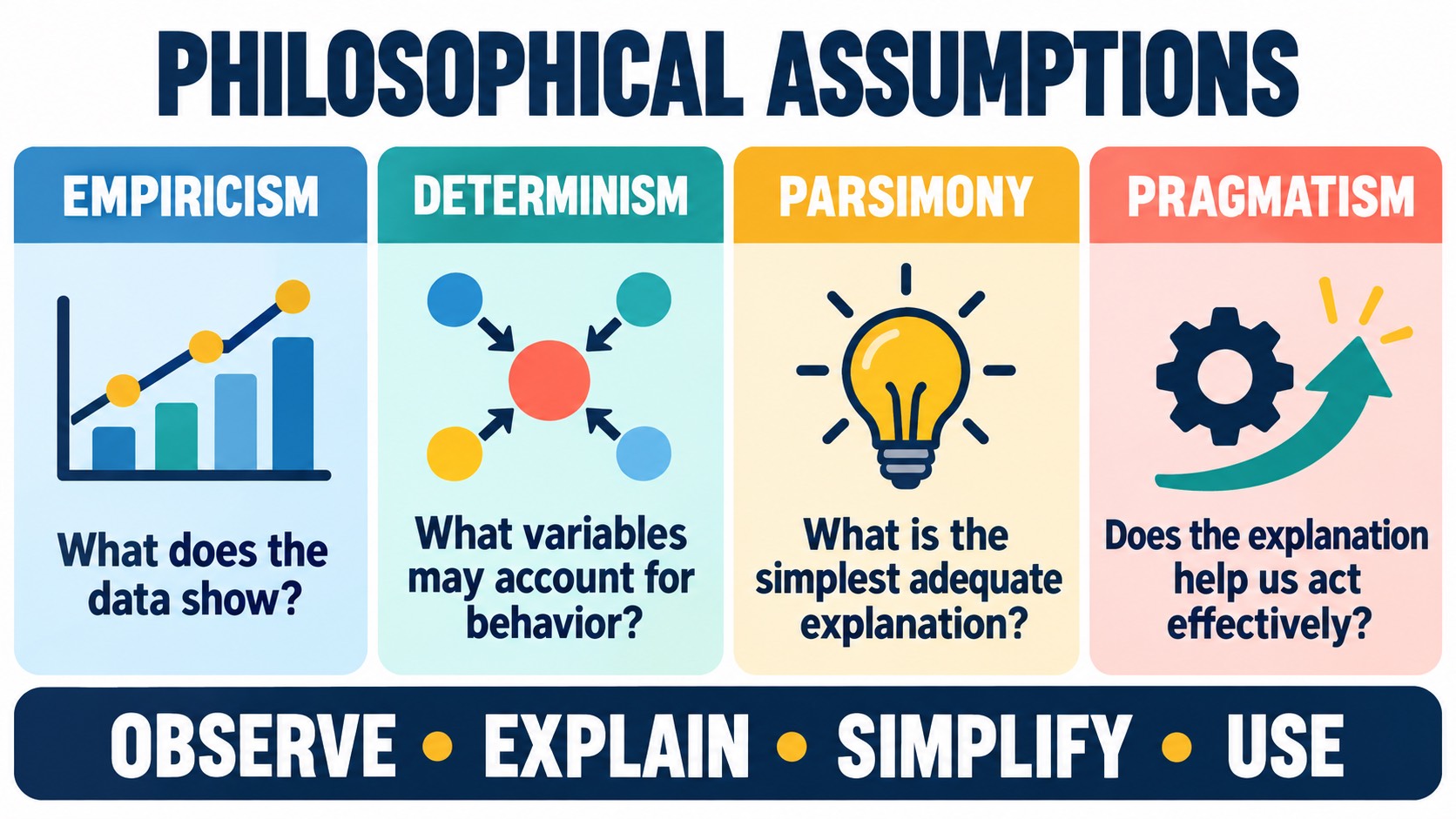
BCBA questions often place several philosophical assumptions in the same answer set. They are related, but they answer different questions. Empiricism asks how knowledge is built. Determinism assumes that behavior is lawful and influenced by variables that can be investigated. Parsimony recommends ruling out simpler adequate explanations before adopting a complex one. Pragmatism asks whether an explanation or procedure is useful for achieving meaningful outcomes.
| Assumption | Core question | BCBA-style clue |
|---|---|---|
| Empiricism | What does objective observation and measurement show? | The practitioner collects data before accepting a conclusion |
| Determinism | What variables may account for behavior? | The analysis assumes behavior is influenced by lawful relations, not randomness alone |
| Parsimony | What is the simplest adequate explanation? | The practitioner rules out ordinary, simpler explanations before proposing an unusual one |
| Pragmatism | Does the explanation or procedure help us act effectively? | The team evaluates whether the approach produces meaningful improvement |
These assumptions can work together. A BCBA may use determinism to search for relevant environmental variables, empiricism to collect evidence, parsimony to avoid an unnecessarily complex account, and pragmatism to judge whether the resulting intervention is useful. Do not choose “empiricism” merely because a scenario mentions science; choose it when the emphasis is on observable facts, measurement, and evidence.
How to Apply Empiricism Step by Step
A simple empirical workflow can be used for an exam scenario or a real measurement question. The steps are not a substitute for a full assessment or individualized clinical judgment, but they provide a disciplined way to connect a concern to evidence.
- State the question. Decide whether the concern is about occurrence, skill accuracy, duration, delay, generalization, treatment integrity, or another measurable outcome.
- Define the target. Write a clear operational definition or performance criterion. Include examples and nonexamples when necessary.
- Select the measurement. Choose the dimension that best represents the question. A convenient score is not automatically a valid score.
- Collect representative data. Sample enough opportunities, sessions, people, and settings to support the decision you need to make.
- Check data quality. Review observer agreement, integrity, missing data, changes in materials, and any event that could affect interpretation.
- Analyze and decide. Examine the pattern and apply the planned rule. Continue, modify, pause, or investigate further as the evidence indicates.
- Replicate or recheck. Confirm that the result is stable, meaningful, and not limited to one accidental observation.
For a broader review of the assumptions that support behavior analysis, see the site’s philosophical underpinnings ABA guide. The key study habit is to ask, “What observation or measurement would distinguish these possible answers?”
Empiricism, Measurement, and Reliability
Reliable measurement is a support for empiricism, but reliability and validity are not the same thing. A measure can be consistent and still fail to capture the behavior that matters. For example, two observers may agree that a vague label occurred, but agreement on a poorly defined label does not make the label valid. The data system must be both sufficiently consistent and meaningfully connected to the target.
| Quality check | Question | Example evidence |
|---|---|---|
| Operational clarity | Would trained observers identify the same event? | Definition includes form, boundaries, examples, and nonexamples |
| Reliability or agreement | Do independent observers produce similar scores? | Scheduled IOA checks across representative sessions |
| Validity | Does the measure represent the behavior or skill that matters? | Chosen dimension matches the decision and critical behavioral feature |
| Treatment integrity | Was the intervention implemented as planned? | Checklist or fidelity score shows the relevant steps occurred |
| Representativeness | Do the observations reflect the conditions where the decision applies? | Data include typical tasks, people, settings, and time periods |
If data are missing or the measurement system changed halfway through a phase, note that limitation rather than hiding it. Empiricism includes transparent treatment of uncertainty. A careful conclusion may be “the current data are insufficient; collect another representative sample” rather than “the intervention failed.”
Common BCBA Exam Traps About Empiricism
The most common errors involve confusing empiricism with a related assumption or treating an opinion as evidence. Use the table below as a quick discrimination guide.
| Exam trap | Why it is wrong | What to select instead |
|---|---|---|
| “Empiricism means behavior has causes.” | That clue points more directly to determinism. | Look for objective observation, measurement, and evidence. |
| “Empiricism means choose the easiest explanation.” | That is the emphasis of parsimony. | Choose empiricism when the question is how the claim is tested. |
| “Empiricism means the procedure worked.” | Usefulness and outcome emphasis point to pragmatism. | Ask whether the scenario emphasizes data or practical effectiveness. |
| “A staff member’s impression is enough.” | An impression may be useful background information but is not automatically objective evidence. | Define the target and collect a suitable measure. |
| “One data point proves the hypothesis.” | Evidence must be interpreted in context and, when possible, replicated. | Inspect the pattern, quality, and representative sample. |
| “More data are always better.” | Large amounts of irrelevant or invalid data do not answer the question. | Select a valid, efficient measurement procedure. |
When two options both mention data, identify what the question is testing. A choice about direct versus indirect measurement is a measurement-system question. A choice about whether a conclusion is grounded in objective observation is an empiricism question. A choice about whether the result is useful may be pragmatism.
Empiricism Study Checklist
Before answering an empiricism question, run through this short checklist:
- What is the exact observable behavior, skill, or environmental event?
- What data would show that the event occurred or changed?
- Is the proposed evidence objective, measurable, and relevant to the question?
- Could the score be distorted by an unclear definition, observer drift, missing data, or treatment-integrity problem?
- Is the answer actually describing empiricism, or is it describing determinism, parsimony, pragmatism, or a measurement procedure?
- What decision would follow from the data, and how would the team check the result again?
For another practice step, review the site’s reliable versus valid BCBA guide and then try the free BCBA mock exam. Those resources help separate the philosophical principle from the technical details of measurement quality.
Empiricism in ABA FAQ and Final Review
What is a simple definition of empiricism in ABA? Empiricism is the commitment to using objective observation, measurement, and data to build knowledge and guide decisions about behavior.
Does empiricism mean that every measure must be direct? No. Direct observation is often valuable, but product measures and carefully designed indirect measures can also contribute evidence. The procedure must be appropriate, valid, and interpreted within its limits.
Is empiricism the same as evidence-based practice? They are closely related but not identical. Empiricism is a foundational assumption about how knowledge is built. Evidence-based practice also integrates the best available evidence with clinical expertise, context, and the learner’s values and needs.
How is empiricism different from pragmatism? Empiricism emphasizes how we know—through observation and data. Pragmatism emphasizes whether an explanation or procedure is useful for achieving meaningful outcomes.
What is the fastest BCBA exam memory cue? Remember: empiricism equals “show me the data.” If the scenario emphasizes objective facts, measurement, and data-based decisions, empiricism is likely the intended concept.
Empiricism gives ABA its evidence-centered discipline. Define the event, measure what matters, inspect the pattern, and let the quality of the evidence determine the next step. When the data do not support the original explanation, revise the explanation and continue investigating rather than forcing the data to fit it.



