

Parsimonious ABA means choosing the simplest explanation sufficient for the behavior and data. Start with observable relations, test environmental variables, and add complexity only when evidence requires it. Do not ignore health, culture, communication, trauma, or context.
This guide connects parsimony with determinism, empiricism, selectionism, and pragmatism, then applies it to task refusal, leaving a seat, and communication. The goal is a testable, ethical hypothesis—not an “easy” guess.
Parsimonious ABA: Definition and Central Rule
Parsimony prefers the simplest sufficient explanation before adding assumptions. “Sufficient” matters: the account must fit the pattern and context, make predictions, and remain revisable.
If a learner pushes away a worksheet after a difficult instruction and the task is removed, first test task difficulty and escape. Measure task features, supports, communication, and the consequence; the hypothesis is not yet proof.
| Part of the rule | Meaning | Question for the analyst |
|---|---|---|
| Simple | Uses the fewest unsupported assumptions needed to explain the pattern. | Can observable conditions explain the result before a hidden trait is proposed? |
| Sufficient | Accounts for the important features of the behavior and context. | Does the explanation fit the setting, history, consequence, and data? |
| Testable | Makes predictions that could be supported or contradicted. | What would we expect to see if this hypothesis were correct? |
| Revisable | Changes when new evidence does not fit. | What result would make us modify the hypothesis? |
| Useful | Guides an ethical and socially meaningful next step. | Does it help the team improve behavior and quality of life? |
On exams, choose measurable behavior and environmental relations. Be cautious when “lazy,” “defiant,” or “unmotivated” replaces observable conditions.
Why Parsimony Starts With Observable Environmental Variables
Parsimony studies behavior and environment without denying private events or biology. Do not make an inferred trait the final explanation when conditions, history, effort, and consequences can be examined.
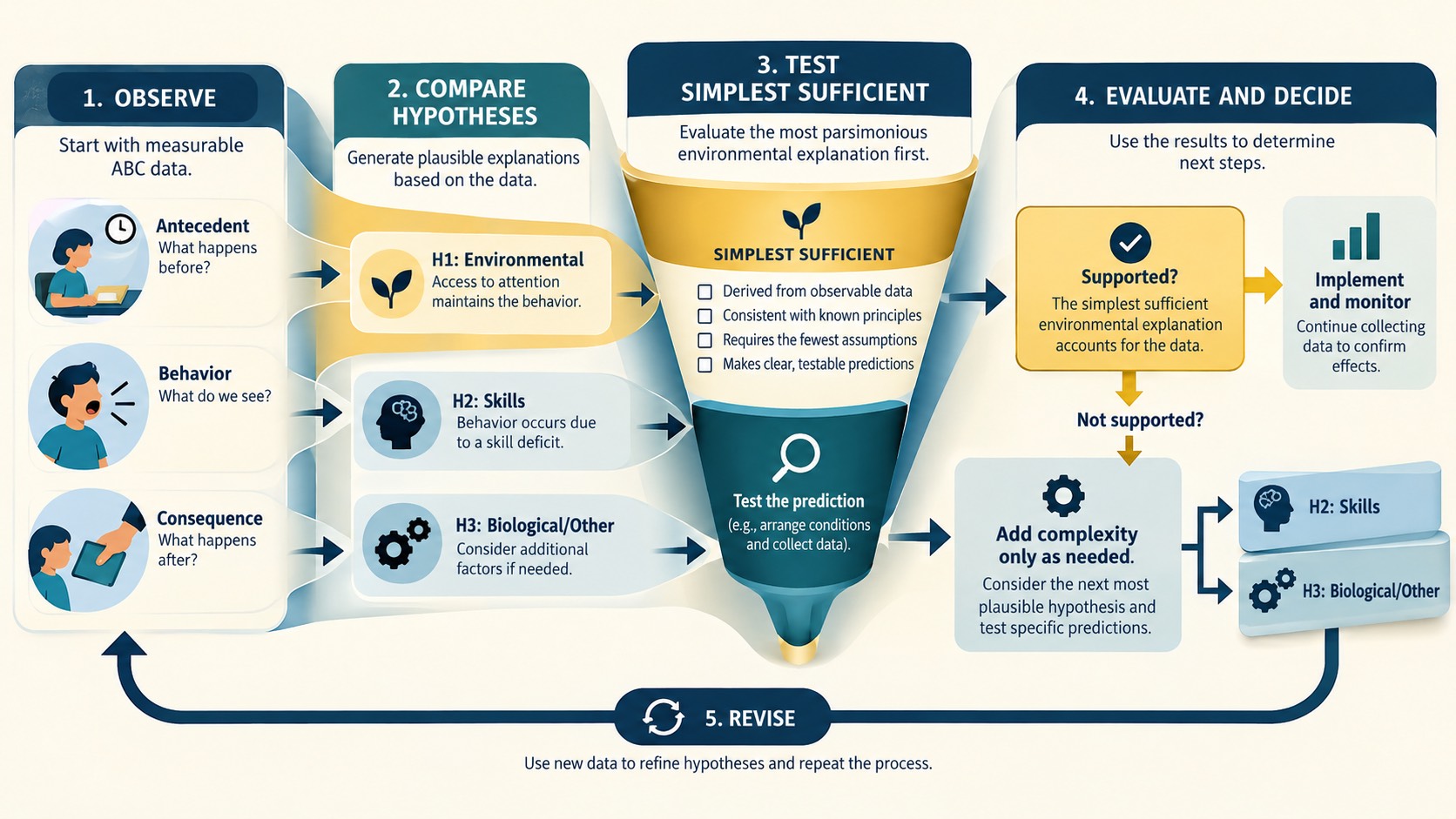
Observable does not mean superficial. Definitions and functional assessments can capture interacting variables. “Leaves within 20 seconds of a multi-step language task” is measurable; “avoids learning” ends inquiry.
| Starting statement | Parsimony concern | More useful reformulation |
|---|---|---|
| “The learner is noncompliant.” | It summarizes behavior without specifying when or why it occurs. | Define the response and record antecedents, task features, prompts, and consequences. |
| “She seeks attention.” | It may skip over the actual social events that follow behavior. | Test whether specific forms of attention follow the response and change its future rate. |
| “He cannot learn this skill.” | It treats current performance as a fixed capacity. | Review prerequisite skills, instruction, prompts, reinforcement, response effort, and practice history. |
| “The behavior is random.” | It claims no relation before enough observation has occurred. | Check measurement quality, context changes, delayed consequences, and missing variables. |
| “The client is anxious, so the behavior happens.” | It may confuse a private event or report with a complete functional account. | Respect the report and also measure the conditions, behavior, and consequences surrounding it. |
Compare the site’s mentalism guide and radical behaviorism guide. Parsimony guards against satisfying but untested stories.
Parsimony vs Mentalism, Reductionism, and Oversimplification
Mentalism uses an inner trait or construct as cause; reductionism shifts analysis to another level; oversimplification ignores variables. Parsimony does none of these: it seeks a sufficient, testable account.
A parsimonious account can include task difficulty, language, sleep, pain, communication, reinforcement history, and effort when evidence supports each relation.
| Concept | What it does | Exam-safe distinction |
|---|---|---|
| Parsimony | Prefers the simplest sufficient, testable account. | Start with observable relations and add complexity when evidence demands it. |
| Mentalism | Uses an inferred inner cause as the explanation. | A label such as motivation or attitude is not enough without environmental analysis. |
| Reductionism | Explains one level only by another level of analysis. | Biological or cognitive information can matter without replacing functional analysis. |
| Oversimplification | Leaves out variables that are necessary to explain the data. | “Simple” is not a reason to ignore health, culture, communication, or history. |
| Functional explanation | Relates behavior to conditions and consequences that can be tested. | It may be complex, but each part should support a prediction or decision. |
Choose the answer preserving behavior-context relations. Private or medical variables can be context, not substitutes for data about what changes behavior.
How Parsimony Works With Other Philosophical Assumptions
Parsimony works with other assumptions: determinism searches lawful relations, empiricism measures, selectionism examines consequences over time, and pragmatism asks whether change is useful and social meaningful.
They are not interchangeable: evidence suggests empiricism, consequences selecting behavior suggest selectionism, simplest adequate explanation suggests parsimony, and meaningful difference may suggest pragmatism or effectiveness.
| Assumption or practice | Connection to parsimony | Example question |
|---|---|---|
| Determinism | Supports the search for discoverable relations rather than random or trait-based explanations. | What conditions may reliably influence the response? |
| Empiricism | Provides the data needed to judge whether a simple hypothesis is sufficient. | What was directly observed, measured, and graphed? |
| Selectionism | Explains persistence through consequences and learning history. | What consequence helps the response pattern continue? |
| Pragmatism | Checks whether the explanation and intervention are useful in real life. | Does the plan improve a meaningful outcome? |
| Philosophic doubt | Prevents a plausible simple story from becoming a permanent conclusion. | What evidence could disconfirm the current hypothesis? |
Review the BACB BCBA examination outline and approved course materials; organization can vary across study resources.
A Step-by-Step Parsimony Workflow for BCBA Cases
Use a repeatable workflow: define behavior, identify preceding and following conditions, check measurement, generate multiple hypotheses, test the least complex account, and add variables only when needed.
If a learner vocalizes and pushes materials away during independent work, check task difficulty, break history, help requests, prompts, people, and materials rather than assuming a trait.
| Step | Action | Decision rule |
|---|---|---|
| 1. Define | Write a precise operational definition and select a matching measure. | Another trained observer should know exactly what to record. |
| 2. Describe | Collect ABC, setting-event, skill, and context information. | Separate what is observed from what is inferred. |
| 3. Compare | List plausible environmental and learning-history explanations. | Do not treat the first plausible story as confirmed. |
| 4. Predict | State what should happen if each hypothesis is correct. | Predictions must be specific enough to test. |
| 5. Test | Arrange safe, ethical comparisons or conduct an appropriate assessment. | Change relevant variables while protecting the learner. |
| 6. Revise | Use the data to keep, narrow, combine, or reject hypotheses. | Unsupported explanations do not survive merely because they sound simple. |
A precise account tells teachers what to do, caregivers what to observe, and supervisors what to review. A hypothesis that cannot guide a measurable next step is not yet sufficient.
Parsimony Examples: Task Refusal, Leaving Seat, and Communication
These examples replace unsupported labels with testable variables. They do not assign function from one observation; they create conditional, data-based hypotheses.
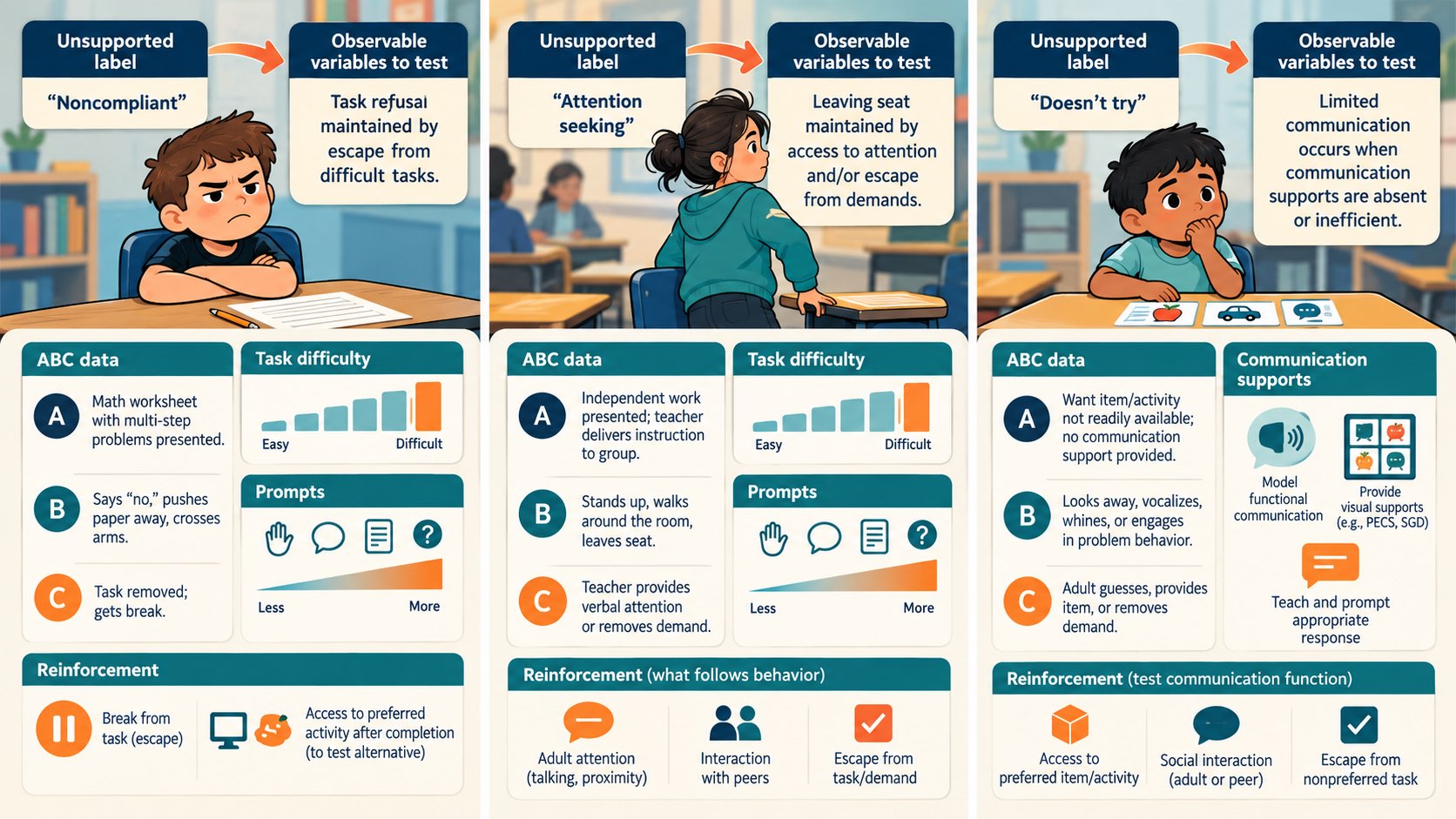
| Case | Less useful label | Parsimonious hypothesis to test | Possible measure |
|---|---|---|---|
| Task refusal | “Noncompliant.” | Refusal is more likely when difficult tasks are presented and a break follows. | Latency to start, refusal frequency, task difficulty, and break delivery. |
| Leaving seat | “Attention seeking.” | Leaving is more likely when group demands occur and adult or peer interaction follows. | Antecedent type, time seated, attention delivered, and task completion. |
| Limited communication | “Does not try.” | Problem behavior occurs when a desired item is unavailable and functional communication is not efficient. | Opportunities, communication response, prompt level, and access to the item. |
| Slow responding | “Unmotivated.” | Latency increases with high response effort, unclear instructions, or weak reinforcement. | Instruction clarity, response effort, latency, prompts, and consequence quality. |
Hypotheses remain provisional. If leaving occurs equally during easy and difficult tasks but follows peer noise, revise the escape hypothesis rather than protecting the first guess.
Parsimony in Assessment, Intervention, and Data Review
Parsimony applies across assessment, intervention, and review: limit speculation, select the least complicated effective procedure, and do not invent a new story for every graph change.
A simple intervention can be strong. Teach an efficient request, adjust difficulty, reinforce alternatives, and improve prompts before layering consequences; follow function, skill, safety, assent, and data.
| Service stage | Parsimonious question | Evidence to keep visible |
|---|---|---|
| Assessment | What is the smallest set of variables that could explain the current pattern? | Operational definition, ABC data, interview limits, direct observation, and context. |
| Goal selection | What socially meaningful outcome should change? | Learner and stakeholder priorities, independence, access, communication, and quality of life. |
| Intervention | Which effective procedure directly addresses the tested relation? | Teaching steps, reinforcement, prompts, response effort, and safety safeguards. |
| Monitoring | What data would show benefit, no effect, or an adverse effect? | Level, trend, variability, treatment integrity, IOA, generalization, and side effects. |
| Revision | What part of the account needs to change? | Predicted versus observed patterns and the rationale for each revision. |
Remove the label and ask whether the plan still makes sense. Behavior, conditions, skills, consequences, and data should remain clear without “defiant” or “unmotivated.”
Ethics, Culture, Health, and Context: When Simple Is Not Shallow
“Simplest” must not dismiss pain, sleep, medication, trauma, language, culture, or inaccessible communication. If a variable changes prediction or understanding, omitting it is incomplete.
Ethical parsimony uses no more assumptions than evidence supports, not fewer variables than circumstances require. Collaborate with qualified providers, respect privacy, avoid diagnosis from ABA data alone, and preserve refusal and support requests.
| Context to examine | Why it may matter | Parsimony safeguard |
|---|---|---|
| Health, pain, sleep, or medication | Physiological changes can alter response effort, tolerance, or performance. | Document observations and coordinate with qualified providers instead of guessing a diagnosis. |
| Language and communication | Instruction or response demands may be inaccessible or ambiguous. | Assess functional communication and use language-accessible supports. |
| Culture and family priorities | Social validity depends on the values and routines of the people affected. | Ask, listen, and avoid treating cultural differences as deficits. |
| Trauma and safety | Some conditions may evoke distress or create risk. | Use trauma-informed safeguards, assent-sensitive practice, and the least intrusive effective approach. |
| Generalization | A simple account may fit one room but fail in natural contexts. | Probe across people, places, materials, routines, and consequences. |
Review the BACB Ethics Code and supervision requirements. Parsimony should make practice transparent and respectful, never minimize the person or context.
Parsimony vs Related Exam Terms and Common Traps
Read the exact relationship. “Simplest adequate explanation before complexity” indicates parsimony; repeated measurement, replication, or comparison may indicate a science attitude or experiment.
| Exam clue | Likely answer | Why |
|---|---|---|
| Uses the fewest assumptions while still accounting for the data. | Parsimony. | The explanation is simple, sufficient, and testable. |
| Assumes behavior occurs in lawful relation to conditions. | Determinism. | The focus is on discoverable order, not simplicity. |
| Relies on direct observation and measurement. | Empiricism. | The focus is on the source and quality of knowledge. |
| Explains persistence through consequences over time. | Selectionism. | The focus is on selection by consequences and learning history. |
| Repeats a procedure to see whether the finding recurs. | Replication. | The focus is a scientific attitude or practice, not parsimony. |
| Produces a meaningful change for the learner. | Pragmatism or effectiveness. | The focus is usefulness and social significance. |
Do not choose parsimony merely because “simple” appears, confuse it with certainty, or ignore complex context. The answer should be testable, data-fitting, and revisable.
Parsimony Checklist, FAQ, and Practice Takeaway
Use this checklist when a case asks for the most parsimonious explanation:
- Define the target behavior measurably.
- Identify antecedents and consequences.
- Check setting events and skills.
- Separate observations from labels.
- List multiple plausible hypotheses.
- Choose the simplest testable account.
- Check health, communication, culture, and safety.
- Add complexity only when evidence requires it.
- Revise when data disagree.
- Evaluate social validity.
| Question | Short answer | Practical reminder |
|---|---|---|
| What is parsimonious ABA? | Using the simplest sufficient, evidence-based explanation of behavior. | “Sufficient” means it must fit the pattern and guide a test. |
| Does parsimony mean the easiest explanation? | No. It means the fewest unsupported assumptions, not the least effort or least detail. | Do not omit variables that change the prediction. |
| Is parsimony the same as ignoring biology or private events? | No. Those factors can be relevant context and may require qualified collaboration. | Include them responsibly while still analyzing observable relations. |
| How does parsimony differ from mentalism? | Parsimony asks for a testable sufficient account; mentalism may stop at an inferred inner cause. | Ask what can be observed, measured, and changed. |
| What is the one-sentence exam rule? | Choose the simplest explanation that accounts for the data and makes a testable prediction. | Revise it when the data do not support it. |
Parsimony is disciplined humility: start with the clearest relation, test it ethically, and let evidence determine complexity. Practice with the free BCBA mock exam.



