Radical behaviorism in ABA is the philosophy that places public behavior and private events within the same natural science of behavior. It does not deny thoughts, feelings, or sensations. Instead, it asks how environmental history, current context, and consequences relate to behavior without treating an unmeasured inner trait as the final cause.
The BCBA® exam tests this idea through short vignettes. A learner may say, “I am anxious,” a supervisor may describe a client as “unmotivated,” or a question may contrast radical behaviorism with methodological behaviorism. The safest answer is usually the one that identifies observable relations and learning history while treating private events as behavior or bodily events that can be included in the analysis.
This guide is aligned with Domain A, especially the BACB® Test Content Outline (6th ed.) task A.3, “Explain behavior from the perspective of radical behaviorism,” and task A.4, which asks candidates to distinguish behaviorism, the experimental analysis of behavior, applied behavior analysis, and professional practice guided by behavior analysis. Read the official BCBA Test Content Outline for the complete exam framework.
What Is Radical Behaviorism in ABA?
Radical behaviorism is a philosophical account of behavior analysis. It treats behavior as part of the natural world and explains behavior through relations among the organism, the environment, and a history of consequences. “Radical” means going to the root of the subject matter; it does not mean extreme, harsh, or punitive.
The philosophy extends the subject matter beyond behavior that another person can directly observe. Thinking, feeling, remembering, and sensing can be private events, but their privacy does not make them supernatural or exempt from analysis. A radical behaviorist can acknowledge that a learner feels nervous while still asking what conditions occasioned the behavior, what learning history is relevant, and what consequences maintain the pattern.
That distinction matters because a label can describe a pattern without explaining it. “She is anxious” may summarize what she says and does, but it does not by itself identify the variables that occasion avoidance, escape, reassurance seeking, or help requesting. A functional account moves from the label to the relations that can be observed, measured, tested, and changed.
| Term | What it means | Exam-safe question |
|---|---|---|
| Radical behaviorism | A philosophy that analyzes public and private behavior through behavioral relations. | What environmental and historical variables control the behavior? |
| Behavior analysis | A natural science that describes, predicts, and influences behavior through functional relations. | What relation is demonstrated by the data? |
| Mentalism | An explanation that treats an inner trait or state as an initiating cause without analyzing its controlling variables. | Is the explanation circular or merely a restatement of the behavior? |
The Philosophical Assumptions Behind the Analysis
Radical behaviorism is not a data-collection procedure by itself. It is a philosophical foundation for the science of behavior analysis. The assumptions below help a BCBA candidate recognize why a behavior analyst prefers a functional, parsimonious account over an appeal to an inner cause.
| Assumption | Practical meaning | Vignette clue |
|---|---|---|
| Selectionism | Behavior is selected and maintained by consequences across biological, behavioral, and cultural levels. | A response becomes more likely after a consequence that functions as reinforcement. |
| Determinism | Behavior is orderly and related to variables, even when the variables have not yet been identified. | The analyst searches for relevant conditions instead of assuming behavior is random. |
| Empiricism | Knowledge is built through direct, systematic observation and measurement. | The decision is based on data rather than a preferred story. |
| Parsimony | Prefer an adequate explanation using established principles before adding a more complex one. | Check reinforcement, stimulus control, and history before inventing a hidden construct. |
| Pragmatism | The value of an explanation is judged by whether it helps predict and influence behavior effectively. | The account leads to a workable, socially meaningful intervention. |
These assumptions work together. Determinism encourages the analyst to look for order. Empiricism supplies measurement. Parsimony limits unsupported speculation. Selectionism explains why consequences matter. Pragmatism asks whether the account improves prediction and control in a meaningful context. No single assumption should be treated as a synonym for radical behaviorism, but the set provides a useful map for Domain A questions.
How Radical Behaviorism Treats Private Events
A private event is an event that is accessible directly to the person experiencing it but not directly accessible to other observers in the same way. Examples can include pain, covert verbal behavior, imagery, or a sensation of anxiety. Privacy describes access, not whether the event is real, mentalistic, or outside science.
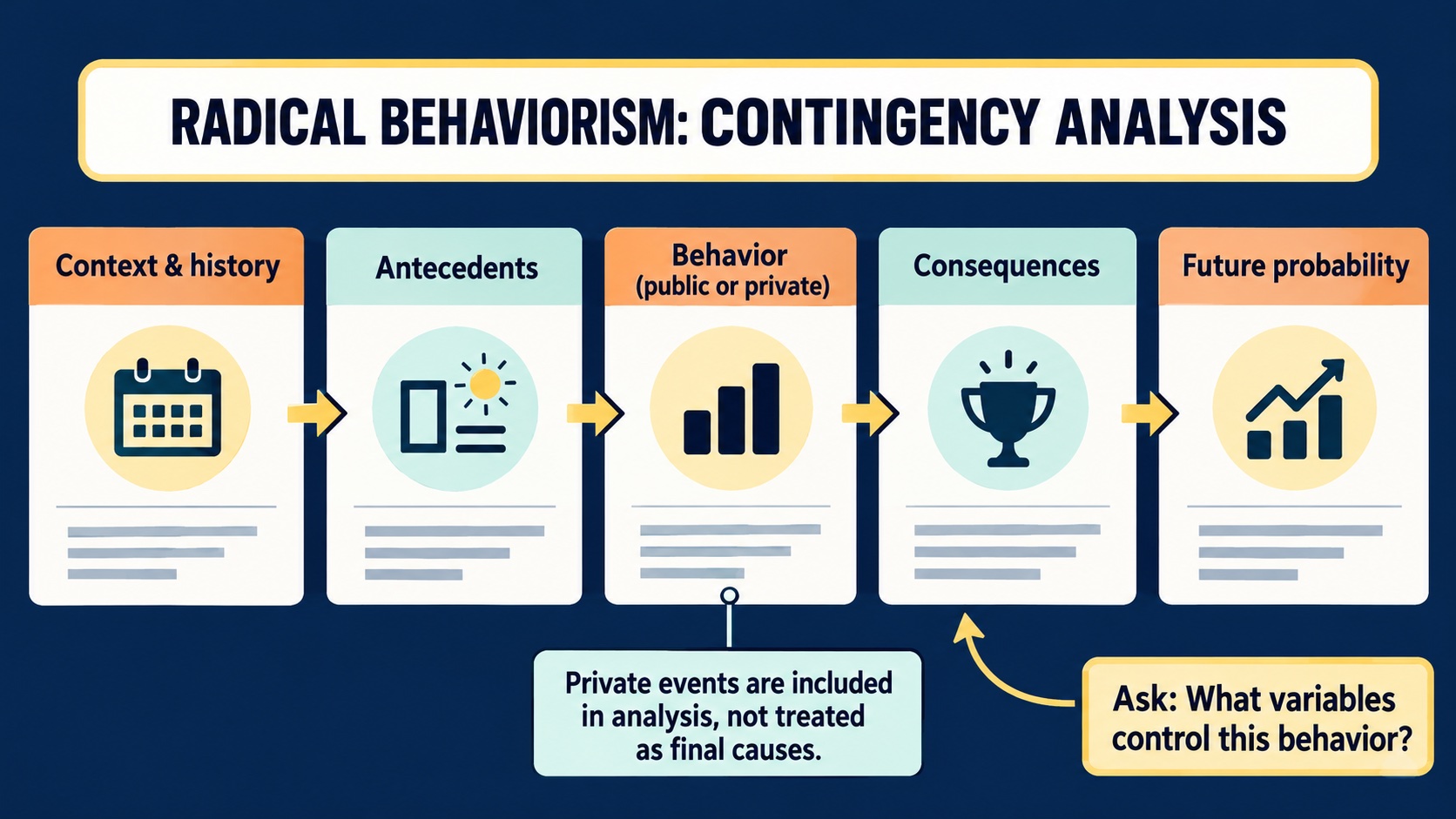
Radical behaviorism includes private events in the subject matter of behavior analysis. At the same time, it does not automatically treat a private event as an autonomous initiating cause. For example, “the learner refused because of low motivation” is incomplete. A stronger analysis asks what operation changed the value of a consequence, what antecedent occasioned refusal, what behavior was emitted, and what consequence followed.
This does not require a practitioner to pretend that private events can always be directly observed. A learner’s report can be behavior that is shaped by a verbal community and occasioned by relevant conditions. The report can be useful data, but it should be interpreted alongside direct observation, contextual information, and the contingency that gives the report its function.
| Statement | Problem | Behavior-analytic follow-up |
|---|---|---|
| “He hit because he was angry.” | Anger may simply rename the event and leave the controlling variables unspecified. | Identify the antecedent, response form, immediate consequence, and relevant history. |
| “She knows the answer but is unmotivated.” | The label does not show whether the response is in the repertoire under the present conditions. | Assess stimulus control, response effort, reinforcement, prompts, and task conditions. |
| “He reports pain before leaving.” | The report is relevant behavior, but its function and relation to leaving still need analysis. | Record the report, context, observable behavior, and consequences without dismissing the report. |
Jay Moore’s discussion of private events emphasizes an operational analysis of what talk about a private event is doing. It may refer to a private behavioral event, physiology, a disposition describing a probability of behavior, or an explanatory fiction. For BCBA exam purposes, the key point is not to memorize a long taxonomy. It is to avoid confusing a private event with a complete causal explanation.
Radical vs Methodological Behaviorism vs Mentalism
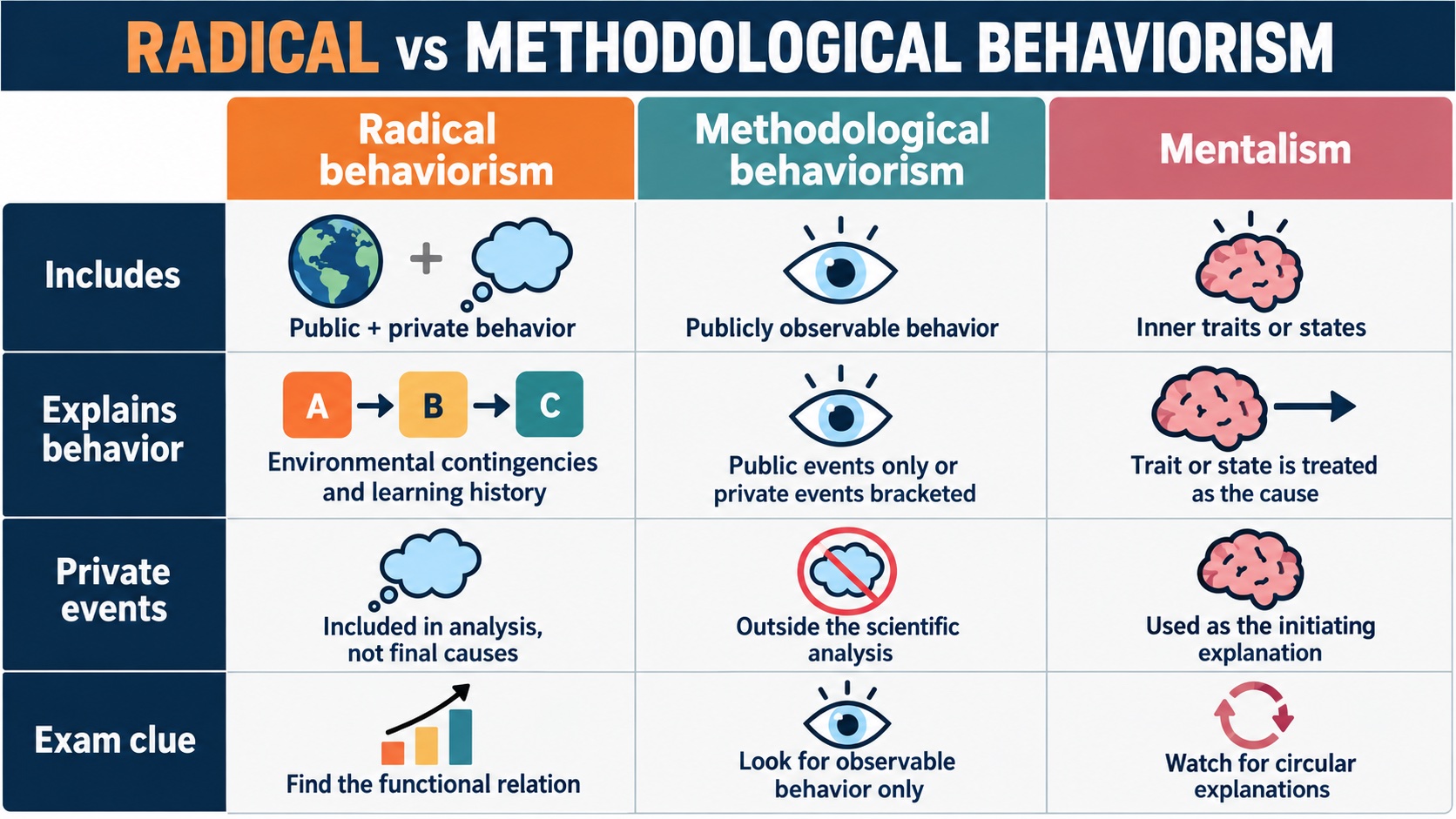
Comparison questions often use similar-sounding language. The fastest route is to identify what each position does with private events and what it treats as the source of explanation.
| Position | Subject matter | Treatment of private events | Typical exam clue |
|---|---|---|---|
| Radical behaviorism | Public and private behavior, studied through behavioral relations. | Included, but not automatically used as an ultimate cause. | Analyze context, history, contingencies, and function. |
| Methodological behaviorism | Publicly observable events that allow interobserver agreement. | Excluded, bracketed, or treated as outside the scientific subject matter. | Focus only on what can be publicly observed. |
| Mentalism | Behavior is explained by inner traits, states, or entities. | Often treated as the initiating explanation. | “He did it because he is aggressive” without a functional account. |
Do not confuse radical behaviorism with saying that everything is publicly observable. That is the methodological position. Do not confuse it with saying that feelings are imaginary. That is also incorrect. The radical position is more precise: private events may be real behavioral or physiological events, but a functional account still asks about the contingencies and history in which they occur.
How to Analyze Behavior Functionally
In a case vignette, apply a simple sequence. First, define the target response in observable terms. Second, identify the relevant context and antecedent events. Third, describe the response, including public behavior and any useful self-report. Fourth, identify the immediate consequence and consider how it may affect future probability. Finally, use data to test whether the hypothesized relation predicts behavior.
- Describe the behavior. Replace “noncompliant” with a response definition such as “does not begin the assigned task within 30 seconds of the instruction and pushes the worksheet away.”
- Locate the context. Consider task difficulty, available reinforcers, response effort, deprivation or satiation, instructions, prompts, and the person’s learning history.
- Separate antecedent and consequence. A consequence is defined by its effect on future behavior, not by whether it looks pleasant. A behavior analyst checks the data.
- Include private events without stopping there. Record a report such as “I feel worried,” but do not treat the report as the end of the analysis.
- Evaluate the hypothesis. Use descriptive data or a functional analysis when appropriate, ethically, and within the practitioner’s competence.
For example, suppose a student tears a worksheet after a difficult instruction, the teacher removes the worksheet, and tearing is more likely during similar tasks. A mentalistic account might say the student is “frustrated.” A radical behaviorist can acknowledge frustration as a private event while identifying the escape contingency that may be strengthening tearing. The intervention then targets an effective alternative, such as requesting a break, while using data to evaluate the plan.
Radical Behaviorism, EAB, ABA, and Professional Practice
The BACB TCO separates the philosophical foundation from the scientific and professional activities built on it. These terms are related, but they are not interchangeable.
| Term | Primary role | What to remember |
|---|---|---|
| Behaviorism | A broad philosophical and scientific tradition focused on behavior. | It is not automatically the same as applied behavior analysis. |
| Radical behaviorism | The philosophy that supports a comprehensive behavioral account. | It includes private events in the subject matter. |
| Experimental analysis of behavior | Basic research that tests behavioral processes under controlled conditions. | Its goal is not automatically a client-specific applied outcome. |
| Applied behavior analysis | A systematic approach to socially significant behavior using behavioral principles. | Social significance, measurement, and demonstrated relations matter. |
| Professional practice | Ethical, culturally responsive service guided by behavior-analytic science and client context. | Good philosophy does not replace competence, consent, collaboration, or ethics. |
This distinction prevents a common error: treating radical behaviorism as a treatment package. Radical behaviorism guides how behavior is conceptualized. Assessment, measurement, experimental design, intervention selection, and ethical practice are the professional activities that apply the broader science.
Common BCBA Exam Traps
- “Radical” means harsh. It means going to the root of the subject matter, not using punishment or an extreme intervention.
- Private events are denied. Radical behaviorism includes them; it does not claim that thoughts and feelings are unreal.
- Private events are the final cause. A feeling can be relevant, but the analyst still looks for the contingencies and history that relate to the behavior.
- Only public behavior counts as behavior. That is the classic methodological-behaviorism contrast, not the radical position.
- A label is a functional analysis. “Attention seeking,” “avoidant,” and “unmotivated” can be shorthand, but they do not replace operational definitions and data.
- Prediction is enough. A useful behavioral explanation supports prediction and influence while respecting social validity and ethical limits.
- Philosophy and intervention are interchangeable. Radical behaviorism is not itself a prompting hierarchy, reinforcement schedule, or assessment format.
When two answer choices both sound behavioral, choose the one that is more precise about the relation. The strongest option usually specifies the response, antecedent, consequence, learning history, or data pattern rather than relying on a trait label.
Quick Review and Practice
Use the following mini-vignettes to rehearse the distinction.
| Vignette | Best analysis | Why |
|---|---|---|
| A learner says “I cannot do this” and leaves when difficult work is presented. | Record the verbal report and test whether leaving is reinforced by escape from the task. | The report is included, but it does not replace a contingency analysis. |
| A supervisor says a client screams because she has a bad temperament. | Define screaming and assess antecedents, consequences, and history. | Temperament is not a sufficient functional explanation. |
| A question says behavior analysis studies only events that two observers can see. | Identify the statement as methodological behaviorism. | Radical behaviorism does not restrict the subject matter to public events. |
Final checklist: Can you define radical behaviorism as a philosophy? Can you explain why private events are included without using them as circular causes? Can you distinguish radical behaviorism from methodological behaviorism and mentalism? Can you separate the philosophy from EAB, ABA, and professional practice? If yes, you are ready for most BCBA® exam questions targeting TCO A.3.
For deeper reading, compare the official BACB outline with the Association for Contextual Behavioral Science discussion of behaviorism and private events and Jay Moore’s peer-reviewed article, Why the Radical Behaviorist Conception of Private Events Is Interesting, Relevant, and Important.