

The philosophical underpinning ABA refers to the assumptions that guide how behavior analysts define behavior, evaluate evidence, and decide whether an explanation is useful. These assumptions are not abstract decoration. They shape what counts as an observable problem, how a practitioner looks for environmental variables, and why data are preferred over intuition alone.
Table of Contents
- What Does Philosophical Underpinning ABA Mean?
- Core Philosophical Assumptions in ABA
- Worked Philosophical Underpinning ABA Scenario
- How Philosophy Connects to Science and Practice
- Common Study Mistakes
- Quick Review Checklist
- Practice Philosophical Foundations
- References
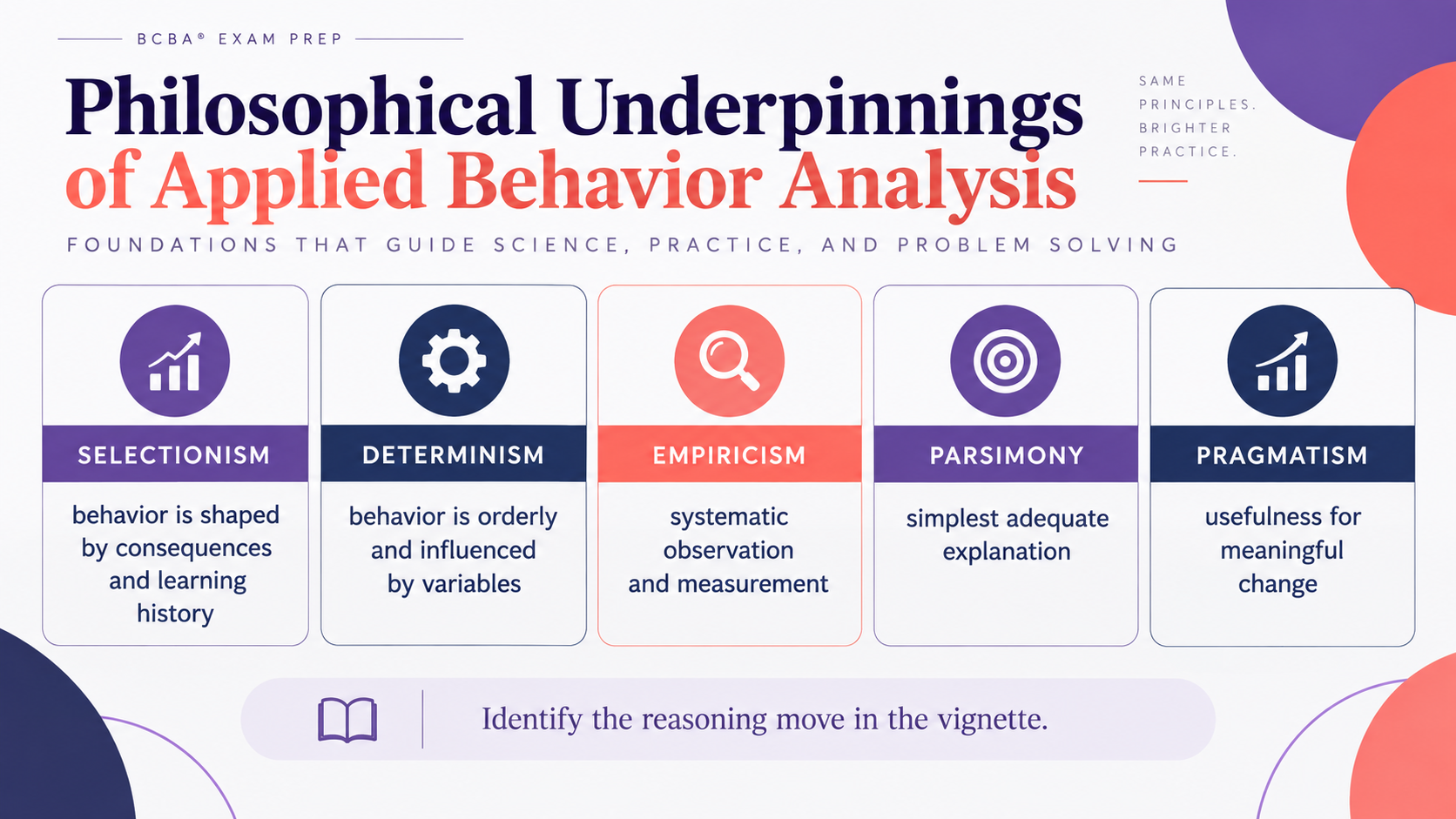
For BCBA exam preparation, the most useful way to study the topic is to connect each assumption to a decision. Selectionism asks how behavior is selected by its consequences and history. Determinism treats behavior as lawful rather than random. Empiricism emphasizes observation and measurement. Parsimony favors the simplest adequate explanation. Pragmatism asks whether an explanation helps us understand and improve behavior.
The current BACB content outline places philosophical foundations within the exam scope, but the outline is not a glossary of every classroom phrase. Use the official outline for scope, then use examples to practice discrimination among the terms. Table of Contents
What Does Philosophical Underpinning ABA Mean?
In this context, “philosophical” does not mean choosing a personal opinion about why someone behaves. It means identifying the assumptions that make a scientific approach to behavior possible. A behavior analyst begins with events that can be described, measured, and related to conditions in the environment. The analyst remains willing to revise an explanation when better data become available. These assumptions support a chain of reasoning:
- Define the behavior in observable and measurable terms.
- Collect data under relevant conditions.
- Look for lawful relations between behavior and environmental variables.
- Test whether the explanation leads to useful, socially significant change.
A question about the philosophical underpinning ABA may use a short vignette rather than naming the assumption. Look for the reasoning move in the vignette. Is the person asking for direct observation? Rejecting a vague inner-cause explanation? Choosing a simpler explanation before adding a complex one? Those clues usually matter more than memorizing isolated definitions.
Core Philosophical Assumptions in ABA
The following terms are common in BCBA preparation. Treat the examples as study anchors, not as substitutes for the official content outline or the wording of a specific question.
| Assumption | Plain-language meaning | Exam clue |
|---|---|---|
| Selectionism | Behavior is shaped and maintained through selection by consequences and learning history. | The vignette asks why a pattern persists or changes after its consequences change. |
| Determinism | Behavior is orderly and influenced by variables that can be investigated. | The question contrasts a lawful explanation with “it happened randomly.” |
| Empiricism | Knowledge is built from systematic observation and measurement. | The analyst collects direct data rather than relying on an unsupported impression. |
| Parsimony | Prefer the simplest explanation that adequately accounts for the data. | A simple environmental explanation is tested before a more elaborate one is assumed. |
| Pragmatism | The value of an explanation is connected to whether it helps solve a meaningful problem. | The analyst asks whether the interpretation leads to effective, socially significant action. |
Study materials may also discuss philosophical doubt, radical behaviorism, or other foundations. Do not collapse those terms into the five assumptions above. Philosophical doubt is a stance of continued questioning and willingness to revise conclusions. Radical behaviorism is a philosophy of behavior that includes private events as behavior while still analyzing them in relation to environmental and historical variables. A multiple-choice question may test the distinction directly.
Worked Philosophical Underpinning ABA Scenario
Consider this vignette: A team says that a learner refuses work “because he is unmotivated.” A BCBA asks the team to define refusal in observable terms, reviews when it occurs, measures task presentation and breaks, and tests whether changes in the task context alter the response. Which philosophical assumption is most directly reflected by the move toward measurement?
The best answer is empiricism because the BCBA is replacing an unsupported impression with systematic observation. Determinism may also support the overall approach because the BCBA is looking for lawful variables, but the wording about collecting and measuring evidence points most directly to empiricism.
Now change one detail: The team has data showing that refusal decreases when task difficulty is adjusted, but someone proposes an elaborate explanation involving several unmeasured personality traits. The principle that favors testing the simpler adequate explanation first is parsimony. If the question instead asks why the behavior changes when the task consequence changes, focus on selectionism.
- “Measure it directly” usually points toward empiricism.
- “Behavior is lawful rather than random” points toward determinism.
- “Behavior changes through consequences and history” points toward selectionism.
- “Start with the simplest adequate account” points toward parsimony.
- “Does the explanation help improve a meaningful outcome?” points toward pragmatism.
How Philosophy Connects to Science and Practice
It helps to separate three levels when studying the philosophical underpinning ABA:
- Philosophy: assumptions about what can be known and how behavior should be understood.
- Science: systematic methods for describing, predicting, and analyzing relations between behavior and variables.
- Practice: professional application of behavior-analytic knowledge to socially significant goals.
These levels are related but not interchangeable. “Collecting frequency data during observation” is a scientific or measurement action. “Choosing a socially important target” is part of applied practice. “Assuming that behavior can be understood through orderly relations and evidence” expresses a philosophical foundation. When a question asks for an assumption, do not choose the concrete procedure merely because it sounds scientific.
The seven dimensions of applied behavior analysis are another nearby topic. They describe features of applied work such as being applied, behavioral, analytic, technological, conceptually systematic, effective, and capable of generality. The dimensions tell you what strong applied work looks like; philosophical assumptions explain the perspective that supports scientific inquiry. Related does not mean identical.
Common Study Mistakes
- Defining determinism as “the person has no choices” instead of recognizing lawful relations that can be investigated.
- Treating empiricism as a preference for numbers without considering systematic observation and measurement.
- Confusing parsimony with choosing the shortest explanation even when it does not fit the data.
- Reducing pragmatism to “whatever works” without considering socially significant goals and evidence.
- Explaining selectionism as simple reinforcement without including learning history or selection by consequences.
- Using the seven dimensions as if they were the same list as philosophical assumptions.
- Assuming that a private event is outside behavior analysis because it cannot be observed directly by another person.
- Memorizing labels without identifying the reasoning move in a scenario.
Quick Review Checklist
Before selecting an answer about the philosophical underpinning ABA, ask:
- Is the question asking about evidence, lawful relations, consequences, simplicity, or usefulness?
- Does the vignette emphasize direct observation and measurement?
- Does it describe behavior as orderly and influenced by variables?
- Does it describe change through consequences or learning history?
- Does it prefer a simple adequate explanation?
- Does it judge an explanation by whether it helps improve a meaningful outcome?
- Is the answer choice actually describing a scientific procedure or an applied dimension instead of a philosophical assumption?
Practice Philosophical Foundations
After learning the definitions, practice matching short scenarios to the reasoning move they illustrate. Our philosophical underpinning ABA practice questions can help you discriminate among selectionism, determinism, empiricism, parsimony, pragmatism, and nearby BCBA exam concepts. Practice supports preparation, but the official BACB outline remains the source for current exam scope. Take the Free BCBA Mock Exam
References
- BACB BCBA Test Content Outline (6th ed.)
- BACB Test Content Outlines and Task Lists
- Philosophical assumptions and ABA dimensions study guide
- Behavior-Analytic Instruction for Children with Autism: Philosophy Matters



