
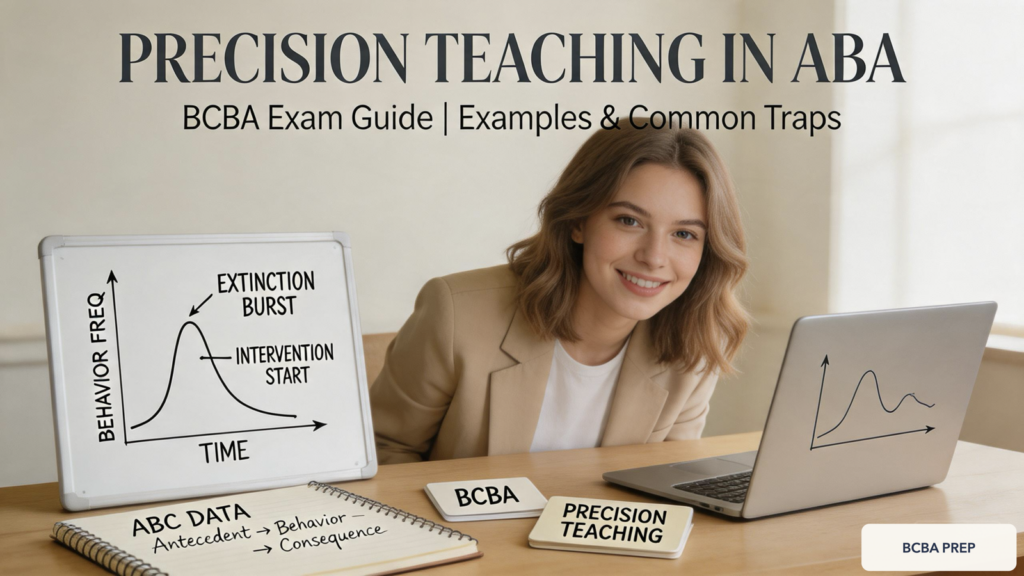
What Is Precision Teaching in ABA?
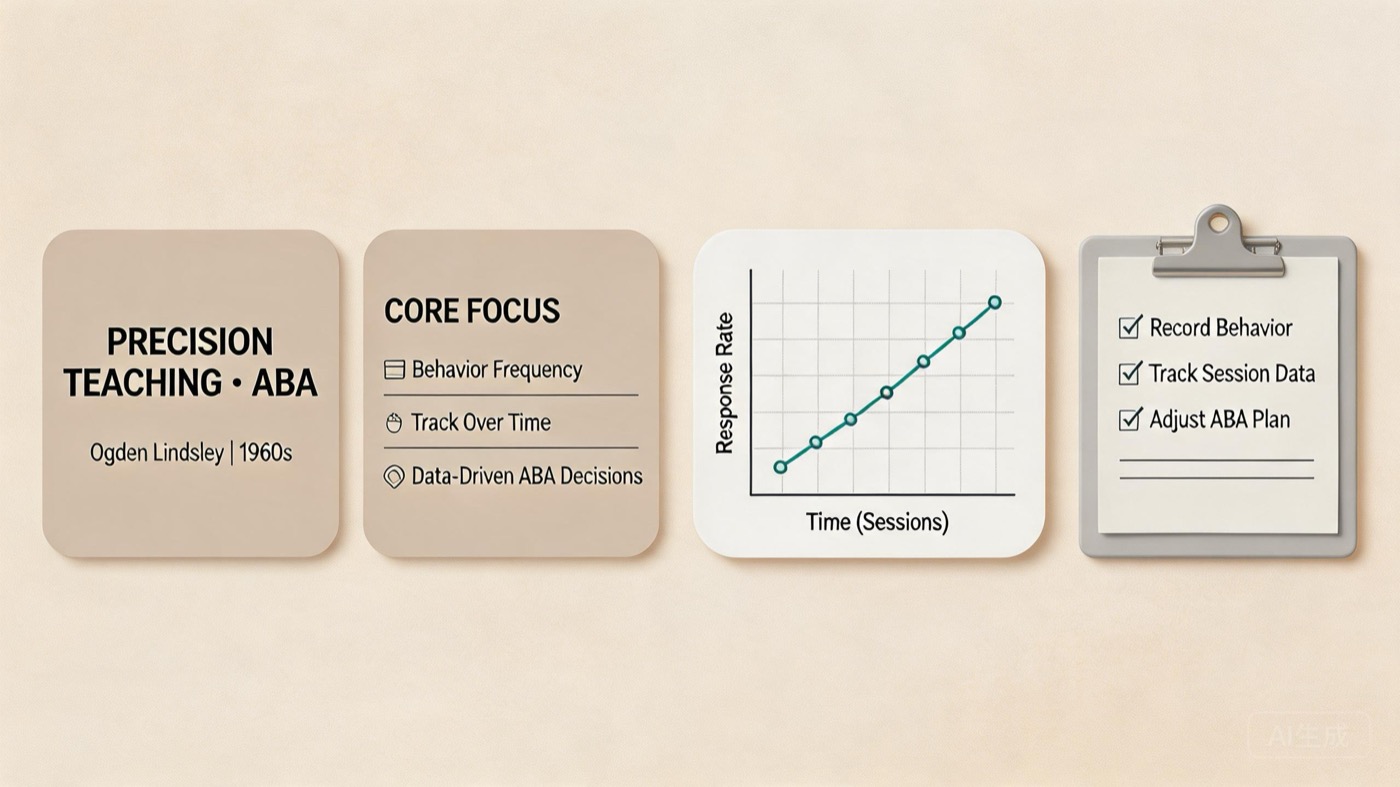
Precision teaching is a data-based decision-making method used in applied behavior analysis (ABA) to monitor and accelerate learning. It was developed by Ogden Lindsley in the 1960s and focuses on measuring the frequency of behavior over time using a specialized chart called the standard celeration chart.
Table of Contents
- What Is Precision Teaching in ABA?
- Precision Teaching in ABA: Worked Examples with ABC Analysis
- Precision Teaching and the BCBA Exam: What You Must Know
- Quick Checklist: Precision Teaching Essentials for the Exam
Unlike traditional ABA methods that often rely on percentage correct or count per session, precision teaching emphasizes the rate of behavior (count per minute) and how that rate changes over time. This approach is directly aligned with the BCBA task list under measurement and data analysis. Practitioners using precision teaching track behavior frequency daily and plot it on the standard celeration chart, which allows them to quickly see whether an intervention is working or needs adjustment. Because the chart uses a logarithmic scale, even small changes in low-frequency behaviors are visually amplified, making it easier to detect patterns that might be missed on a linear graph. This sensitivity is especially valuable when working with slow-to-acquire skills or behaviors that occur rarely. On the BCBA exam, you may be asked to interpret a standard celeration chart or select a measure that best captures growth over time—precision teaching data often win because they reflect both accuracy and speed.
The Standard Celeration Chart Explained
The standard celeration chart is a semi-logarithmic graph that allows behavior analysts to visualize changes in behavior frequency across time. Key features include:
- Semi-log scale: The y-axis uses a logarithmic scale to show equal proportionate changes, making it easier to compare growth rates across different baseline frequencies.
- Celeration line: A trend line that shows the rate of change (celeration) in behavior frequency per week. A celeration of x2 means doubling each week; a celeration of ÷2 means halving each week.
- Frequency floor: The minimum expected frequency based on observation time (e.g., 1 per minute). This prevents misinterpretation of zero counts.
- Daily data points: Each data point represents the number of behaviors per minute during a timed session, typically one per day.
Understanding the chart’s axes is critical for the exam. The x-axis spans 140 days (20 weeks), and the y-axis ranges from 1 per day to 1000 per minute. Because the scale is multiplicative, a behavior that goes from 2 per minute to 4 per minute shows the same proportional growth as from 20 to 40 per minute. This feature allows the chart to display both very low and very high frequencies on the same graph, a major advantage over linear charts that compress low frequencies. Many exam questions test your ability to read celeration values from a chart: for example, if a data series crosses two logarithmic cycles in four weeks, the weekly celeration is approximately x1.41 (square root of 2). Practice these calculations using the standard celeration chart templates available in ABA resources.
Key Principles: Frequency, Fluency, and Celeration
Three core concepts underpin precision teaching:
- Frequency: The number of times a behavior occurs per unit of time (e.g., 5 correct math facts per minute). Frequency is the primary datum collected in precision teaching.
- Fluency: The combination of accuracy and speed; fluent behavior is both fast and accurate, leading to better retention (stays in long-term memory), endurance (performed for longer periods), and application (can be combined with other skills). Fluency aims for a frequency threshold known as the “aim,” often set at 40–60 correct responses per minute for academic behaviors.
- Celeration: The rate of change in frequency over time. Celeration is expressed as a multiplier (e.g., x1.5 means the frequency multiplies by 1.5 each week) or divider (÷1.2 means frequency declines by a factor of 1.2 each week). On the chart, the celeration line is drawn through the data points and its slope indicates acceleration or deceleration.
These three principles work together: frequency data are collected daily, plotted on the semi-log chart, and analyzed for celeration. If celeration is too low (e.g., x1.1), the intervention is not producing meaningful growth and may need to be changed. Fluency aims are set based on peer norms or retention research. For the BCBA exam, remember that precision teaching does not prescribe any specific intervention; it is a measurement system that helps you evaluate any intervention’s effectiveness. A common exam trap is to think precision teaching requires a specific teaching method—it does not; it can be used with any ABA procedure, from DTT to incidental teaching.
Precision Teaching in ABA: Worked Examples with ABC Analysis
Understanding how to apply precision teaching in real-world scenarios is essential for the BCBA exam. Below are three examples with ABC analysis and hypothesized functions.
Example 1: Increasing On-Task Behavior in a Classroom
Antecedent: Teacher gives instruction to complete a worksheet. Behavior: Student writes answers (on-task). Consequence: Teacher provides praise after 2 minutes of continuous writing. Hypothesized function: Positive reinforcement (social positive). The teacher charts frequency of on-task behavior per minute and observes a celeration of x1.2 per week, indicating steady improvement. After two weeks, the celeration line becomes flat (x1.0), so the teacher increases the praise schedule to every 30 seconds. The celeration then rises to x1.4 per week. On the BCBA exam, you might be asked what to do when celeration plateaus—the answer is to adjust the independent variable (e.g., consequences) while continuing to chart frequency.
Example 2: Reducing Vocal Stereotypy in a Child with Autism
Antecedent: No demands or structured activity. Behavior: Vocal stereotypy (e.g., humming, repeating phrases). Consequence: Automatic sensory stimulation (feels good). Hypothesized function: Automatic reinforcement. Using precision teaching, the BCBA tracks frequency per minute of vocal stereotypy and implements a scheduled access to preferred auditory stimuli (e.g., 30 seconds of music every 2 minutes). The standard celeration chart shows a deceleration (declining trend) from x1.0 to x0.8 per week. The BCBA continues the intervention until the behavior reaches a frequency of 1 per minute or less. An exam trick: even though the behavior is decreasing, the chart can still show a celeration value below 1.0 (e.g., ÷1.2). Know how to report “celeration as a divide” when behavior is reducing.
Example 3: Building Math Fact Fluency with a Timer
Antecedent: Worksheet with 50 multiplication facts and a 2-minute timer. Behavior: Correct answers written. Consequence: 5-minute break if goal (e.g., 20 correct per minute) is met. Hypothesized function: Negative reinforcement (escape from math demands). The chart shows celeration of x1.3 per week; when celeration plateaued, difficulty increased by adding more facts. On the exam, you might be shown a chart with a steep celeration line and asked to identify the weekly acceleration. Practice calculating: if the frequency goes from 10 to 20 in one week, the celeration is x2. If it goes from 20 to 10 in one week, the celeration is ÷2. Always check the y-axis labels—they are logarithmic, so equal distances represent equal ratios, not equal numbers.
Precision Teaching and the BCBA Exam: What You Must Know
Precision teaching appears on the BCBA exam primarily in measurement and data analysis. Be ready for these common traps.
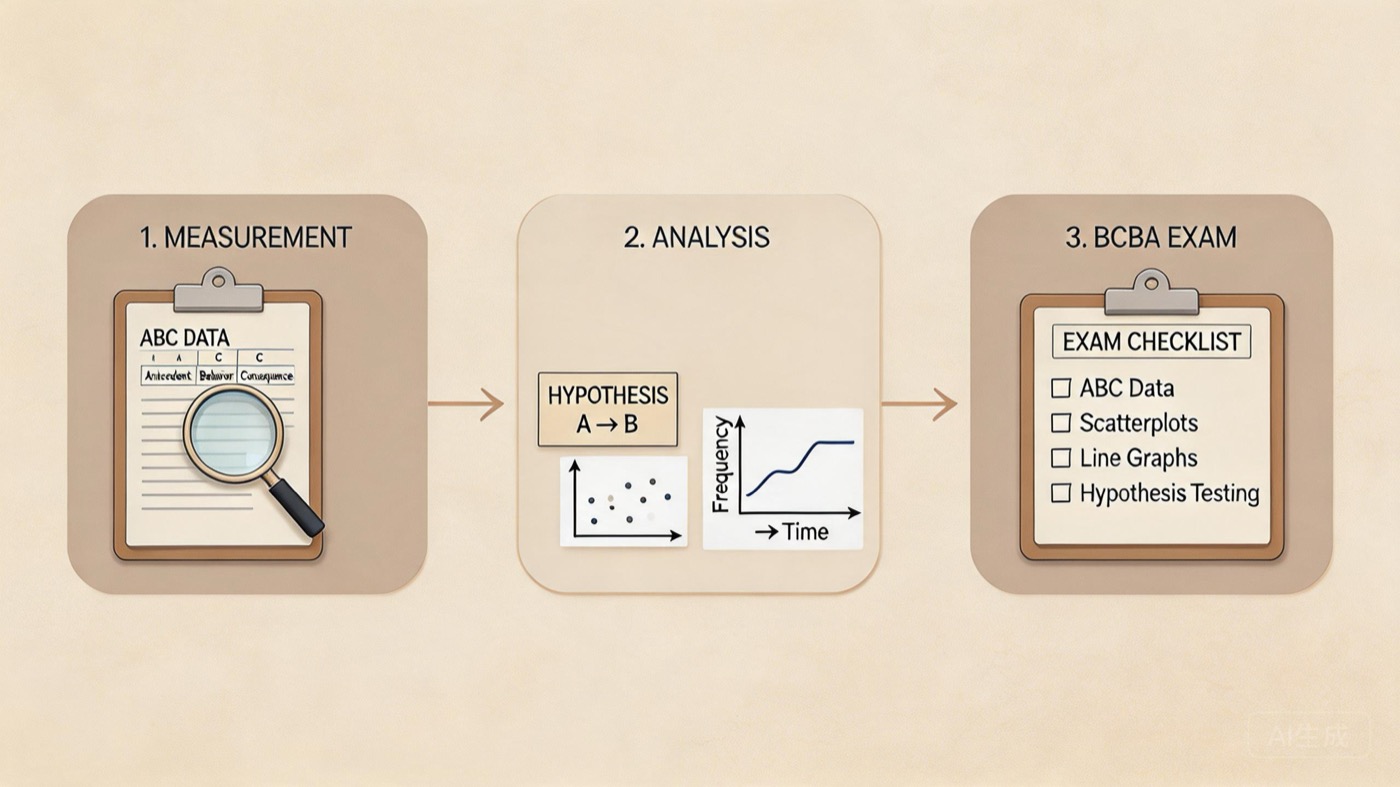
Common Exam Traps
- Confusing precision teaching with precision measurement: Precision teaching is a system that uses the standard celeration chart, not just any precise measurement. If the question mentions “precise measurement of behavior,” it may refer to any continuous recording method, not necessarily precision teaching.
- Equating celeration with slope on a linear graph: Celeration is a multiplicative change, not additive; it must be read on a log scale. A linear slope of 2 units per week is not the same as a celeration of x2.
- Forgetting the logarithmic scale: The standard celeration chart’s y-axis is logarithmic; misinterpreting it as linear is a common error. For example, a jump from 2 to 4 per minute looks the same as a jump from 40 to 80 because both double.
- Mixing up frequency and rate: Frequency is count per observation time; rate is count per unit of time (often per minute). Precision teaching uses frequency per minute, which is essentially a rate. But on the exam, note that “frequency” in precision teaching is always timing-based (e.g., per minute, per hour, per day).
Study Tips for the BCBA Exam
- Memorize the components of the standard celeration chart: celeration line, frequency floor, daily data points.
- Practice interpreting charts: identify celeration values, variability, and whether the behavior is accelerating or decelerating. Use sample charts from BCBA study materials.
- Know the difference between celeration and variability: celeration is the trend; variability is the scatter around the trend. High variability may require changing the intervention or the measurement timing.
- Review the BCBA task list items on measurement and data analysis: precision teaching falls under these domains. Focus on items like “use data-based decision rules” and “evaluate effectiveness of interventions.”
One additional trap is the concept of “frequency floor.” If a student has only one 2-minute observation per day, the lowest possible frequency is 0.5 per minute. On the exam, a question might ask why the chart shows no points below 0.5 per minute—the answer is the frequency floor based on observation duration. Always consider observation time when interpreting data.
Quick Checklist: Precision Teaching Essentials for the Exam
Use this checklist for last-minute review before your BCBA exam.
- Define precision teaching as a measurement and decision-making system, not a specific intervention.
- Identify the standard celeration chart as a semi-log graph with a logarithmic y-axis and a linear x-axis.
- Explain frequency, fluency, and celeration and how they relate: frequency data lead to celeration; fluency is the aim.
- Interpret a celeration line (e.g., x1.5 means 50% increase per week; ÷1.25 means 20% decrease per week).
- Describe an ABC example with hypothesized function, showing how data on the chart inform decisions.
- List common exam traps (log scale, frequency vs. rate, celeration vs. slope).
- Distinguish precision teaching from other measurement methods (e.g., percentage, interval recording): precision teaching uses count per minute and a semi-log chart.
For additional review, check out our guide on graphing and visual analysis for the BCBA exam. Also, the BACB website provides detailed task list information.
Complete BCBA Exam Prep
Turn this topic into exam-day practice
Practice concepts in context with five full-length 6th Edition mock exams, two bonus practice exams, a 6th Edition study guide, and key-term flashcards—all in one $120 USD package.
Get the $120 All-in-One Prep Pack
Review everything included on the product page before ordering. No pass guarantee is implied.



