
What Is Operant Behavior in ABA?
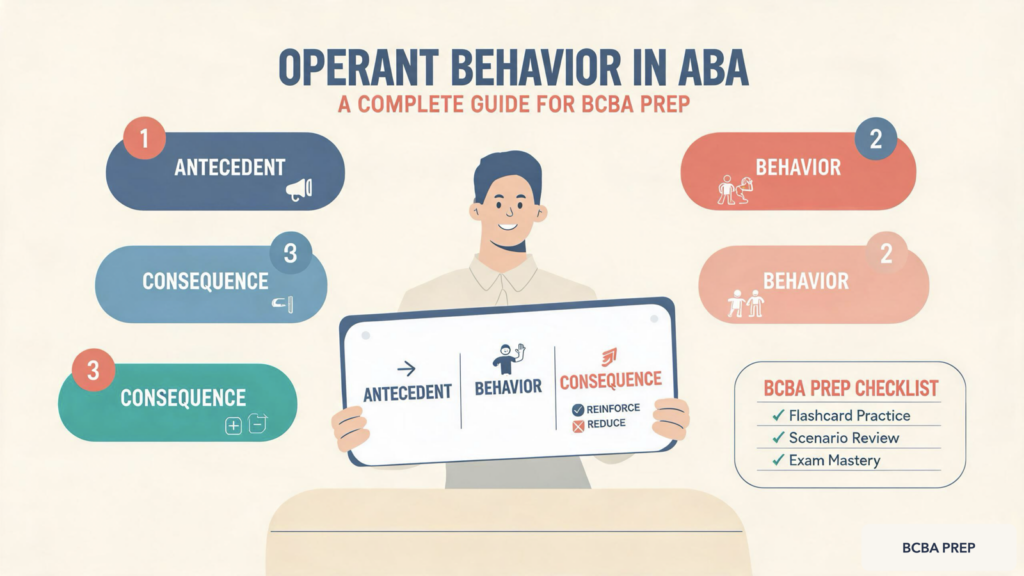
Operant behavior is behavior that is influenced by its consequences. In ABA, this is the foundation for understanding how new behaviors are learned and maintained. Unlike respondent behavior, which is elicited automatically by a stimulus, operant behavior is emitted and shaped by what happens after it occurs. This distinction is critical because most socially significant behaviors we target in therapy—communication, self-care, social skills—are operant.
Table of Contents
- What Is Operant Behavior in ABA?
- Operant Behavior Examples with ABC Analysis
- Why Operant Behavior Matters on the BCBA Exam
- Quick Review Checklist
- Summary and Next Steps
- References
For example, a child who asks for candy and receives it is more likely to ask again. The consequence (receiving candy) strengthens the behavior. This is the heart of operant conditioning, a term first coined by B.F. Skinner.
Operant vs. Respondent Behavior
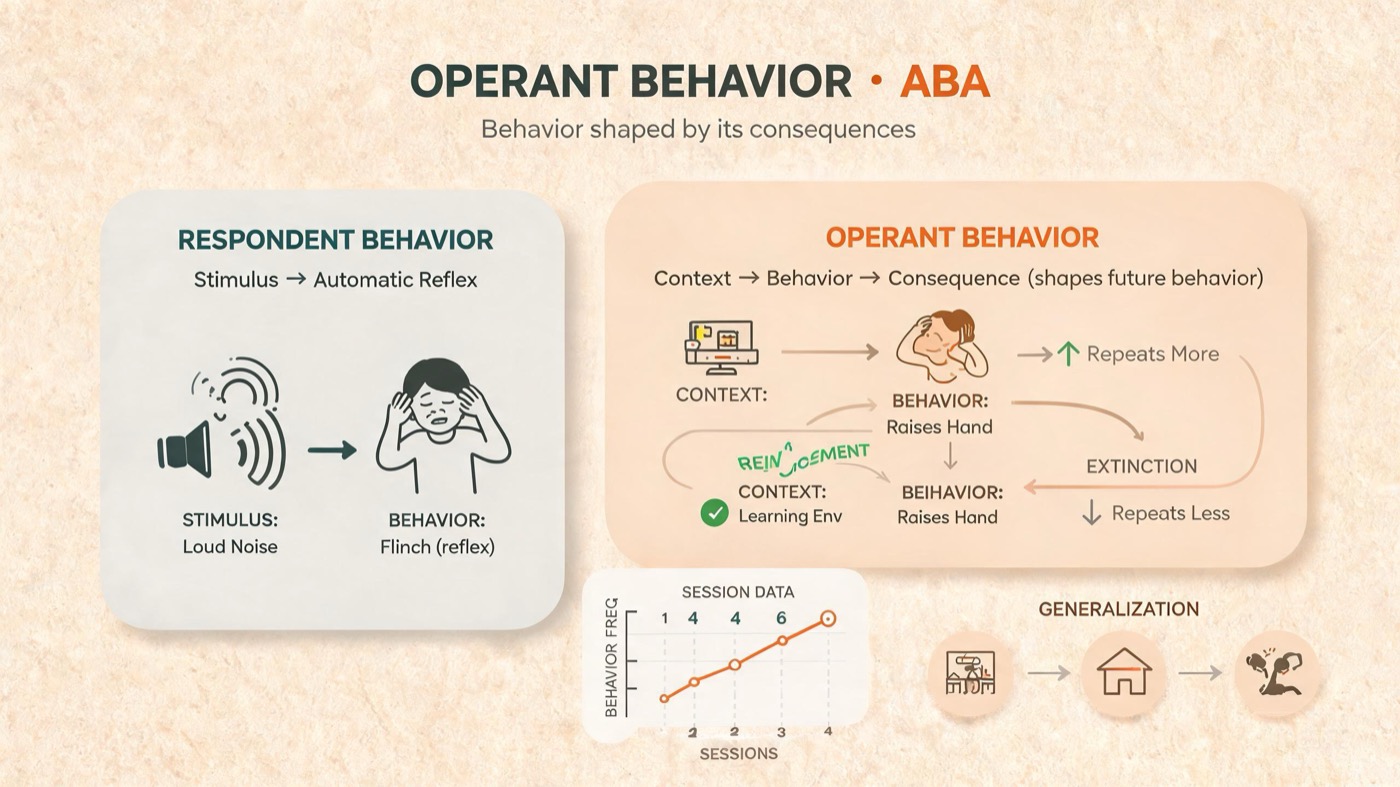
A classic example of respondent behavior is a dog salivating when it hears a bell after repeated pairings with food. The salivation is automatic and involuntary. In contrast, a child raising a hand in class to get the teacher’s attention is operant—the behavior is controlled by its consequence (teacher attention). The key difference: operant behavior is learned through consequences, while respondent behavior is elicited by antecedents.
On the BCBA exam, you might see a scenario where a client flinches when a loud noise occurs (respondent) versus a client tantrums to escape a task (operant). Recognizing which is which is a common test point.
The Four-Term Contingency
The four-term contingency is the standard framework for analyzing operant behavior. It includes: Motivating Operation (MO), Discriminative Stimulus (SD), Response, and Consequence. The MO alters the value of a reinforcer; the SD signals that a response will produce that reinforcer. For example, a child is hungry (MO: food deprivation), sees a cookie jar (SD), asks for a cookie (response), and receives one (consequence). The four-term model helps exam-takers systematically break down any scenario.
Operant Behavior Examples with ABC Analysis
Applying the ABC (Antecedent-Behavior-Consequence) framework is essential for identifying the function of behavior. Below are three realistic ABA scenarios with full ABC breakdowns.
Example 1: Disruptive Behavior in a Classroom
- Setting: Classroom during independent work.
- MO: Teacher attention has been low (deprivation of attention).
- Antecedent (SD): Teacher turns to another student.
- Behavior: Student screams loudly.
- Consequence: Teacher immediately looks at the student and says, ‘Quiet down.’
- Hypothesized Function: Social positive reinforcement (access to teacher attention).
Example 2: Compliance at Home
- Setting: Living room after school.
- MO: Child has been denied tablet access all day (establishing operation for tangibles).
- Antecedent (SD): Parent says, ‘Please pick up your toys.’
- Behavior: Child cleans up toys within 2 minutes.
- Consequence: Parent says, ‘Great job, you can have 20 minutes of tablet time.’
- Hypothesized Function: Access to tangibles (tablet).
Example 3: Aggression in a Clinic
- Setting: Therapy room during a difficult task.
- MO: Child was denied a preferred toy earlier (abolishing operation for demands?).
- Antecedent (SD): Therapist blocks access to a toy.
- Behavior: Child hits the therapist.
- Consequence: Therapist removes the task and leaves the room.
- Hypothesized Function: Social negative reinforcement (escape from task demands).
Why Operant Behavior Matters on the BCBA Exam
Operant behavior is a core concept tested across multiple domains of the BCBA task list. Mastery of this concept allows you to analyze intervention effectiveness, select appropriate reinforcement procedures, and design function-based treatments. The exam often presents scenarios where you must identify the operant function or select the correct antecedent manipulation.
Common Exam Traps
Many test-takers lose points due to subtle misunderstandings. Watch out for these traps:
- Trap 1: Confusing operant with respondent. If a behavior seems automatic (e.g., eye blink to puff of air), it is likely respondent. Operant behaviors are voluntary and shaped by consequences.
- Trap 2: Forgetting the Motivating Operation. A scenario might include an SD but no clear MO—or an MO that is irrelevant. Always check if the MO alters the value of the consequence.
- Trap 3: Mixing up behavior and consequence. For example, saying ‘attention is the behavior.’ Attention is a consequence—the behavior is what the person does to get attention.
- Trap 4: Overlooking automatic reinforcement. Some behaviors produce their own reinforcement (e.g., sensory stimulation). This is still operant but without a social mediator.
How to Approach Operant Questions
When you see a scenario on the exam, use this step-by-step method:
- Identify the behavior of interest. What exactly did the person do?
- Look for antecedents: What happened right before? Is there an MO (e.g., deprivation) and an SD (e.g., instruction)?
- Analyze the consequence: Did the behavior lead to something being added (positive reinforcement) or removed (negative reinforcement)?
- Determine the function: Is the reinforcer social (attention, tangible, escape) or automatic (sensory)?
- Map it onto the four-term contingency: This ensures you haven’t missed any component.
Quick Review Checklist
Use this checklist to reinforce key points before your exam:
- Define operant behavior as behavior influenced by consequences.
- Distinguish operant from respondent: operant is emitted, respondent is elicited.
- Memorize the four-term contingency: MO, SD, Response, Consequence.
- Practice ABC analysis for at least three different functions.
- Identify common traps: confusion with respondent, missing MO, reversing behavior and consequence.
- Apply the step-by-step approach to practice questions.
- Review the four functions of behavior for deeper integration.
Summary and Next Steps
Operant behavior is the engine of ABA. By understanding how consequences shape behavior, you can design effective interventions and ace exam questions that require functional analysis. Remember the key distinction: operant behavior is learned through consequences, while respondent behavior is reflexive. Use the four-term contingency to break down any scenario, and watch for common traps like missing the MO or confusing behavior with its consequence.
To further solidify your skills, check out our BCBA mock exam and practice with real-world scenarios. For more on the philosophical foundations, see our guide on radical behaviorism. Good luck with your studies!



