

What Is Least-to-Most Prompting?
Least-to-most prompting is a teaching strategy in applied behavior analysis (ABA) where the therapist provides the learner with the minimal level of assistance needed to evoke a correct response. This approach is designed to promote independent responding by systematically increasing the intensity or intrusiveness of prompts only when the learner does not respond correctly.
Table of Contents
- What Is Least-to-Most Prompting?
- ABA Examples of Least-to-Most Prompting
- Exam Relevance: What the BCBA Board Expects
- Quick Checklist for Least-to-Most Prompting
- Summary: Why Least-to-Most Works
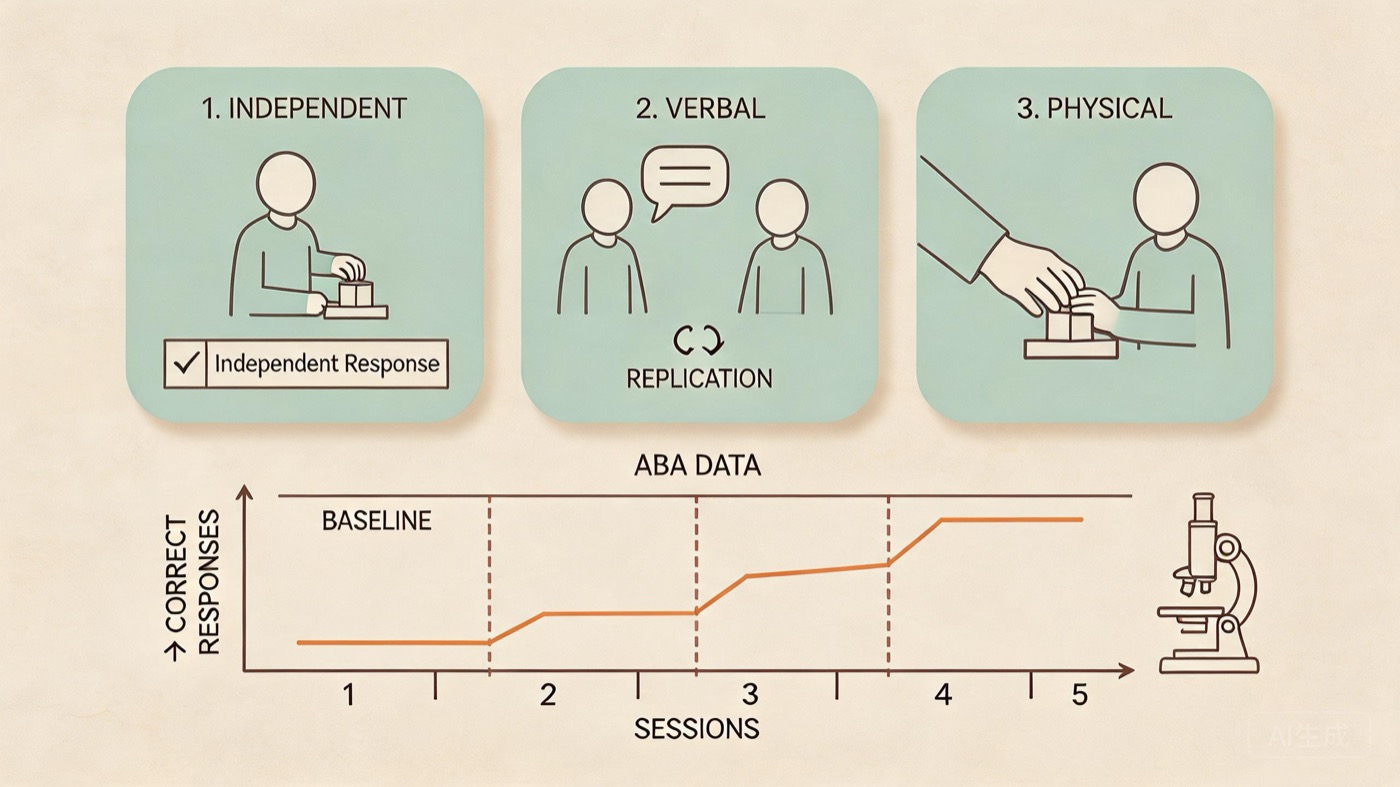
The Prompt Hierarchy in Least-to-Most
The typical prompt hierarchy used in least-to-most prompting includes, from least to most intrusive:
- Independent – no prompt; learner responds on their own
- Verbal – a spoken instruction or cue
- Gestural – pointing or motioning toward the correct response
- Modeling – demonstrating the correct behavior
- Partial physical – light guidance (e.g., touching the learner’s hand)
- Full physical – hand-over-hand assistance
Prompt fading occurs naturally because the learner is encouraged to respond at the least intrusive level first, reducing prompt dependency. The therapist waits a predetermined time delay (e.g., 3–5 seconds) after each prompt level before moving to the next, allowing the learner an opportunity to respond independently. If the learner responds correctly at any level, they receive reinforcement, and future trials begin again at the least intrusive level. Over time, the learner learns to respond to the natural antecedent alone, and prompts are faded out.
How It Differs from Most-to-Least
Most-to-least prompting starts with the most intrusive prompt (e.g., full physical) and gradually reduces assistance. This method is often used for errorless learning with learners who have difficulty acquiring new skills. In contrast, least-to-most is typically used when the learner already has some prerequisite skills and needs to build independence. The choice depends on the learner’s history and the goal of the intervention. For example, least-to-most is ideal for skills that the learner has partially mastered, such as initiating a conversation or completing a familiar routine, while most-to-least is better for new, complex skills where errors could be frustrating or dangerous.
Why Use a Time Delay?
A consistent time delay (e.g., 3–5 seconds) between prompt levels is essential to avoid rapid-fire prompting that can overwhelm the learner or create prompt dependency. The delay gives the learner a chance to process the antecedent and respond independently. If the learner does not respond within the delay, the therapist moves to the next prompt level. This structured approach ensures that prompting is systematic and that data can be collected to track progress and make fading decisions.
ABA Examples of Least-to-Most Prompting
Here are three practical examples using an ABC format (antecedent, behavior, consequence) with hypothesized function. Each example illustrates how the hierarchy is applied stepwise.
Example 1: Requesting a Snack
Setting: Child with ASD in the kitchen. Antecedent: Snack is on a high shelf out of reach. Behavior: The child reaches toward the snack. Least prompt: Therapist says ‘What do you want?’ If no response, gesture toward the snack, then model ‘cookie,’ then partial physical to prompt signing. Consequence: Access to snack (reinforcement). Hypothesized function: Access to tangible.
In this scenario, the therapist starts with a minimal verbal prompt, allowing the child to independently request. If the child does not respond, the therapist increases the prompt level successively. The key is to reinforce the correct response immediately, regardless of prompt level, but to fade prompts over trials. Over time, the child should respond to the antecedent (snack visible) without any prompt.
Example 2: Toileting Routine
Setting: Preschool classroom. Antecedent: Timer goes off indicating it’s time to use the bathroom. Behavior: The child walks toward the bathroom door. Least prompt: Therapist gestures toward the door. If the child hesitates, the therapist provides a verbal prompt (‘Go to the bathroom’), then a light touch on the back. Consequence: Successful toileting and praise. Hypothesized function: Escape from accidents (negative reinforcement).
Note that in a toilet training context, the function is escape from the aversive state of a wet or soiled diaper, so the reinforcer is the removal of that aversive condition. Prompting should be sensitive to the child’s readiness; starting with a gesture respects the child’s independence while offering support.
Example 3: Completing a Worksheet
Setting: Academic table. Antecedent: Worksheet on the table. Behavior: The child picks up a pencil. Least prompt: ‘Do the first problem.’ If no response, point to the first problem, then model solving one problem, then guide the child’s hand. Consequence: Break from work (if escape-maintained) or access to a preferred activity. Hypothesized function: Avoid challenging task (escape from demand).
Here, if the behavior is escape-maintained, the consequence (break from work) must be contingent on task completion, not on problem behavior. The least-to-most approach helps the learner complete the task with minimal struggle, gradually increasing independence.
Exam Relevance: What the BCBA Board Expects
The BCBA 6th Edition Task List includes prompt and prompt-fading strategies under items like D-05 (use prompting and prompt fading) and G-04 (implement stimulus control transfer). On the exam, you may be asked to identify the correct prompt hierarchy, differentiate between least-to-most and most-to-least, or select the appropriate fading procedure for a given scenario. Understanding the function of behavior is also critical because the same prompting strategy may work differently depending on the reinforcing consequence.
Common Exam Traps
- Trap 1: Confusing least-to-most with most-to-least. Remember: least-to-most starts with the least intrusive prompt; most-to-least starts with the most.
- Trap 2: Forgetting that prompts must be faded. Leaving a prompt in place can lead to prompt dependency.
- Trap 3: Not identifying the function of the behavior. The same prompting sequence may require different reinforcement contingencies depending on whether the behavior is maintained by access or escape.
- Trap 4: Using an inconsistent time delay. The BCBA expects systematic prompting; random delays or no delay can invalidate the procedure.
How to Study for These Questions
- Use flashcards to memorize prompt hierarchy levels and definitions
- Practice with scenario-based questions (e.g., ‘Which prompt should be delivered first?’)
- Review task list items D-05 and G-04, and connect them to stimulus control transfer
- Explore our BCBA mock exam for more practice questions
- Create your own ABC tables for different functions to internalize how prompting interacts with reinforcement
Quick Checklist for Least-to-Most Prompting
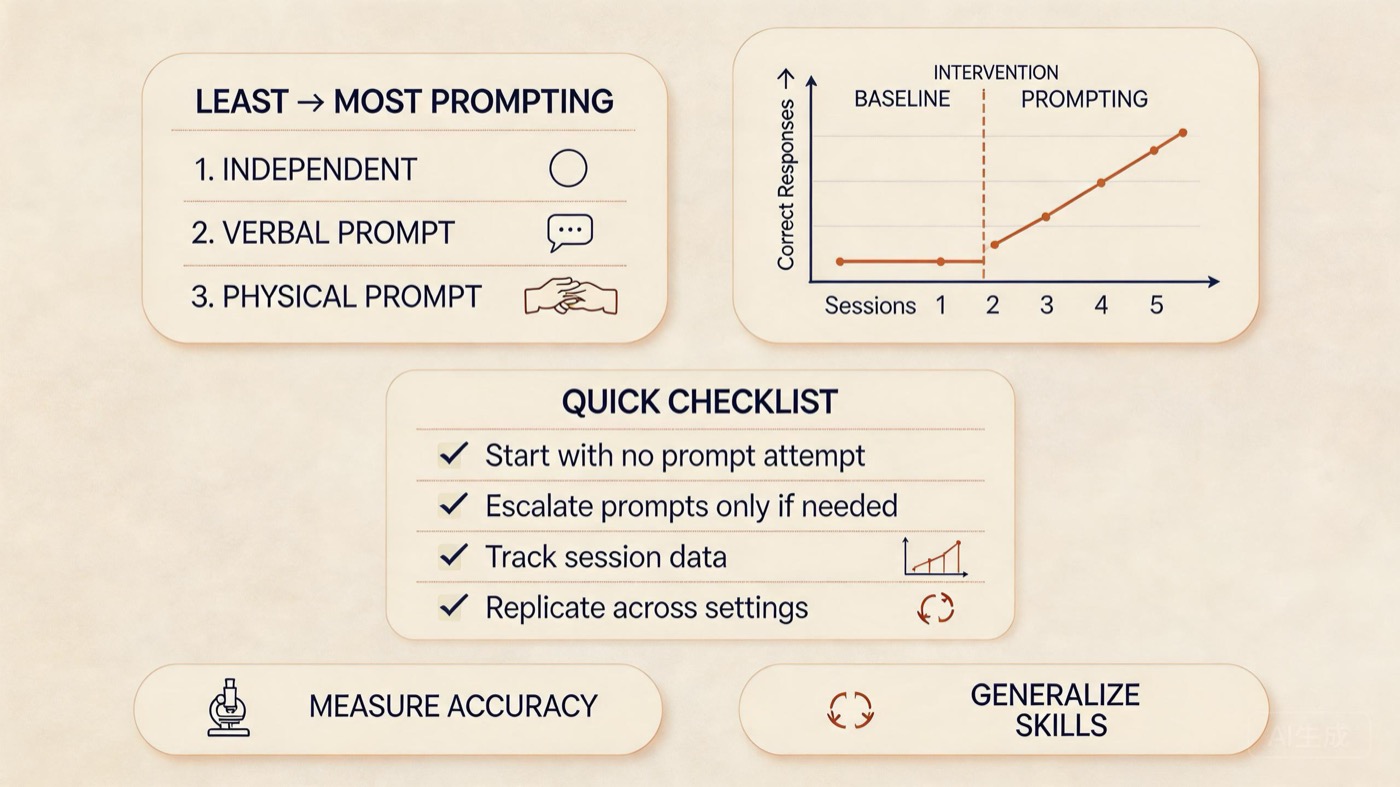
- Identify the learner’s current skill level – ensure they can respond to at least the second prompt level
- Define the prompt hierarchy clearly: independent, verbal, gestural, model, physical
- Use a consistent time delay (e.g., 3-5 seconds) between each prompt level
- Reinforce correct responses immediately – especially after independent or minimal prompts
- Collect data on prompt levels to monitor progress and guide fading decisions
- Fade prompts systematically – do not keep using higher prompts if the learner succeeds at a lower one
- Consider function – ensure the reinforcer matches the behavior’s maintaining variable
Summary: Why Least-to-Most Works
Least-to-most prompting is a powerful, learner-centered strategy that promotes independence by starting with minimal assistance. It aligns with the ABA principles of positive reinforcement and stimulus control transfer. By understanding the hierarchy, avoiding common exam traps, and applying these examples, you can prepare effectively for the BCBA exam and for real-world practice. For a deeper dive into related concepts, check out our guide on prompt dependency and the BACB Task List (external).
Complete BCBA Exam Prep
Turn this topic into exam-day practice
Practice concepts in context with five full-length 6th Edition mock exams, two bonus practice exams, a 6th Edition study guide, and key-term flashcards—all in one $120 USD package.
Get the $120 All-in-One Prep Pack
Review everything included on the product page before ordering. No pass guarantee is implied.



