

Defining the Independent Variable and Dependent Variable in ABA
When you open a BCBA prep book or sit down to review experimental design, two terms appear constantly: the independent variable and the dependent variable. These are not just abstract research concepts; they structure how you analyze interventions, interpret graphs, and design behavior-change programs. For BCBA candidates, knowing the difference is not optional—it is foundational to almost every question that asks you to evaluate an experiment or identify what a study is testing.
Table of Contents
- Defining the Independent Variable and Dependent Variable in ABA
- Why It Matters for the BCBA Exam: Key Concepts and Terminology
- Applying the Concepts: Worked ABA Examples and ABC Analysis
- Exam Relevance and Common Traps to Avoid
- Quick Checklist for Practice and Study
- Summary and Next Steps in Your BCBA Preparation
- Quick Review Checklist
- Take the Free BCBA Mock Exam
- References
In applied behavior analysis, the independent variable is the variable that the researcher or practitioner systematically manipulates. This is often an intervention, a change in the environment, or a new teaching procedure. The dependent variable is the behavior that is measured to see if it changed as a result of the intervention. The term dependent reflects the idea that the outcome depends on the intervention. Once you lock this relationship into your mind, many exam scenarios become easier to parse.
What Is the Independent Variable?: The independent variable (IV) is the component of the environment that is deliberately altered to observe its effect. In ABA, the IV is usually an intervention such as differential reinforcement, a prompting procedure, or a token economy. It can also be a change in the physical setting, like rearranging a classroom to reduce distractions. The IV is the cause in the cause-and-effect relationship that behavior analysts investigate.
What Is the Dependent Variable?: The dependent variable (DV) is the behavior that is observed and measured. It is the effect that you are tracking. In ABA, the DV must be operationally defined so that different observers can reliably record it. For instance, if you are working on compliance, the DV might be the percentage of instructions followed within 5 seconds. If you are targeting aggression, the DV could be the frequency of hitting or biting per session. The DV is always the behavior that is expected to change as the IV is introduced or removed.
Why It Matters for the BCBA Exam: Key Concepts and Terminology
The BCBA exam does not simply ask you to recall definitions; it asks you to apply them in experimental scenarios. Understanding how IV and DV function within different research designs is essential. For example, in an ABAB withdrawal design, the IV is the intervention that is present during B phases and absent during A phases, while the DV is the behavior measured continuously across all phases. In a multiple baseline design, the IV is staggered across behaviors, settings, or subjects, and the DV is the behavior that is expected to change only when the intervention reaches that baseline.
You will also encounter terms that interact with IV and DV, such as confounding variables, control conditions, and baseline. A confounding variable is an external factor that changes alongside the IV and could influence the DV, making it difficult to attribute changes in behavior to the intervention alone. A control condition is a phase where the IV is not present, providing a comparison for evaluating its effect. Baseline refers to the initial phase where the DV is measured under natural conditions, before any intervention is applied.
Applying the Concepts: Worked ABA Examples and ABC Analysis
To solidify your understanding, it helps to see how IV and DV appear in real ABA scenarios. One powerful tool is the ABC analysis (Antecedent-Behavior-Consequence), which helps identify the function of a behavior. When you design an intervention based on that analysis, the IV is the intervention itself, and the DV is the target behavior you continue to measure. Below are three practical examples that illustrate this relationship.
Example 1: Reducing Aggression in a Classroom: Imagine a student who frequently hits peers when asked to complete a difficult worksheet. An ABC analysis reveals that the antecedent is the demand (worksheet), the behavior is aggression, and the consequence is escape from the task. The hypothesized function is escape. You decide to implement functional communication training (FCT) to teach the student to request a break instead of hitting. In this case, the independent variable is the FCT intervention, and the dependent variable is the frequency of aggressive behavior per session.
Example 2: Increasing Compliance with a Token Economy: A teacher reports that a student only completes instructions about 40% of the time. You conduct an ABC analysis and notice that the antecedent is a verbal instruction, the behavior is compliance (or non-compliance), and the consequence is often reprimands. You decide to introduce a token economy where the student earns tokens for following instructions, which can be exchanged for preferred items. Here, the IV is the token intervention, and the DV is the percentage of instructions followed within a 5-second window.
Example 3: Decreasing Chronic Tics in a Clinical Setting: In a clinical setting, a client demonstrates frequent motor tics that interfere with daily activities. An ABC analysis suggests that the behavior occurs across various settings and is not consistently followed by social consequences, indicating a possible automatic reinforcement function. You implement habit reversal training, specifically competing response training, as the intervention. The IV is the competing response procedure, and the DV is the number of tics observed during 10-minute observation periods.
Exam Relevance and Common Traps to Avoid
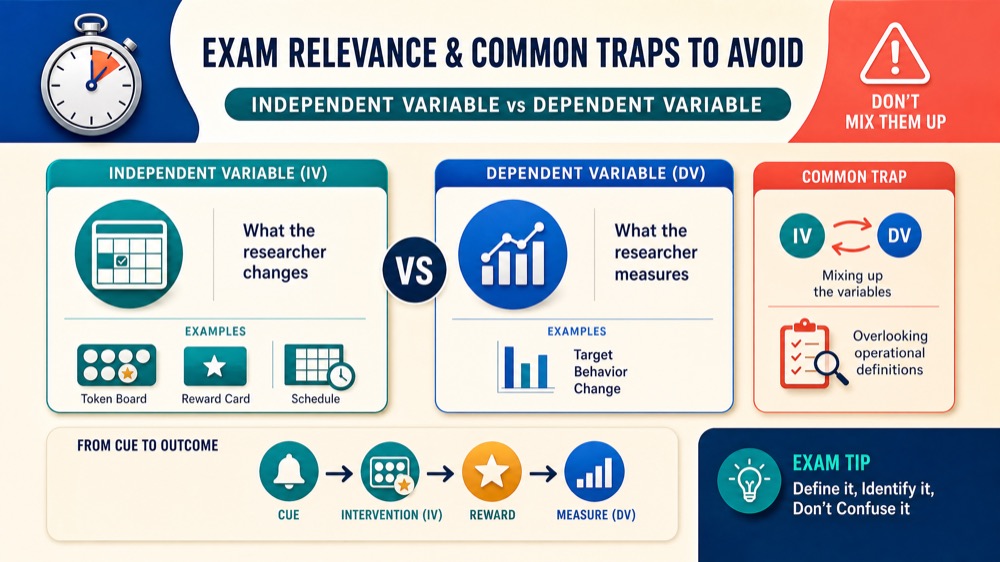
On the BCBA exam, identifying the IV and DV can be deceptively simple. Many candidates lose points not because they don’t understand the concepts, but because they mix them up under time pressure or overlook the need for operational definitions. Let’s review the most common traps and how to avoid them.
Mixing up the variables: The most frequent error is confusing the IV and DV in scenario questions. Remember: the IV is what the researcher changes or manipulates; the DV is the behavior that is measured. A useful trick is to ask yourself, “What is being delivered or changed?” That is the IV. Then ask, “What is being recorded or tracked?” That is the DV.
- Trap 1: Confusing the intervention with the target behavior. Always label the intervention as the IV and the behavior as the DV.
- Trap 2: Overlooking the operational definition. If the DV is not clearly defined, it is difficult to measure reliably. Ensure you can describe the behavior in observable terms.
- Trap 3: Ignoring the baseline. Without a stable baseline, you cannot determine whether the IV had an effect. Baseline data are the comparison point for the DV.
Quick Checklist for Practice and Study
As you prepare for the BCBA exam, use this checklist to evaluate any research article or practice scenario. It will help you quickly identify the key variables and stay focused on what the question is asking.
- Identify the behavior that is being measured (DV) and how it is operationally defined.
- Determine what intervention or environmental change is being implemented (IV).
- Check that the baseline phase is clearly described and stable.
- Look for any possible confounding variables that could influence the results.
- Examine the graph or data to see if the DV changes when the IV is introduced.
- Ask yourself: “If I replicate this study, what would I manipulate and what would I measure?”
This checklist is also useful when you are reading research summaries in your study materials. Before you read the results, try to predict what the IV and DV are. This active approach reinforces your understanding and speeds up your response time on the exam.
Summary and Next Steps in Your BCBA Preparation
Mastering the independent variable and dependent variable is not just about passing the BCBA exam; it is about becoming a precise and thoughtful behavior analyst. Whenever you design an intervention, you are manipulating an IV and monitoring a DV. Whenever you evaluate a published study, you are scrutinizing those same elements. Make it a habit to identify these variables in every scenario you practice.
To further strengthen your skills, revisit your notes on experimental analysis of behavior and functional behavior assessment, as these topics frequently rely on the IV/DV distinction. You can also check out the BCBA 6th edition exam blueprint to see how these concepts are weighted across domains. With consistent practice, you will not only identify IV and DV accurately but also apply them in real-world behavior change programs.
Remember, the key to success on the BCBA exam is not memorization—it is applied understanding. The more you practice identifying independent and dependent variables in various scenarios, the more intuitive this skill will become. Keep this guide handy as you work through practice questions and mock exams, and you will be well on your way to mastering this foundational concept.
Quick Review Checklist
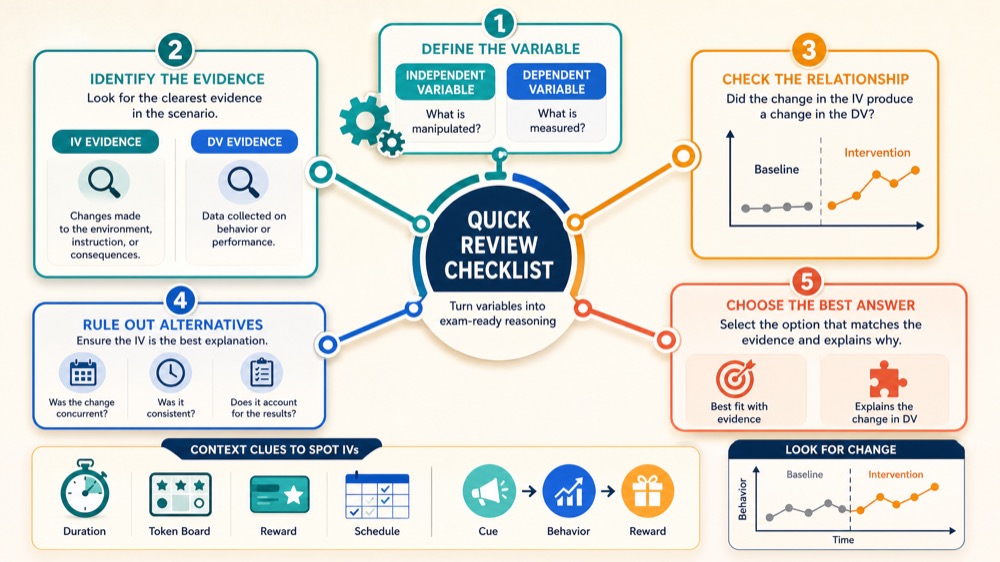
Use this final checklist to turn independent variable and dependent variable into exam-ready reasoning. The goal is not to memorize a label in isolation; it is to identify the relevant evidence and explain why the best answer fits the scenario. Key ideas to review:
- State the central definition or decision point for independent variable and dependent variable in your own words.
- Identify the detail that makes independent variable and dependent variable different from its closest related ABA term.
- Separate the observable facts in a scenario from assumptions that are not supported by the facts.
- Write one example and one nonexample so you can recognize the concept in a new setting.
Exam application checks:
- Ask what the question is actually requesting before comparing the answer choices.
- Mark the antecedent, response, consequence, or other evidence that supports the selected answer.
- Look for a distractor that describes a related process but does not answer the specific question.
Final self-check:
- Explain how you would verify the interpretation with clear observations or data.
- Change one detail in the scenario and decide whether your answer should change.
- Give a one-sentence rationale that a supervisor or study partner could evaluate.
Take the Free BCBA Mock Exam
Ready for more practice? Use the free mock exam to keep testing your accuracy with realistic BCBA-style items. Take the Free BCBA Mock Exam



