
What Are Independent and Dependent Variables?
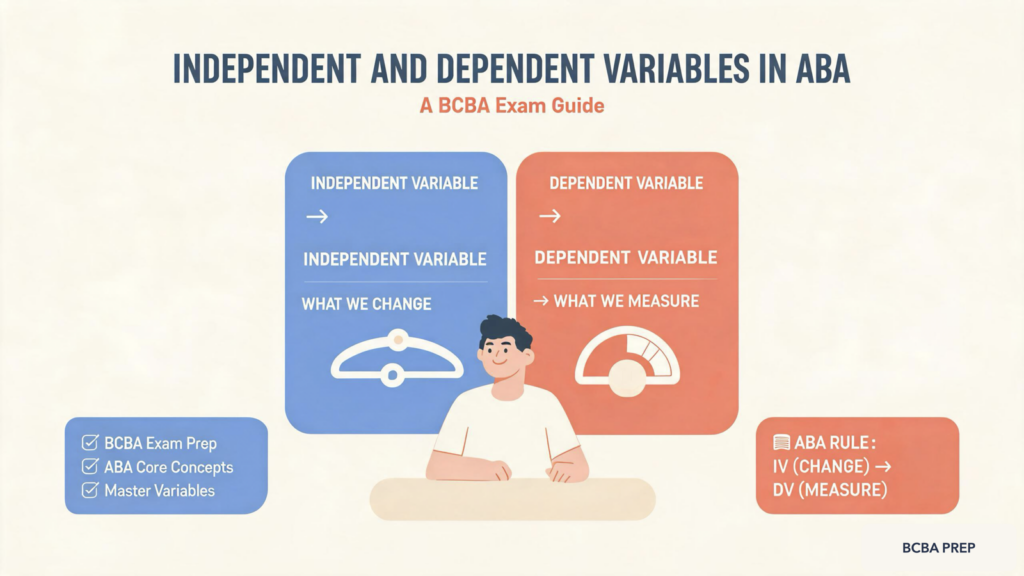
Understanding the independent and dependent variable is fundamental for the BCBA exam. In applied behavior analysis, these terms describe the core of any experimental or intervention design. The independent variable is what you manipulate; the dependent variable is what you measure.
Table of Contents
- What Are Independent and Dependent Variables?
- ABA Examples: Independent and Dependent Variables in Action
- Exam Relevance: How BCBA Questions Test Independent and Dependent Variables
- Independent vs Dependent Variable: A Quick Checklist for the BCBA Exam
- References
Independent Variable (IV) in ABA
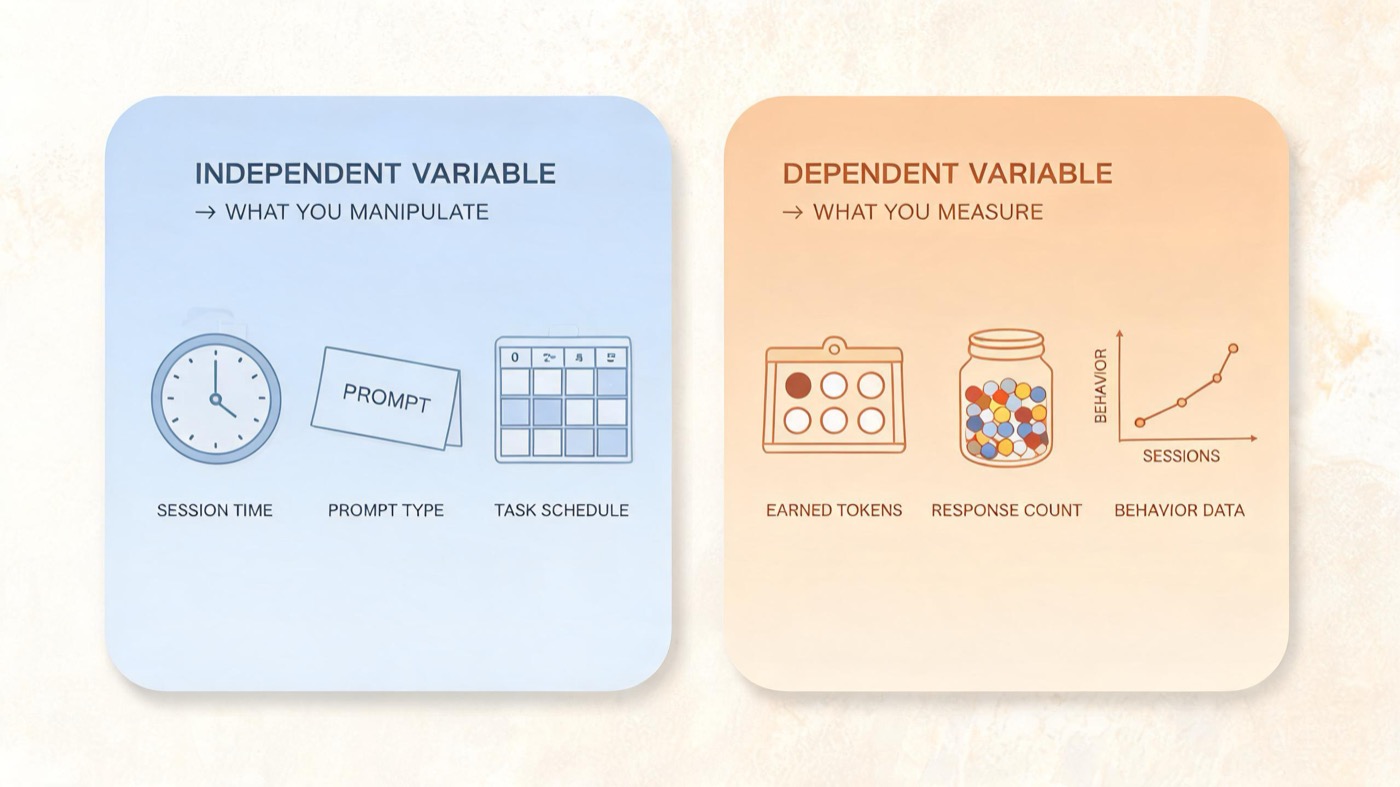
The independent variable is the intervention, treatment, or environmental change you deliberately implement. In ABA, this is often a reinforcement schedule, prompting strategy, or punishment procedure. For example, if you implement a token economy to increase on-task behavior, the token economy is the IV. The key is that the IV is under the experimenter’s control and is manipulated to see if it produces change in behavior.
Dependent Variable (DV) in ABA
The dependent variable is the target behavior you measure. It must be operationally defined so it can be observed and counted reliably. In the token economy example, the percentage of intervals with on-task behavior is the DV. The DV is what changes (or doesn’t) as a result of the IV. A strong operational definition includes a measurable dimension (e.g., frequency, duration, latency) and clear examples and non-examples.
ABA Examples: Independent and Dependent Variables in Action
Let’s look at two concrete ABA scenarios that mirror typical BCBA exam questions. Each includes an ABC analysis and hypothesized function to deepen your understanding.
Example 1: Reducing Aggression with Differential Reinforcement
A child engages in aggression (hitting) when given a difficult task. The hypothesized function is escape from demands. The behavior analyst implements differential reinforcement of alternative behavior (DRA): the child earns a break (escape) for requesting help appropriately. Here, the IV is the DRA procedure, and the DV is the frequency of aggression per session. The antecedent is a demand, the aggressive behavior is hitting, and the consequence (escape) maintains the behavior. The DRA changes the consequence for appropriate requests.
Example 2: Increasing On-Task Behavior with Token Economy
A student daydreams during independent work. The hypothesized function is access to tangibles (e.g., preferred items). The analyst introduces a token economy: tokens delivered for each 5 minutes of on-task behavior, exchangeable for toys. The IV is the token economy, and the DV is the percentage of on-task intervals. The antecedent is the instruction to work, the target behavior is on-task engagement, and the consequence is token delivery. The token economy increases the DV.
Example 3: Reducing Stereotypy with Response Interruption and Redirection (RIRD)
A learner engages in hand-flapping during downtime. The hypothesized function is automatic reinforcement (sensory stimulation). The analyst implements response interruption and redirection (RIRD): each instance of hand-flapping is interrupted, and the learner is redirected to a functional motor task. The IV is the RIRD procedure, and the DV is the rate of hand-flapping per minute. This example shows how the IV can be a procedural intervention that directly disrupts the behavior, while the DV captures its change over time.
Exam Relevance: How BCBA Questions Test Independent and Dependent Variables
BCBA exam questions often present a scenario and ask you to identify the IV, DV, or both. Some questions require you to choose the best operational definition for a DV or to recognize a confounding variable. Being able to quickly parse the IV and DV is a high-leverage skill.
Common Exam Traps
- Confusing which variable is manipulated vs. measured. The IV is always the intervention; the DV is always the behavior outcome. Remember: you change the IV, then observe the DV.
- Misidentifying confounding variables as the IV. For example, if a student receives both a token economy and extra attention, the extra attention is a confound, not the IV. The IV is only the planned intervention.
- Forgetting to operationally define the DV. An answer choice that says ‘aggression’ without a measurable definition is usually incorrect. Always look for a dimension (e.g., ‘frequency of aggression per hour’).
- Mixing up the IV and DV in reversal designs. In an ABAB design, the IV is the presence/absence of the intervention; the DV is the behavior level across phases.
Quick Recall Checklist
- 1) IV is what you do (the intervention). 2) DV is the behavior (the target). 3) The IV is manipulated; the DV is measured. 4) Always operationally define the DV with a dimension and examples. 5) When in doubt, ask: ‘What am I changing?’ (IV) vs. ‘What am I tracking?’ (DV).
Independent vs Dependent Variable: A Quick Checklist for the BCBA Exam
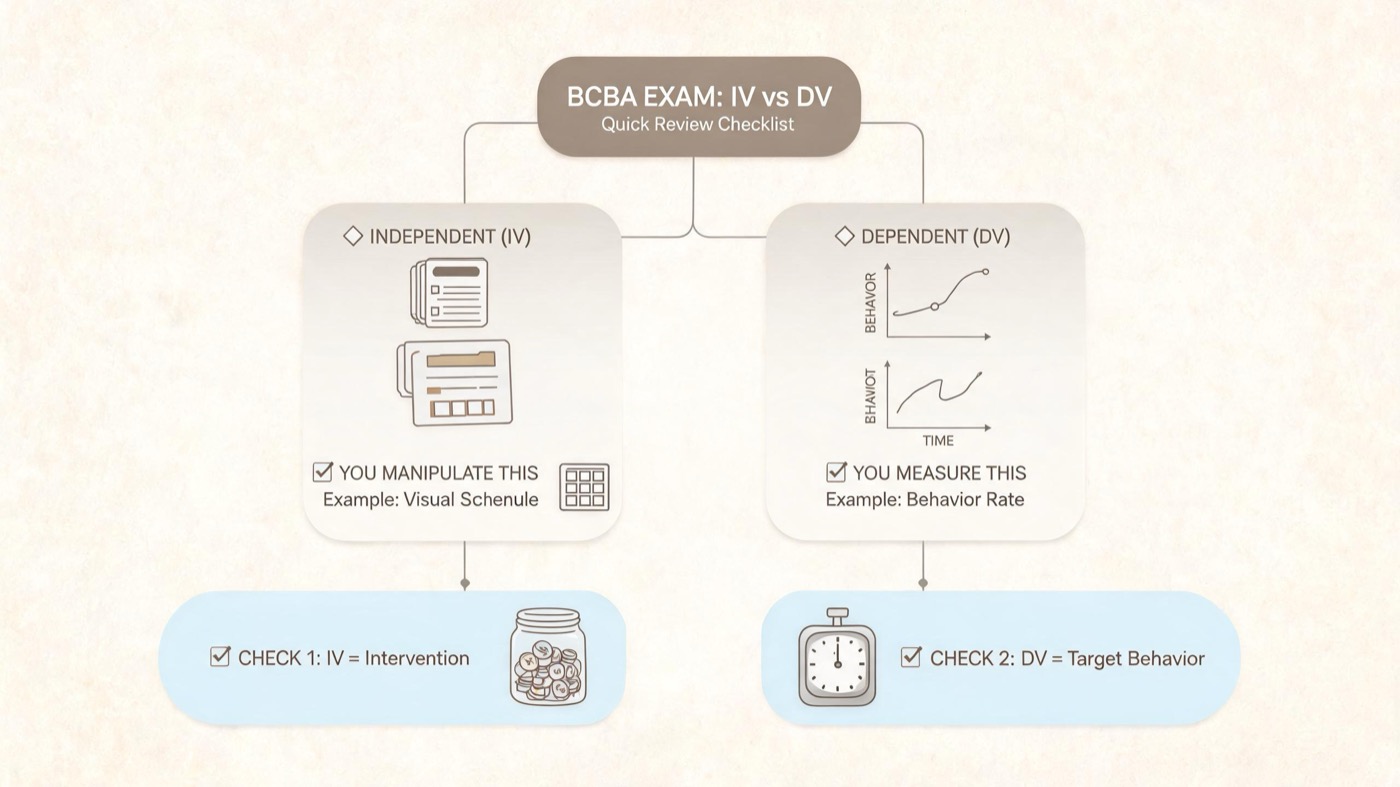
Use this checklist for last-minute review before your BCBA exam. Each bullet captures a critical distinction that frequently appears in test questions. Bookmark this page or write these down as a quick reference.
- IV = Intervention (token economy, DRA, prompting, extinction). It is the cause you introduce.
- DV = Target behavior (aggression, on-task, self-injury). It is the effect you measure.
- Functional relationship: A change in the IV should produce a reliable change in the DV. Without a functional relationship, experimental control is not demonstrated.
- Operational definition: The DV must be defined clearly enough that two observers can agree on its occurrence. Include examples and non-examples.
- Graphing: On a line graph, the IV is typically not plotted; the DV is plotted on the y-axis. Phase change lines indicate when the IV is introduced or removed.
- Confounds: Any uncontrolled variable that could affect the DV is a threat to internal validity. Good experimental designs control for confounds.
For deeper practice, explore our independent and dependent variables ABA resource or try BCBA practice exam materials. For a solid foundation, review the 7 dimensions of ABA. These internal resources will sharpen your skills.
Mastering the independent and dependent variable is not just about passing the exam—it’s about designing effective interventions. Keep this guide handy as you study, and remember: the IV is your lever, the DV is your compass. Good luck!
References
Complete BCBA Exam Prep
Turn this topic into exam-day practice
Practice concepts in context with five full-length 6th Edition mock exams, two bonus practice exams, a 6th Edition study guide, and key-term flashcards—all in one $120 USD package.
Get the $120 All-in-One Prep Pack
Review everything included on the product page before ordering. No pass guarantee is implied.



