
What Is Explanatory Mentalism?
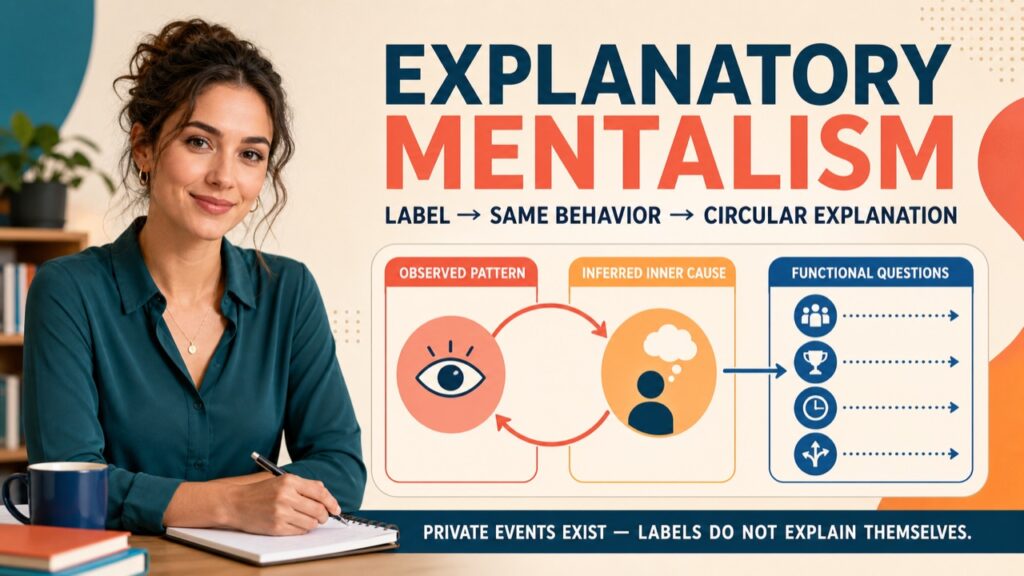
Explanatory mentalism is a concept in behavior analysis that describes a type of explanation where behavior is attributed to an inferred inner cause—a mental entity, trait, faculty, or inner agent—without identifying the functional relations that would explain both the label and the behavior itself. For example, saying “a student fails because he lacks motivation” uses “lack of motivation” as an autonomous inner cause. The evidence for the lack of motivation is the failing, yet it is invoked to explain the failing. This circular explanation can lead practitioners away from relations that could be measured, tested, or changed. Understanding explanatory mentalism is foundational for behavior analysts because it sharpens the distinction between circular accounts and functional explanations that identify manipulable antecedents and consequences.
Table of Contents
- What Is Explanatory Mentalism?
- Distinguishing Explanatory Mentalism From Other Concepts
- The Circularity Problem
- How to Translate a Label Into a Testable Account
- Common Traps for ABA Practitioners
- Practical Strategies for Studying Mentalism
- Conclusion
In applied behavior analysis, the term mentalism often refers to this explanatory style. The explanatory mentalism definition in psychology ABA contexts emphasizes that the inferred cause is not independent of the behavior it purports to explain. Recognizing this pattern is essential for designing interventions based on functional relations rather than hypothetical constructs, as outlined in the BACB BCBA Test Content Outline (6th ed.).
- Observed pattern: A learner pushes away a worksheet after difficult items. Circular label: “unmotivated.” Functional questions: Which task features precede the response, what happens next, and how has escape been arranged historically?
- Observed pattern: A learner rarely initiates with unfamiliar peers. Circular label: “shy.” Functional questions: Does initiation vary with familiarity, response effort, available prompts, or reinforcement?
- Observed pattern: An employee misses steps on a new checklist. Circular label: “poor work ethic.” Functional questions: Were expectations clear, was the skill trained, and does feedback follow accurate performance?
- Observed pattern: Hitting occurs after a demand and is followed by a pause. Circular label: “aggressive personality.” Functional questions: Does the pattern replicate, and what assessment would distinguish escape, attention, or another relation?
Distinguishing Explanatory Mentalism From Other Concepts
It is crucial to separate explanatory mentalism from ordinary descriptions of thoughts and feelings, first-person reports, physiological mechanisms, and testable cognitive models. Radical behaviorism—the philosophy underlying applied behavior analysis—does not deny that people think or feel. It treats thinking and feeling as natural phenomena, specifically as private events, which are behaviors or stimuli that occur within the skin. These private events are influenced by the same environmental variables as public behavior and are not considered autonomous inner causes.
The key difference is that explanatory mentalism uses inferred entities as autonomous causes, whereas behavior analysis seeks to identify functional relations between behavior and environment. For instance, saying “a client is anxious” may be a description of a private event, but using anxiety as the cause of avoidance without specifying the environmental antecedents and consequences is explanatory mentalism. A functional account would ask: What stimuli evoke reports of anxiety? What avoidance behaviors are reinforced? This approach expands inquiry rather than banning everyday words. For a primary discussion of descriptive, explanatory, and experiential mentalism, see Zuriff (2003), Science and Human Behavior, Dualism, and Conceptual Modification.
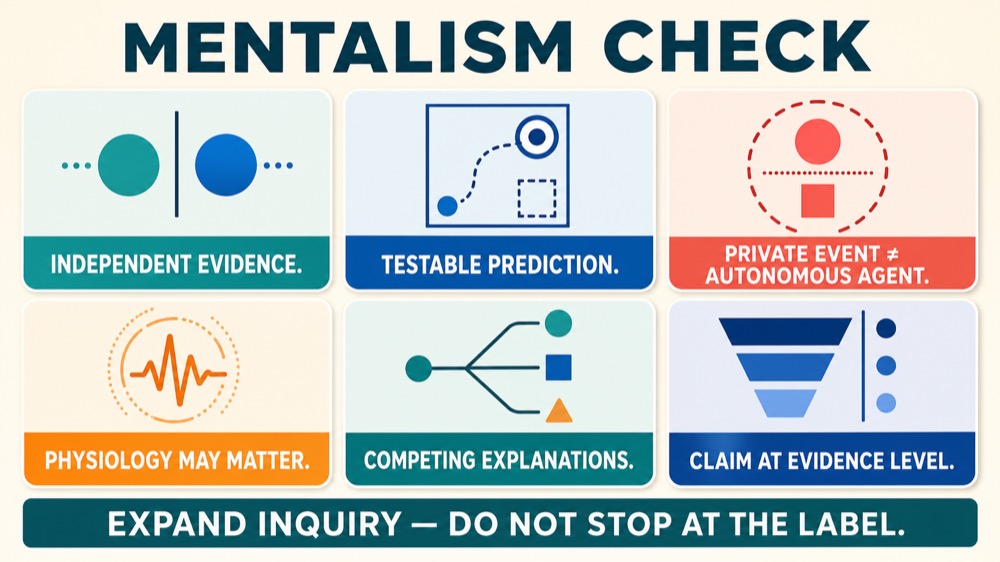
A hypothetical construct is not evaluated merely by whether it sounds cognitive or behavioral. Ask whether it is measured independently of the behavior being explained, yields risky predictions, can be tested against alternatives, and expands rather than terminates inquiry. A working-memory measure may predict performance without by itself identifying the function of off-task behavior. Conversely, simply renaming avoidance as “escape maintained” is not enough unless assessment data support that relation. A behavior-analytic account connects observable performance, relevant private or physiological events when evidence supports them, current context, and learning history without reifying a label as an initiating inner agent.
The Circularity Problem
The circularity problem is central to explanatory mentalism. When a label derived from behavior is used to explain that same behavior, the reasoning is logically empty. Consider these original examples:
- Shy: Treat this as a summary of low social initiation, not an independent cause. Measure initiation across familiar and unfamiliar people, settings, prompts, and consequences.
- Aggressive: Define the response topography and examine when it occurs and what reliably follows. Do not infer an escape or attention function from one sequence.
- Anxious: Separate self-report, physiological measures, avoidance, and context. Each may be relevant evidence, but the label alone does not specify the functional relation.
Translating each mentalistic label into observable behavior, current context, learning history, consequences, and private events without claiming certainty is a core skill. For example, when studying stimulus control in ABA, practitioners learn that behavior is under the control of environmental stimuli, not inner states. This perspective favors demonstrable controlling relations over an inferred state used as an unexamined stopping point. For discussion of private events, dispositions, and the functional analysis of mental talk, see Moore (2011), A Review of Baum’s Review of Conceptual Foundations of Radical Behaviorism.
How to Translate a Label Into a Testable Account
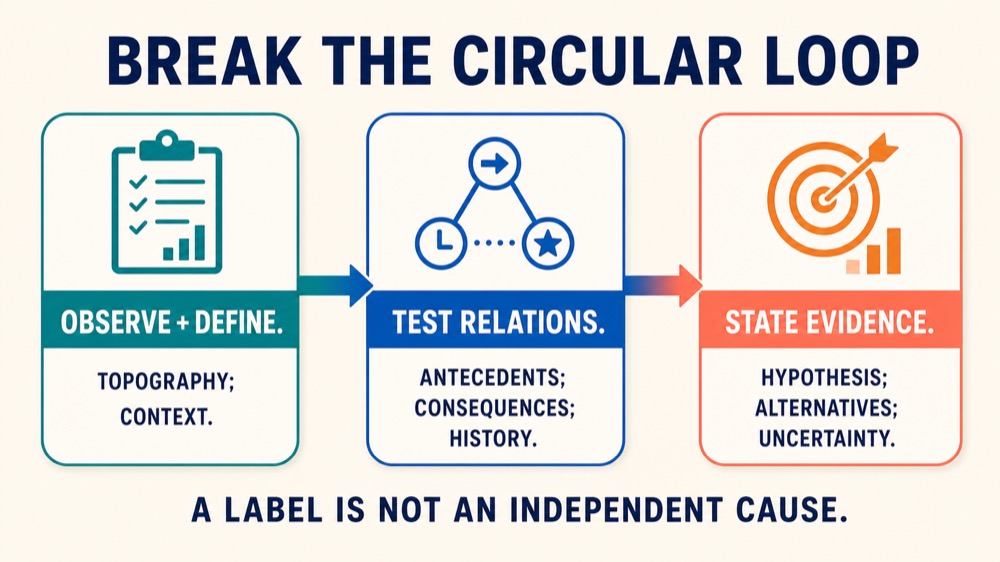
Replacing explanatory mentalism is not a matter of deleting psychological vocabulary. The goal is to turn a stopping label into questions that could change with evidence. Use the following sequence:
- Define the response. State what a person says or does in terms that permit reliable observation or, for a private event, identify the report or measure available.
- Specify the context. Record relevant antecedents, setting events, task features, people, and timing without assuming that temporal order proves causation.
- Describe consequences and history. Ask what has followed similar responding and whether the proposed contingency is supported across repeated observations.
- List competing explanations. Consider skill deficits, unclear instructions, response effort, reinforcement history, motivating operations, physiological variables, and measurement error as appropriate.
- State the claim at the evidence level. Use “is associated with,” “is consistent with,” or a testable functional hypothesis until experimental or converging evidence supports a stronger conclusion.
Suppose a learner completes easy worksheets but leaves the table when novel multi-step problems appear. “Low motivation” restates the pattern. A testable account defines leaving, compares task conditions, records prompts and consequences, checks prerequisite skills, and evaluates whether breaks or assistance differentially follow the response. The result may support a functional hypothesis, reveal a skill problem, or show multiple control. Each outcome is more informative than treating motivation as an autonomous inner agent.
Common Traps for ABA Practitioners
Even experienced behavior analysts can slip into explanatory mentalism. Watch for these biases:
- Matching Law Misapplication: Saying “He responds more to attention because he has a higher need for attention” treats an inferred need as a cause. Instead, examine the relative rates of reinforcement for attention-maintained behavior.
- Diagnostic Label Seduction: A diagnosis of autism does not explain specific behaviors. It can inform practice by suggesting common deficits, but each learner’s functional relations must be identified individually. The diagnostic label is not an autonomous cause; it is a description of a pattern of behavior that itself requires functional analysis.
- Trait Attribution Fallacy: Calling a client “stubborn” or “manipulative” can become a mentalistic explanation. Always revert to functional descriptions of behavior under specific conditions. For example, instead of “He is stubborn,” describe: “When given a non-preferred task, he engages in vocal protest and does not comply.”
- Circular Reasoning in Assessments: Using behavior rating scales that ask “Is the child hyperactive?” and then using the score to explain activity level creates a circular loop. Functional assessment should target observable events and their environmental correlates.
To detect explanatory mentalism, ask whether the proposed cause has evidence independent of the target behavior and whether the account produces testable predictions. Ethical manipulation is one method, but converging descriptive, physiological, historical, or self-report evidence may also matter. A functional account should specify the relevant context, response, consequences, and learning history while marking uncertainty and alternative explanations.
Practical Strategies for Studying Mentalism
Here is a study checklist to master the concept of mentalism in psychology ABA:
- Define explanatory mentalism in your own words and describe the circularity problem.
- Practice identifying mentalistic statements in case scenarios. Rewrite them as functional hypotheses that specify antecedents, behaviors, and consequences.
- Read the required primary sources: Zuriff (2003) on descriptive, explanatory, and experiential mentalism and Moore (2011) on private events and mental talk.
- Use free BCBA practice questions to test your ability to distinguish mentalism from radical behaviorism. For more on stimulus control and generalization, see stimulus generalization in ABA.
- Create comparison tables: mentalistic vs. functional explanations for common behaviors such as tantrums, noncompliance, and self-injury.
- Review the current BCBA Test Content Outline, especially Domain A’s goals, assumptions, radical-behaviorist perspective, and distinctions among the domains of behavior analysis.
Conclusion
Understanding explanatory mentalism helps behavior analysts avoid conceptual pitfalls and build interventions rooted in functional relations. By asking environmental questions—What happened before? What happens after? What is the learning history?—you move from circular mentalism to effective, evidence-based practice. Continue to refine your analytical skills with resources like the Free BCBA Mock Exam, which provides practice and feedback on foundational ABA concepts. Remember, the goal is not to eliminate words like “think” or “feel” from your vocabulary, but to ensure that your explanations lead to testable, manipulable variables. By mastering the distinction, you will be better prepared for ethical and effective practice.
Next step for BCBA exam prep
Turn this topic into exam-day practice
Use this topic as a focused review, then test it in exam-style conditions with a free mock before deciding whether five full-length mocks are the right next step.
Start the Free BCBA Mock ExamContinue with Five Full-Length Mocks — $99
Review the included materials and access details before ordering. No pass guarantee is implied.



