
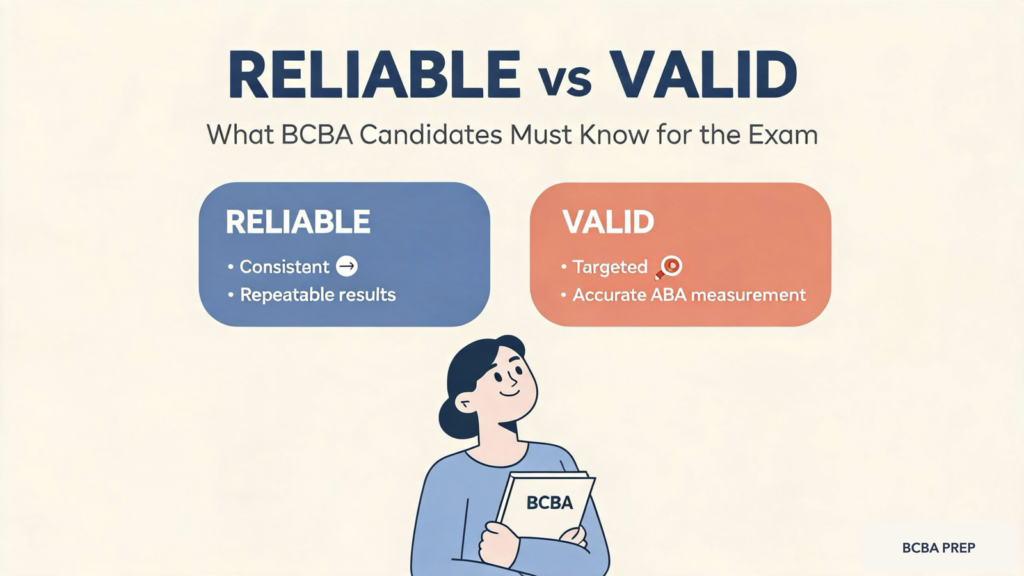
Defining Reliability and Validity in ABA Measurement
When you collect data on a target behavior, you need to know that your measurement system is both reliable and valid. These two concepts are foundational for BCBA exam questions and for ethical practice. Let’s break them down.
Table of Contents
- Defining Reliability and Validity in ABA Measurement
- Why Both Reliability and Validity Matter for BCBAs
- Worked ABA Examples: Applying Reliable vs Valid to Real Client Scenarios
- Exam Relevance and Common Traps
- Quick Checklist for Reliability and Validity in ABA
- Summary: Mastering Reliable vs Valid for the BCBA Exam
What Does Reliability Mean in Behavior Analysis?
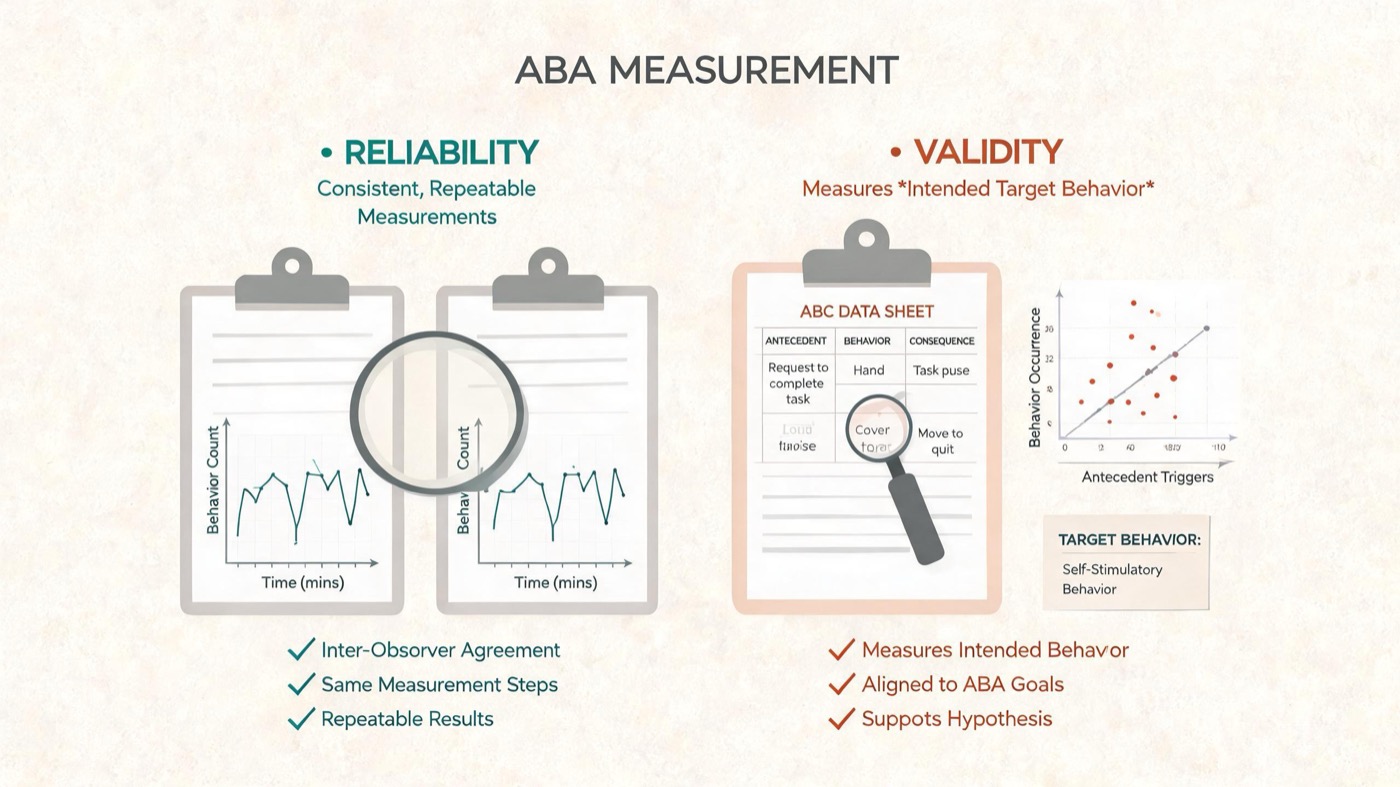
Reliability refers to the consistency of measurement. If you measure the same behavior under the same conditions, you should get the same results. In ABA, we often assess reliability through interobserver agreement (IOA)—when two independent observers agree on what they saw. Other forms include test-retest reliability and split-half reliability. A reliable measurement is reproducible, but it does not guarantee accuracy.
What Does Validity Mean in Behavior Analysis?
Validity refers to the accuracy of measurement. It answers the question: Are we measuring what we intend to measure? In ABA, we consider face validity (does it appear to measure the right thing?), content validity (does it cover all aspects of the behavior?), and criterion validity (does it correlate with an accepted standard?). If your measurement is valid, it truly reflects the target behavior. For example, measuring aggression by counting only physical hits (not threats) has content validity if that is your operational definition.
Why Both Reliability and Validity Matter for BCBAs
Think of a reliable but invalid measurement like a clock that is consistently 10 minutes slow. It gives the same reading every day (reliable), but it does not tell you the correct time (invalid). Similarly, in ABA, you can have high IOA but still be measuring the wrong behavior. Both properties are essential for data-driven decisions.
Can a Measure Be Reliable but Not Valid?
Yes, this is a common scenario. For example, two data collectors agree 95% of the time that a child is having a tantrum (high reliability), but the behavior is actually due to pain from an ear infection (not a tantrum). The measure is reliable but not valid.
Can a Measure Be Valid but Not Reliable?
In practice, this is rare. If your measurement is inconsistent, it cannot be truly accurate. However, a flawed instrument might occasionally give the right answer by chance—but that does not make it a valid measure. Validity presupposes reliability.
Worked ABA Examples: Applying Reliable vs Valid to Real Client Scenarios
Let’s walk through two detailed examples to see how these concepts play out in everyday ABA practice.
Example 1: Measuring Aggression
Your team defines aggression as hitting, kicking, or biting others. Two observers record the frequency of aggression during a session. They agree on 90% of intervals—this is reliable. However, the definition includes accidental hits when the client is playing roughly. Those hits are not intentional aggression, so the measurement may overestimate the true rate. To improve validity, refine the definition to exclude accidental contact.
Example 2: Measuring On-Task Behavior
You use momentary time sampling every 5 minutes to measure on-task behavior. The data are consistent across sessions (reliable), but on-task behavior occurs in brief bursts between samples. The measurement misses many on-task episodes, so it is not valid. A better method might be whole-interval recording or duration recording to capture the true occurrence.
For a deeper dive into measurement systems, check out our guide on data collection methods in ABA.
Exam Relevance and Common Traps
The BCBA exam frequently presents scenario-based questions where you must decide whether the issue is reliability or validity. Here is how to prepare.
How the BCBA Exam Tests Reliability and Validity
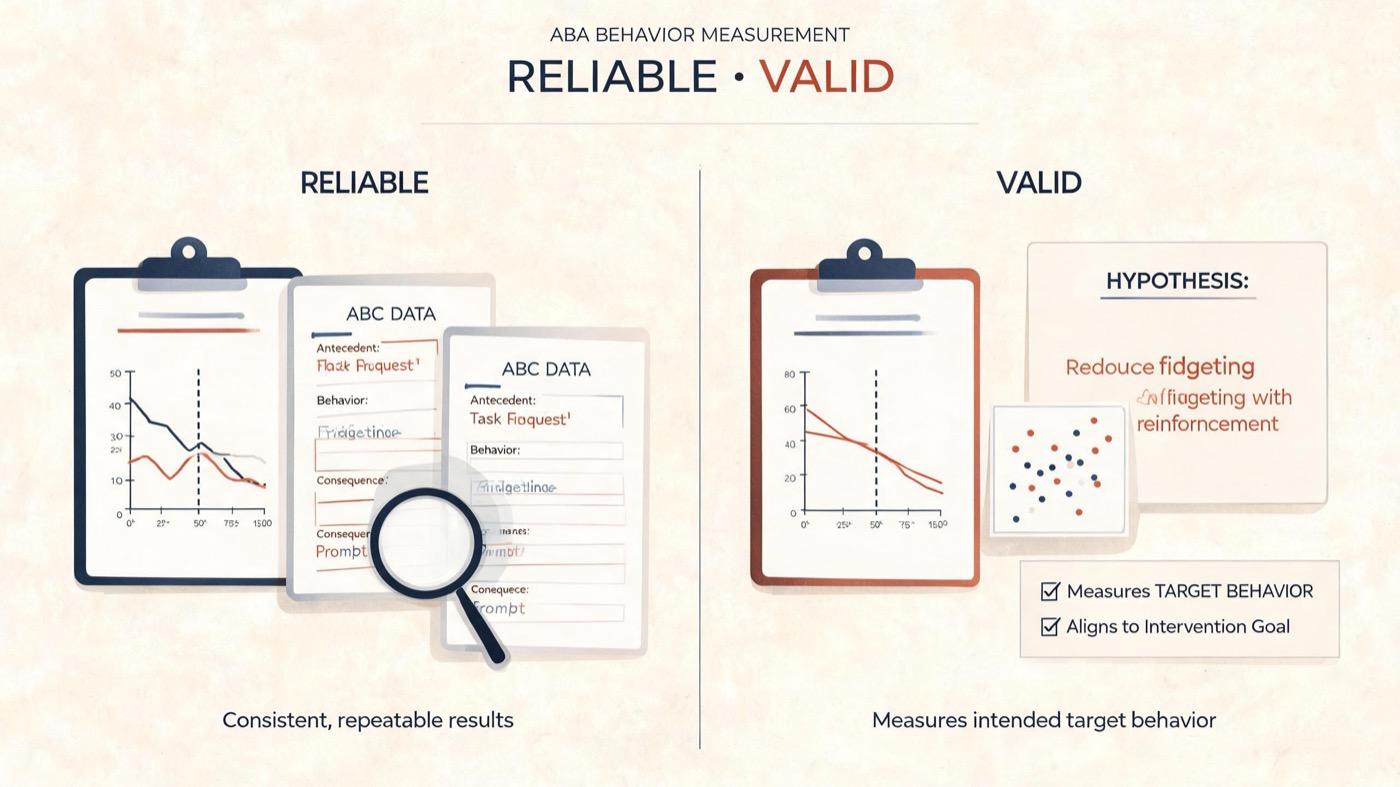
Expect questions like: Two data collectors agree on 85% of observations, but the behavior targeted is not the socially meaningful behavior. Is the problem reliability or validity? The answer: The system is reliable (high IOA) but not valid (wrong target).
Common Traps to Avoid
- Confusing reliability with validity: High IOA does not mean you are measuring the right thing.
- Assuming high reliability guarantees validity: Reliability is necessary but not sufficient for validity.
- Overlooking threats to validity in single-subject designs, such as instrumentation changes or observer drift.
- Mixing up type of validity: For example, face validity alone is weak; you need content or criterion validity for strong measurement.
Another Common Trap: Observer Drift
Even if your IOA was high initially, observers may drift over time, reducing reliability. Regularly recalibrate your definitions to maintain both reliability and validity.
Quick Checklist for Reliability and Validity in ABA
Use this checklist to review your measurement systems before starting data collection:
- Define the behavior in observable, measurable terms.
- Train observers to high IOA (at least 80% agreement, ideally 90% or higher).
- Assess face and content validity by asking: Does this definition capture all instances of the target behavior?
- Check for threats to validity like irrelevant topographies or missed instances.
- Re-evaluate reliability periodically to catch observer drift.
- Ensure the measurement method matches the nature of the behavior (e.g., frequency for discrete behaviors, duration for continuous).
For more on the foundations of ABA measurement, see our article on the 7 dimensions of ABA.
Summary: Mastering Reliable vs Valid for the BCBA Exam
Understanding the difference between reliable vs valid is critical for both the exam and your future practice. Remember: reliability is about consistency, validity is about truth. A measurement can be reliable but not valid, but not the other way around. Use the checklist, avoid the common traps, and always ask: Are we measuring what we think we are measuring?
For additional exam prep resources, visit our BCBA exam prep guide.
For authoritative reading, consult the BACB website for ethics and measurement standards.
Complete BCBA Exam Prep
Turn this topic into exam-day practice
Practice concepts in context with five full-length 6th Edition mock exams, two bonus practice exams, a 6th Edition study guide, and key-term flashcards—all in one $120 USD package.
Get the $120 All-in-One Prep Pack
Review everything included on the product page before ordering. No pass guarantee is implied.



