
Escape Extinction in ABA: Definition and Core Concepts
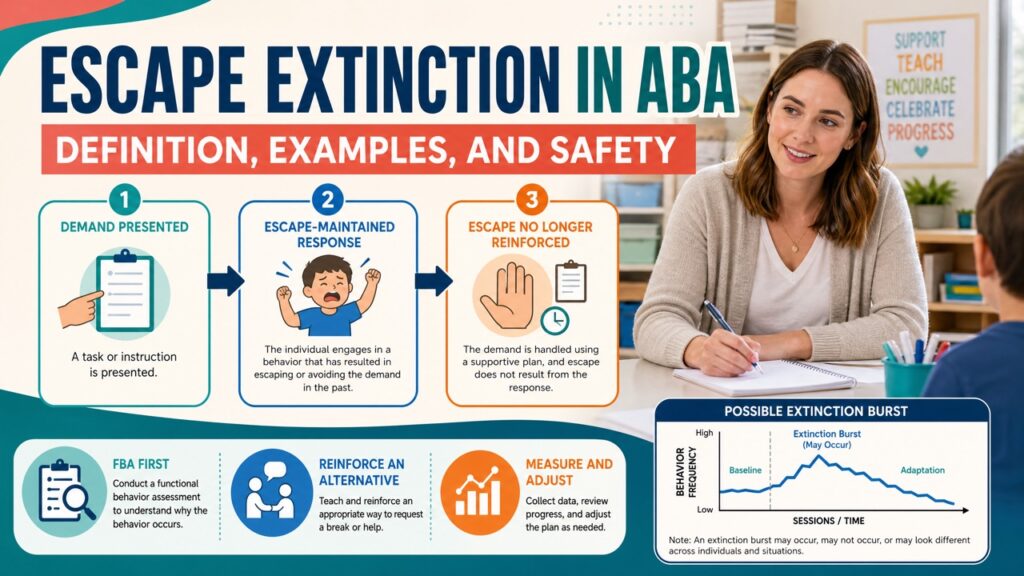
Escape extinction is a procedure used in applied behavior analysis (ABA) to reduce behavior maintained by negative reinforcement. In this procedure, the response–reinforcer relation for escape-maintained behavior is discontinued by preventing escape or maintaining the demand. In other words, the individual no longer obtains the reinforcing outcome of escaping or avoiding an aversive stimulus, task, or demand. For example, if a child tantrums to avoid a chore, escape extinction would involve keeping the demand in place so that the tantrum no longer leads to removal of the chore. This procedure is grounded in the principle of extinction, where the maintaining reinforcer is withheld, leading to a gradual reduction in the behavior over time. The ultimate goal is a measurable outcome, such as a decrease in the frequency or duration of the target behavior, which can be tracked through data collection to verify the effectiveness of the intervention.
Table of Contents
- Escape Extinction in ABA: Definition and Core Concepts
- How Escape Extinction Works: Mechanisms and Key Components
- Escape Extinction Examples in Everyday ABA Practice
- Escape Extinction vs. Punishment vs. Negative Reinforcement
- Ethical and Practical Considerations in Implementing Escape Extinction
- Ready to Test Your Knowledge?
- Reference
Escape extinction specifically targets negative reinforcement, which is the process by which a behavior is strengthened by the removal of an aversive stimulus. It is important to distinguish between extinction as a general process and negative reinforcement as a behavioral mechanism. Extinction involves discontinuing the reinforcer that maintains a behavior, while negative reinforcement describes how a behavior is strengthened by the removal of an aversive stimulus. Escape extinction addresses the negative reinforcement contingency by ensuring that the escape response no longer produces the removal of the aversive stimulus. This distinction is central to understanding how escape extinction works and why it is not a punishment procedure.
Before implementing escape extinction, a functional behavior assessment (FBA) is necessary to confirm that the behavior is maintained by escape. Without this assessment, the intervention may be ineffective or even harmful if the behavior is actually maintained by attention, access to tangibles, or automatic reinforcement. The FBA helps identify the function of the behavior, which guides the selection of appropriate interventions. In applied behavior analysis, the function of behavior is a key consideration in designing effective treatments, and escape extinction is appropriate when escape is the confirmed maintaining function.
How Escape Extinction Works: Mechanisms and Key Components
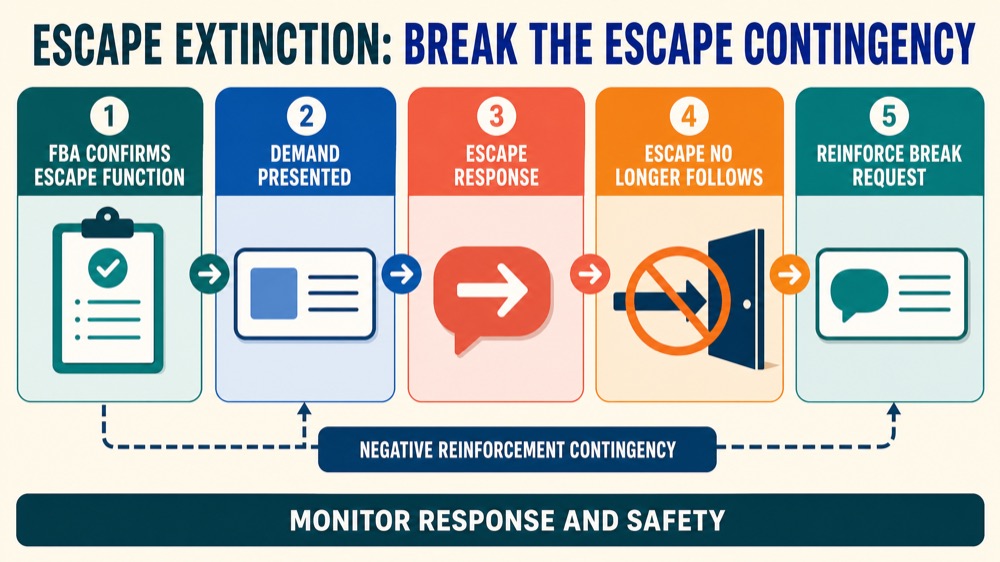
Escape extinction works by breaking the contingency between the problem behavior and the removal of the aversive stimulus. When a demand is presented, the individual may engage in behavior that previously resulted in escape. With escape extinction, that behavior no longer leads to escape; the demand remains in place. Over time, the individual learns that the problem behavior is ineffective, and the behavior decreases. This process is a form of extinction, which is the discontinuation of the reinforcement that maintains a behavior.
One key component of escape extinction is the extinction burst, which is a temporary increase in the frequency, intensity, or duration of the behavior when extinction is first introduced. For example, a child who screams to avoid a task may scream louder and longer when the task is not removed. This burst is a normal part of the extinction process and should be anticipated. Consistency in implementing escape extinction is important; if escape is occasionally allowed, the behavior may become more resistant to extinction. Therefore, all caregivers and staff should implement the procedure consistently to maximize its effectiveness. The measurable outcome of a well-implemented escape extinction procedure is a clear reduction in the target behavior, which can be documented through systematic data collection and graphed for analysis.
Another important aspect is the role of the aversive stimulus. In escape extinction, the aversive stimulus (e.g., a difficult task, an unpleasant sensation) is not removed when the problem behavior occurs. However, escape extinction does not involve delivering an aversive stimulus; it simply prevents the escape that previously reinforced the behavior. This distinction is crucial for understanding why escape extinction is not punishment. Punishment involves adding an aversive stimulus or removing a reinforcing stimulus contingent on behavior, whereas escape extinction withholds the reinforcing consequence of escape.
Escape Extinction Examples in Everyday ABA Practice
Here are two original examples that illustrate escape extinction in practice. Each example specifies the behavior, the escape contingency, and the intervention.
- Child avoiding homework: A 10-year-old student engages in yelling and throwing pencils when asked to complete a math worksheet. Previously, the teacher would remove the worksheet and send the student to a quiet corner, which reinforced the tantrum. With escape extinction, the teacher calmly keeps the worksheet on the desk and provides a brief verbal prompt to begin. The teacher does not remove the task or allow the student to leave the area. The yelling no longer results in escape. Over time, the student learns that completing the task is one programmed way to end the current demand, and the tantrum decreases. The teacher also reinforces the student for completing problems with praise and a short break after a set amount of work. The measurable outcome here is a reduction in the frequency of yelling and an increase in task completion, both of which can be tracked to evaluate progress.
- Dog avoiding nail clipping: A dog growls and pulls its paw away during nail clipping. The owner previously stopped the clipping when the dog growled, thereby reinforcing the growling. With escape extinction, the owner calmly holds the paw and continues clipping, using a safety harness if necessary. The growling no longer leads to the cessation of clipping. After several sessions, the growling reduces because it no longer works. The owner also provides treats for calm behavior during the procedure, reinforcing an alternative response. The measurable outcome is a decrease in growling and an increase in calm behavior during nail clipping, which can be measured by counting instances or duration.
These examples show that escape extinction requires persistence and often involves a brief increase in the problem behavior before it improves. It is also important to pair escape extinction with reinforcement for alternative behaviors, such as compliance or appropriate requests for breaks, to make the intervention acceptable and effective. This combination is often referred to as differential reinforcement of alternative behavior (DRA), which will be discussed later.
Escape Extinction vs. Punishment vs. Negative Reinforcement
One of the most common confusions among ABA students is distinguishing escape extinction from punishment and negative reinforcement. These concepts are related but fundamentally different.
- Negative reinforcement: This is a process that strengthens a behavior by removing an aversive stimulus. For example, a child completes homework to stop the teacher’s nagging. Here, the completion of homework is negatively reinforced. This process creates escape-maintained behavior. Escape extinction is not the same as negative reinforcement; it is the opposite, because it removes the reinforcing consequence.
- Punishment: Punishment is a process that weakens a behavior by adding an aversive stimulus (positive punishment) or removing a reinforcing stimulus (negative punishment). For instance, if a child throws a tantrum and is sent to time-out (removing access to toys), that’s negative punishment. Escape extinction does not add anything; it simply withholds the escape reinforcer. It is a form of extinction, not punishment.
- Escape extinction: This procedure involves discontinuing the negative reinforcement contingency that maintains the behavior. The behavior no longer produces escape. This is a type of extinction, not punishment, because no aversive stimulus is added contingent on the behavior.
To put it simply, negative reinforcement creates escape behavior, punishment suppresses behavior by adding or removing stimuli, and escape extinction eliminates the reinforcer that keeps the behavior alive. Understanding these differences is crucial for exam questions and practical application. For example, if a behavior is maintained by escape, punishment might not be effective and could produce other side effects; escape extinction directly targets the function. The measurable outcome of escape extinction is a reduction in the escape-maintained behavior, which can be contrasted with the effects of punishment, which may involve suppression but not necessarily a change in the underlying function.
Ethical and Practical Considerations in Implementing Escape Extinction
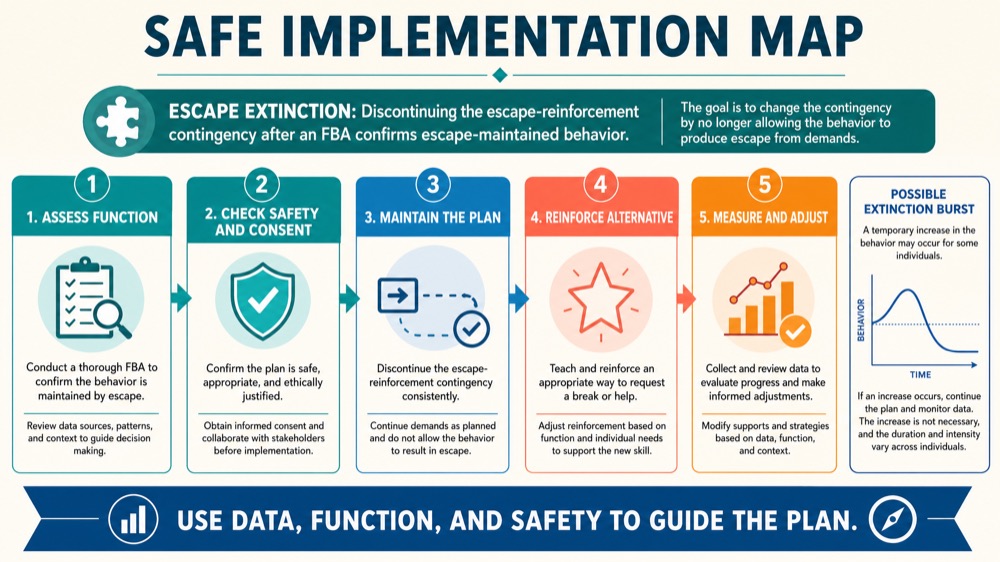
Before implementing escape extinction, behavior analysts must consider several ethical and practical factors to ensure the intervention is safe and acceptable. The BACB Ethics Code requires practitioners to use the least restrictive procedures and to prioritize the individual’s welfare.
- Safety first: If the problem behavior involves risk of harm to the individual or others, such as severe tantrums or self-injury, escape extinction may need to be modified. For example, you might use a gradual fading procedure where the demand is presented in small increments to avoid extreme distress. Have a safety plan in place.
- Obtain informed consent: Explain the procedure, including the possibility of an extinction burst, to the client or guardian. Obtain written consent before starting, especially if physical guidance is required.
- Combine with reinforcement: Escape extinction is most effective when paired with DRA or FCT. Provide reinforcement for appropriate behaviors, such as completing a task or requesting a break. This teaches the individual a more adaptive way to escape or avoid.
- Ensure consistency: All caregivers and staff must implement escape extinction consistently. Inconsistent implementation can lead to resurgence or prolong the extinction process. Train everyone involved and monitor fidelity.
- Monitor progress: Collect data on the target behavior and any alternative behaviors. Regularly review the data to determine if the intervention is working or if adjustments are needed. The measurable outcome should be clearly defined and tracked, such as a decrease in the frequency of tantrums or an increase in the use of a functional communication response.
These considerations are essential for ethical practice. Escape extinction is a powerful tool, but it is not a standalone solution. It must be used within a comprehensive behavior intervention plan that includes positive reinforcement, environmental modifications, and careful monitoring.
Ready to Test Your Knowledge?
Now that you have a thorough understanding of escape extinction, it is time to put your skills to the test. Use our free BCBA mock exam to practice realistic questions and receive feedback. This resource helps you gauge your readiness and identify areas for improvement. Additionally, explore our related guides on stimulus control in ABA and stimulus generalization to deepen your understanding of these interconnected topics. Good luck with your studies, and remember that mastery of escape extinction is a key step toward becoming a competent behavior analyst.



