
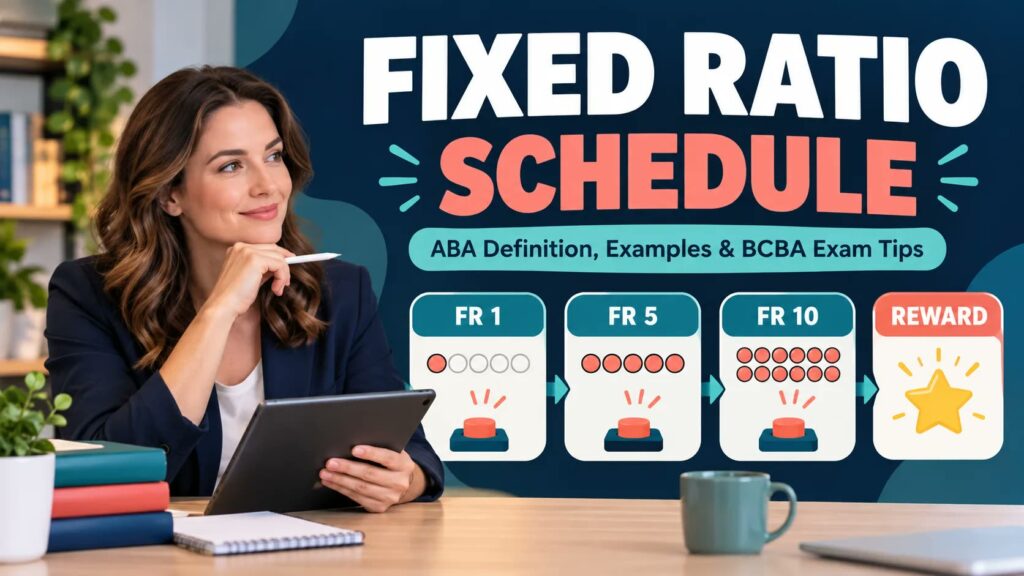
Quick answer: A fixed ratio (FR) schedule delivers reinforcement after a fixed number of responses. In an FR 5 schedule, the fifth qualifying response produces the programmed reinforcer; the count resets for the next ratio. The number is a response requirement, not a time requirement.
Fixed ratio schedules are common in ABA examples and BCBA exam vignettes because they test two distinctions at once: ratio versus interval and fixed versus variable. This guide gives you the definition, notation, applied examples, response patterns, and a fast way to identify FR schedules without confusing them with fixed interval or variable ratio schedules.
Fixed Ratio Schedule in ABA: The Core Definition
A fixed ratio schedule is a contingency in which reinforcement is made available after a constant number of responses. “Ratio” tells you that the requirement is based on how many responses occur. “Fixed” tells you that the response requirement is predictable and does not vary from one completed ratio to the next.
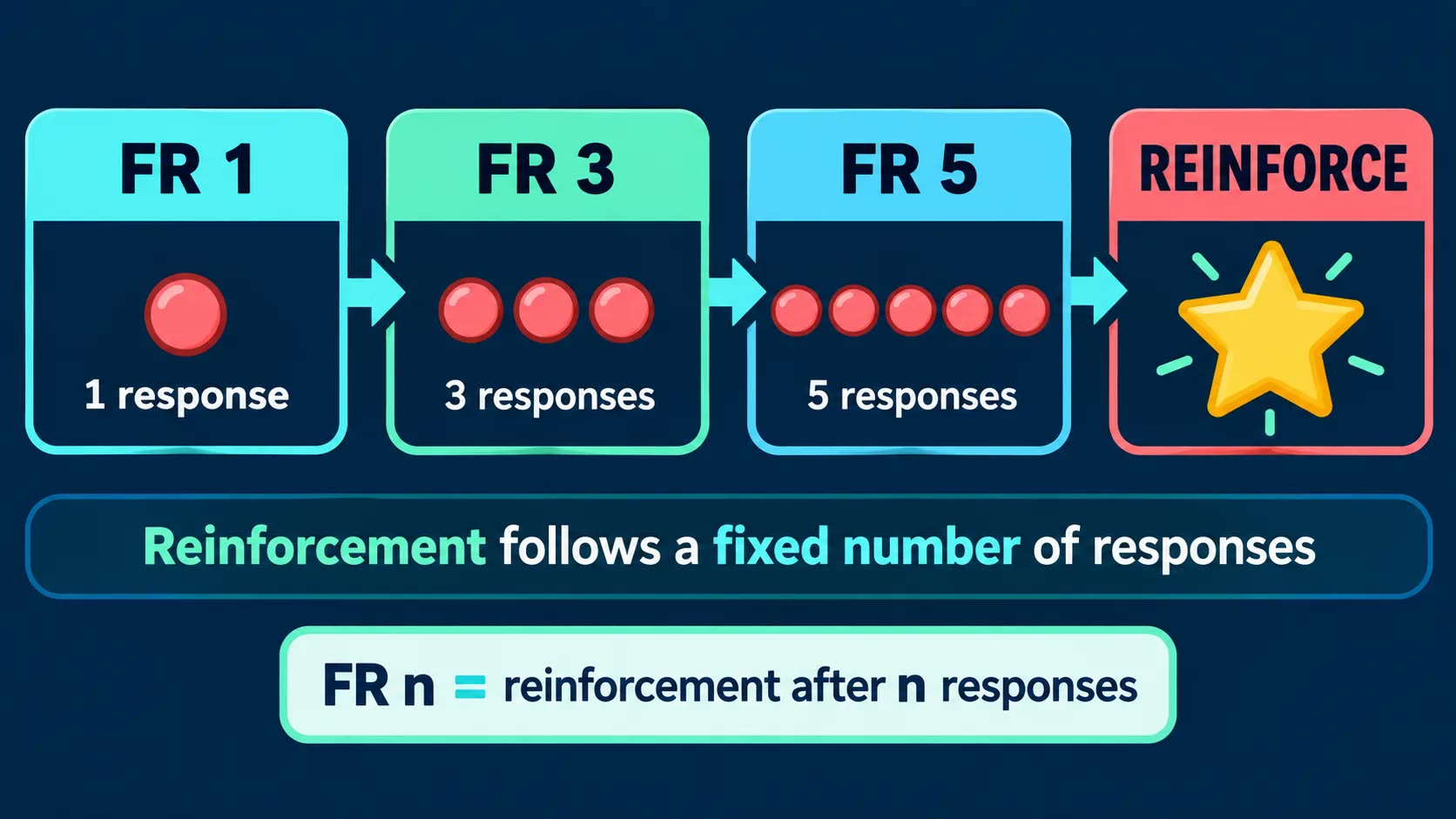
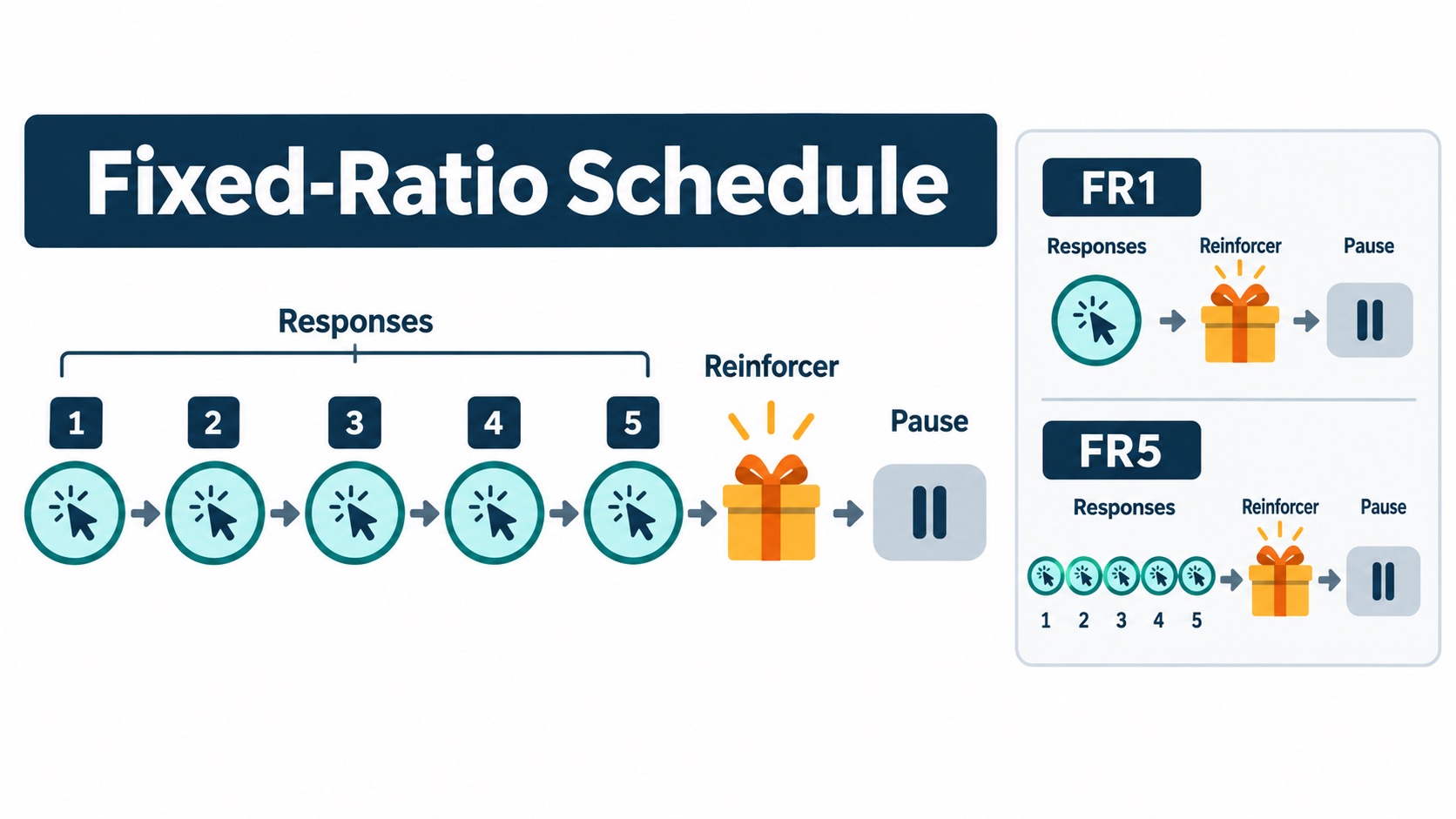
The notation is FR n, where n is the number of responses required for one programmed reinforcer. Thus, FR 1 means one response produces reinforcement, FR 5 means five responses produce reinforcement, and FR 10 means ten responses produce reinforcement. The response count starts again after the reinforcer is delivered.
| Term | What it specifies | Example |
|---|---|---|
| Ratio | The requirement is based on response count. | Complete five correct responses. |
| Fixed | The response requirement stays constant. | Every completed ratio requires five responses. |
| FR 5 | One reinforcer follows each five-response requirement. | Response 5 produces the token or other programmed reinforcer. |
| FR 1 | Each qualifying response is reinforced. | Each independent correct answer contacts reinforcement. |
For BCBA exam purposes, do not define FR as “reinforcement after a certain amount of work” unless the vignette makes the response requirement explicit. “Work” could refer to responses, time, completed tasks, or a mixed contingency. Identify the actual dimension first.
How an FR Schedule Works: Count Responses, Then Reinforce
An FR contingency has a simple sequence. First, the learner emits the target response. Next, the observer or programmed system counts responses toward the requirement. When the fixed criterion is met, the reinforcer is delivered. The next ratio begins after that delivery.
| Trial sequence | What happens under FR 5 | Is reinforcement delivered yet? |
|---|---|---|
| Response 1 | One qualifying response is recorded. | No; four responses remain. |
| Response 2 | The count advances to two. | No; three responses remain. |
| Response 3 | The count advances to three. | No; two responses remain. |
| Response 4 | The count advances to four. | No; one response remains. |
| Response 5 | The fixed requirement is met. | Yes; deliver the programmed reinforcer, then reset the count. |
The response requirement is not the same as “five minutes” or “the first response after five minutes.” Those are interval arrangements. Likewise, FR 5 does not mean that the learner receives a reinforcer on every fifth minute or that five responses occur on average. A fixed ratio has a stable response count.
Fixed Ratio Examples in ABA Practice
The same schedule can be used with different response forms and different reinforcers. What makes the schedule FR is the relation between the count of qualifying responses and the delivery of reinforcement—not whether the response is academic, communicative, motor, or vocational.
| ABA situation | Programmed contingency | Schedule | Why it qualifies |
|---|---|---|---|
| Discrete-trial instruction | One token after every three independent correct responses. | FR 3 | Three responses are required each time. |
| Functional communication | After five appropriate requests, the learner earns a brief preferred activity. | FR 5 | The response count is fixed at five. |
| Classroom work completion | Complete ten assigned items, then access a chosen break. | FR 10 | Ten completed response units produce the break. |
| Skill acquisition | Deliver labeled praise after each correct imitation. | FR 1 | One response produces one programmed consequence. |
| Home routine | After four completed steps, provide the planned reinforcer. | FR 4 | The criterion is a constant number of responses or completed steps. |
In applied practice, the team must define what counts as a qualifying response and what happens when an error, prompt, or incomplete response occurs. If a learner receives reinforcement after a variable number of responses, the schedule is not FR even if the average requirement happens to be five.
Fixed Ratio vs Variable Ratio vs Interval Schedules
Use a two-question classification rule: What dimension is counted? Responses indicate a ratio schedule; elapsed time indicates an interval schedule. Is the requirement predictable? A constant requirement is fixed; a changing requirement is variable.
| Schedule | Requirement | What varies? | Example |
|---|---|---|---|
| FR | Fixed number of responses | Nothing about the response requirement | Reinforce every fifth correct response. |
| VR | Variable number of responses | Response requirement changes around an average | Reinforce after an unpredictable number of correct responses averaging five. |
| FI | Fixed amount of time, then a response | Time requirement is constant | After 30 seconds have passed, reinforce the first correct response. |
| VI | Variable amount of time, then a response | Time requirement changes around an average | After varying time intervals, reinforce the first correct response. |
The word “first” does not automatically make a schedule fixed interval. Under FI 30 seconds, the first qualifying response after 30 seconds can produce reinforcement. Under FR 5, the fifth qualifying response produces reinforcement regardless of how much time has passed. Always identify the controlling dimension.
For a broader comparison, see the related fixed interval versus fixed ratio BCBA guide. The canonical page here focuses on the fixed-response requirement and its applied examples.
Post-Reinforcement Pause, Response Rate, and Ratio Strain
A common pattern under a fixed ratio schedule is a post-reinforcement pause: responding briefly slows or stops after reinforcement, followed by responding toward the next ratio. Once the learner resumes, responding may be relatively rapid until the next requirement is met. The exact pattern depends on the response effort, reinforcer value, history, competing events, prompting, and other features of the arrangement.
| Observation | Possible interpretation | What not to conclude automatically |
|---|---|---|
| Brief pause after the reinforcer | A post-reinforcement pause may be occurring. | The learner is “noncompliant” or the schedule is ineffective. |
| Fast responding after the pause | The current ratio may be supporting a high response rate. | Every FR schedule produces the same response rate. |
| Longer pauses as the ratio grows | The response requirement may be becoming more effortful. | The procedure should be increased again without data review. |
| Errors or escape-maintained behavior | Check response definition, reinforcer quality, effort, and competing contingencies. | Changing the ratio alone will solve the problem. |
Ratio strain describes a breakdown in responding when a ratio requirement becomes too demanding relative to the learner’s history, reinforcer value, or available alternatives. It is a clinical decision point, not a diagnosis. A responsible analyst reviews data and adjusts the teaching arrangement rather than treating a larger ratio as automatically better.
Research on fixed-ratio performance often measures pauses and interresponse times because the overall number of responses can hide changes in the pattern of responding. For exam questions, recognize the pattern as a schedule effect, but do not treat one observation as proof of a specific function.
Using FR Schedules in Skill Acquisition
FR 1 is often useful early in acquisition because each independent correct response can contact reinforcement. Once the skill is stable, the team may thin reinforcement to an intermittent schedule so the skill contacts reinforcement less often while remaining strong. The thinning plan should be data-based and should not remove reinforcement abruptly without considering performance and learner assent.
| Teaching phase | Possible FR arrangement | Decision data |
|---|---|---|
| Early acquisition | FR 1 for independent correct responses. | Accuracy, prompt level, latency, and learner engagement. |
| Stable skill | Move gradually to FR 2, FR 3, or another planned schedule. | Whether accuracy and responding remain stable as reinforcement thins. |
| Generalization | Program reinforcement across people, materials, and settings. | Performance with changed stimuli and less artificial support. |
| Maintenance | Use the least intrusive schedule that maintains the target response. | Long-term response level and meaningful outcomes, not just trial count. |
Do not confuse “FR 1” with “reinforce everything.” FR 1 applies to the defined qualifying response under the programmed contingency. Other behavior may contact different consequences, and the reinforcer should still be identified precisely.
How to Solve a Fixed Ratio BCBA Exam Question
On a vignette, ignore the surface story first. Translate the contingency into four pieces: the target response, the counted unit, the requirement, and the consequence. Then classify the schedule.
| Question to ask | If the answer is… | Classification clue |
|---|---|---|
| What is counted? | Responses or completed response units | Ratio schedule |
| What is counted? | Elapsed time before a response can produce reinforcement | Interval schedule |
| Does the requirement stay the same? | Yes; it is always five responses, for example | Fixed |
| Does the requirement vary? | It changes around an average | Variable |
| When is the reinforcer delivered? | When the fixed response requirement is met | FR n |
Example: “A learner earns a token after every fourth independent answer, and the count restarts after each token.” The answer is FR 4. The requirement is a fixed number of responses, not a time interval.
Contrast: “After 30 seconds have passed, the first correct answer earns a token.” That is FI 30 seconds, not FR 30. “After an unpredictable number of correct answers averaging four” is VR 4, not FR 4.
Common Traps and a Final FR Checklist
These are the errors most likely to turn a correct-looking answer into the wrong schedule:
- Confusing ratio with interval: ratio counts responses; interval uses time.
- Confusing fixed with variable: fixed means the requirement is constant; variable means it changes around an average.
- Calling FR 1 “continuous reinforcement” without context: FR 1 is a ratio notation, and it describes reinforcement after one qualifying response.
- Assuming the ratio is the reinforcer: the ratio is the response requirement; the reinforcer is the consequence delivered when the requirement is met.
- Overreading a pause: a post-reinforcement pause may be a response pattern, but the vignette still controls the schedule classification.
- Ignoring the reset: after the programmed reinforcer, the next ratio starts again.
For the current BCBA exam outline, simple schedules of reinforcement are listed under task B.9 in the BACB’s BCBA Test Content Outline (6th ed.). The outline is the exam blueprint; it does not replace the need to read the full vignette and identify the actual contingency.
Final check: If you can state “the learner emits n responses, then the programmed reinforcer is delivered, and the count resets,” you have identified a fixed ratio schedule. If you are counting time or averaging an unpredictable requirement, choose the corresponding interval or variable schedule instead.



