

Short answer: There is no single, official list of the “highest rated ABA providers for functional communication training.” Ratings depend on location, payer, service model, reviewer experience, and the date of the review. A more reliable comparison asks whether the provider can verify qualified supervision, complete a function-based assessment, teach an efficient communication response, involve caregivers and communication partners, monitor fidelity, and show how progress and generalization will be evaluated.
Table of Contents
- What does FCT mean in ABA?
- How should you compare ABA providers for functional communication training?
- How can you tell whether an FCT provider is function-based?
- What communication options should a provider consider?
- What does a strong FCT provider process look like?
- How should FCT providers measure progress?
- What are red flags in provider comparisons?
- FCT provider FAQ
- Take the Free BCBA Mock Exam
Functional communication training (FCT) teaches a communication response that produces the same class of reinforcement that has been maintaining a challenging behavior. A provider should therefore be able to explain the assessment-to-teaching logic, not just advertise “communication therapy” or a popular app. The right provider for one learner may not be the right provider for another, and this article does not rank or endorse any company.
If you are researching the phrase highest rated ABA providers for functional communication training, use the comparison framework below. It is designed for families and BCBA candidates who need to distinguish a verifiable service quality signal from a marketing claim. Use this ABA providers for functional communication training checklist as a starting point, then verify the supervising clinician separately through the official BACB resource. This page is educational information, not individualized clinical, legal, or payer advice. Table of Contents
What does FCT mean in ABA?
Functional communication training is a function-based differential-reinforcement procedure. The learner is taught an alternative communicative response—such as a spoken request, sign, picture selection, gesture, or speech-generating-device response—that can access the relevant outcome more efficiently and safely than the challenging behavior.
The word functional is important. A provider should not choose a communication form solely because it is fashionable, easy for adults to prompt, or available in a particular software package. The response should be connected to the assessment. If behavior has historically produced a break from a difficult task, the team may evaluate a help or break request. If behavior has produced attention, the team may evaluate an attention request. The exact choice depends on the learner’s repertoire, preferences, context, and assessment evidence.
The classic FCT literature describes several linked stages: assess the behavior’s maintaining consequence, select a recognizable and efficient functional communication response, teach the response, arrange reinforcement, and plan for generalization and maintenance. The FCT review and practical guide is a useful research source for understanding this sequence. A modern provider should also discuss communication autonomy, assent, access to appropriate communication, and collaboration with other qualified professionals when the learner uses AAC or has speech-language needs.
How should you compare ABA providers for functional communication training?
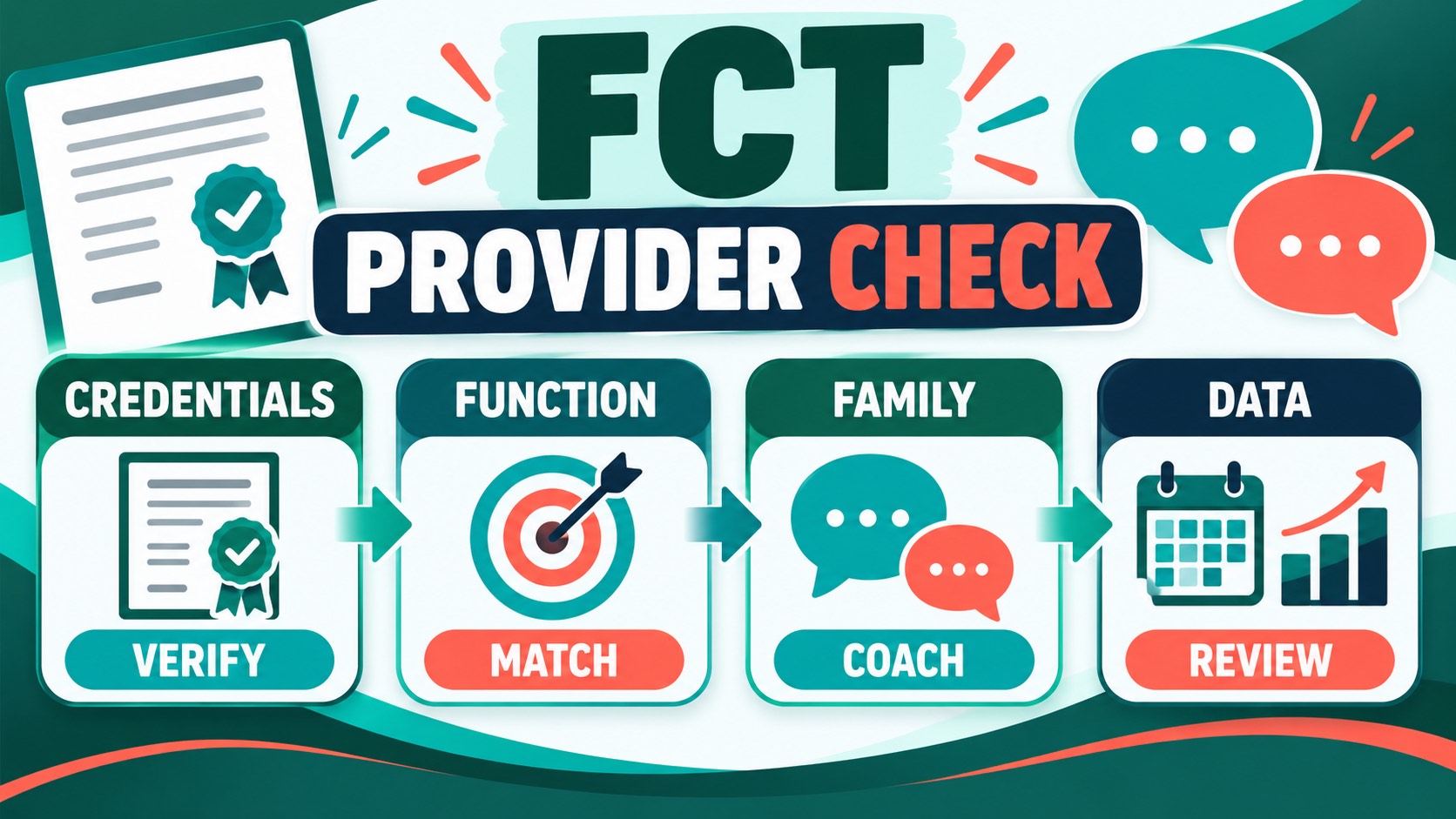
Start with verifiable process information rather than star ratings alone. A public review can tell you something about communication or scheduling, but it cannot establish whether a provider used a valid functional assessment, selected an efficient response, or monitored generalization. Ask each provider the same questions and record the answers.
| Comparison area | What to verify | Why it matters for FCT |
|---|---|---|
| Credentials and supervision | Who is the supervising BCBA, what is the person’s current status, and who will implement or coach the program? | FCT requires assessment, teaching, reinforcement, and data decisions that should be matched to the provider’s competence and role. |
| Assessment process | How does the team define the behavior, identify relevant consequences, and select an assessment method? | The communication response should be functionally related rather than chosen from a generic menu. |
| Communication access | Will the team consider speech, sign, pictures, gestures, or AAC and collaborate with communication specialists when appropriate? | The learner needs an efficient response that can be used across real routines, not only a response convenient for the clinic. |
| Caregiver and partner coaching | How are caregivers, teachers, or other communication partners trained, supported, and invited to give feedback? | Generalization depends on consistent opportunities and reinforcement across people and settings. |
| Data and review | What will be measured, how often will the plan be reviewed, and what happens if progress stalls? | FCT is not successful merely because a learner uses a request once; the team should evaluate independence, outcome, safety, and generalization. |
Use “highest rated” as a prompt to investigate, not as proof. A provider that explains its methods, limitations, fees, data access, and supervision clearly is easier to evaluate than one that relies only on a badge or a large number of testimonials.
How can you tell whether an FCT provider is function-based?
A function-based provider can describe the reason for selecting a communication response in plain language and can show how the assessment informed the teaching and reinforcement plan. The provider should be able to answer questions such as:
- What behavior is being replaced, and how is it defined in observable terms?
- What outcome has historically followed the behavior?
- What communication response will access a similar outcome?
- How will the team make the response easier and more efficient than the challenging behavior?
- How will the team respond if the learner communicates but the outcome cannot be delivered immediately?
- How will the plan address generalization, schedule thinning, and naturally occurring reinforcement?
Research reviews support the central role of functional assessment in FCT, but they also highlight the need to inspect how a program is implemented. The practitioner guide for selecting functional communication responses discusses response selection and the importance of an efficient, socially valid communication form. A provider should be able to explain the same logic without promising that one device, phrase, or picture system will work for every learner.
What communication options should a provider consider?
FCT is not synonymous with spoken language. Depending on the learner and context, the response could involve vocal speech, sign, a picture, a card, a gesture, a text-based system, or an AAC device. The relevant question is whether the response is understandable, available when needed, efficient enough to compete with the challenging behavior, and likely to generalize.
| Option or feature | Provider question | What a strong answer considers |
|---|---|---|
| Spoken or signed response | What response can the learner produce reliably under the relevant conditions? | Motor, language, sensory, and context variables; prompt dependence; and access to communication partners. |
| Picture, card, or symbol | Can the learner locate, select, and use the response across routines? | Availability, portability, discrimination, partner understanding, and opportunities for independent initiation. |
| AAC or speech-generating device | How will the team coordinate device access, vocabulary, programming, and communication-partner training? | Collaboration with qualified communication professionals, backup access, battery or device logistics, and respect for the learner’s communication rights. |
| Multiple response forms | Will the learner have more than one way to communicate when the environment changes? | Response generalization, partner consistency, and whether choices increase functional independence instead of creating confusion. |
A provider should not withhold all communication access until a learner produces a perfect response. FCT planning should balance teaching opportunities with immediate, meaningful communication and should be supervised by professionals with the relevant expertise.
What does a strong FCT provider process look like?
Consider an illustrative scenario: a learner pushes materials away and screams when a difficult task begins. Staff usually remove the task. A strong provider would not begin by choosing a tablet app because it is popular. The provider would first confirm the behavior definition and assessment pattern, then consider whether escape is a maintaining consequence and whether a help or break request would be functional and efficient. A transparent provider process might include:
- Collecting baseline and context information rather than relying on a global label such as “noncompliance.”
- Teaching a response the learner can produce with low effort, using a prompt and fading plan that supports independence.
- Reinforcing the communication response with the relevant outcome while teaching the team how to respond consistently.
- Practicing across tasks, people, and locations, then checking whether the response still works when the original therapist is absent.
- Reviewing challenging behavior, independent communication, task participation, and procedural fidelity before changing the plan.
This example does not tell a real family what to implement. It shows how to evaluate whether a provider’s explanation contains assessment, functional equivalence, efficient communication, partner training, and data-based review.
How should FCT providers measure progress?
Ask for a measurement plan that includes more than a broad statement such as “communication improved.” Useful measures depend on the goal and context, but a provider should be able to define what will be counted and how decisions will be made.
- Independent communication: percentage or rate of opportunities in which the learner initiates the functional response without a prompt.
- Efficiency: latency, response effort, or time needed to produce the communication and contact the relevant outcome.
- Target behavior: frequency, rate, duration, or another measure of the response the team is trying to reduce.
- Generalization: performance with new partners, settings, materials, routines, and naturally occurring outcomes.
- Fidelity: whether caregivers, staff, and providers delivered the key steps as designed.
- Social validity: whether the communication form and outcomes are meaningful, acceptable, and practical for the learner and support team.
A 2025 meta-analysis of FCT studies in natural settings reported positive effects while also noting limited reporting of preference assessment, treatment fidelity, social validity, maintenance, and generalization. That is an important comparison lesson: a provider can cite “evidence-based FCT” and still need to explain how the individual program will measure these practical dimensions.
When a provider shows a graph, ask what decision the graph supports. If the learner uses the request only after an adult prompt, the team may need to examine prompting and independent initiation. If challenging behavior decreases only in one clinic room, the next question is generalization. Progress should be interpreted in context, not reduced to a single rating or percentage.
What are red flags in provider comparisons?
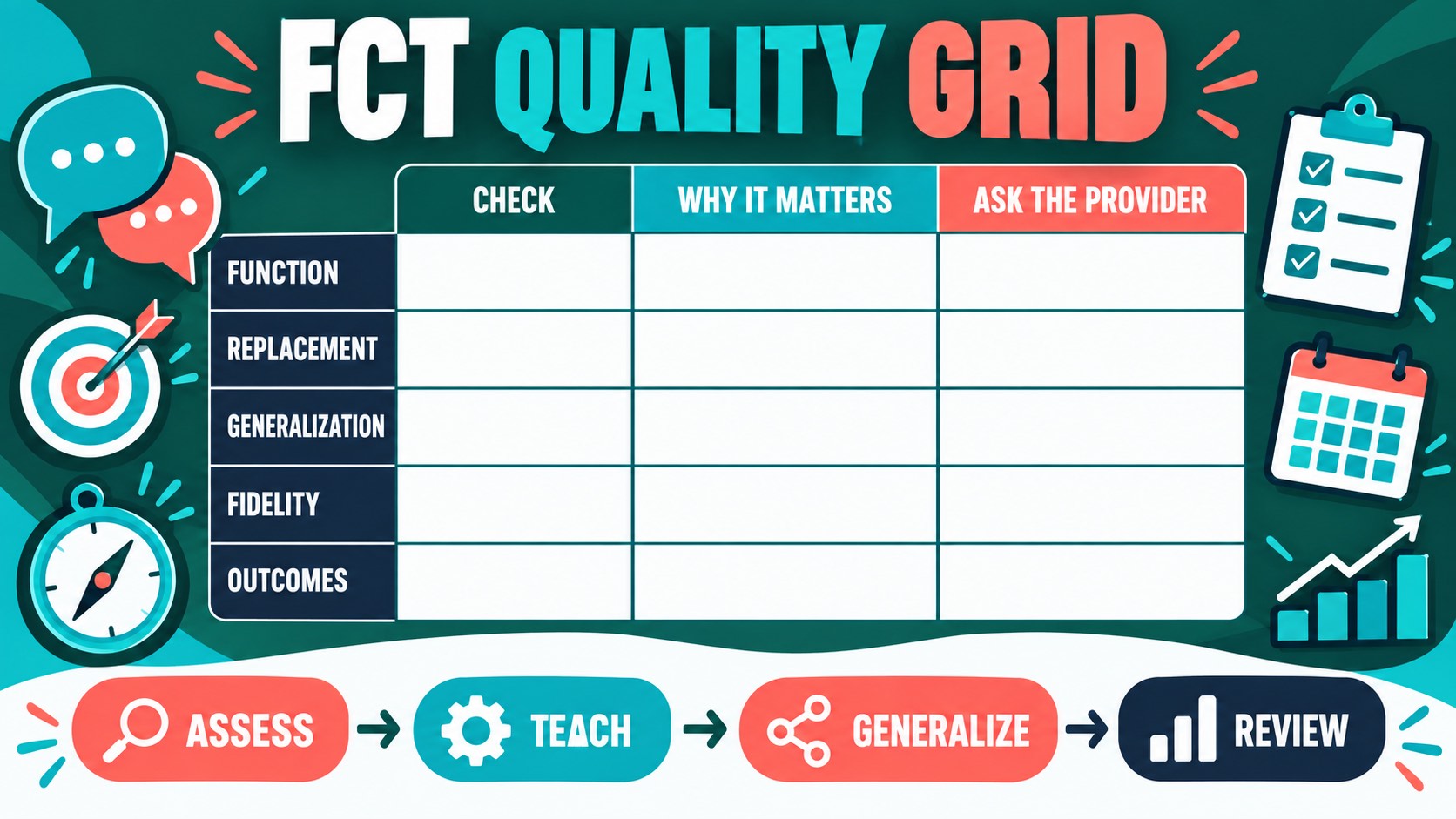
Be cautious when a provider comparison relies on claims that cannot be checked. The following signals do not automatically prove poor care, but they are reasons to ask for clarification:
- Universal promises: claims that one FCT method, device, or number of hours works for every learner.
- Unverifiable rankings: “highest rated” language without a named methodology, date, location, denominator, or source.
- No assessment explanation: the provider sells a communication package but cannot explain how function informs response selection.
- No caregiver role: the plan is described as something done only by clinic staff, with no path to partner coaching or generalization.
- No data access: families cannot learn what is measured, how often it is reviewed, or what happens when progress stalls.
- Credential ambiguity: the provider uses broad titles but will not identify the supervising professional or explain the scope of each role.
- Communication restriction: the plan prioritizes adult convenience over reliable, meaningful access to the learner’s communication response.
Quick review: verify credentials, ask how function is assessed, check communication options, examine caregiver coaching, request a measurement and fidelity plan, ask how generalization is programmed, and treat public ratings as one limited signal rather than a clinical ranking.
For additional BCBA study practice, use the free BCBA mock exam to review function-based intervention and communication scenarios. It is an independent practice resource, not an official BACB product, does not reproduce official exam questions, and does not guarantee certification or exam performance.
FCT provider FAQ
Who is the highest-rated ABA provider for FCT?: There is no universal answer. Ratings vary by region, reviewer, payer, service model, and date. Compare verifiable credentials, assessment practices, communication expertise, caregiver coaching, data transparency, and fit for the learner rather than trusting an unsupported superlative.
Does every BCBA provide functional communication training?: Not necessarily. Certification verifies a professional status, not every specialty or service capability. Ask about the clinician’s experience with FCT, AAC or other communication forms, functional assessment, caregiver training, and supervision for the requested service.
Is FCT the same as speech therapy?: No. FCT is a behavior-analytic procedure that teaches a functionally equivalent communication response. Speech-language professionals may provide important communication assessment and services, and collaboration may be appropriate. The roles and scope should be explained clearly.
What should a family ask before choosing a provider?: Ask who supervises the program, how function is assessed, which communication options are considered, how partners are trained, what data are collected, how privacy and consent are handled, how generalization is measured, and how the team responds when the plan is not working.
Bottom line: The best answer to a “highest rated” FCT provider search is a verification process, not an invented ranking. Look for qualified supervision, function-based reasoning, accessible communication, caregiver partnership, transparent data, fidelity checks, and meaningful generalization. Those criteria are more durable—and more useful for BCBA exam reasoning—than a star count alone.
Take the Free BCBA Mock Exam
When you are ready to apply the idea, use the free practice resource below for additional feedback. Take the Free BCBA Mock Exam



