
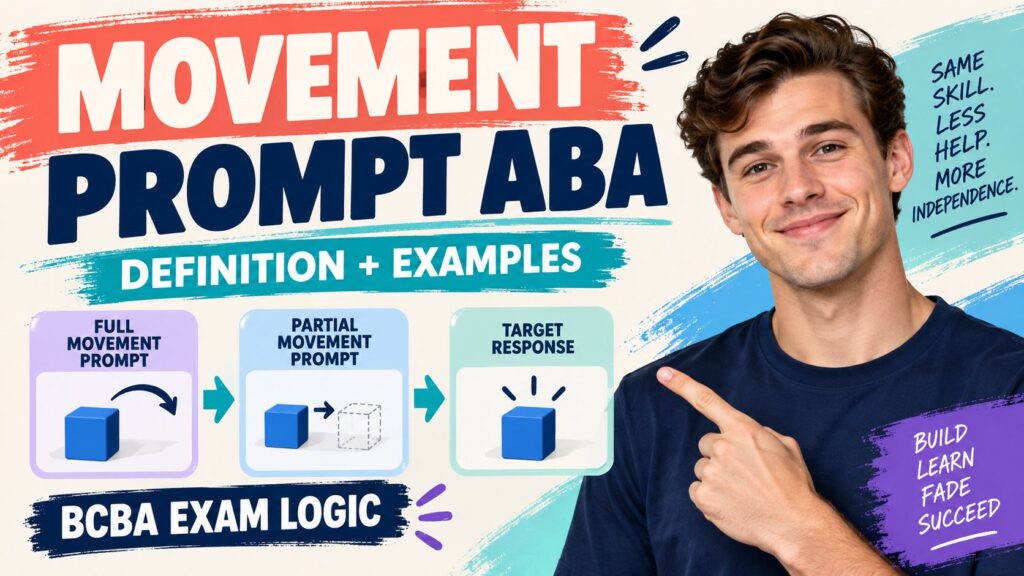
Short answer: Movement prompt ABA usually refers to a movement-based cue—such as pointing, tapping, looking toward an item, or making a gesture—that signals or guides the learner toward a response. The phrase is useful as a search term, but it is not a universal standalone prompt category in the way a BCBA exam question may describe a gestural, model, partial physical, full physical, verbal, or stimulus prompt.
Table of Contents
- What is a movement prompt in ABA?
- Why is the term movement prompt ambiguous?
- What are movement prompt ABA examples?
- How does a movement prompt compare with other prompts?
- How should a BCBA measure and fade a movement prompt?
- What are the movement prompt BCBA exam traps?
- Movement prompt ABA FAQ
- Take the Free BCBA Mock Exam
For a fast BCBA decision, ask what actually changed: Did the instructor move a hand, point toward the correct item, demonstrate the response, physically guide the learner, or change the materials? Then label the prompt by its observable topography and function. That step matters because “movement prompt” can describe more than one prompt type, and the wrong label can lead to wrong fading and measurement decisions. Table of Contents
What is a movement prompt in ABA?
A movement prompt is a cue delivered through movement to increase the likelihood of a correct response. A teacher may point to the correct picture, tap the item, orient their gaze toward a target, or use another visible gesture to indicate what the learner should select or do. The ABA Study Guide movement-prompt definition describes the term in this broad way and uses pointing to a correct item as an example.
The term describes the form of the help, not automatically the entire teaching procedure. It does not tell you whether the prompt is a gestural prompt, a model prompt, a partial physical prompt, or a stimulus prompt. It also does not tell you whether the learner responded independently, whether the prompt was delivered before or after an error, or whether the prompt was successfully faded. Those details must be recorded separately.
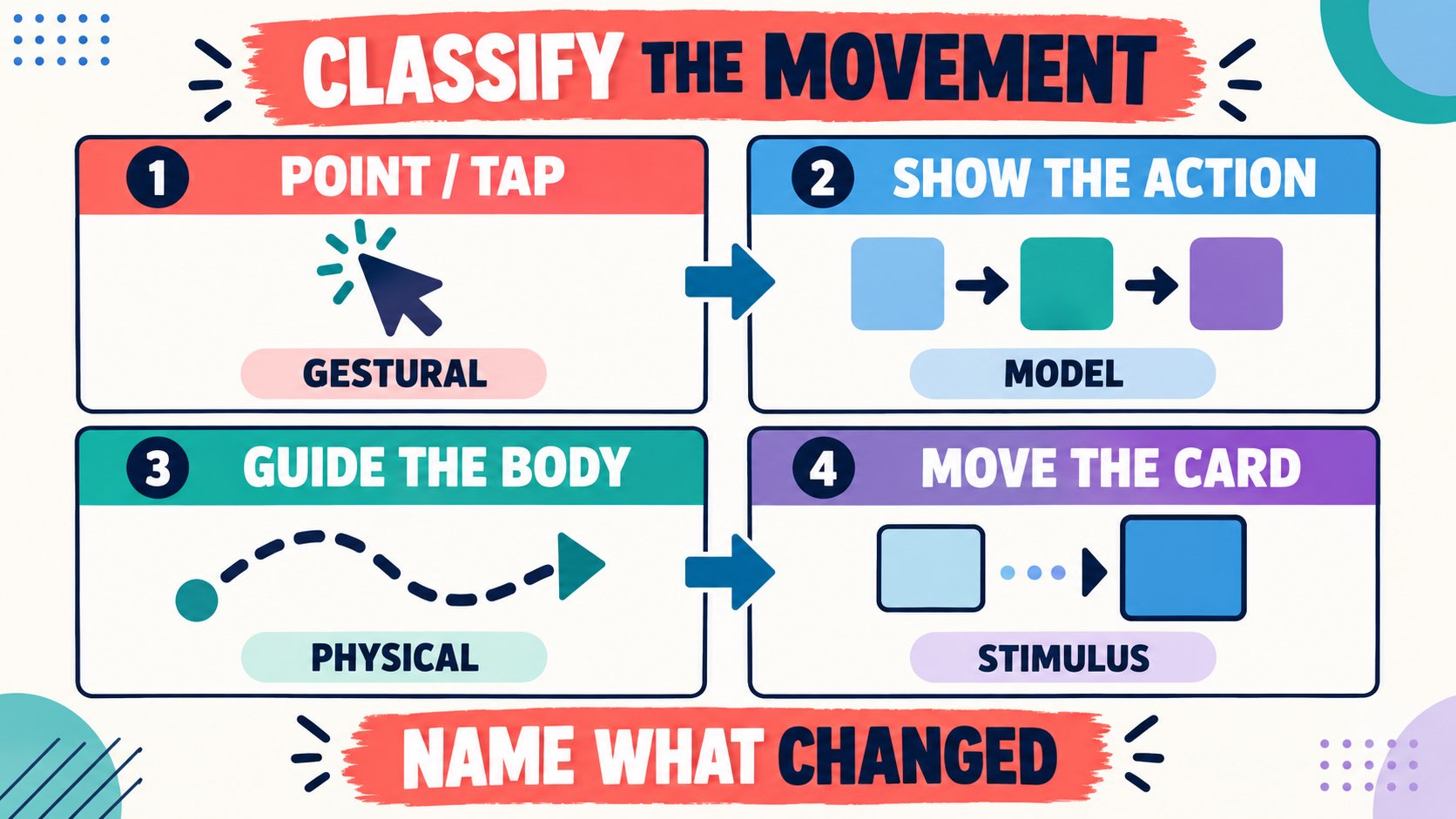
On a BCBA-style question, classify the event by identifying the component that was changed. If the instructor points toward a cup but does not touch the learner, the movement is usually a gestural response prompt. If the instructor performs the whole action for the learner to imitate, it is more accurately a model prompt. If the instructor moves the learner’s arm or hand, it is physical guidance. If the instructor moves the correct card closer, the material—not the learner’s movement—was changed, so the event is a stimulus prompt.
The current BACB BCBA Test Content Outline includes selecting and evaluating stimulus and response prompting procedures, prompt fading, and measurement. That scope supports a precise classification approach. It does not turn “movement prompt” into a fixed BACB label or authorize one prompt hierarchy for every learner and skill.
Why is the term movement prompt ambiguous?
Prompt terminology can be confusing because everyday descriptions focus on what the instructor looks like while technical classification focuses on the relation between the antecedent, the learner’s response, and the consequence. Many prompts involve movement. A point, a model, a hand-over-hand guide, and moving a card all look like actions, but they alter different parts of the teaching arrangement. Use the following questions to translate the phrase into a more precise label:
- Did the instructor indicate a target without touching the learner? Consider a gestural response prompt, such as pointing, tapping, or a head movement.
- Did the instructor demonstrate the complete response? Consider a model prompt when the learner is expected to imitate the demonstrated action.
- Did the instructor physically start, steer, or complete the learner’s movement? Consider partial or full physical prompting, depending on how much guidance was provided.
- Did the instructor alter the item, position, size, color, or arrangement of materials? Consider a stimulus prompt, because the stimulus display changed.
- Did the instructor say the answer or part of the answer? Consider a verbal response prompt, even if the instructor also gestured.
This translation protects the learner from vague notes such as “movement prompt used.” A useful note identifies the topography, the target response, the prompt delay, the prompt level, and whether the response was independent. It also makes it possible for a supervisor or another implementer to reproduce the procedure without guessing what “movement” meant.
What are movement prompt ABA examples?
Example 1: pointing to a picture. The instructor presents pictures of a spoon and a ball and says, “Touch spoon.” The learner hesitates. The instructor points to the spoon without touching the learner or moving the cards. The pointing movement is best classified as a gestural response prompt. The target response is touching the spoon; the prompt is the added gesture; the consequence should follow the programmed contingency.
Example 2: tapping a location. A learner is learning to place a block in a bin. After the instruction, the instructor taps the bin opening. The tap may function as a gestural prompt if it directs attention to the response location. Record whether the tap occurred before the learner began moving and whether the learner completed the response without physical assistance. If tapping the bin becomes necessary on every trial, the team should evaluate prompt dependence rather than count all trials as independent.
Example 3: looking toward the target. The instructor asks the learner to select the item that is “cold” and briefly shifts gaze toward the correct picture. If the gaze shift is intentionally programmed to guide selection, it may be described as a subtle gestural or nonverbal response prompt. Because gaze can be difficult to detect consistently, define it operationally before using it as a planned prompt and check implementer agreement.
Example 4: moving the learner’s elbow. A learner is learning to hang a coat. After the instruction and wait period, the instructor lightly touches the elbow to initiate the reach, and the learner completes the remaining movement. This is not merely a gesture. It is a partial physical prompt because the instructor contacted the learner’s body and initiated part of the response. Document the contact and the response segment that still required independent completion.
Example 5: demonstrating the action. The instructor places one ring on a peg and then presents a ring to the learner. If the learner is expected to copy the action, the movement is a model prompt. The instructor’s movement functions as a demonstration rather than a directional gesture. A model can be helpful, but it can also be difficult to fade if the learner waits for the adult to perform first.
Example 6: moving the correct card. The instructor places the correct picture closer to the learner and leaves the other comparisons farther away. This is not a movement prompt in the response-prompt sense. The instructor changed the stimulus arrangement, so it is a positional or other stimulus prompt. The correct comparison should later be rotated and the positional difference faded if the goal is control by the intended stimulus relation. Before choosing a label, write the trial in a compact sequence:
- Instruction: what natural cue or SD was presented?
- Movement: what did the instructor, learner, or material actually do?
- Response: what behavior was expected and what part was completed independently?
- Consequence: what followed the response, and was it delivered according to the plan?
How does a movement prompt compare with other prompts?
The table below is a study tool, not a substitute for an individualized written teaching plan. It separates the visible action from the technical question: what did the prompt change, and what should be measured?
| What changed? | Likely label | Example | What to measure |
|---|---|---|---|
| Direction toward the response | Gestural response prompt | Point to the correct picture | Prompt level and independent selection |
| Demonstration of the action | Model prompt | Show how to place the ring | Imitation, delay, and independent response |
| Contact or guidance of the learner | Partial or full physical prompt | Guide the elbow or hand | Contact, amount of response completed, and fade criterion |
| Change to the materials | Stimulus prompt | Move the correct card closer | Position bias and responding after the alteration is faded |
| Spoken cue or answer | Verbal response prompt | Provide the first sound of the word | Prompt delay, verbal level, and independent vocal response |
The closest neighboring concept is often the stimulus prompt. The existing stimulus prompt ABA guide explains that a stimulus prompt changes the stimulus itself, while a response prompt guides the learner’s behavior. Use that distinction when a question includes an apparent movement: movement by the instructor does not automatically mean response prompting if the movement changes the materials instead.
How should a BCBA measure and fade a movement prompt?
Start with an operational definition. For example: “A gestural movement prompt is a point, tap, or hand orientation toward the programmed target delivered after the instruction and before the learner initiates the target response.” The definition should state what counts, what does not count, and how to score overlapping actions. If the team uses a physical prompt, define the body contact and the amount of response guidance separately.
Record independent and prompted responding separately. A learner who selects the correct item after a point did not demonstrate the same level of independence as a learner who selected it before the point. A useful trial record can include the target, response, prompt topography, prompt level, latency, error status, consequence, and whether the prompt was delivered according to the plan.
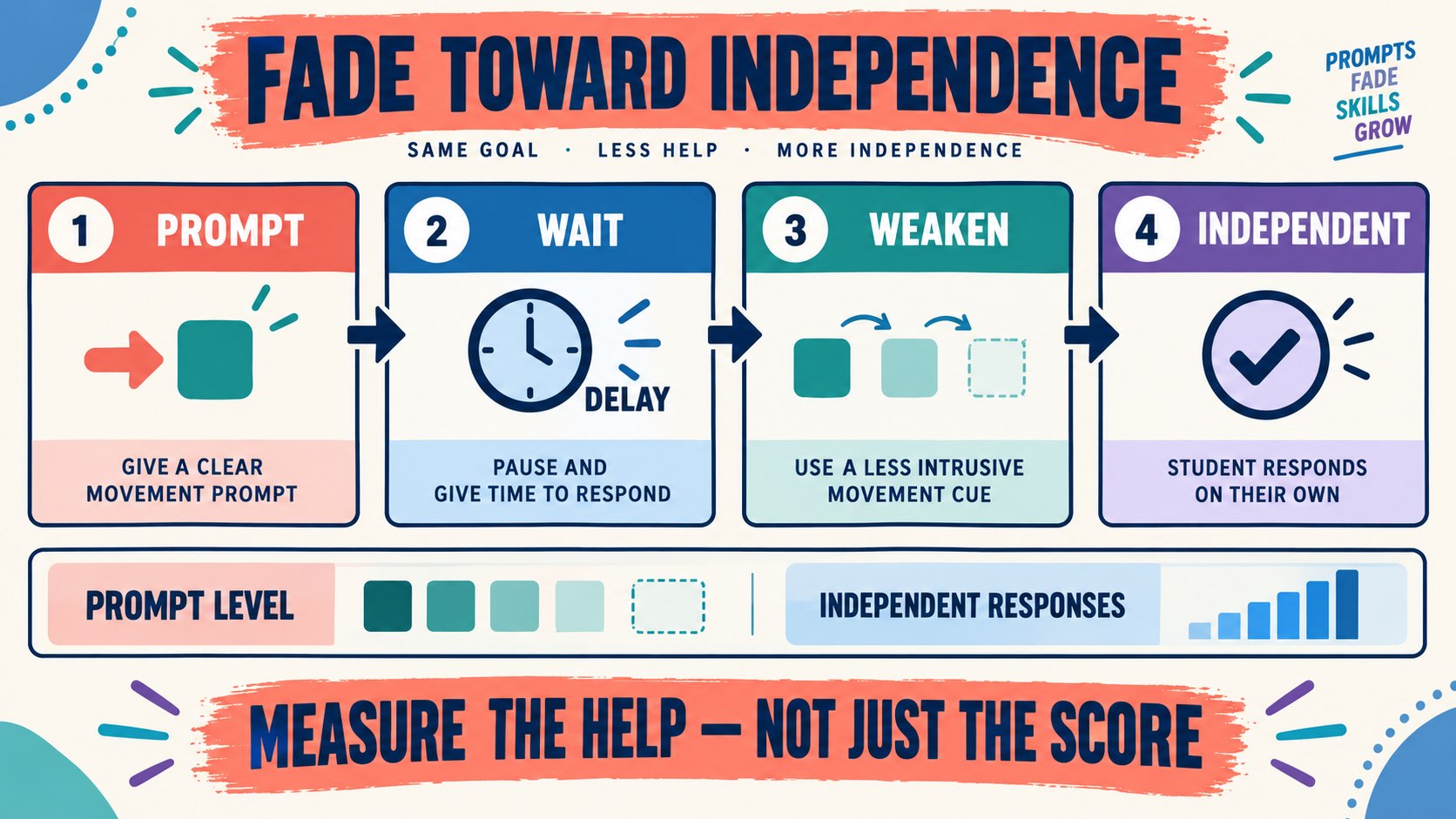
- Baseline the target response: give the planned instruction and wait according to the protocol before adding a prompt.
- Record the first effective prompt: do not label a trial “independent” if a gesture, model, verbal cue, or physical contact occurred before the response.
- Set a fading rule: decide what accuracy, latency, or number of consecutive trials supports reducing the prompt.
- Vary irrelevant features: rotate positions, materials, instructors, and exemplars when those changes fit the target and learner’s plan.
- Probe without the prompt: include planned opportunities to see whether the natural SD or task cue now controls responding.
- Check procedural integrity: compare what staff delivered with the written prompt, wait, reinforcement, and error-correction steps.
Prompt fading should be systematic, individualized, and data-based. A point that is gradually smaller, farther from the target, delayed after the instruction, or replaced with a less intrusive cue may be fading—but the team must define the dimension being changed. Do not fade by making the prompt unpredictable if the result is repeated errors or frustration. The BACB ethics-code resource is a useful reminder that consumer protection and assent belong in professional decision-making; a prompt plan is not successful if it ignores dignity, communication access, or the learner’s response to the procedure. For a broader prompt-fading comparison, see the existing prompt fading ABA guide. The movement-prompt page should send that broader intent to the established canonical rather than recreate a second general fading article.
What are the movement prompt BCBA exam traps?
- Treating the phrase as a fixed BACB category: classify the actual prompt topography and function instead of assuming “movement prompt” has one official definition.
- Calling every point a stimulus prompt: a point toward a learner’s response may be a gestural response prompt; a change to the card or array is a stimulus prompt.
- Calling a demonstration a gesture: showing the complete action is a model prompt when imitation is the expected response.
- Missing physical contact: touching or guiding the learner’s body changes the analysis from a simple gesture to a physical prompt.
- Counting prompted accuracy as independence: score prompt level and independent responding separately.
- Ignoring prompt delay: the same gesture delivered after an error is not analyzed the same way as a gesture delivered immediately with the instruction.
- Fading without a criterion: remove or weaken prompts according to observable decision rules, not because the instructor feels the learner is ready.
- Overlooking assent and communication: a technically neat hierarchy does not justify continuing a procedure that is unsafe, inaccessible, or not socially valid.
Quick review: “Movement prompt” is a broad descriptive phrase. Identify the movement, identify what it changed, label the prompt precisely, and measure whether the learner responded independently. If the movement altered materials, think stimulus prompt. If it pointed or tapped toward a response, think gestural response prompt. If it demonstrated or physically guided the action, use the more specific model or physical label. For scenario practice, try the free BCBA mock exam. It is a study resource and does not claim to reproduce official BACB questions.
Movement prompt ABA FAQ
Is a movement prompt the same as a gestural prompt? Not always. In many study resources, movement prompt is used broadly for pointing, tapping, looking, or gesturing. A BCBA question may expect the more specific term gestural prompt, so classify the observable action rather than repeating the broad phrase.
Is a movement prompt a stimulus prompt? Only if the movement changes the stimulus arrangement or a feature of the materials. Moving the correct card closer is a stimulus prompt. Pointing toward an unchanged card is generally analyzed as a gestural response prompt.
Does a movement prompt physically touch the learner? It can, in ordinary language, but physical contact should be labeled explicitly. Touching or guiding an elbow, hand, or body part is a physical prompt and should be recorded with the amount of assistance provided.
How do I write movement prompt data? Record the target response, the exact prompt topography, when it was delivered, the learner’s response, the consequence, and whether the response was independent. Avoid a single unexplained score such as “correct with movement.”
Can I use this term in a behavior plan? Use the term only if the plan defines it operationally and the team shares the same meaning. When possible, use a more precise label—gestural, model, partial physical, full physical, verbal, or stimulus prompt—and specify the fading and integrity criteria.
Take the Free BCBA Mock Exam
When you are ready to apply the idea, use the free practice resource below for additional feedback. Take the Free BCBA Mock Exam



