
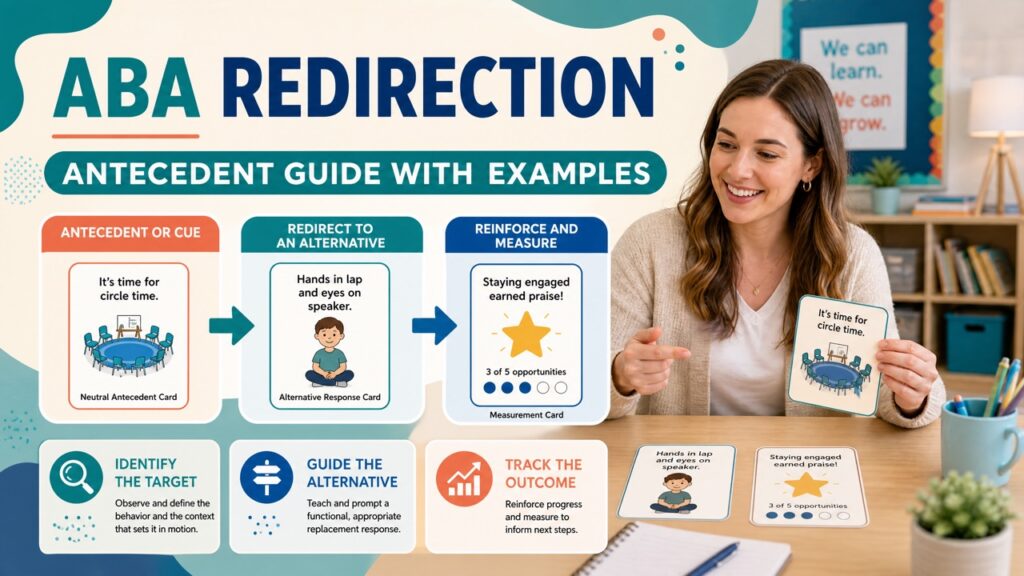
In applied behavior analysis (ABA), redirection is an antecedent intervention that involves guiding an individual from a problematic behavior toward an appropriate alternative, often using prompts and differential reinforcement. This article explains what redirection is, how it differs from punishment and extinction, when it is appropriate, and how to implement it step by step. It also provides original examples and discusses important limitations, emphasizing the role of functional assessment and reinforcement.
Table of Contents
- What Is ABA Redirection?
- Key Distinctions: Redirection vs. Punishment and Extinction
- Step-by-Step Process for Using ABA Redirection
- Original Examples of ABA Redirection
- When Is Redirection Appropriate?
- Common Pitfalls and Limitations
- Study Checklist for BCBA Exam Preparation
- Conclusion
- Reference
What Is ABA Redirection?
Redirection is a proactive strategy used within applied behavior analysis to shift an individual’s behavior from a problematic response to a more appropriate alternative. As an antecedent intervention, it focuses on changing the conditions that precede behavior rather than delivering consequences after the behavior occurs. The practitioner observes the early signs of the problem behavior and then prompts an alternative response that serves a similar function. For example, if a child begins to throw toys, the practitioner might guide the child toward a puzzle and say, “Let’s do a puzzle together.” The goal is to make the alternative behavior more likely by providing clear cues and reinforcement.
Technically, redirection combines prompting and differential reinforcement. Prompting involves providing cues or assistance to increase the likelihood of the alternative behavior. Differential reinforcement involves reinforcing the alternative behavior while withholding reinforcement for the problem behavior. However, redirection does not necessarily withhold reinforcement for the problem behavior entirely; it primarily focuses on prompting and reinforcing the alternative. This distinction is important because it separates redirection from extinction, which specifically involves discontinuing reinforcement for a previously reinforced behavior.
Key Distinctions: Redirection vs. Punishment and Extinction
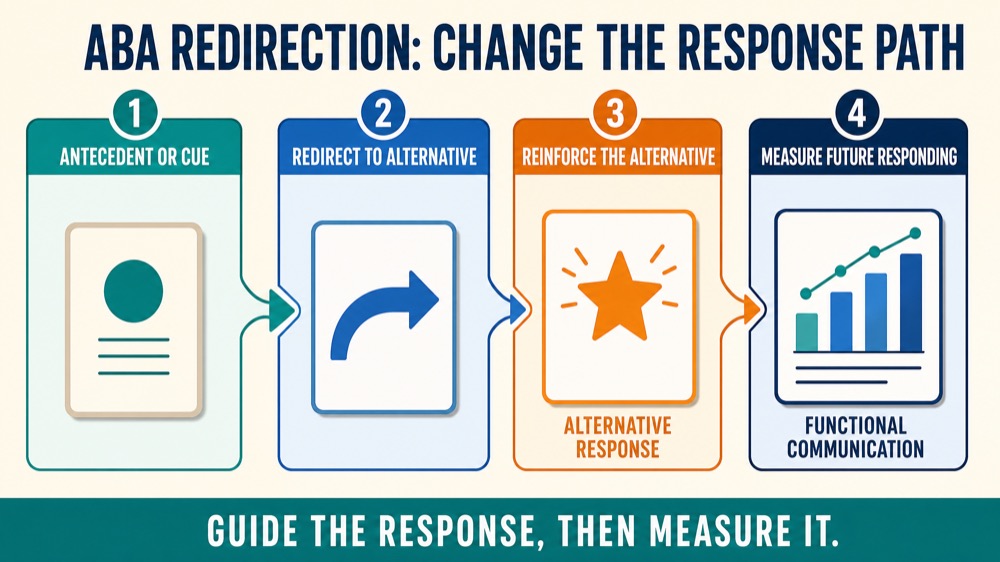
Understanding what redirection is not helps clarify its role in behavior intervention. Redirection is often confused with punishment and extinction, but each has distinct mechanisms and purposes.
- Redirection vs. punishment: Punishment involves presenting an aversive stimulus or removing a reinforcing one to decrease behavior. Redirection does not involve aversive consequences; it focuses on prompting and reinforcing an alternative behavior. For instance, if a child screams for attention, punishment might involve a reprimand, whereas redirection would prompt the child to say “excuse me” and then provide attention for that appropriate request.
- Redirection vs. extinction: Extinction involves withholding the reinforcer that maintains the problem behavior. Redirection does not necessarily withhold reinforcement for the problem behavior; it focuses on prompting and reinforcing a different response. In practice, redirection may inadvertently provide attention during the redirect, which could reinforce the problem behavior if not carefully managed. Therefore, redirection is often combined with extinction to be most effective.
These distinctions are crucial for behavior analysts because they demonstrate an understanding of behavioral processes, not just surface features. A behavior analyst must consider the function of the behavior and choose interventions that align with behavioral principles. Redirection is not a form of punishment, and it does not work without reinforcement of the alternative behavior.
Step-by-Step Process for Using ABA Redirection
Implementing redirection requires careful observation and timing. The following steps provide a practical framework for using this antecedent intervention effectively.
1. Observe the Behavior: First, identify the problem behavior and its possible function. Look for patterns: when does it occur, what happens before, and what is the likely reinforcer? For example, a child may throw toys when asked to clean up, possibly to escape the demand. Effective redirection depends on understanding what the alternative behavior should achieve.
2. Calmly Interrupt or Redirect Attention: When the behavior begins, intervene early and calmly. Avoid raising your voice or showing frustration. Simply state the learner’s name and use a neutral phrase like “let’s do this instead” or physically guide them away from the problematic activity. The goal is to break the response chain without adding aversive events.
3. Prompt an Alternative Response: Provide a clear prompt for the alternative behavior. This could be a verbal instruction, a gesture, a model, or physical guidance. Choose an alternative that is functionally equivalent—that is, it produces the same reinforcer as the problem behavior. For instance, if the behavior is attention-seeking, prompt a socially acceptable way to request attention.
4. Reinforce the Alternative Behavior: Immediately and consistently reinforce the alternative response when it occurs. This is the most critical step. Without reinforcement, the new behavior will not become established. Use praise, tokens, or other preferred items/activities. Over time, thin the reinforcement schedule as the behavior becomes more fluent. This process is not a one-time fix; it requires repetition and consistency across settings. Behavior analysts often embed redirection into a larger plan that includes functional communication training and environmental modifications.
Original Examples of ABA Redirection
Examples help illustrate how redirection works in different contexts. The following scenarios are original and designed for study purposes.
Example 1: Redirecting Toy Throwing to Puzzle Play: A 4-year-old boy, Liam, frequently throws blocks across the room during free play. A functional assessment suggests the behavior is maintained by sensory stimulation—the sound and sight of blocks flying. The therapist decides to redirect Liam to a puzzle with large, colorful pieces that also provide visual and tactile input. When Liam starts to lift a block with a throwing motion, the therapist steps in and says, “Let’s do a puzzle,” while guiding his hand to a puzzle piece. The therapist then provides enthusiastic praise and allows Liam to complete a puzzle, which yields similar sensory feedback. Over time, Liam learns that engaging with puzzles leads to reinforcement, and throwing decreases.
Example 2: Redirecting Table Tapping to Stress Ball Use: An adult with autism, Maya, taps a table loudly during group discussions, which disturbs others. The behavior appears to be maintained by sensory feedback (tactile and auditory). The behavior analyst introduces a stress ball as a replacement. When Maya begins tapping, the analyst cues her by saying “squeeze the ball” and models the action. Maya squeezes the stress ball, which provides a similar proprioceptive input. The analyst provides social praise and continues the discussion. The stress ball is readily available, and over time, Maya independently uses it when she feels the urge to tap. Redirection alone may not eliminate the behavior entirely, but combined with differential reinforcement, it increases alternative behavior.
When Is Redirection Appropriate?
Redirection is most appropriate when the problem behavior is not dangerous to the learner or others, and when a functionally equivalent alternative can be taught. For behaviors that are severe, such as aggression or self-injury, redirection may be used as part of a safety plan but not as a standalone intervention. In those cases, a thorough functional assessment and more intensive interventions are necessary.
Additionally, redirection works best when the alternative behavior is already in the learner’s repertoire or can be easily taught. If the learner does not have the skills to perform the alternative, prerequisite training is needed. For example, redirecting a nonverbal child to request a break requires teaching a communication response first. Redirection is not limited to children; it can be used with individuals of any age, including adults, as illustrated in the example above.
Common Pitfalls and Limitations
- Redirection alone is rarely sufficient: If you redirect without reinforcing the alternative, the problem behavior will likely continue because its maintaining reinforcer is still available. Pair redirection with differential reinforcement of alternative behavior (DRA).
- Ignoring the function: Redirection that does not address the function of the behavior—such as redirecting to a non-equivalent alternative—will be ineffective. For instance, redirecting an attention-seeking child to a solitary activity does not provide attention.
- Using redirection as punishment: Some implementers may accidentally turn redirection into a punishing event by using a harsh tone or physical force. This can evoke avoidance behavior and worsen the situation.
- Not planning for generalization: Redirection in one setting may not naturally carry over to others. Teach the skill across environments and people.
It is essential to conduct a functional assessment before implementing redirection. While redirection can be a helpful tool, it is not a substitute for understanding why the behavior occurs. The BACB Task List (6th ed.) emphasizes the importance of function-based interventions, so a behavior analyst should evaluate whether the maintaining variables are addressed. Redirection is not always effective for all behaviors, and it does not always work the same way; its success depends on the function of the behavior and the availability of a suitable alternative.
Study Checklist for BCBA Exam Preparation
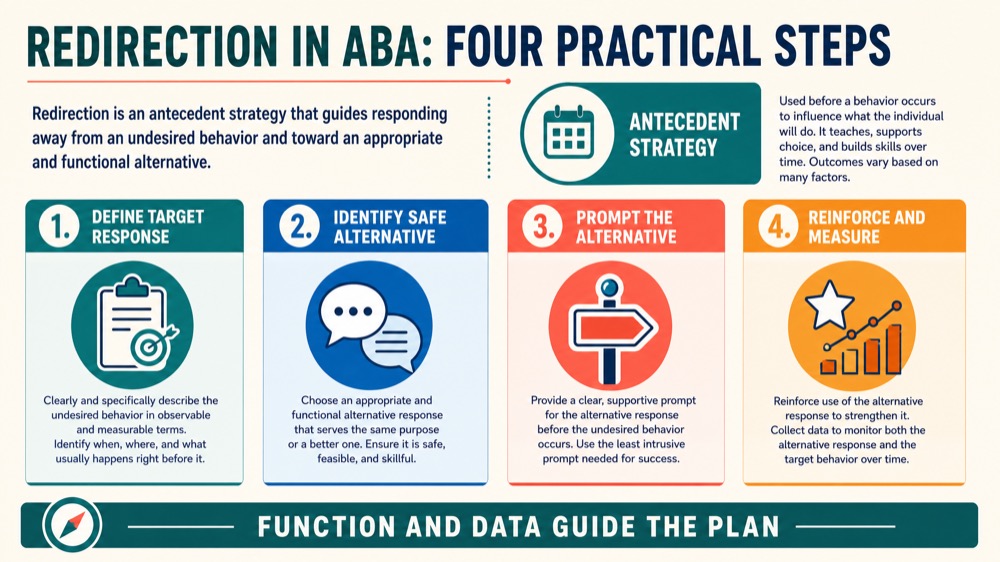
- Define redirection as an antecedent intervention that involves prompting an alternative behavior and reinforcing it.
- Explain how redirection differs from punishment (no aversive consequence) and extinction (does not necessarily withhold reinforcement for the problem behavior).
- List the four steps: observe, interrupt calmly, prompt alternative, reinforce.
- Identify the function-based requirement: the alternative must be functionally equivalent.
- Describe the role of differential reinforcement in redirection.
- Recognize the need for a functional assessment when redirection is not effective.
Use these points to self-test your understanding. Create your own examples to practice identifying the function and selecting a suitable alternative behavior. Remember that redirection is not guaranteed to appear on the BCBA exam, but understanding it as part of applied behavior analysis is valuable for practice.
Conclusion
ABA redirection is a valuable antecedent intervention that guides learners from problem behavior to appropriate alternatives without relying on punishment. Its effectiveness hinges on using functionally equivalent alternatives and pairing the procedure with reinforcement. While not a one-size-fits-all solution, redirection is a practical component of a comprehensive behavior plan. For continued study, remember to always base intervention decisions on functional assessment data.
Ready to test your knowledge? Take our free BCBA mock exam to practice with realistic questions and receive instant feedback. It’s a great way to identify areas for improvement as you prepare for certification.



