
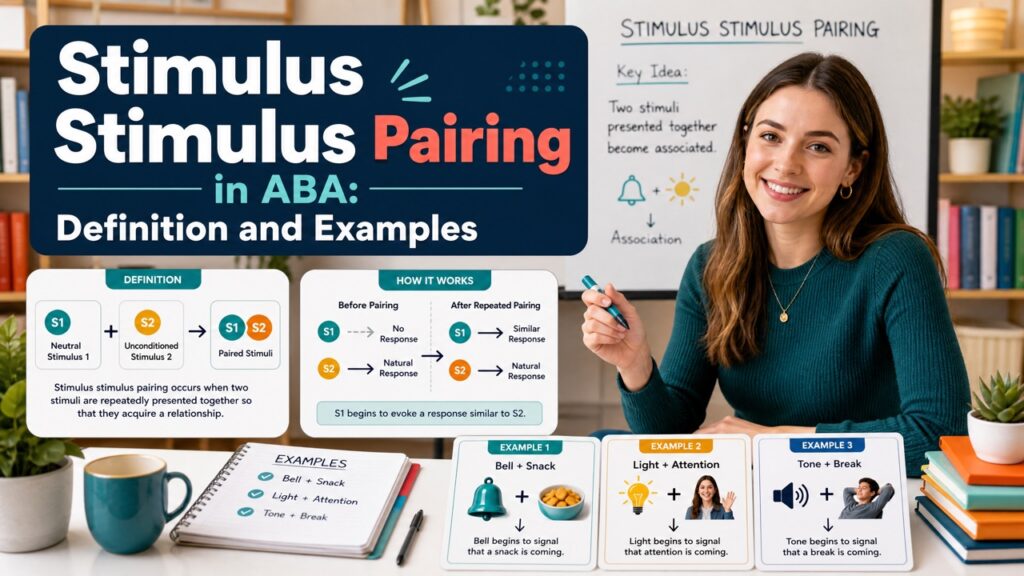
What Is Stimulus-Stimulus Pairing in ABA?
Stimulus-stimulus pairing is a procedure in applied behavior analysis (ABA) where a neutral stimulus is repeatedly presented with an established reinforcer or punisher. Through this pairing procedure, the neutral stimulus may acquire similar functions, becoming a conditioned reinforcer or conditioned punisher. The underlying process is respondent conditioning, also known as classical conditioning. This is distinct from operant conditioning, which involves consequences following behavior. Understanding the difference between the operation (pairing), the process (respondent conditioning), and the effect (conditioned reinforcement) is essential for designing effective interventions.
Table of Contents
- What Is Stimulus-Stimulus Pairing in ABA?
- How Stimulus-Stimulus Pairing Works
- Stimulus-Stimulus Pairing vs. Operant Conditioning
- Real-World ABA Examples of Stimulus-Stimulus Pairing
- Evaluating the Effectiveness of Stimulus-Stimulus Pairing
- Common Pitfalls and Misconceptions
- Maintenance and Ethical Considerations
- Exam Traps and How to Avoid Them
- Free BCBA Mock Exam Practice
- Reference
In practice, stimulus-stimulus pairing is often used to create conditioned reinforcers such as tokens, praise, or a specific sound. For example, a teacher might pair a clicker sound with food for a child during a feeding program. After several pairings, the clicker alone may reinforce desired behaviors. By learning how to pair stimuli systematically, behavior analysts can design interventions that are both efficient and ethical. Recognizing the distinction between the procedure, process, and effect is crucial for accurate behavioral assessment and intervention planning.
How Stimulus-Stimulus Pairing Works
Stimulus-stimulus pairing involves the systematic arrangement of a neutral stimulus and an unconditioned or already established conditioned reinforcer. The neutral stimulus initially has no reinforcing value; however, when it is repeatedly presented immediately before or simultaneously with a reinforcer, it may begin to evoke a conditioned response. The temporal arrangement is crucial: the neutral stimulus should reliably predict the reinforcer. In practice, this might involve pairing a specific word like “good” with a bite of food. Over time, the word “good” alone may serve as a reinforcer for the client.
Key Components of the Pairing Procedure: To implement stimulus-stimulus pairing effectively, practitioners must identify a genuinely neutral stimulus, select a potent reinforcer, and follow a consistent pairing protocol. The following list outlines the essential elements, each playing a vital role in the process.
- Neutral stimulus (NS): A stimulus that does not yet function as a reinforcer or evoke a specific response.
- Unconditioned reinforcer: A stimulus that is naturally reinforcing, such as food, water, or warmth, without prior learning.
- Pairing procedure: The precise method of presenting the NS and reinforcer together across multiple trials, often using a differential reinforcement schedule.
- Conditioned reinforcer: The NS after it has acquired reinforcing properties through pairing, also known as a secondary reinforcer.
For example, in a classroom, a teacher may pair a specific tone with praise and a high-five. Initially, the tone has no value. After several pairings, the tone alone may increase behavior when presented as a consequence. This example illustrates how pairing can create portable, immediate reinforcers that are less disruptive than edible reinforcers.
Stimulus-Stimulus Pairing vs. Operant Conditioning
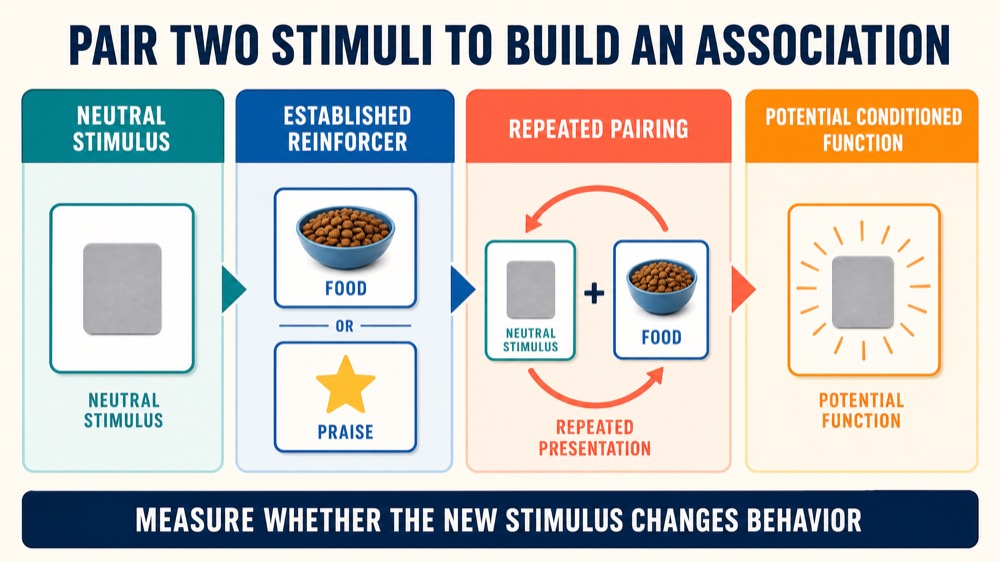
Stimulus-stimulus pairing is often confused with operant discrimination training, but they are distinct processes. In operant conditioning, behavior is followed by a consequence, and an antecedent stimulus sets the occasion for reinforcement. In contrast, stimulus-stimulus pairing does not involve behavior; it simply associates two stimuli. However, pairing can be a component of operant training. For instance, a token is first paired with praise to become a conditioned reinforcer, and then the token is used as a consequence in an operant procedure. This distinction is crucial for BCBA exam questions that ask you to identify the type of conditioning involved.
Moreover, understanding the relationship between stimulus-stimulus pairing and stimulus control is essential. In stimulus control, a behavior occurs in the presence of a discriminative stimulus (SD) because that stimulus has a history of reinforcement. Conversely, an S-delta signals extinction or non-reinforcement. Pairing can create conditioned reinforcers that then serve as consequences, which in turn establish stimulus control. For example, a green card might be paired with praise, and later, the green card may function as an SD for a child to request a break, because the pair has acquired reinforcing properties.
Real-World ABA Examples of Stimulus-Stimulus Pairing
Real-world applications of stimulus-stimulus pairing are abundant in ABA. Below are three original examples that illustrate how this procedure is used in clinical and educational settings. Each example demonstrates the steps of pairing and the resulting conditioned reinforcer.
- Dog training: Pairing a tone with food for a dog. The tone becomes a conditioned reinforcer, allowing the trainer to reinforce behaviors even when food is not immediately available.
- Classroom token system: Pairing a token with praise and access to a preferred activity. The token becomes a conditioned reinforcer that can be exchanged for backup reinforcers.
- Teaching social interactions: Pairing a parent’s presence with preferred toys. The parent becomes a conditioned reinforcer, increasing the child’s approach behavior.
In clinical settings, pairing is often used to establish social interaction as reinforcing. For instance, a therapist might pair their voice with a child’s favorite toy. Over time, the therapist’s voice becomes a conditioned reinforcer, making social engagement more rewarding. Similarly, pairing a specific auditory stimulus with a known reinforcer for a client can later serve as an effective consequence for desired behaviors, such as a chime that signals a break.
Evaluating the Effectiveness of Stimulus-Stimulus Pairing
To determine if a stimulus has become a conditioned reinforcer, you must use it as a consequence and measure its effect on behavior. This evaluation is essential for evidence-based practice. A systematic reinforcer assessment helps confirm its reinforcing function. For example, if a therapist pairs a specific color card with praise, they must then test whether the card alone increases a target behavior, such as completing a task.
How to Test a Conditioned Reinforcer: Conduct a reinforcer assessment: present the target stimulus following a behavior under controlled conditions. If behavior increases, the stimulus functions as a reinforcer. Several experimental designs can be used to validate the conditioning effect.
- Use a reversal design: measure baseline, then introduce the stimulus as a consequence, then return to baseline to see if behavior changes.
- Compare response rates with and without the stimulus as a consequence, using alternating treatments.
- Use a concurrent schedule: offer a choice between the conditioned reinforcer and a known reinforcer to assess relative value.
For example, if you have paired a tone with food, you can present the tone immediately after a bar press. If the rat presses the bar more often than when no consequence is given, the tone is functioning as a reinforcer. In applied settings, you might use a multiple baseline design across behaviors to demonstrate that the conditioned reinforcer is responsible for increases in behavior.
Common Pitfalls and Misconceptions
Stimulus-stimulus pairing is not foolproof. Several factors can undermine its effectiveness, and many misconceptions exist about the process. Being aware of these can help you avoid common errors in practice and on the exam. The following list highlights the most frequent pitfalls and misunderstandings.
- Insufficient pairings: A single pairing rarely produces a lasting conditioned reinforcer; multiple pairings are typically needed.
- Inconsistent pairings: If the neutral stimulus is sometimes presented without the reinforcer, the association weakens.
- Pairing with weak reinforcers: If the unconditioned reinforcer is not currently potent, the pairing may be ineffective.
- Misconception: Pairing is the same as operant conditioning. In reality, it is a respondent process that supports operant learning.
- Misconception: Any neutral stimulus will become a reinforcer after a single pairing. This is rarely true.
- Misconception: Conditioned reinforcers are permanent. They require maintenance; if not paired periodically, they may lose their effectiveness.
For instance, if a token is paired with praise once, it may not function as a reinforcer. Additionally, if the praise is not reinforcing for the child, the token will acquire little to no value. Therefore, practitioners should conduct preference assessments to identify potent reinforcers before pairing.
Maintenance and Ethical Considerations
Conditioned reinforcers are not permanent. They depend on the current strength of the paired reinforcer. If the unconditioned reinforcer is no longer valuable, the conditioned reinforcer may lose its power. Thus, periodic re-pairing may be necessary to maintain effectiveness. For example, a teacher might re-pair a token with a highly preferred activity every few weeks to ensure it remains reinforcing. This ongoing maintenance is a critical component of intervention integrity.
Ethically, stimulus-stimulus pairing should be used with care. Ensure that the pairing is done with the client’s best interest, without causing harm or creating unintended emotional responses. Avoid pairing stimuli that might lead to maladaptive conditioned responses. Also, consider the client’s preferences and current motivating operations. For BCBA candidates, it is important to understand the ethical use of behavioral procedures as outlined in the BACB Ethics Code. Practitioners should practice within their scope and under appropriate supervision. Furthermore, transparency with caregivers and clients about the purpose of pairing is essential for informed consent.
Exam Traps and How to Avoid Them
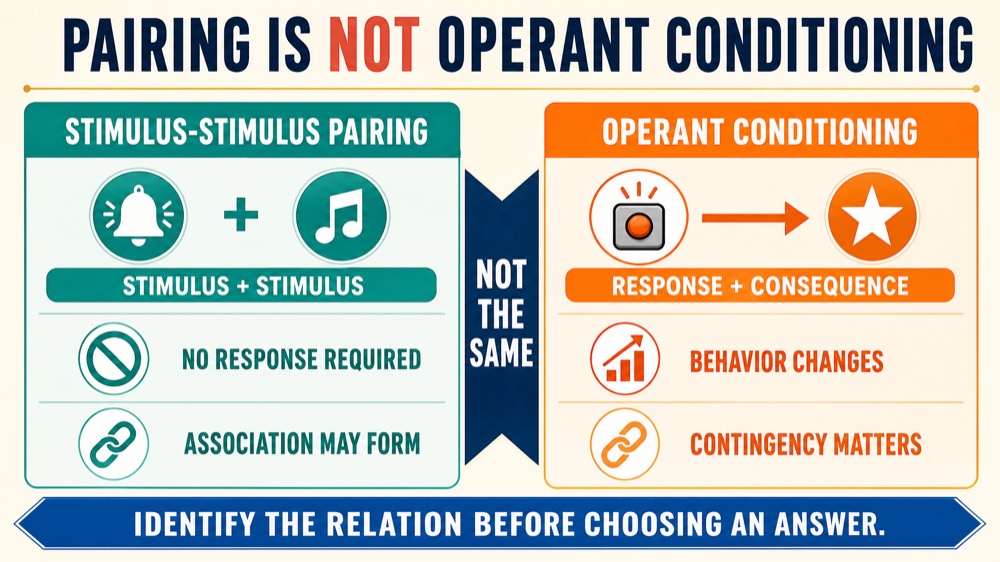
BCBA exam questions on stimulus-stimulus pairing often include tricky wording designed to test your understanding of the concepts. Recognizing common traps can help you select the correct answer. The following list highlights typical misconceptions and how to approach them.
- Confusing procedure and process: The pairing procedure is the operational implementation, while the process is respondent conditioning. The question might ask which is the procedure.
- Assuming one pairing is enough: Many items imply a single pairing creates a permanent conditioned reinforcer; remember that multiple pairings are needed.
- Mixing up conditioned and unconditioned reinforcers: Unconditioned reinforcers are biological; conditioned reinforcers are learned. Pay attention to the wording.
- Ignoring motivating operations: The value of a reinforcer can change based on deprivation or satiation. A conditioned reinforcer may not work if the backup reinforcer is not currently valuable.
For example, a scenario might describe pairing a bell with food for a rat. The question may ask what is the unconditioned reinforcer (food) versus the conditioned reinforcer (bell). Another trap might describe a token system but say the token is a primary reinforcer; recall that tokens are typically secondary because their value is learned.
Free BCBA Mock Exam Practice
Ready to test your knowledge of stimulus-stimulus pairing and other ABA concepts? Try the free BCBA mock exam at bcbamockexam.com. The exam provides practice questions and feedback to help you identify areas for improvement. While it may not include this exact topic, it offers a broad range of stimulus control and other ABA concepts to sharpen your skills.
Visit: Free BCBA Mock Exam For more on stimulus control, see Stimulus Control in ABA and Stimulus Generalization in ABA.
Reference
Next step for BCBA exam prep
Turn this topic into exam-day practice
Use this topic as a focused review, then test it in exam-style conditions with a free mock before deciding whether five full-length mocks are the right next step.
Start the Free BCBA Mock ExamContinue with Five Full-Length Mocks — $99
Review the included materials and access details before ordering. No pass guarantee is implied.



