

If you are reviewing anecdotal assessment ABA concepts, start by asking what kind of information the term describes. In behavior analysis, “anecdotal assessment” is often used for indirect information gathered from people who know the learner, such as interviews, rating scales, checklists, or questionnaires. In other contexts, “anecdotal recording” means a narrative record of an observed event, often organized as antecedent, behavior, and consequence. Those uses are related, but they are not interchangeable.
Table of Contents
- What Is Anecdotal Assessment in ABA?
- What Information Does an Anecdotal Assessment Collect?
- How Is It Different From Descriptive Assessment and Functional Analysis?
- How Should a BCBA Use Anecdotal Assessment Results?
- What Are the Strengths and Limitations?
- How Should You Read QABF, MAS, or Similar Tools?
- How Does Anecdotal Assessment Appear on the BCBA Exam?
- Anecdotal Assessment ABA FAQ
- Take the Free BCBA Mock Exam
A BCBA should treat anecdotal information as an efficient way to develop or refine a hypothesis, not as proof of behavioral function by itself. The strongest workflow combines a clear operational definition, carefully selected informants, direct observation when feasible, and a plan for confirming the most important hypothesis. This guide explains what anecdotal assessment means, what it can tell you, how it differs from descriptive assessment and functional analysis, and how to recognize the distinction on the BCBA exam.
What Is Anecdotal Assessment in ABA?
Anecdotal assessment in ABA is an indirect or informant-based approach to learning about the conditions surrounding a behavior. A caregiver, teacher, RBT, or other knowledgeable person reports what usually happens before and after the behavior, which settings are associated with it, and what consequence appears to follow it. The report can be open-ended, or it can use a structured interview, rating scale, checklist, or questionnaire.
The key word is indirect. The analyst is not directly observing every response while the informant answers. The information may be accurate and clinically useful, but it is still a report that can be affected by memory, attention, interpretation, question wording, and the informant’s opportunities to observe. A report that a learner “acts out for attention” is a hypothesis about a relation. It is not yet an experimental demonstration that attention reinforces the behavior.
There is a second terminology issue worth knowing. In older behavior-analytic writing, an anecdotal observation or anecdotal record may refer to a narrative description of an observed incident. An ABC narrative is direct descriptive information when an observer records observable events in the natural environment. Therefore, before interpreting a form, identify whether it is asking a person to remember and rate patterns or asking an observer to record what happened during an observation. The source of the information changes the strength of the conclusion.
What Information Does an Anecdotal Assessment Collect?
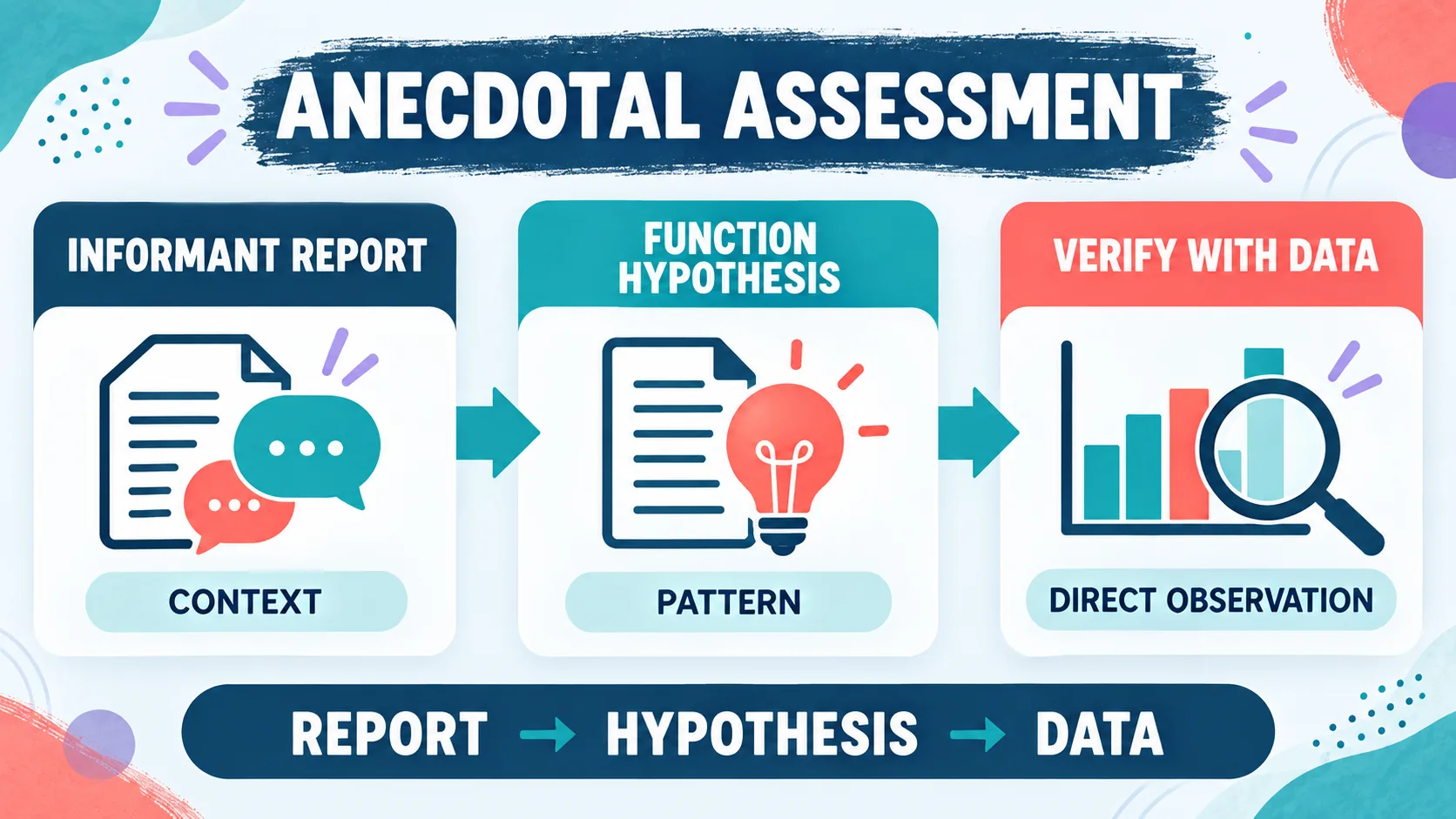
A useful assessment turns a broad concern into a testable description. The exact fields vary by tool, but a BCBA typically wants enough information to compare situations rather than simply collect a label for the behavior.
- Target behavior: what the person does, stated in observable and measurable terms rather than a mentalistic label such as “seeking attention.”
- Setting and context: where the behavior occurs, who is present, what activity is underway, and whether there are relevant setting events.
- Antecedent pattern: what commonly happens immediately before the response, including demands, denied access, transitions, social interaction, or changes in materials.
- Consequence pattern: what other people do after the response and what the learner gains, avoids, delays, or changes.
- History and variability: when the pattern began, how often it occurs, and whether the report changes across people, routines, or environments.
- Reporter confidence: how often the informant sees the behavior and how certain the person is about the sequence being described.
Do not let the form replace an operational definition. “Noncompliance” could include looking away, saying “no,” leaving the area, pushing materials, or failing to begin within a specified interval. Those responses may have different antecedents and consequences. If several respondents use the same vague label, agreement may look high even though they are describing different events.
The most useful output is a prioritized set of hypotheses. For example, several informants may report that property destruction is more likely after a difficult task and is often followed by a task pause. That pattern may justify a direct observation during demands and a safety-conscious test of the escape hypothesis. It does not justify claiming that escape is the function before the next step is completed.
How Is It Different From Descriptive Assessment and Functional Analysis?
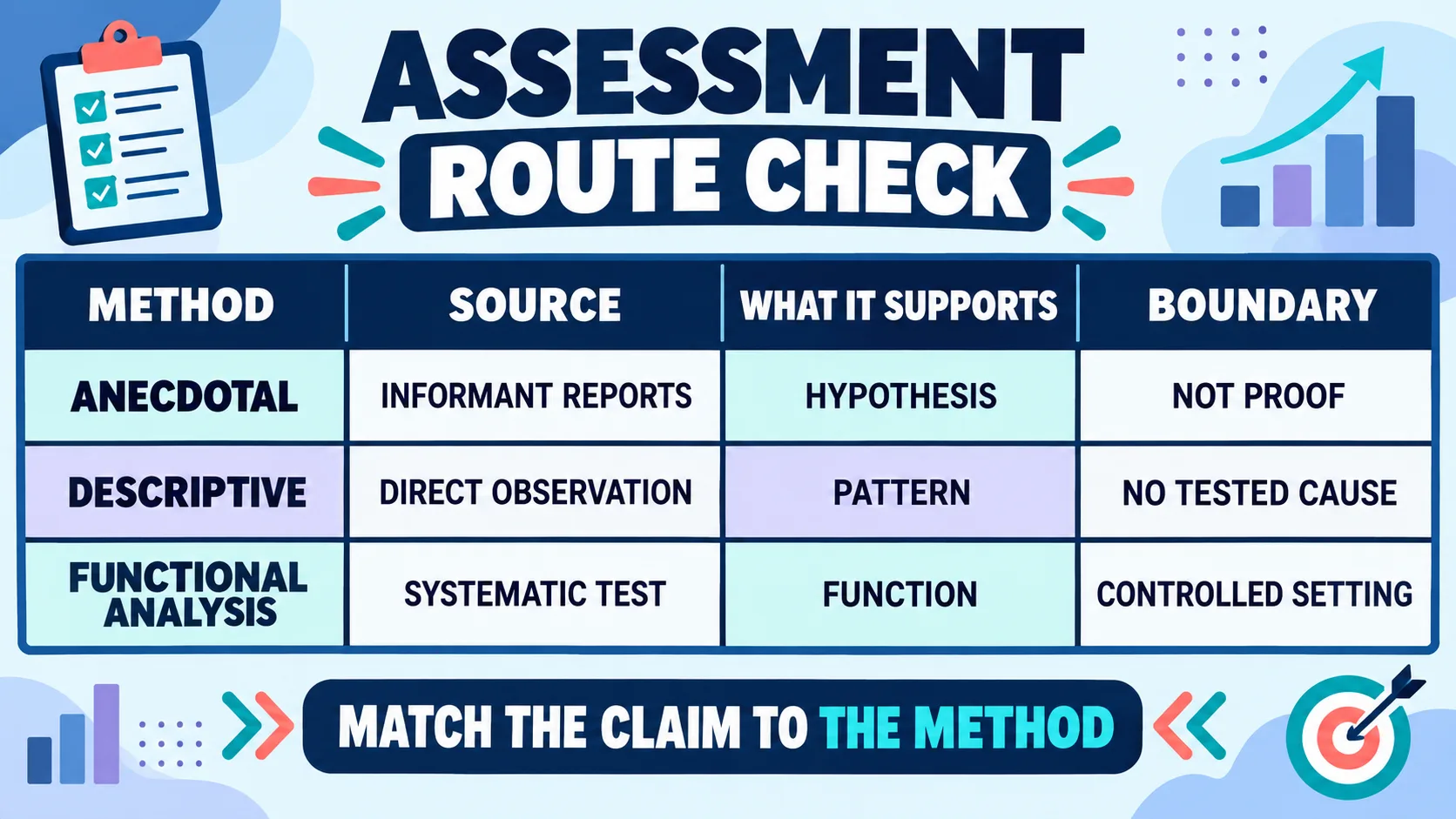
These methods sit within the broader process of functional behavior assessment, but they answer different questions. Anecdotal assessment asks what knowledgeable people report about a pattern. Descriptive assessment records what happens in the natural environment without systematically manipulating the contingency. Functional analysis arranges test and control conditions to evaluate whether a change in an environmental event produces a corresponding change in behavior.
| Method | Primary information source | What it can support | Main boundary |
|---|---|---|---|
| Anecdotal or indirect assessment | Interviews, questionnaires, rating scales, checklists, or informant reports. | Efficient hypothesis development and prioritization of situations to observe. | It does not directly demonstrate a functional relation and may reflect memory or observer bias. |
| Descriptive assessment | Direct observation of antecedents, behavior, and consequences in context. | A record of correlations and naturally occurring patterns that can guide the next assessment step. | Because variables are not systematically manipulated, correlation is not proof of function. |
| Functional analysis | Repeated measurement across arranged test and control conditions. | Evidence of a functional relation when the design and data show experimental control. | Requires trained implementation, safety planning, and an appropriate design; it is not a casual questionnaire. |
The methods can be sequenced rather than treated as competing labels. An informant interview may identify the times that are most likely to evoke the behavior. Direct observation can then show whether the reported antecedent and consequence actually occur together. If the question remains important and safe to test, a qualified analyst can select an appropriate functional-analysis arrangement. The conclusion should match the strongest evidence available, not the most confident-sounding report.
How Should a BCBA Use Anecdotal Assessment Results?
A disciplined workflow keeps indirect information useful without overclaiming. The following sequence is a practical study model; actual service decisions must follow the client’s plan, applicable rules, and the responsible clinician’s judgment.
- Define the behavior first. Write what an observer would count, including the beginning and ending of an episode when appropriate.
- Choose informants with relevant access. Include people who see the behavior in the situations being discussed, and record their role and opportunity to observe.
- Ask about complete sequences. Request specific examples of what happened before, what the learner did, and what happened immediately after, rather than only asking why the behavior occurs.
- Compare respondents. Look for agreement, disagreement, and setting-specific differences. Disagreement is information that may point to a missing context or an unclear definition.
- Rank hypotheses conservatively. State “the report suggests” or “the pattern warrants direct observation,” not “the function is proven.”
- Collect direct data. Use ABC recording, event recording, latency, duration, or another system that matches the question.
- Verify before treatment changes. If a function-based intervention is being considered, make sure the assessment evidence and safety plan are adequate for the decision.
When an assessment points toward escape, attention, tangible access, or automatic reinforcement, the next observation should make the relevant events visible. A report is most valuable when it helps the analyst choose a focused observation window. It is least useful when it becomes a permanent substitute for measuring the behavior and its environmental relations.
What Are the Strengths and Limitations?
Anecdotal assessment is popular for understandable reasons. It can be completed quickly, may include the knowledge of people who see the learner across routines, and can be less disruptive than arranging repeated test conditions. It can also reveal history or context that is not present during a short observation. In a busy school, home, or clinic, those advantages can help the team decide where to start.
- Efficient: it can screen several situations before the analyst schedules direct observation.
- Context-rich: informants may know routines, setting events, and communication patterns that are not visible in one session.
- Collaborative: asking for specific examples can build a shared description among caregivers, teachers, RBTs, and clinicians.
- Risk-aware: it may help identify high-risk situations before an observation or analysis is designed.
The limitations are equally important. Respondents may remember unusual episodes more vividly than typical episodes, interpret private events as causes, or use different definitions for the same word. A rating scale can produce a numerical score that looks precise while still depending on subjective report. Even when several respondents agree, their agreement can reflect shared assumptions or shared exposure to the same incomplete information.
For that reason, do not use a high questionnaire score as if it were a functional-analysis graph. Use the result to decide what to observe, what to clarify, and what evidence is still missing. If the report and direct data disagree, investigate the difference rather than averaging the two into an unsupported conclusion.
How Should You Read QABF, MAS, or Similar Tools?
The Questions About Behavioral Function (QABF) and Motivation Assessment Scale (MAS) are examples of structured tools that can organize informant information. A higher score on an area may indicate that the respondent endorsed items associated with a possible function. It does not mean that the tool manipulated the consequence or demonstrated that the behavior is maintained by it.
When multiple respondents complete a tool, inspect the pattern rather than reporting only the highest number. Ask whether the respondents agree, whether they observe the same situations, and whether their reports match direct observation. Research on multiple-respondent anecdotal assessments suggests that agreement and correspondence can be useful under some conditions, while also showing why the method should be integrated into a broader assessment process.
- Record which tool, version, respondent, and date were used.
- Keep the target behavior and response options consistent across respondents.
- Report disagreement instead of hiding it in one combined score.
- Use scores to prioritize observation and follow-up, not to declare a function in isolation.
- Revisit the hypothesis when the behavior, setting, or treatment context changes.
How Does Anecdotal Assessment Appear on the BCBA Exam?
Exam questions often test whether you can separate an informant hypothesis from a demonstrated functional relation. Look for words such as “parent reports,” “teacher completes a questionnaire,” “caregiver believes,” or “rating scale suggests.” Those clues identify an indirect or anecdotal source. If the vignette describes an observer recording naturally occurring ABC events, classify that as descriptive data instead, even though the record may be written in narrative form.
- Questionnaire or interview: indirect or anecdotal assessment; useful for hypothesis generation.
- Direct ABC observation: descriptive assessment; records naturally occurring correlations.
- Arranged test and control conditions: functional analysis; evaluates a functional relation through experimental comparison.
- Best next step: define the behavior, review the report, collect direct data, or plan a safe analysis rather than overstate what the report proves.
Use the current BACB Task Lists as the boundary for exam content, and keep terminology version-aware. A study source can explain why indirect assessments have practical value and limits, but the current task list and official BACB materials determine what belongs in your certification preparation plan.
Anecdotal Assessment ABA FAQ
Is anecdotal assessment the same as ABC data?: Not necessarily. In many current behavior-analytic discussions, anecdotal assessment means indirect informant information such as an interview, questionnaire, or rating scale. ABC data usually refers to direct observation of antecedents, behavior, and consequences. Some texts use “anecdotal record” for a narrative ABC observation, so identify the information source and procedure before labeling it.
Does an anecdotal assessment prove the function of behavior?: No. It can suggest a likely function or help prioritize observations, but it does not by itself arrange a controlled comparison of environmental events. The strength of the conclusion must match the assessment method and the quality of the data.
Can a parent or teacher report still be valuable?: Yes. A parent or teacher may observe routines, setting events, and outcomes that a short clinic observation misses. Treat the report as important context, define the behavior clearly, compare it with other information, and verify the hypothesis with direct data when the decision requires it.
Once you can identify the difference between a report, a naturalistic observation, and an experimental test, you can answer assessment questions with much more precision. Our free BCBA mock exam can help you practice functional-assessment scenarios, data interpretation, and the boundary between a useful hypothesis and a demonstrated relation.
Take the Free BCBA Mock Exam
When you are ready to apply the idea, use the free practice resource below for additional feedback. Take the Free BCBA Mock Exam



