A motivating operation (MO) in ABA is an environmental variable that momentarily changes the effectiveness of a consequence and the current frequency of behavior that has produced it. In plain language, an MO changes an outcome’s value and makes related behavior more or less likely right now.
Going without water can make water more valuable and increase behavior that has produced access to it; drinking freely can have the opposite effect. Analyze the environmental condition, the consequence whose value changed, and the measurable behavior—not whether someone “feels motivated.”
The BACB Test Content Outline, 6th edition includes motivating operations among concepts BCBA candidates must identify and apply. This guide separates MOs from SDs, reviews EO/AO and UMO/CMO types, and provides an exam-scenario method.
What Is a Motivating Operation in ABA?
An MO has two defining effects: a value-altering effect, changing the momentary effectiveness of a consequence, and a behavior-altering effect, changing the current frequency of behavior that has produced it. Preference change or behavior occurring after an event alone is not enough.
| MO component | Question to ask | Example |
|---|---|---|
| Environmental variable | What condition changed? | Several hours have passed without access to water |
| Value-altering effect | Which consequence became more or less effective? | Water becomes a more effective reinforcer |
| Behavior-altering effect | Which behavior changes because it has produced that consequence before? | Requests for a drink become more frequent |
| History with the consequence | What response-consequence relation makes the behavior relevant? | Requesting has previously produced access to water |
If water becomes more valuable but no learned response produces water, there may be no specific water-seeking response to increase. Identify learning history separately from value change.
Value-Altering and Behavior-Altering Effects
Start with the consequence: what outcome became more or less valuable, and which response has produced it before? This keeps the analysis tied to observable relations rather than an inferred internal state.
An establishing operation (EO) increases consequence effectiveness and evokes behavior that has produced it. An abolishing operation (AO) decreases effectiveness and abates that behavior. EO and AO describe the direction of a temporary MO effect.
| Scenario | Value-altering effect | Behavior-altering effect | Classification |
|---|---|---|---|
| Water deprivation before a teaching session | Access to water becomes more effective | Previously reinforced requests for water increase | EO for water |
| Free access to water immediately before the session | Water becomes less effective | Previously reinforced water requests decrease | AO for water |
| Long delay before a preferred activity | The activity may become more effective as a reinforcer | Responses that have produced the activity may increase | EO for that activity |
| Extended access to the same activity | The activity becomes less effective | Responses previously reinforced by it may decrease | AO for that activity |
Effects are temporary and context-sensitive. Learning history, current access, health, setting, and alternatives can change the result, so describe the relation supported by data instead of treating a stimulus as always EO or AO.
Establishing vs. Abolishing Operations
EO/AO is a frequent BCBA exam target: an EO increases consequence effectiveness and evokes related behavior; an AO decreases effectiveness and abates it. “Evokes” and “abates” describe the behavior-altering effect, not a general feeling.
| Feature | Establishing operation (EO) | Abolishing operation (AO) |
|---|---|---|
| Effect on consequence | Increases its momentary effectiveness | Decreases its momentary effectiveness |
| Effect on related behavior | Evokes behavior that has produced the consequence | Abates behavior that has produced the consequence |
| Food example | Food deprivation increases the value of food | Satiation decreases the value of food |
| Escape example | An aversive condition makes escape more valuable | Removal of the aversive condition makes escape less valuable |
| Exam cue | “Makes reinforcement more effective” plus an increase in related responding | “Makes reinforcement less effective” plus a decrease in related responding |
An EO changes consequence effectiveness; it is not the reinforcer. An AO means the consequence is less effective at that moment, not that it can never reinforce behavior.
UMO vs CMO
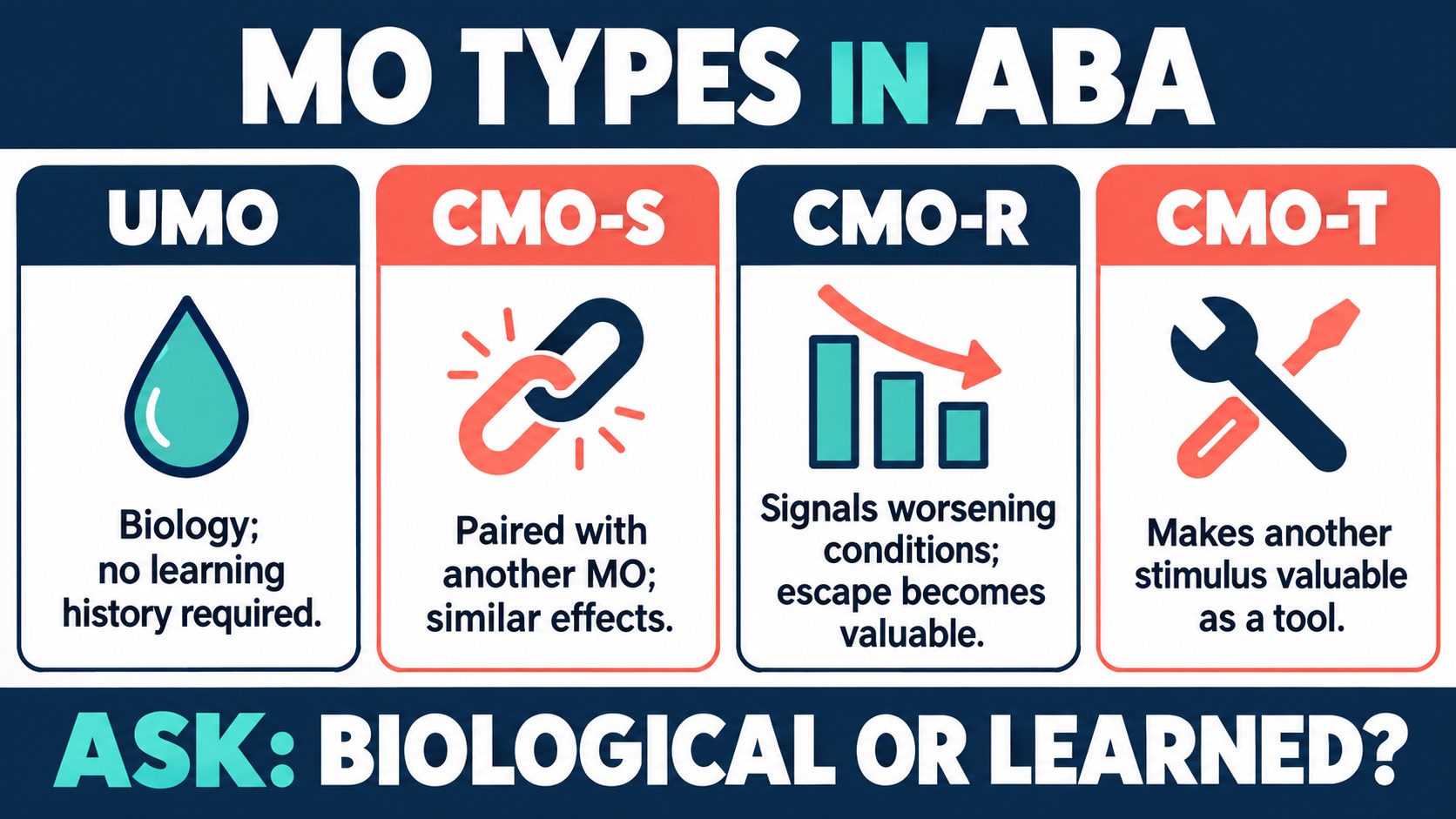
A UMO has its effects without a particular learning history; examples include deprivation, satiation, temperature changes, and some pain or illness. Analyze the consequence and response too: “biological” does not identify the full relation.
A conditioned motivating operation (CMO) acquires its effects through learning. A stimulus becomes an MO through a relation involving another MO, worsening conditions, or access to a terminal reinforcer. Identify that relation before naming the subtype.
| Question | UMO | CMO |
|---|---|---|
| Does the MO effect require a specific pairing or learning history? | No particular pairing is required for the basic effect | Yes; the effect is acquired through a learning relation |
| Typical examples | Hunger, thirst, sleep deprivation, temperature, pain | A warning signal, missing tool, or stimulus associated with a worsening condition |
| How to analyze it | Identify the consequence affected and the related response | Identify the learned relation and the consequence it changes |
| Common trap | Assuming every biological event automatically evokes a named response | Calling a stimulus a CMO without explaining the learning history |
“Biological” may suggest a UMO, but the answer must still identify the changed consequence and affected behavior. A learned warning, missing item, or obstacle may indicate a CMO.
CMO-S, CMO-R, and CMO-T
CMO labels describe functions of learned stimuli; remember the relation, not just the abbreviation.
| Type | Core relation | Typical effect | Simple example |
|---|---|---|---|
| CMO-S, surrogate | Paired with another MO and takes on similar effects | Changes the value of the same or a similar consequence | A stimulus repeatedly paired with food deprivation begins to produce food-related MO effects |
| CMO-R, reflexive | Signals that conditions are worsening or improving | Establishes its own removal or avoidance as valuable and evokes behavior that produces removal | A warning signal for an unpleasant event evokes behavior that has previously stopped the warning |
| CMO-T, transitive | Makes another stimulus valuable because that stimulus is needed to access a terminal reinforcer | Evokes behavior that has produced the needed tool, key, instruction, or assistance | A locked container makes a key valuable because the key is needed to access the preferred item |
CMO-T is common in instructional examples: a tool or assistance becomes valuable because it is needed to reach a terminal reinforcer. A difficult task can similarly make help valuable when help has produced progress or reinforcement.
CMO-R scenarios feature worsening conditions; the response produces termination, avoidance, or improvement. CMO-S scenarios emphasize pairing with another MO.
MO vs SD
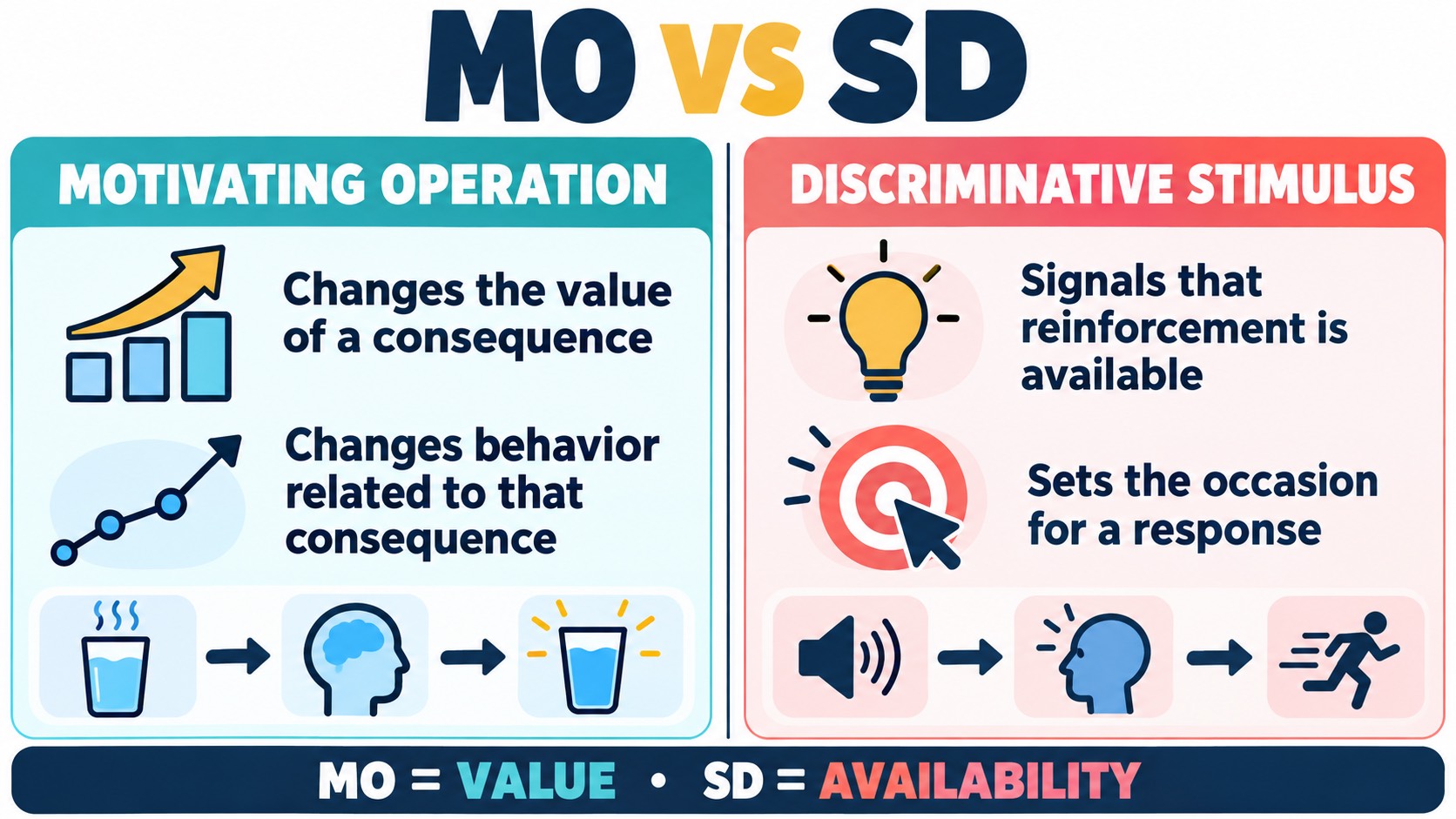
An MO and an SD can both affect behavior for different reasons. An MO changes consequence value and related responding; an SD signals that a consequence is available because the response was reinforced in its presence.
| Feature | Motivating operation | Discriminative stimulus |
|---|---|---|
| Primary function | Changes consequence value and related responding | Signals the availability of reinforcement for a response |
| Question it answers | “How valuable is the consequence right now?” | “Is reinforcement likely if the response occurs now?” |
| Common cue | Deprivation, satiation, pain, obstacle, warning, missing tool | Teacher present, sign lit, app open, instruction delivered |
| Example | Thirst increases the value of water and evokes water requests | A water fountain signaled as available increases the likelihood of requesting or approaching |
| Can it occur without the other? | Yes; a consequence can be valuable even when it is not currently available | Yes; reinforcement can be signaled even when its current value is low |
If a learner is thirsty while a “water available” sign is posted, thirst is the MO and the sign may be the SD. Thirst changes water’s value; the sign signals where or when water is available. Deprivation or satiation points to an MO; an availability cue points to an SD.
See the site’s SD versus MO BCBA exam guide and conditioned motivating operations guide for focused comparisons.
How to Analyze an MO Scenario Step by Step
Use a fixed sequence: identify the consequence, determine whether its value increased or decreased, identify the behavior that produced it, and decide whether the vignette describes an MO, SD, or both.
| Step | Analysis question | Example answer |
|---|---|---|
| 1. Name the consequence | What outcome is delivered, removed, or accessed? | Access to a break from a difficult task |
| 2. Find the changing condition | What happened before the behavior changed? | The task became more effortful and aversive |
| 3. Determine direction | Did the consequence become more or less effective? | Escape became more effective |
| 4. Identify the response history | What behavior has produced the consequence? | Appropriate break requests have produced a brief break |
| 5. Name the relation | EO/AO, UMO/CMO, or SD? | EO for escape; if learned relation is specified, analyze the CMO subtype |
In a locked-box example, the toy is the terminal reinforcer; the key or adult assistance becomes valuable because it is needed to access the toy. That supports CMO-T only when the vignette emphasizes the tool relation, not merely the toy’s preference.
An antecedent is not automatically an MO. An instruction may be an SD; call it an MO only when the vignette supports a consequence-value change and related behavior change.
Measurement and Ethical Application
MOs do not justify inferring private motivation or manipulating deprivation without safeguards. Describe the environmental event, measure behavior, consider health and assent, and use the least restrictive effective arrangement. Sensitive consequences require attention to safety, dignity, consent, and the individualized plan.
Measure the environmental condition and the behavior it should affect. Record time since access, context, opportunities, target response, and consequence so the predicted EO/AO effect can be evaluated.
- Define the MO-related condition in observable terms.
- Record the consequence whose value is expected to change.
- Measure the response that has historically produced that consequence.
- Check whether the response change is consistent across representative opportunities.
- Monitor health, assent, preference, dignity, and treatment integrity.
- Do not use unnecessary deprivation, pain, or extended denial of access to create responding.
A precise analysis predicts behavior instead of labeling the person: an extended work requirement may increase the value of escape and previously reinforced break requests. Observable wording is easier to evaluate with data.
Common BCBA Exam Traps
Most errors confuse the consequence, signal, and current consequence value. Use the table to distinguish them.
| Scenario clue | Likely concept | Why |
|---|---|---|
| “The consequence became more effective, and related responding increased.” | EO | This describes the value-altering and behavior-altering effects of an establishing operation. |
| “The consequence became less effective, and related responding decreased.” | AO | This describes an abolishing operation. |
| “The cue signals that reinforcement is available.” | SD | The cue changes the likelihood of reinforcement for a response, not the value of the reinforcer. |
| “A key is needed to open a box containing the preferred item.” | CMO-T | The key becomes valuable as a tool to reach the terminal reinforcer. |
| “A warning signals that conditions are getting worse, and escape behavior occurs.” | CMO-R | The stimulus establishes its removal or avoidance as valuable. |
| “A stimulus was repeatedly paired with another MO and now has similar effects.” | CMO-S | The learned pairing gives the stimulus surrogate MO effects. |
| “The question only says a preferred item is present.” | Insufficient for an MO label | Preference or presence alone does not show a temporary value change and related behavior change. |
Do not treat “motivation” as a permanent trait. MOs are temporary relations shaped by context and history; identify the environmental event and measurable behavioral effect.
Review the site’s ABA EO versus AO comparison guide and free BCBA mock exam for practice.
Motivating Operation in ABA FAQ and Final Review
What is the simplest definition of a motivating operation? It is an environmental variable that changes consequence value and the current frequency of behavior that has produced it.
What is the difference between an EO and an AO? An EO increases consequence effectiveness and evokes related behavior; an AO decreases it and abates related behavior.
Is an MO the same as an SD? No. An MO changes consequence value; an SD signals that reinforcement is available. One situation can include both.
What is a UMO? It has its basic effect without a particular learning history, such as hunger, thirst, temperature, or sleep deprivation.
What is a CMO-T? It makes another stimulus valuable as a tool needed to obtain a terminal reinforcer, such as a key needed to open a box.
What is the fastest exam memory cue? Remember: MO equals value; SD equals availability. Deprivation, satiation, or a learned value change points to an MO; an availability cue points to an SD.
Use this final review checklist:
- Name the consequence and the response that previously produced it.
- Identify the environmental change and whether consequence value increased or decreased.
- State the value-altering and behavior-altering effects.
- Classify EO/AO and check whether a learning relation supports UMO, CMO-S, CMO-R, or CMO-T.
- Separate an MO from an SD and describe the relation with observable data.