

In applied behavior analysis (ABA), measurement is the foundation for understanding behavior change. One essential dimension is temporal locus, which answers a simple but critical question: when does a behavior occur? This article explains temporal locus in ABA, focusing on two common measures: latency and interresponse time (IRT). You will learn how to calculate these measures, how they differ from duration and rate, and why they are vital for behavior analysts. By the end, you will have a clear grasp of temporal locus—a key concept for the BCBA exam and professional practice. Table of Contents
- What is Temporal Locus in ABA?
- Understanding Latency in ABA
- Understanding Interresponse Time (IRT)
- How Temporal Locus Differs from Temporal Extent and Repeatability
- Why Temporal Locus Matters in Applied Behavior Analysis
- How to Measure Temporal Locus: Step-by-Step
- Common Traps and Misconceptions About Temporal Locus
- Practical Examples of Temporal Locus in Different Settings
- Stimulus Control and Temporal Locus
- How to Study Temporal Locus for the BCBA Exam
- Conclusion and Further Study
- Reference
Before diving deeper, it is helpful to know that behavior analysts measure behavior along several dimensions. Temporal locus is one of the fundamental dimensions, alongside temporal extent (duration) and repeatability (count and rate). While duration tells you how long a behavior lasts and rate tells you how often it occurs, temporal locus specifies the exact timing of a behavior relative to a meaningful event. This makes temporal locus indispensable for understanding stimulus control, functional relations, and the effectiveness of interventions.
What is Temporal Locus in ABA?
Temporal locus refers to the point in time when a behavior occurs relative to a specific environmental event. In measurement, it anchors the behavior to a reference point, such as the onset of an instruction, a stimulus change, or the previous instance of the same behavior. Temporal locus is measured in units of time, like seconds or minutes, and provides information about the timing of behavior, not its count or duration.
For example, if a teacher says “Please start your worksheet” and the student begins writing after 4 seconds, the temporal locus is 4 seconds. Similarly, if a child engages in hand flapping and then flaps again after 10 seconds, the temporal locus of the second response is 10 seconds after the first. These measurements help behavior analysts understand patterns and make data-based decisions.
Temporal locus is not an intervention or procedure; it is a measurement concept. Behavior analysts use it to quantify behavior in real-world settings, allowing for objective data collection and analysis. For example, in a classroom, a teacher might measure latency to clarify whether a student follows directions promptly. In a functional analysis, latency to problem behavior after presenting a demand can indicate sensitivity to task demands.
Understanding Latency in ABA
Latency is the time between the onset of an environmental event (e.g., an instruction, a cue, or a discriminative stimulus) and the beginning of a target behavior. It measures the initiation of behavior after a signal. For example, if a teacher says “Please start your worksheet” and the student begins writing after 4 seconds, the latency is 4 seconds. Latency is a measure of temporal locus because it specifies the time of the response relative to the environmental event.
To calculate latency, you must define the environmental event precisely and identify the exact onset of the behavior. For example, the event might be the presentation of a task request, and the behavior onset might be the first instance of the student picking up a pencil. Using a stopwatch or data collection software, you start timing at the event onset and stop at the behavior onset. The resulting time is the latency.
Example: Measuring Latency in a Classroom: Consider a student who is learning to follow verbal instructions. The teacher says, “Put your book away,” and the student begins to place the book in the backpack after 3 seconds. The latency is 3 seconds. If the teacher records this across multiple trials, she can track whether the student’s latency decreases over time, indicating improved responsiveness. Latency data are useful for assessing the effectiveness of interventions aimed at increasing rapid initiation of behaviors.
Understanding Interresponse Time (IRT)
Interresponse time (IRT) is the time between the end of one response and the beginning of the next response of the same behavior, or sometimes the time between onset to onset, depending on operational definition. More commonly, IRT measures the elapsed time between consecutive instances of the same response. For example, if a student answers a question, then answers another question 10 seconds later, the IRT is 10 seconds. IRT is also a measure of temporal locus because it specifies when the next behavior occurs relative to the previous behavior.
IRT is particularly useful in measuring response spacing. For instance, a behavior analyst might measure IRT for stereotypic behavior to see if the behavior occurs in bursts or is evenly spaced. IRT data can also help evaluate the effects of differential reinforcement of low rates (DRL) or other schedules.
Example: Measuring IRT in a Clinical Setting: Suppose a child engages in hand flapping. The behavior analyst records the onset of each instance. If the first instance ends at 2:00:05 and the second instance begins at 2:00:15, the IRT is 10 seconds. By recording IRT, the clinician can determine the average time between episodes, which may inform treatment decisions. IRT is distinct from latency because it involves two responses of the same behavior, not a response following an external event.
How Temporal Locus Differs from Temporal Extent and Repeatability
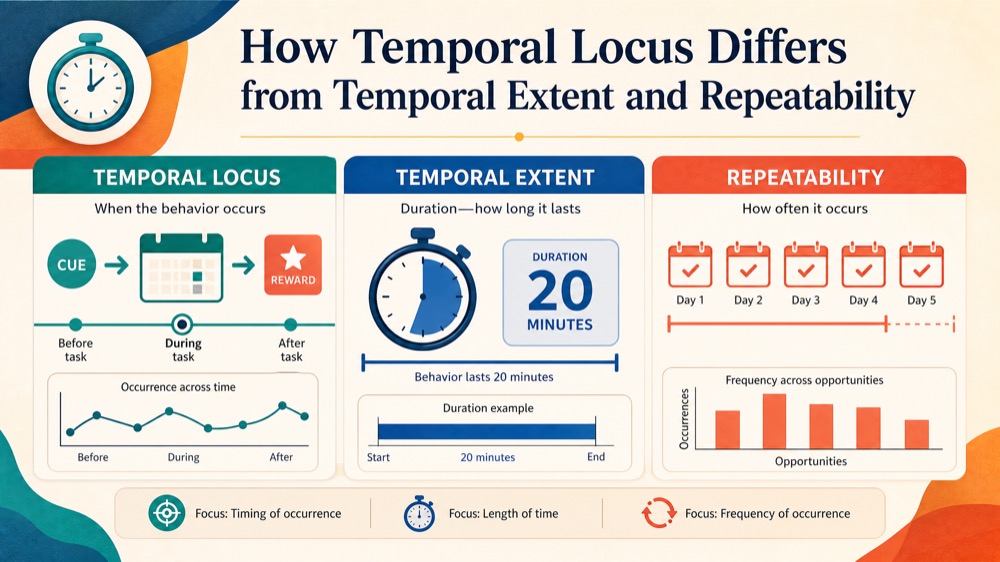
Temporal locus is often confused with other dimensions of behavior. Temporal extent refers to the duration of a behavior—how long it lasts. For example, if a student reads for 20 minutes, the duration is 20 minutes. In contrast, temporal locus focuses on a single time point relative to a reference event, not the length of the behavior. Repeatability refers to the number of times a behavior occurs, measured as count or rate (e.g., 5 responses per minute). Neither count nor rate tells you when a behavior occurred, only how often. Temporal locus adds the temporal dimension to the measurement.
Another important distinction is between latency and response latency. Some texts use “latency” to refer specifically to the time between an SD and the response onset, whereas “temporal locus” is a broader term that includes any reference event. In practice, both share the same measurement logic.
Understanding these differences is critical for accurate data collection and interpretation. Mislabeling duration as latency, for example, can lead to incorrect conclusions about behavioral patterns. Always ask: Does this measure specify when a behavior occurs relative to an event? If yes, it is a temporal locus measure.
Why Temporal Locus Matters in Applied Behavior Analysis
Temporal locus is a fundamental measurement concept in ABA. It provides objective data that can guide intervention decisions. For example, in functional analysis, measuring latency to problem behavior after presenting an establishing operation (EO) can help identify whether behavior is maintained by escape or attention. If a child quickly engages in aggression when demands are presented, the short latency suggests a strong relationship between the demand and the behavior.
Additionally, temporal locus is used to evaluate treatment effectiveness. If an intervention aims to reduce the time it takes for a student to comply with instructions, latency data collected before and after treatment can show improvement. Similarly, IRT data can reveal changes in response patterns, such as increased spacing between tantrums.
Measurement is the backbone of behavior analysis. Without precise measures like temporal locus, it is impossible to make data-based decisions. As a BCBA candidate, mastering temporal locus will help you design robust measurement systems and interpret data accurately.
How to Measure Temporal Locus: Step-by-Step
Measuring temporal locus requires careful planning. Here is a step-by-step guide:
- Define the target behavior in observable, measurable terms. For latency, define the onset of the behavior. For IRT, define the response and the inter-response interval.
- Identify the reference event. For latency, this is the environmental event that precedes the behavior (e.g., teacher instruction). For IRT, the reference is the previous response.
- Choose a timing method: stopwatch, timer, or data collection software. Ensure it measures to the nearest second or fraction thereof, depending on the behavior.
- Record the time at the onset of the reference event and the time at the onset of the target behavior (for latency) or the next response (for IRT). Subtract to obtain the measure.
- Repeat across multiple observation sessions to obtain a representative sample. Calculate averages or medians as needed.
For example, if a behavior analyst wants to measure latency to a greeting after the SD “Say hi,” they might collect 10 trials. The latencies might be 1, 2, 1, 3, 2, 1, 2, 1, 2, and 3 seconds. The mean latency is 1.8 seconds. This data can be graphed to show trends.
It is essential to define the reference event precisely. For instance, if the SD is the teacher saying the child’s name, the onset is the first sound of the name. Ambiguity in the reference event can lead to unreliable data.
Common Traps and Misconceptions About Temporal Locus
Even experienced practitioners can misunderstand temporal locus. Here are common traps to avoid:
- Confusing latency with duration. Latency is the time to start, not the time spent.
- Using temporal locus to infer response rate. Temporal locus gives no information about how often a behavior occurs.
- Measuring temporal locus without a reference event. Without a clear event, there is no temporal locus.
- Assuming temporal locus is the only dimension of behavior. Behavior has multiple dimensions: temporal extent, repeatability, and temporal locus.
- Believing that one example proves behavioral function. Temporal locus data alone cannot determine function; it must be paired with experimental analysis.
These pitfalls can lead to misinterpretation of data and ineffective interventions. Always review your measurement definitions and ensure you are measuring what you intend to measure. For instance, if you are interested in compliance, latency might be appropriate, but if you are interested in persistence, duration is better.
Practical Examples of Temporal Locus in Different Settings
Temporal locus is used across many ABA settings. Here are a few examples:
- School: A teacher measures latency from the instruction “Line up” to the student standing up. If the latency decreases after a visual schedule is introduced, the intervention is effective.
- Clinic: A behavior analyst measures IRT between vocalizations for a child with autism. If the IRT increases after a DRL schedule is implemented, the child is talking less frequently.
- Home: A parent measures latency from a request to a child’s compliance to see if a token economy speeds up responding.
- Functional Analysis: A clinician measures latency to problem behavior after presenting a demand. Short latencies suggest escape function.
These examples show how temporal locus can be applied to various behaviors and environments. By selecting the appropriate measure (latency or IRT) and tracking it over time, behavior analysts can make data-driven decisions.
Stimulus Control and Temporal Locus
Temporal locus is closely tied to stimulus control. Latency, for instance, can indicate the strength of a discriminative stimulus (SD) in evoking a response. If a student starts answering quickly when the teacher says “What is 2+2?” but slowly when another adult asks the same question, the SD has stronger control over the behavior. Conversely, if the latency is equally short for a non-relevant stimulus (S-delta), then stimulus discrimination is weak.
In practice, measuring latency can help behavior analysts assess whether a stimulus is functioning as an SD or an S-delta. For example, if a child responds to a red card but has a long latency or no response to a blue card, the red card likely controls the behavior. Temporal locus data thus provide valuable information about stimulus control, which is essential for designing effective teaching procedures.
How to Study Temporal Locus for the BCBA Exam
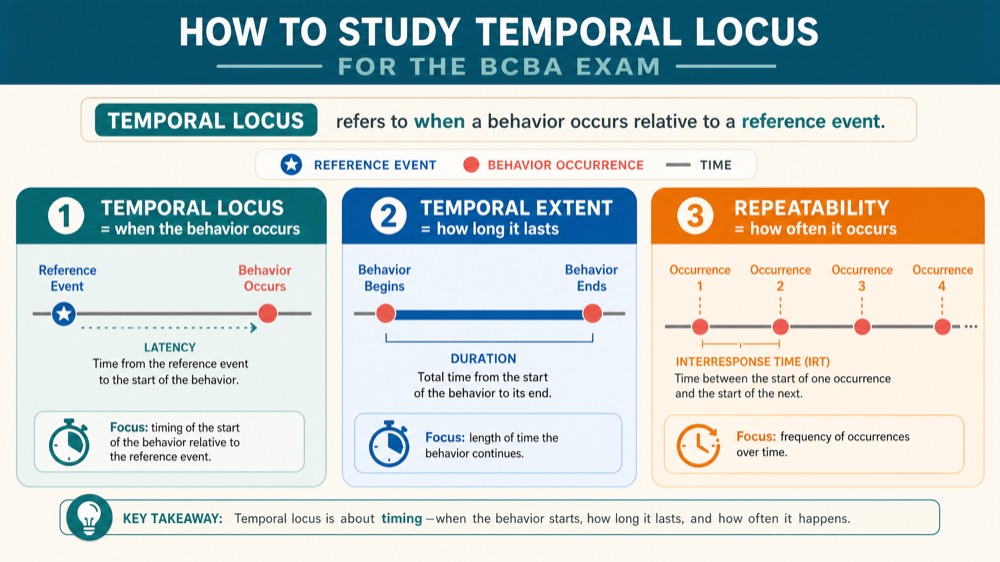
To master temporal locus for the BCBA exam, focus on the definitions, calculations, and distinctions. Here is a study checklist:
- Memorize the definition of temporal locus and its two main measures: latency and IRT.
- Practice calculating latency and IRT from sample data (e.g., given a timeline, determine the latency or IRT).
- Understand the difference between latency and duration, and between IRT and rate.
- Review how temporal locus relates to stimulus control, especially discrimination and generalization.
- Look at real-world examples in clinical and educational settings.
- Take practice questions on measurement dimensions.
Also, read about stimulus generalization and stimulus control practice questions to deepen your understanding. Additionally, consider the broader concept of stimulus control in ABA to see how temporal locus fits into the bigger picture.
Conclusion and Further Study
Understanding temporal locus in ABA is essential for effective measurement and intervention. Latency and interresponse time provide crucial information about when behaviors occur relative to events, which can inform functional analysis, progress monitoring, and treatment decisions. By distinguishing temporal locus from temporal extent and repeatability, you can choose the most appropriate measure for your clinical or educational questions.
For more practice, check out our free BCBA mock exam to test your knowledge of temporal locus and other key concepts. Also, explore related articles on stimulus control and stimulus generalization to reinforce your learning. With consistent study and application, you will excel on the BCBA exam and in your practice as a behavior analyst.



