
What Are Operant Behaviors? Definition in Applied Behavior Analysis
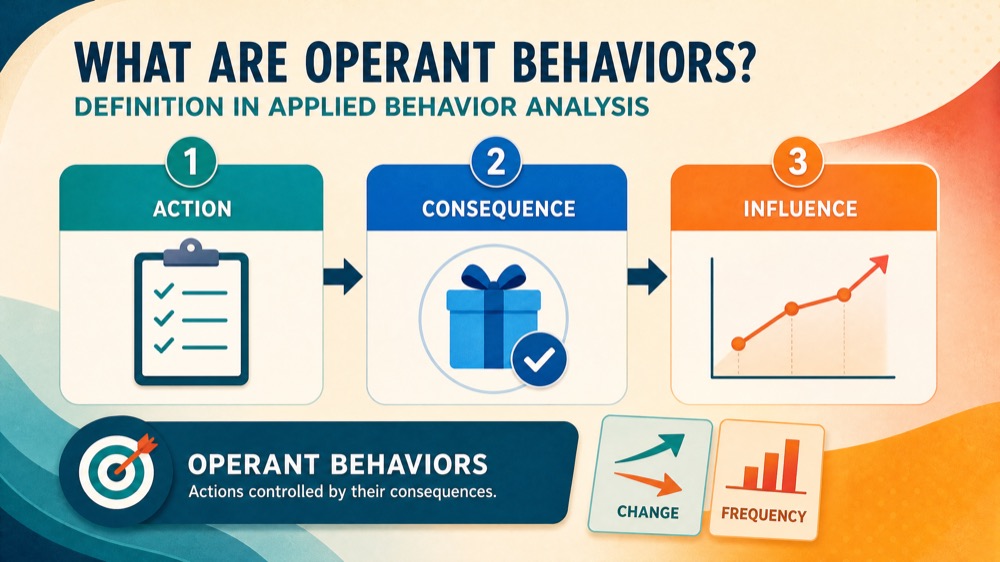
In applied behavior analysis, operant behaviors are actions that are emitted by an organism and are controlled by their consequences. Unlike reflexes or involuntary responses, operant behaviors are influenced by what happens after them. This is a foundational concept for the BCBA exam because it forms the basis for understanding reinforcement, punishment, and extinction.
Table of Contents
- What Are Operant Behaviors? Definition in Applied Behavior Analysis
- Key Characteristics of Operant Behaviors
- Operant Behaviors in Practice: Real ABA Examples with ABCs
- Operant Behaviors on the BCBA Exam: What You Need to Know
- Quick Checklist: Study Points for Operant Behaviors
- Summary of Key Takeaways
- Take the Free BCBA Mock Exam
- References
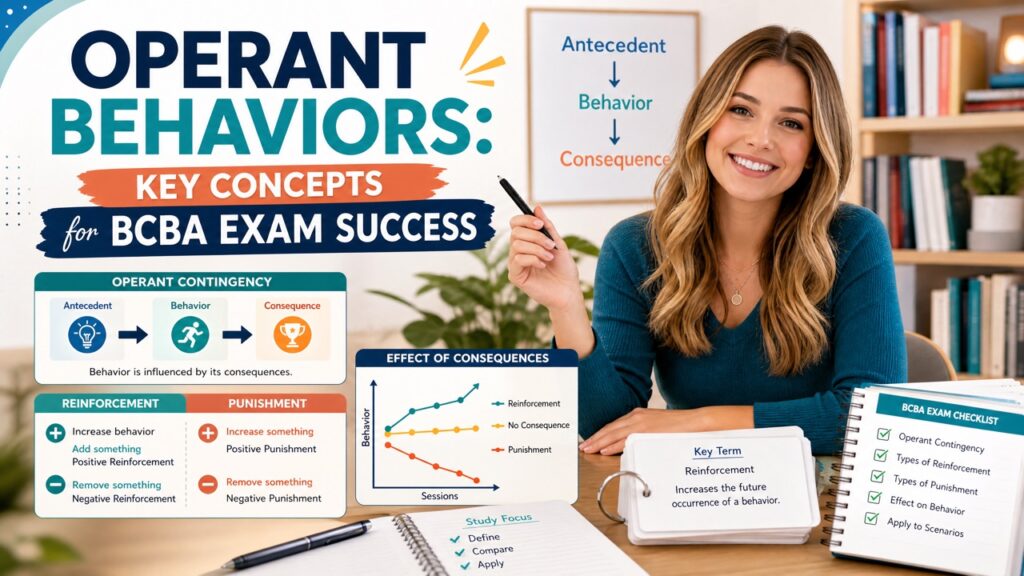
To grasp operant behavior, consider the three-term contingency: the antecedent, the behavior, and the consequence. The antecedent is the environment or event that signals the behavior, the behavior is the observable action, and the consequence is what follows, which either increases or decreases the future probability of that behavior. For example, a child raises her hand in class, and the teacher calls on her. The behavior of raising the hand is operant because it is influenced by the consequence of gaining attention.
Operant vs. Respondent Behaviors: A Key Distinction for the BCBA Exam: A major distinction on the exam is between operant and respondent behaviors. Respondent behaviors are elicited by antecedent stimuli and are largely involuntary, like salivating when you smell food. They follow a simple stimulus-response model. In contrast, operant behaviors are emitted and are shaped by their consequences.
- Operant behaviors are voluntary and selected by consequences.
- Respondent behaviors are reflexive and elicited by stimuli.
- The BCBA exam often tests this distinction with scenario questions.
Remember that most behaviors we analyze in ABA are operant. However, understanding respondent behaviors is crucial for comprehensive analysis. You can think of respondent behavior as the body’s automatic reaction, while operant behavior is the action we choose. This distinction is a common source of confusion, so being clear on it early can save you points on the exam.
Key Characteristics of Operant Behaviors
Exam questions often require you to identify which of several behaviors is operant. To do that, you need to know the defining features. Operant behaviors have three key characteristics: they are emitted, they are influenced by consequences, and they come under stimulus control.
First, operant behaviors are emitted, meaning they are not automatically triggered by a preceding stimulus but rather occur at some rate. Second, they are sensitive to reinforcement and punishment. If a consequence increases the future frequency of the behavior, it is reinforcement; if it decreases it, it is punishment. Third, operant behaviors can come under stimulus control: the behavior occurs more often in the presence of a discriminative stimulus than in its absence.
These characteristics are central to behavior modification. For instance, a student might learn to raise his hand only when the teacher is looking at the class, because that is when reinforcement (being called on) is most likely.
How Operant Behaviors Are Selected by Consequences: The principle that consequences shape behavior is often called the law of effect. This idea, introduced by Edward Thorndike, states that behaviors followed by satisfying consequences are more likely to recur, while behaviors followed by unpleasant consequences are less likely. In ABA, this is a cornerstone of intervention.
Consequences can be positive or negative. Positive reinforcement adds a stimulus, negative reinforcement removes a stimulus, and both increase behavior. Similarly, positive and negative punishment decrease behavior. The key is that the effect on behavior defines the consequence, not the pleasantness of the stimulus. For the BCBA exam, you must be able to identify whether a consequence is reinforcing or punishing based on the future trend of the behavior.
Operant Behaviors in Practice: Real ABA Examples with ABCs
Let’s look at three practical examples of operant behaviors in everyday and clinical settings. These examples will help you practice identifying the antecedent, behavior, and consequence, and also hypothesize the function of the behavior. The function tells us why the behavior occurs, which is crucial for intervention.
Example 1: Requesting a Break to Escape Demands: Imagine a student who has difficulty with math worksheets. The antecedent is the teacher handing out the worksheet. The behavior is the student saying, “Can I take a break?” The consequence is that the teacher removes the worksheet and allows the break. The hypothesized function is escape from demands. This is a common operant behavior in classrooms.
Example 2: Raising Hand to Gain Attention: In a classroom discussion, a student raises her hand. The antecedent is the discussion that includes questions directed to the class. The behavior is raising the hand, and the consequence is the teacher calling on her. The function is likely access to attention. Raising the hand is reinforced by the teacher’s response, making it more likely in the future.
Example 3: Hitting to Obtain a Preferred Item: Another child sees a peer playing with a toy. The antecedent is the peer having the toy. The behavior is hitting the peer, and the consequence is the peer giving up the toy. The function is access to tangible items. This is a problem behavior that might be targeted in ABA therapy by teaching a replacement behavior, like requesting the toy. Analyzing operant behaviors using the ABC format is a skill you will use daily as a BCBA. Practicing with real-life scenarios improves your fluency and prepares you for scenario-based exam questions.
Operant Behaviors on the BCBA Exam: What You Need to Know
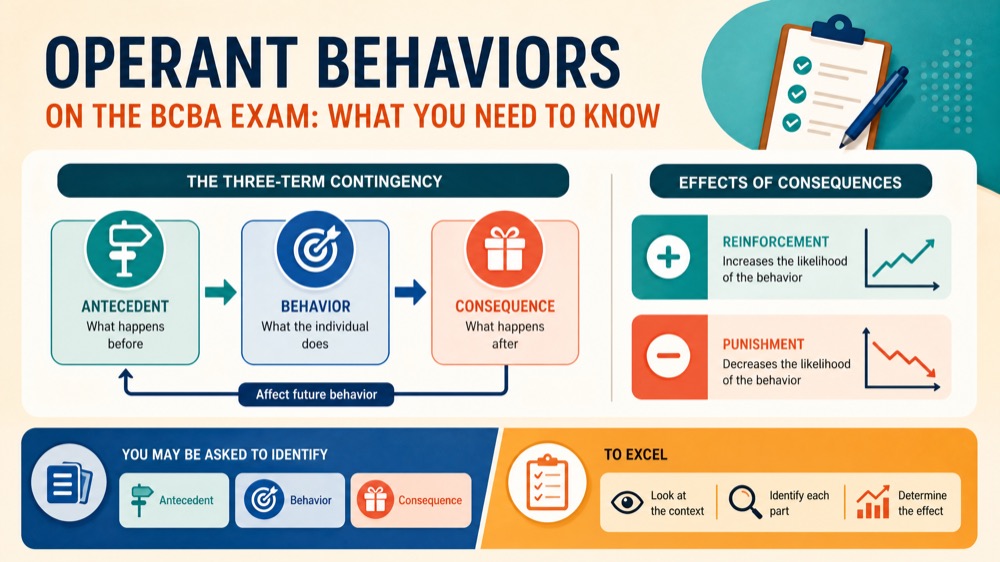
The BCBA exam frequently tests concepts related to operant behaviors, especially the three-term contingency and the effects of consequences. You will likely encounter questions that ask you to identify the antecedent, behavior, or consequence in a scenario, or to determine the function of a behavior.
To excel in this area, you need to go beyond memorizing definitions. You should be able to apply the concepts to novel situations. The exam often uses tricky wording to see if you truly understand the principles. For example, a question might describe a consequence that is supposed to be reinforcer but the behavior decreases, indicating that it is actually punishment. This is where deep understanding pays off. Common Exam Traps and How to Avoid Them: Many candidates stumble on the same traps. Being aware of these can help you navigate the exam confidently. Here are the most common pitfalls:
- Confusing operant with respondent: Always check if a behavior is voluntary and consequence-dependent.
- Assuming reinforcement always increases behavior: Reinforcement is defined by its effect. If a stimulus follows behavior and the behavior increases, it is reinforcement. If not, it’s not reinforcing.
- Overlooking motivating operations: Motivating operations alter the value of a reinforcer and the likelihood of behavior. For example, being deprived of attention makes attention more reinforcing.
- Misidentifying the consequence: The consequence is what follows the behavior, not what the behavior achieves in the environment. Sometimes, the consequence is automatic (e.g., sensory stimulation).
By keeping these traps in mind, you can avoid careless mistakes. Practice with mock exams that include these types of scenarios to build your accuracy. Our BCBA exam question distribution guide can help you understand how this topic is weighted.
Quick Checklist: Study Points for Operant Behaviors
For last-minute review, here is a concise checklist that captures the essential points about operant behaviors. Use this to quiz yourself or as a quick refresher before the exam.
- Definition: Reinforced consequences control the future probability of operant behaviors.
- Three-term contingency: Antecedent, behavior, consequence.
- Reinforcement: Consequence that increases behavior (positive or negative).
- Punishment: Consequence that decreases behavior (positive or negative).
- Functions of behavior: Escape, attention, tangible, automatic.
- Stimulus control: Antecedent signals when reinforcement is available.
Be able to identify the function from a scenario. You should also be comfortable with the difference between operant and respondent behavior. This checklist covers the highest-yield points that are likely to appear on the exam.
Summary of Key Takeaways
Operant behaviors are the cornerstone of applied behavior analysis. They are behaviors controlled by consequences, and understanding them allows you to analyze and change behavior effectively. For the BCBA exam, you must be able to define operant behaviors, distinguish them from respondent behaviors, identify the three-term contingency, and understand how consequences influence future behavior.
We covered real-world examples with ABC analyses, common exam traps, and a study checklist. Remember to keep the law of effect in mind and always consider the function of behavior. With this guide, you are better equipped to tackle operant behavior questions on the BCBA exam. To deepen your knowledge, explore our related articles on functions of behavior and operant behavior BCBA exam guide for more practice.
Take the Free BCBA Mock Exam
Ready for more practice? Use the free mock exam to keep testing your accuracy with realistic BCBA-style items. Take the Free BCBA Mock Exam



