

What Is PLA Check in ABA?
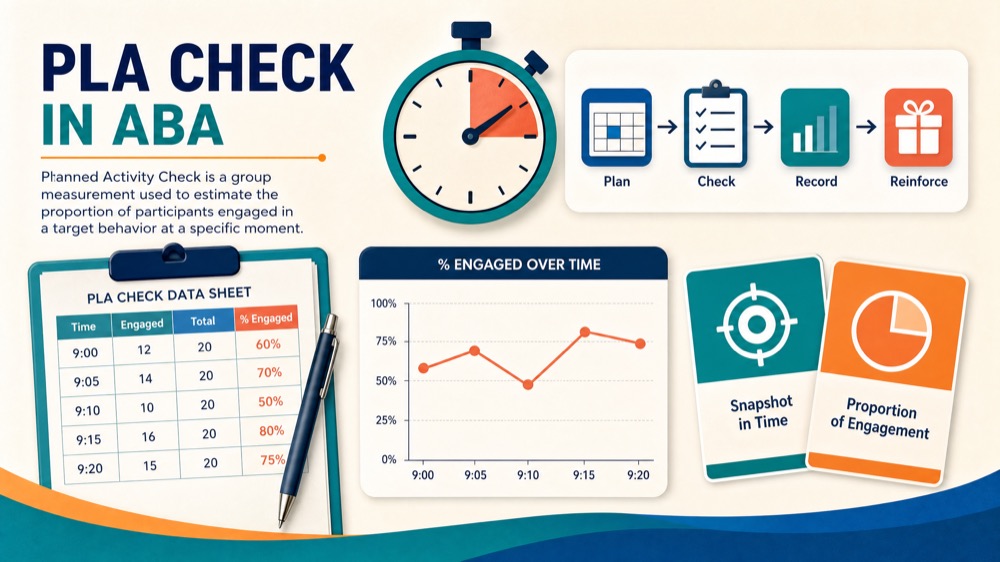
PLA Check, short for Planned Activity Check, is a group measurement procedure used in applied behavior analysis to estimate the proportion of participants engaged in a target behavior at a specific moment. Developed by Cataldo and Risley in 1973, this method applies momentary time sampling: at the end of a predetermined interval, the observer scans the group and records each individual as engaged or not engaged. The resulting percentage reflects group engagement at that instant, not over the entire interval. This approach is efficient for busy settings like classrooms, where continuous observation of every learner is impractical. Table of Contents
Table of Contents
- What Is PLA Check in ABA?
- How to Conduct a PLA Check: Step-by-Step
- PLA Check vs. Continuous Measurement
- Interpreting PLA Check Results
- Common Traps and How to Avoid Them
- Practical Applications in Educational Settings
- Study Checklist for Mastering PLA Check
- Conclusion
- Reference
In practice, PLA Check helps behavior analysts and educators monitor whether a group activity maintains attention and participation. Because it samples only a single moment per interval, it requires less time and effort than continuous recording, making it feasible to collect data throughout the day. The score is a proportion, not a total duration, so it answers the question: “At this moment, what fraction of the group is engaged?” This guide explains the procedure step by step, provides an original classroom example, and clarifies common misconceptions to support accurate use in educational and clinical settings.
How to Conduct a PLA Check: Step-by-Step
Implementing a PLA Check involves a systematic process that ensures reliable data. The following steps outline the typical procedure used in educational and clinical settings. Following these steps helps maintain accuracy and consistency across observations.
- Define the target behavior: Clearly operationalize what counts as engagement. For example, define “on-task” as looking at the teacher, writing, or reading assigned material. Avoid vague terms like “paying attention.”
- Select the interval length: Choose a time interval that matches the activity. Common intervals range from 1 to 10 minutes. Shorter intervals give more samples but require more frequent observations.
- Set a timer: Use a timer that signals at the end of each interval, prompting you to observe.
- Scan the group at the moment the interval ends: At the exact instant the timer signals, look at each participant one by one and record whether they are engaged. Do this quickly, as the observation should capture behavior at that precise moment.
- Record each participant as engaged or not: Use a data sheet with each participant’s name or number. Mark a plus or check for engaged, a minus or X for not engaged.
- Calculate the percentage engaged: Divide the number of participants marked engaged by the total number of participants and multiply by 100. This is the PLA Check score for that interval.
- Repeat across intervals: Continue this process for the entire observation session. At the end, you may average the percentages to get an overall engagement estimate.
For example, a teacher defines on-task behavior as “eyes on the assignment or actively writing.” Every 5 minutes, the teacher sets a timer. When it rings, the teacher looks up and scans the class. If 8 out of 10 students are on-task, the PLA Check score for that interval is 80%. The teacher repeats this throughout a 30-minute worksheet period, resulting in six data points.
The key is that the observation must occur at the end of the interval, not before or after. Waiting even a few seconds can alter the data. Therefore, setting a clear signal is critical. Many practitioners use a vibrating timer or a quiet chime to avoid disrupting the group.
PLA Check vs. Continuous Measurement
It is common to confuse PLA Check with continuous measurement techniques like duration or frequency recording. However, they are fundamentally different. PLA Check is a discontinuous measurement method: it samples behavior at specific moments, not continuously. As a result, it does not measure the duration of each individual’s engagement, nor does it provide a frequency count.
Continuous measurement, such as event recording, tracks every instance of a behavior. For group engagement, continuous measurement would require observing each participant throughout the entire session to note when they start and stop engaging. This is often impractical in a group setting. PLA Check trades some accuracy for feasibility, giving a snapshot that can be used to estimate engagement.
Another key difference is that PLA Check provides a group-level proportion, not individual behavior data over time. For instance, a PLA Check score of 70% indicates that seven out of ten participants were engaged at the moment of observation. It does not tell you which individuals were consistently engaged or how long they remained engaged. To track individual behavior, you would need a different method, such as interval recording per individual.
Because PLA Check only samples a moment, it may miss behaviors that occur between observation points. For example, a student might be off-task for two minutes and then return to work before the next interval ends. That off-task behavior would go undetected. This limitation is acceptable when the goal is to monitor overall group engagement, not individual variability.
Interpreting PLA Check Results
When interpreting PLA Check data, it’s important to remember that the score is an estimate of engagement at a particular moment, not a precise measurement of total engagement time. A score of 80% means that at the moment of observation, 80% of the group were engaged. It does not mean that students were on-task for 80% of the period. This distinction is crucial for accurate data analysis.
PLA Check results are also sensitive to the length of the interval used. Shorter intervals yield more data points and a more fine-grained picture of engagement fluctuations. Longer intervals provide fewer samples and may miss brief changes in engagement. For example, if you use a 10-minute interval, you might miss a 1-minute disruption that happens right after the observation. Therefore, interval length should be chosen to match the nature of the activity.
Another interpretation caveat is that PLA Check is best used for group-level decisions. If you need to evaluate an individual’s engagement, this method is not appropriate. However, for assessing whether a class-wide intervention is improving overall participation, PLA Check is a sensitive and practical measure.
When using PLA Check to evaluate an intervention, it is essential to collect baseline data before implementing the change. Then, continue PLA Check during the intervention. Compare the percentage of engaged participants across phases. If the average engagement increases, it suggests the intervention may be effective. Always consider other factors that could influence engagement, such as time of day or activity type.
Common Traps and How to Avoid Them
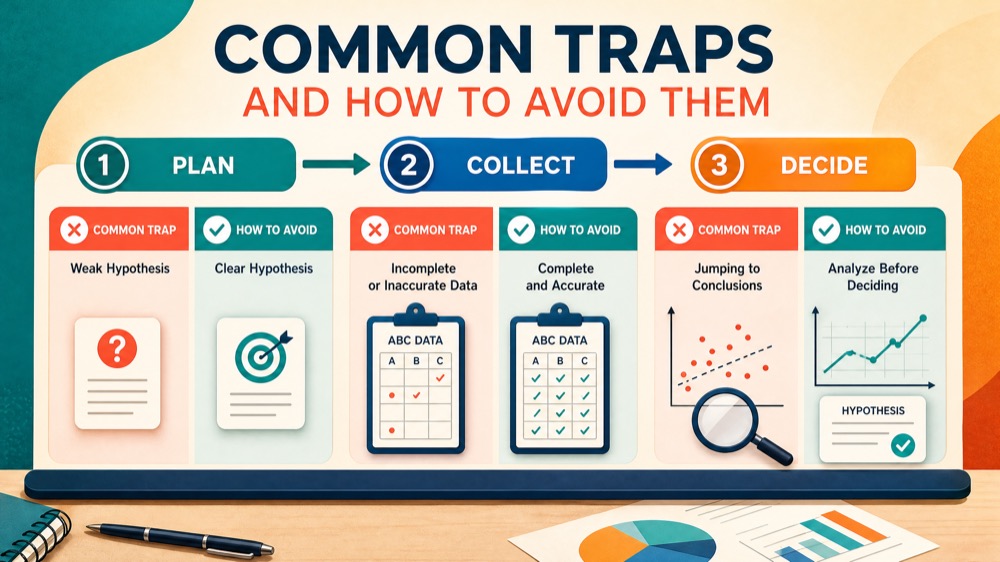
Even experienced practitioners can make errors when using PLA Check. Here are some common pitfalls to watch for, along with strategies to avoid them.
- Vague definitions of engagement: If your definition is not specific, different observers may disagree. Use clear, observable behaviors. For example, “on-task” might be defined as “writing, reading, or looking at the instructor.”
- Observing too early or late: The observation must happen exactly at the interval end. Set a timer and act on its signal immediately. If you wait even five seconds, the data may not be valid.
- Using PLA Check for individual behavior: This method is designed for groups. Do not use it to track one person’s behavior over time, as it only samples at moments.
- Misinterpreting the percentage as duration: A 60% score does not mean participants were engaged for 60% of the time. It means 60% were engaged at that specific moment.
- Ignoring interval length effects: Changing interval length can change results. Keep interval length consistent across sessions for comparison.
- Failing to train observers: Ensure all observers understand the operational definition and practice until interobserver agreement is high.
By being mindful of these traps, you can collect reliable PLA Check data that supports your clinical decisions. Remember that PLA Check is a tool, not a perfect measure, and its limitations should be acknowledged in your analysis.
Practical Applications in Educational Settings
PLA Check is widely used in classrooms to monitor group engagement during lessons, independent work, or group activities. Teachers can use this method to quickly assess whether students are on-task and make adjustments as needed. For example, a teacher might notice that engagement drops after 15 minutes of a lecture, prompting them to incorporate more interactive elements.
In special education settings, PLA Check can evaluate the effectiveness of behavior intervention plans aimed at increasing engagement. By taking data before and after implementing a token economy or other reinforcement system, the teacher can see if group engagement improves. This data-driven approach aligns with the principles of applied behavior analysis.
Another application is in group therapy or social skills groups. A behavior analyst might use PLA Check to measure how many participants are actively participating in a discussion. This can help determine if activities are appropriately engaging or if modifications are needed.
Using PLA Check in these settings is efficient because it does not require constant attention. The observer can attend to other duties between intervals. However, it is important to schedule observations systematically so that the data are representative of the entire session.
Study Checklist for Mastering PLA Check
If you are studying PLA Check for the BCBA exam or for professional development, use this checklist to ensure you understand the procedure fully.
- Can you define PLA Check and identify it as a momentary time sampling procedure?
- Do you know the steps to conduct a PLA Check, including defining behavior, setting intervals, and calculating percentages?
- Can you distinguish PLA Check from continuous measurement methods like duration or frequency recording?
- Do you understand that PLA Check provides a proportion of engaged participants at a specific moment, not a duration?
- Are you aware of the limitations, such as missing behaviors between intervals and sensitivity to interval length?
- Can you give an original example of PLA Check in a classroom or other group setting?
Review these points and practice with sample scenarios. For more practice, take the free BCBA mock exam to test your knowledge of ABA concepts. While the exam may not include PLA Check specifically, it covers a range of measurement and assessment topics.
Remember to consult the current BACB Task List for details on measurement and data collection. You can access the official outline at the BACB website. Additionally, the original article by Cataldo and Risley (1973) provides historical context and is available through ERIC.
Conclusion
PLA Check is a valuable tool for behavior analysts working with groups. It offers a practical way to measure engagement using momentary time sampling. By understanding the procedure, interpreting results correctly, and avoiding common pitfalls, you can use PLA Check to inform your practice and evaluate interventions. Whether you are a teacher, BCBA, or student, mastering this technique will enhance your ability to monitor group dynamics. Continue exploring our resources to deepen your understanding of ABA assessment and measurement. Ready to test your knowledge? Take the Free BCBA Mock Exam and get immediate feedback on your performance. It’s a great way to identify areas for improvement.
Reference
Next step for BCBA exam prep
Turn this topic into exam-day practice
Use this topic as a focused review, then test it in exam-style conditions with a free mock before deciding whether five full-length mocks are the right next step.
Start the Free BCBA Mock Exam
Continue with Five Full-Length Mocks — $99
Review the included materials and access details before ordering. No pass guarantee is implied.



