
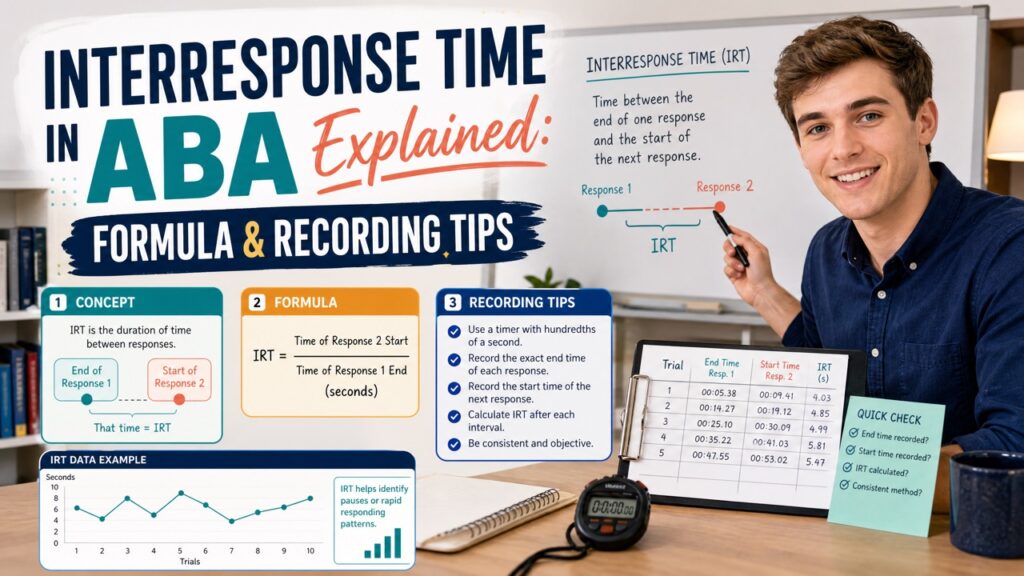
Interresponse time (IRT) is a fundamental temporal measurement in applied behavior analysis (ABA). It measures the elapsed time between two successive instances of the same response class, typically recorded from the offset of one response to the onset of the next. This metric helps behavior analysts understand response pacing, evaluate intervention effects, and implement schedules like differential reinforcement of low rates (DRL). This guide explains the definition, formula, and recording methods for IRT, with clear distinctions from related measures.
Table of Contents
- What Is Interresponse Time in ABA?
- IRT Formula and Worked Example
- IRT vs. Latency, Duration, Count, and Rate
- IRT in DRL Schedules
- Practical Recording Tips for IRT
- Common Traps and Misconceptions
- Recording Checklist for IRT
- Study Strategies for IRT
- Next Steps: Practice with a Free Mock Exam
What Is Interresponse Time in ABA?
Interresponse time (IRT) is defined as the time between two successive instances of the same response class. The standard convention is to measure from the response offset of one response to the response onset of the next. For example, if a child presses a button (onset at 1 second, offset at 2 seconds) and presses it again (onset at 5 seconds), the IRT is 3 seconds (5 − 2). This offset-to-onset convention is used throughout this article unless stated otherwise.
Some software or research contexts may report onset-to-onset intervals, which include the duration of the first response. It is essential to specify the convention in your operational definition and data sheets. Mixing conventions within a single data set can lead to inaccurate conclusions. Always document the chosen method.
IRT is particularly useful for behaviors that occur rapidly or where the spacing of responses is clinically relevant. For example, in treating thumb-sucking, an IRT measure might track the time between sucking episodes. This temporal insight helps differentiate between an individual who sucks once per hour versus someone who sucks 20 times in a burst. Such distinctions inform intervention strategies.
IRT Formula and Worked Example
Using the standard offset-to-onset convention, the formula is:
- IRT = Onset of next response − Offset of preceding response
Let’s work through a detailed example. Imagine you are recording a child’s hand-raising during a 10-minute observation. You record the following timestamps (in seconds):
- Response 1: onset 5.0, offset 6.5
- Response 2: onset 10.0, offset 11.0
- Response 3: onset 15.5, offset 16.0
- Response 4: onset 20.0, offset 21.0
Calculate each IRT:
- IRT1 = 10.0 − 6.5 = 3.5 seconds
- IRT2 = 15.5 − 11.0 = 4.5 seconds
- IRT3 = 20.0 − 16.0 = 4.0 seconds
To find the mean IRT, sum the intervals and divide by the number of intervals: (3.5 + 4.5 + 4.0) / 3 = 4.0 seconds. Notice that with four responses, there are only three IRT intervals. A common error is to divide by the number of responses (4) instead of the number of intervals (3). Always count the number of gaps between responses, not the number of responses.
When you have a larger data set, you may also calculate the median IRT or report the range and standard deviation. These statistics provide a fuller picture of response variability. For example, a mean IRT of 5 seconds might hide a pattern of rapid responses followed by a long pause. Visualizing IRTs on a timeline or histogram helps identify such patterns.
IRT vs. Latency, Duration, Count, and Rate
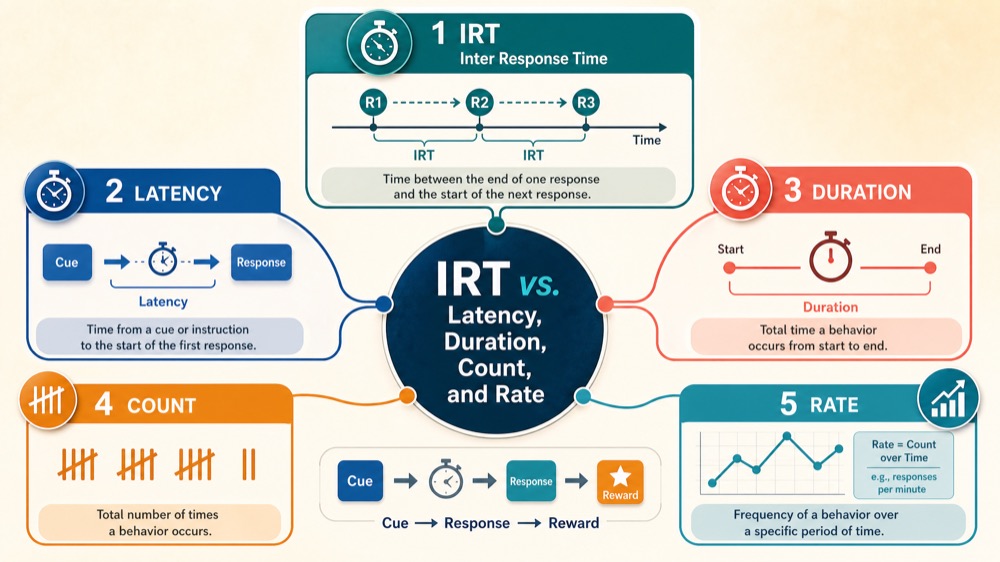
IRT is often confused with other temporal measurements in ABA. Understanding these distinctions is critical for accurate data collection and interpretation. Below, we compare IRT with latency, duration, count, and rate, using examples and non-examples.
IRT vs. Latency: Latency measures the time from the onset of a stimulus to the response onset. For example, if a teacher says “sit down” at time 0 and the student begins sitting at 4 seconds, the latency is 4 seconds. In contrast, IRT involves no external stimulus; it measures the time between two responses. Non-example: recording the time from a bell ringing (stimulus) to a student raising their hand is latency, not IRT. Always ask: Is there an antecedent stimulus that signals the response? If yes, you are likely measuring latency.
IRT vs. Duration: Duration is the total time a single response lasts, from response onset to response offset. For instance, if a child cries for 5 minutes, the duration is 5 minutes. IRT is the gap between the end of one response and the start of the next. Non-example: measuring how long a student stays on task is duration; the time between two separate on-task episodes would be IRT. Remember: duration is within a response; IRT is between responses.
IRT vs. Count and Rate: Count is the number of responses (e.g., 15 hand raises). Rate is count per unit of time (e.g., 15 per hour). IRT provides fine-grained information about the distribution of those responses. For example, two sessions could have the same rate (10 responses per 10 minutes) but very different IRT patterns: one with evenly spaced responses, another with many short IRTs and a long pause. Non-example: reporting that a behavior occurred 20 times in an hour captures count and rate but not IRT. IRT enriches your understanding of response spacing.
IRT in DRL Schedules
IRT is a key component in differential reinforcement of low rates (DRL) schedules. In a DRL schedule, reinforcement is delivered only when the time between responses meets or exceeds a specified criterion. For example, you might set an IRT criterion of 10 seconds: the learner must refrain from responding for at least 10 seconds between responses to earn reinforcement. This encourages spacing of responses and reduces rapid responding.
Importantly, a DRL schedule shapes temporal spacing, not just overall count. For instance, if a child interrupts frequently, simply telling them to “interrupt less” might reduce the total number of interruptions, but there could still be rapid bursts. In contrast, a DRL with a 5-minute IRT criterion requires the child to wait 5 minutes between interruptions, promoting more appropriate pacing. Understanding this distinction is key for designing effective interventions.
There are two types of DRL: full-session DRL and spaced-responding DRL. Full-session DRL sets a maximum number of responses for the entire session, while spaced-responding DRL sets a minimum interresponse time. IRT is directly relevant to spaced-responding DRL. For example, to reduce a child’s excessive nose-picking, you might implement a DRL procedure where reinforcement is provided if the child goes at least 30 seconds without nose-picking. This requires precise IRT measurement.
Practical Recording Tips for IRT
Accurate IRT recording requires a clear operational definition and a consistent measurement strategy. Here are practical tips to improve your data collection:
- Define the response class precisely: Specify what constitutes the onset (e.g., first movement) and offset (e.g., return to rest) of the behavior. For hand-flapping, onset could be the first upward movement; offset when the hand returns to rest.
- Use reliable timing tools: Employ a stopwatch, timer app, or behavioral software for precise timestamps. For high-rate behaviors, automated data collection is often preferred to avoid human error.
- Decide on the IRT convention: Offset-to-onset is standard, but if you use onset-to-onset, be explicit. Document the convention in your data sheets to avoid confusion.
- Record every IRT: Do not skip intervals. If observation breaks occur, mark those intervals as “no data” or “censored.”
- Feasibility limits: IRT measurement works best for discrete responses with clear boundaries. For high-rate, overlapping (e.g., continuous talking) or poorly bounded responses (e.g., rocking), IRT may be difficult or meaningless to record.
Common Traps and Misconceptions
Many students confuse IRT with other measures or misuse the concept. Here are common pitfalls to avoid in practice:
- IRT is not the same as latency: Latency involves a stimulus preceding the response; IRT is purely between responses. For example, if you measure time from a teacher’s prompt to a response, that’s latency, not IRT.
- IRT is not the duration of a single response: Duration measures the length of one response, while IRT measures the gap between responses. For instance, the time you spend reading this paragraph is duration; the time between reading two paragraphs is IRT.
- IRT is not always onset-to-onset: The convention must be stated; many use offset-to-onset. Mixing conventions in one dataset is a serious error.
- Short IRT does not necessarily indicate a problem: Whether a short IRT is problematic depends on the behavioral goal and context. For example, a student’s rapid hand-raising when answering questions might be desired in some settings.
Recording Checklist for IRT
Before collecting IRT data, review this checklist to ensure accuracy and consistency:
- Define the response class (e.g., “pressing the red button” with clear onset/offset).
- Specify the onset and offset events (e.g., “onset: first contact; offset: when hand leaves button”).
- Choose the unit of measurement (e.g., seconds, tenths of seconds).
- Determine the observation period (e.g., 10-minute sessions) and decide how to handle responses that occur right at the start or end (e.g., do you include them?).
- Note any missing or censored intervals (e.g., if you were not observing during a planned break, mark that IRT as “no data”).
- Use a reliable timer or data collection app.
- Practice with a mock recording before official data collection.
Study Strategies for IRT
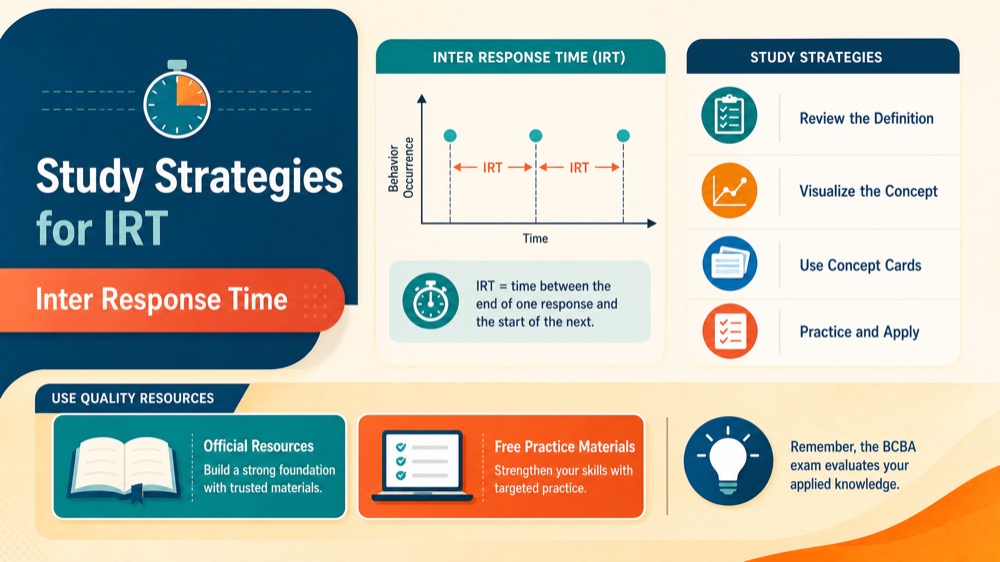
To solidify your understanding of IRT, try these study strategies:
- Create a comparison chart of IRT, latency, duration, count, and rate, with at least one original example and one non-example for each.
- Practice computing mean IRT from a set of timestamps (as shown earlier) and check your answer.
- Design a mini-simulation: observe a video of a behavior (e.g., a child playing) and record IRT using a stopwatch, then compare with a peer.
- Write a brief operational definition for three different behaviors and identify the onset/offset for each.
- Relate IRT to reinforcement schedules: research DRL and think of a real-life application (e.g., reducing interrupting behavior).
- Review the BACB BCBA Test Content Outline to see how measurement concepts like IRT fit into the assessment and intervention sections.
Remember, the BCBA exam evaluates your applied knowledge. Use official resources and our free practice materials to strengthen your skills.
Next Steps: Practice with a Free Mock Exam
Ready to test your understanding of ABA measurement concepts and more? Take our free BCBA mock exam to practice with realistic questions and receive instant feedback. This free resource can help you identify areas for improvement and build your confidence before the real exam. You’ll also find additional practice questions on other key topics. Don’t miss this opportunity to enhance your preparation.
In summary, interresponse time is a critical measure that reveals the temporal dynamics of behavior. By understanding its definition, formula, and distinctions from other measures, you can apply it effectively in research and practice. Use the recording checklist to collect accurate data and the study strategies to master this concept for the BCBA exam. Start practicing today with our free mock exam and take your ABA knowledge to the next level.
Next step for BCBA exam prep
Turn this topic into exam-day practice
Use this topic as a focused review, then test it in exam-style conditions with a free mock before deciding whether five full-length mocks are the right next step.
Start the Free BCBA Mock ExamContinue with Five Full-Length Mocks — $99
Review the included materials and access details before ordering. No pass guarantee is implied.



