
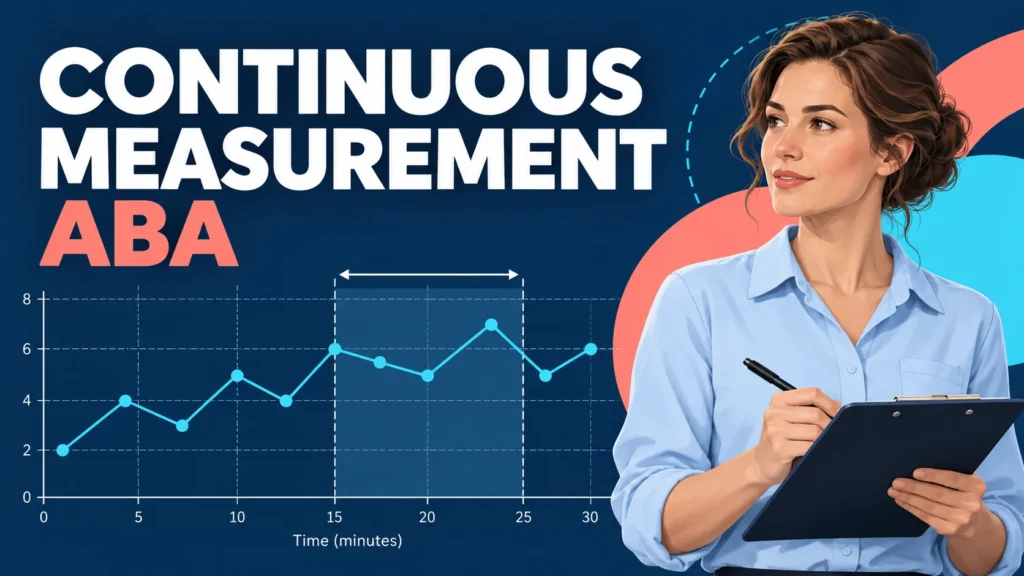
Continuous measurement in ABA means observing a defined target behavior across the full observation period and recording the relevant behavioral dimension as it occurs. If the question is “How often?”, you may record frequency or rate. If the question is “How long?”, use duration. If it is “How quickly did the response begin?”, use latency. Interresponse time (IRT) answers “How much time passed between responses?”
The method is powerful because it preserves more information than interval sampling, but it also requires clear definitions, consistent observation, and enough observer attention to collect trustworthy data. This guide explains the main types, works through the calculations, compares continuous and discontinuous procedures, and shows how to choose a method for clinical work and BCBA exam questions.
Quick answer: Choose continuous measurement when the behavior can be observed reliably and you need a complete record of its occurrence, duration, onset, or spacing. The best procedure is the one that matches the operational definition and the clinical question—not simply the procedure that produces the largest or smallest number.
What is continuous measurement in ABA?
In applied behavior analysis, continuous measurement records behavior throughout the entire planned observation session rather than checking only selected intervals. For a discrete behavior, that may mean counting every instance. For an ongoing behavior, it may mean timing each episode or the total time engaged. For a skill-acquisition target, it may mean recording the time from an instruction to a response or the number of teaching trials needed to meet a criterion.
“Continuous” describes the coverage of the observation period. It does not mean that an observer should collect every conceivable detail. The observer still needs an observable, measurable operational definition, a start and stop rule, a session length, and a recording system. For example, “noncompliance” is too vague to score consistently. “After a clear instruction, the learner does not begin the requested action within 10 seconds” gives the observer a behavior and a timing rule that can be measured.
Continuous data are especially useful when small changes matter, when the behavior is relatively discrete, or when the intervention depends on timing. They can be difficult when the behavior is very frequent, several behaviors compete for attention, the observer cannot watch continuously, or safety responsibilities make uninterrupted recording unrealistic. In those situations, a well-designed discontinuous procedure may be more feasible—but it should be selected deliberately and interpreted according to its sampling limitations.
Types of continuous measurement: definitions and examples
The following procedures answer different questions. Do not select one only because the label sounds familiar; first identify the dimension of behavior that matters.
1. Frequency or count: How many times?
Frequency is the number of times a defined behavior occurs during an observation period. Each occurrence must have a clear beginning and end so that the observer knows whether two movements are one episode or two. For example, if a learner independently requests help seven times during a 30-minute work period, the frequency is 7 requests.
Frequency is useful for discrete responses such as hand raises, verbal requests, aggression episodes with clear onset and offset, or completed steps. Its main limitation is that a raw count is hard to compare when sessions have different lengths. Seven responses in 30 minutes and seven responses in 90 minutes are not equivalent exposure conditions.
2. Rate: How often relative to time?
Rate standardizes a count by the amount of observation time:
Rate = frequency ÷ observation time
Suppose a student calls out 27 times during a 45-minute class. The rate is 27 ÷ 45 = 0.6 calls per minute. In a later 30-minute class, the student calls out 24 times. The raw count is lower, but the rate is 24 ÷ 30 = 0.8 calls per minute. Looking only at frequency would make the second session appear better; rate reveals that calls were actually more frequent relative to time.
Use the same time unit when comparing sessions and label the denominator clearly. Rate can be reported per minute, per hour, or another meaningful unit. It is often the better choice when observation periods differ or when opportunities to respond are not identical.
3. Duration: How long?
Duration recording measures how long a behavior lasts. The observer starts a timer when the operationally defined behavior begins and stops it when the behavior ends. You may report total duration, duration per episode, or the percentage of the observation period spent engaging in the behavior.
For example, a learner is on task for four episodes lasting 3, 5, 2, and 4 minutes. Total duration is 14 minutes. If the session lasted 20 minutes, on-task behavior occupied 14 ÷ 20 = 70% of the session. If the clinical question is how long each tantrum lasts, the same data could be summarized as 13 minutes across three episodes, or an average of about 4.3 minutes per episode. The summary must state which calculation was used.
Duration is a strong fit for behavior that extends over time, such as crying, engagement, sleep, off-task behavior, or time spent completing a task. It is not a substitute for frequency when the number of episodes is the important outcome.
4. Latency: How quickly does the response start?
Latency is the time between a specified antecedent and the beginning of the target response. A common example is the time between an instruction and compliance. If the instruction “Please take out your math book” is delivered at 9:00:00 and the learner starts the response at 9:00:45, latency is 45 seconds.
Across five trials with latencies of 45, 30, 60, 25, and 40 seconds, the mean latency is (45 + 30 + 60 + 25 + 40) ÷ 5 = 40 seconds. Latency is appropriate when response speed matters, such as responding to safety directions, beginning a task, or using a communication response after a motivating operation. Define exactly when the antecedent starts the timer and what observable action stops it.
5. Interresponse time (IRT): How far apart are responses?
Interresponse time is the time between the end of one response and the beginning of the next response of the same class. If a learner completes one request at 10:02:10 and makes the next request at 10:03:40, the IRT is 90 seconds.
IRT is useful when spacing matters. An intervention may aim to increase the time between instances of a stereotypic response, or it may aim to build a fluent pattern in which appropriate responses occur with shorter, consistent gaps. IRT should not be confused with latency: latency begins with an antecedent such as an instruction, whereas IRT begins with one response and ends when the next response starts.
Trials to criterion: How many teaching trials are needed?
Trials to criterion records the number of opportunities required to reach a predefined performance standard, such as 80% independent responses across three consecutive sessions. For example, if a learner reaches the criterion after eight teaching trials, the result is eight trials to criterion.
This is a useful learning-outcome measure, but it is not identical to event recording. It is recorded across discrete teaching trials, and the criterion must be specified in advance. On exam questions, look for the wording “number of trials needed to meet mastery” rather than automatically labeling every trial count as frequency.
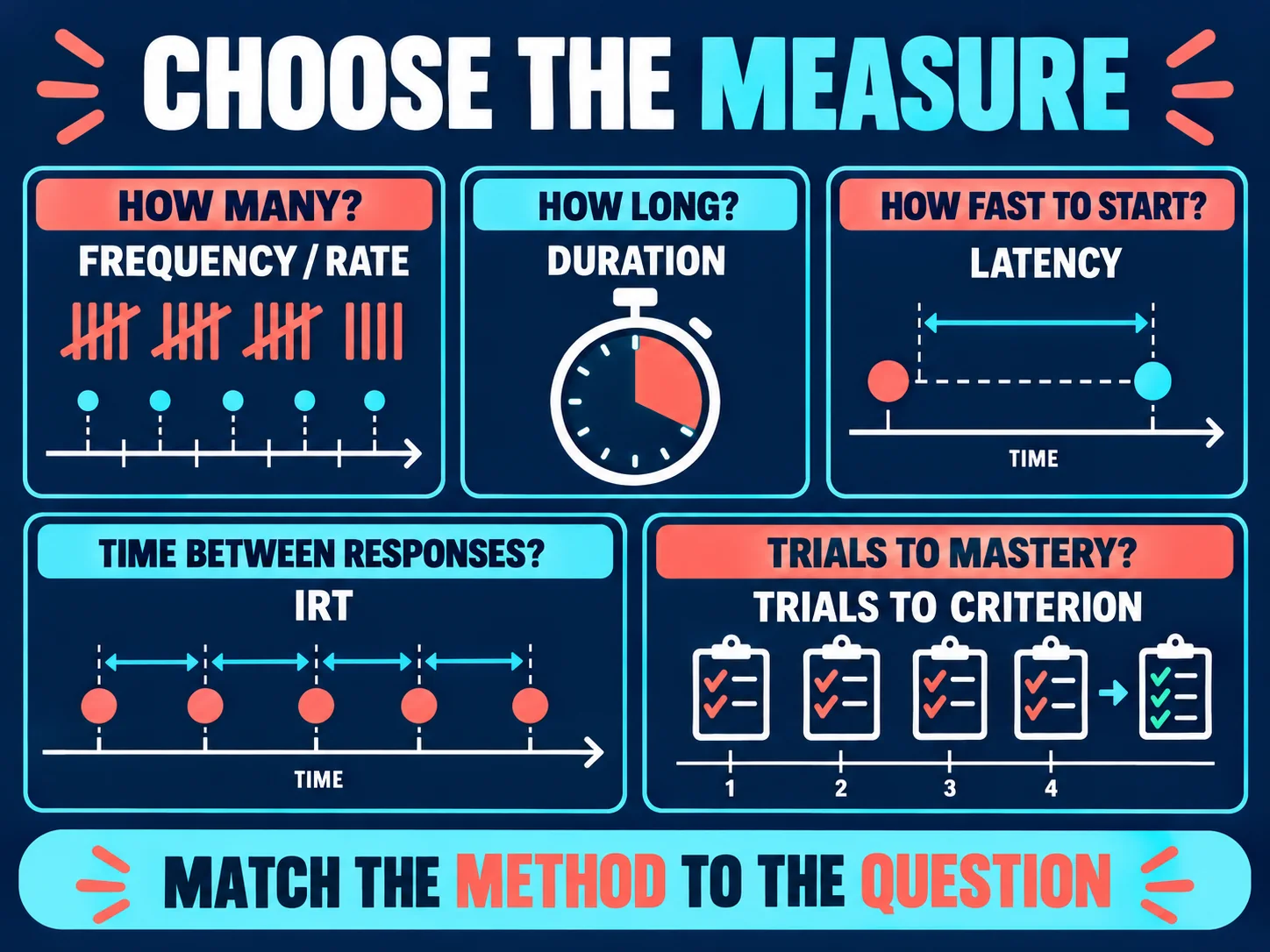
Continuous measurement quick-reference table
| Clinical question | Procedure | Worked example | Watch for |
|---|---|---|---|
| How many responses occurred? | Frequency/count | 7 requests in a 30-minute session | Counts are not directly comparable when session lengths differ. |
| How often did responses occur per unit of time? | Rate | 27 responses ÷ 45 minutes = 0.6/minute | State the time unit and denominator. |
| How long did the behavior last? | Duration | 14 on-task minutes in a 20-minute session = 70% | Specify total, per episode, or percentage duration. |
| How quickly did the response begin? | Latency | 45 seconds from instruction to response onset | Define the exact antecedent and response onset. |
| How much time passed between responses? | IRT | 90 seconds between two requests | Use the same response class and start/stop rules. |
| How many opportunities were needed for mastery? | Trials to criterion | 8 trials to reach the stated criterion | Write the mastery criterion before teaching begins. |
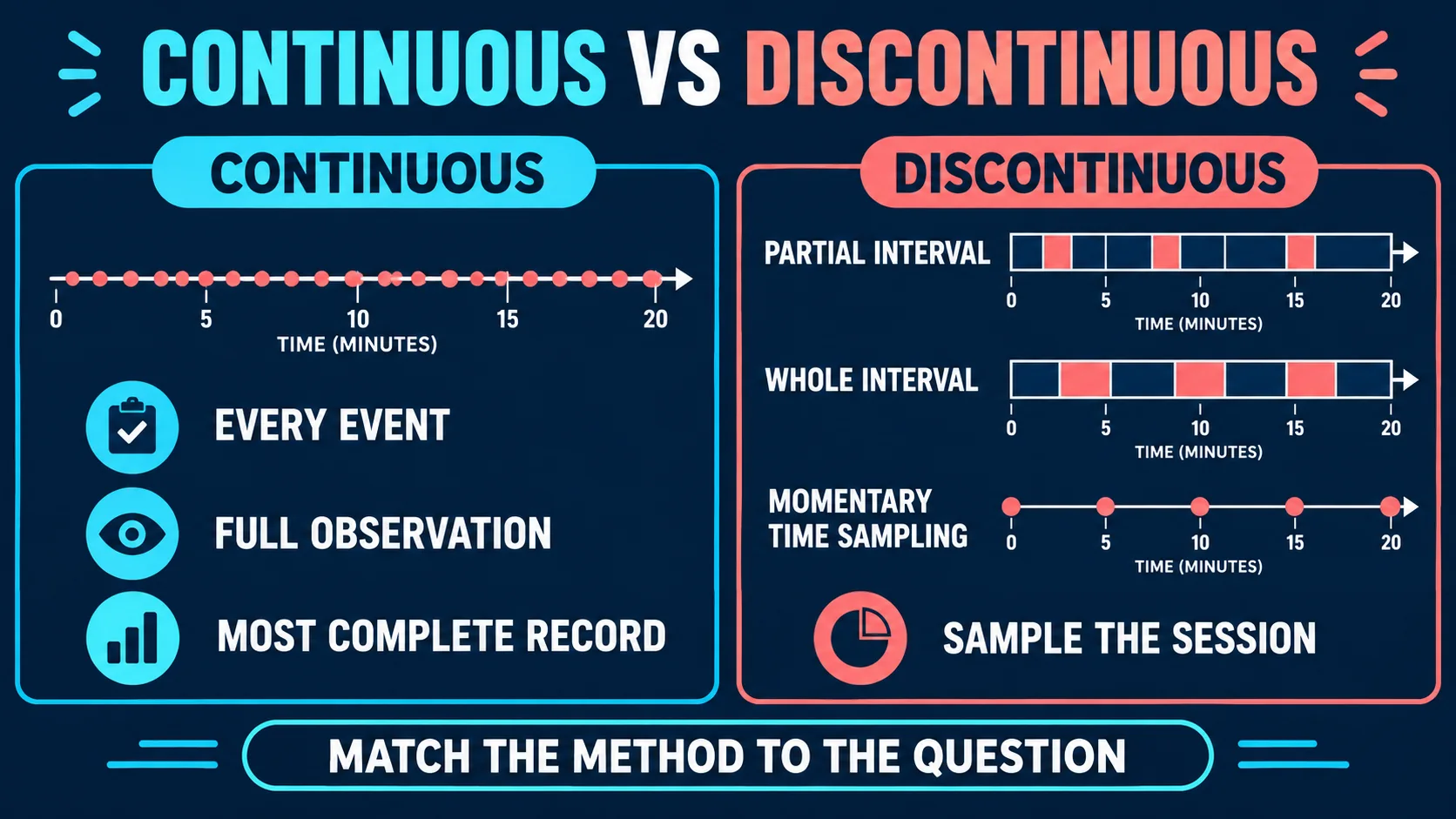
Continuous versus discontinuous measurement
Continuous measurement observes the full planned session. Discontinuous measurement samples behavior during intervals or at selected moments. The choice is a trade-off between information and feasibility, not a ranking in which one method is always correct.
| Procedure | What is scored? | Typical interpretation |
|---|---|---|
| Continuous | Every defined response or the complete timing dimension | Most complete record when observation and definitions are reliable |
| Partial-interval recording | Whether the behavior occurred at any point in the interval | Can overestimate how much of the interval the behavior occurred |
| Whole-interval recording | Whether the behavior occurred for the entire interval | Can underestimate behavior that is present but briefly interrupted |
| Momentary time sampling | Whether the behavior is occurring at the exact moment of the sample | Efficient estimate; it does not capture what happened between samples |
Use discontinuous procedures when continuous observation is impractical, such as when the behavior is ongoing, the observer must monitor more than one target, or the setting does not permit uninterrupted timing. Interpret the result as a sample or estimate. Do not compare a partial-interval percentage directly with total duration as if they were the same measurement.
How to choose the right measurement procedure
- Define the target behavior. Use observable actions, not labels or inferred traits. State what counts and what does not count.
- Identify the important dimension. Ask whether the decision depends on count, time occupied, response speed, spacing, or mastery.
- Set the observation window. Specify when recording starts, when it ends, and whether the same duration will be used across sessions.
- Write the recording rule. Include response onset, response offset, how close responses must be to count as one episode, and what to do if an event is interrupted.
- Check feasibility. The method must fit the setting, the observer’s responsibilities, the behavior’s rate, and safety requirements.
- Protect data quality. Train observers, check procedural fidelity, and use interobserver agreement when appropriate. Consistent definitions and collection rules make results comparable across people and sessions.
- Review the trend, not a single number. If behavior does not improve, inspect the measurement system and the intervention before drawing a clinical conclusion.
Can continuous and discontinuous methods be used together?
Yes, when they answer different questions and are labeled separately. For example, a team might use continuous duration recording for the primary treatment target and momentary time sampling for a second classroom context where the observer cannot time every episode. It may also record frequency of requests while collecting latency to independent task initiation.
The important safeguards are to keep the operational definitions distinct, record the observation windows, and avoid treating outputs as interchangeable. A percentage of intervals with behavior is not the same as a percentage of time with behavior. If the team changes the method, document the change so a later trend is not mistaken for a treatment effect.
What if progress is not observed?
Do not change the measurement procedure merely to make the graph look better. First ask:
- Is the behavior still defined clearly enough for every observer to score it the same way?
- Was the observation window long enough and comparable across sessions?
- Did observers follow the start, stop, and scoring rules?
- Does the selected dimension actually match the clinical question?
- Was the intervention implemented as designed, and did the context or opportunities change?
After checking data quality and treatment fidelity, the supervising behavior analyst can decide whether the operational definition, measurement plan, intervention, or goal needs revision. A stable, honest measurement system is more useful than a favorable-looking but inconsistent number.
How measurement knowledge helps caregivers advocate
Parents and caregivers do not need to calculate every data point to ask useful questions. Ask what the target behavior means in observable terms, what measurement method was used, how long the observation lasted, and whether the same procedure was used across sessions. Request the trend and the denominator—for example, rate per hour or percentage of time—rather than relying on a raw count without context.
These questions make it easier to tell whether a reported change reflects real progress, a different opportunity level, a different observer, or a change in measurement. They also help the team select goals that matter in daily life, such as faster safety responding, longer independent engagement, or more widely spaced challenging behavior.
BCBA exam tips and common traps
- Frequency is not rate. Frequency is a count; rate includes time.
- Latency is not duration. Latency is time from an antecedent to response onset; duration is how long the response continues.
- IRT is between responses. It starts after one response and ends when the next response begins.
- Match the measure to the definition. An extended behavior may call for duration, while a discrete response may call for frequency or rate.
- Remember sampling effects. Partial interval, whole interval, and momentary time sampling do not provide the same information as continuous recording.
- Read the denominator. A lower raw count can still represent a higher rate when the observation period is shorter.
When a question asks which procedure is best, identify the behavior’s observable dimension, the desired decision, and the practical constraints. The answer is usually the method that captures the needed information with a clearly defined, feasible procedure.
FAQ
What is continuous measurement ABA?
It is a data-collection approach that observes the full planned session and records each relevant occurrence or timing dimension of a defined behavior. Frequency, rate, duration, latency, and IRT are common examples.
Is rate a continuous measurement procedure?
Rate is a standardized summary of a continuous count: divide the number of responses by the observation time. It is especially useful for comparing sessions of unequal length.
Which is more accurate, continuous or discontinuous measurement?
Continuous measurement can provide a more complete record when definitions and observer performance are reliable. Discontinuous methods can be the better practical choice when uninterrupted observation is not feasible. Accuracy depends on the question, procedure, and data quality—not on the label alone.
Bottom line: Start with the question, define the behavior, choose the matching dimension, and keep the observation and recording rules consistent. For more practice, review our guides on ABA data collection methods and functional assessment approaches, then use the official BACB content outline to connect measurement concepts to the exam domains.



