
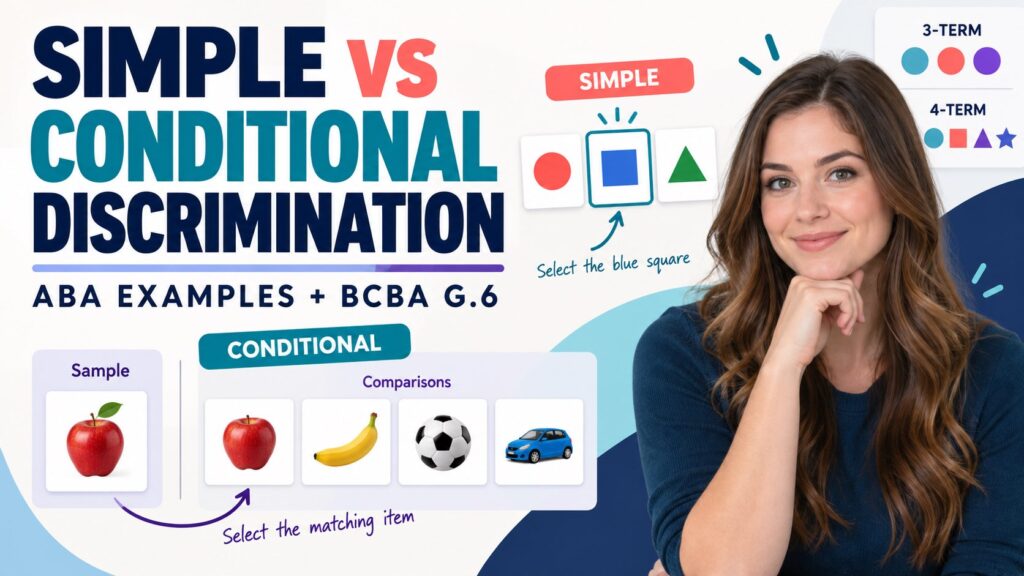
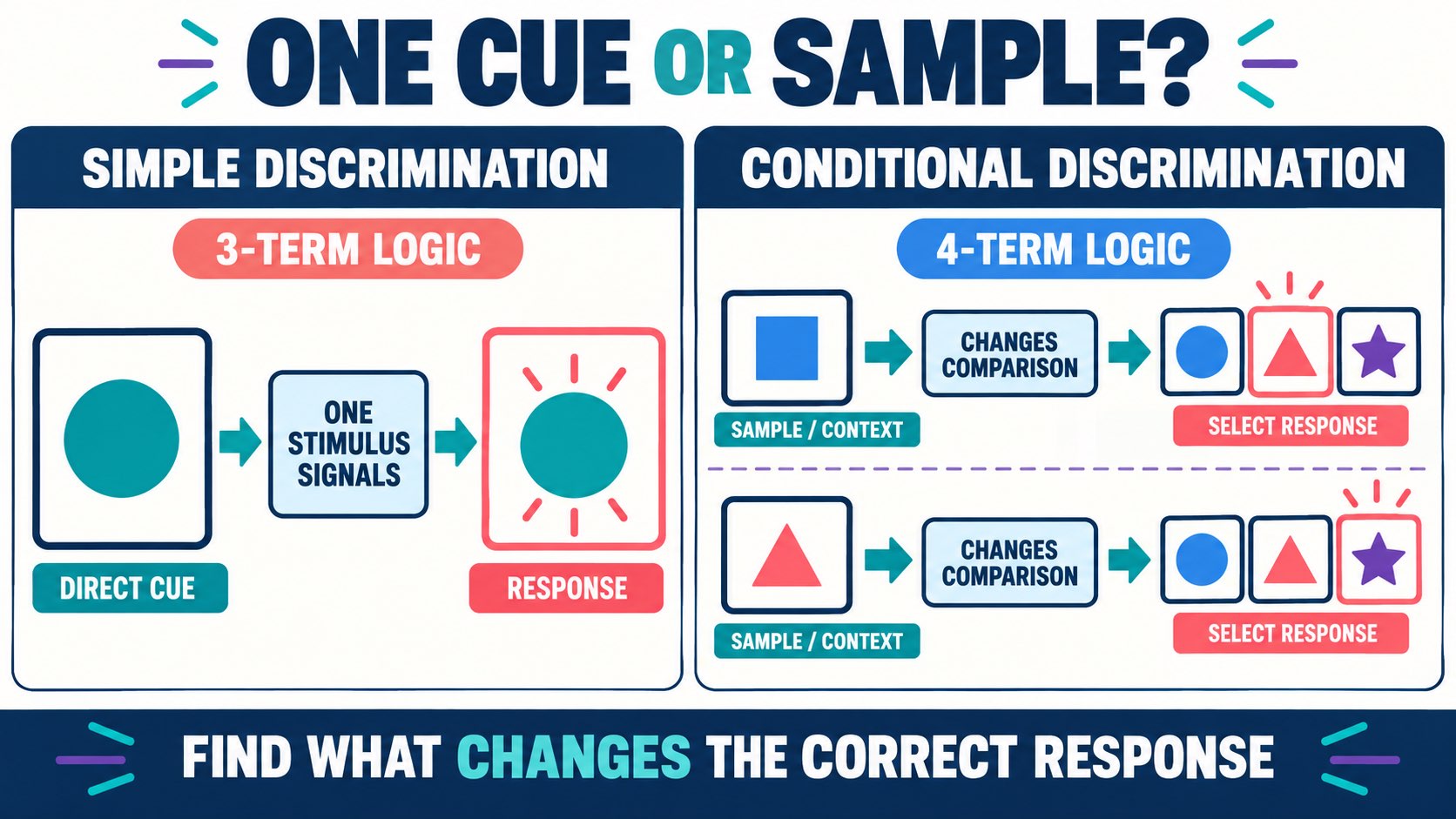
Short answer: Simple vs conditional discrimination ABA questions are asking how many stimulus relations are needed to determine the correct response. In a simple discrimination, one stimulus or stimulus condition directly controls the response. In a conditional discrimination, the correct response depends on another stimulus or context that changes which option is correct. The same comparison stimulus can be correct in one context and incorrect in another.
Table of Contents
- What is simple vs conditional discrimination ABA?
- What is a simple discrimination in ABA?
- What is a conditional discrimination in ABA?
- How do the two arrangements compare?
- What data show the controlling relation?
- How can a BCBA design discrimination training?
- What are the BCBA exam traps?
- Simple vs conditional discrimination ABA FAQ
- Take the Free BCBA Mock Exam
For a fast BCBA decision, ask: “Can I identify the correct response from one stimulus alone, or must I use a sample, instruction, or context to decide?” One controlling relation points toward a simple discrimination. A sample or conditional stimulus that changes the function of the comparison points toward a conditional discrimination. The terms describe the arrangement, not the learner’s intelligence or the difficulty of the task. Table of Contents
What is simple vs conditional discrimination ABA?
Simple discrimination occurs when a response is differentially reinforced in the presence of one stimulus or stimulus condition compared with another. A red card may signal “touch,” while a blue card signals “do not touch.” The learner can determine the relevant response from the stimulus arrangement currently presented; no additional sample is needed to change which comparison is correct.
Conditional discrimination occurs when the function of one stimulus depends on another stimulus. In a match-to-sample task, the sample changes the correct comparison. A triangle sample may make the triangle comparison correct, while a circle sample makes the circle comparison correct. The same comparison stimulus can be selected in one trial and rejected in another, depending on the conditional relation.
The current BACB BCBA Test Content Outline places simple and conditional discrimination procedures in G.6. Use that simple vs conditional discrimination ABA exam scope as a boundary for study, not as a claim that every task with two cards is conditional or that every task with an instruction is automatically simple; identify which stimulus changes the response requirement.
What is a simple discrimination in ABA?
A simple discrimination is a discrimination in which one stimulus dimension or condition directly establishes the occasion for a response, while another stimulus condition signals that the response will not be reinforced. The learner may choose between an SD and an S-delta, follow a direct instruction, or respond differently to the presence and absence of a cue. The defining feature is that the correct response does not change because a separate sample stimulus changes.
Example: selecting red. A teacher presents one red card and one blue card and reinforces touching the red card. The color relation is the relevant discrimination. When a different red card is presented, the learner should still select it if the goal is generalization across red exemplars. This is a simple discrimination even though the array contains several stimuli.
Example: responding to a direct cue. The instruction “stand up” signals standing, while the absence of that instruction does not. If the response is defined by one current cue and the cue does not alter which comparison becomes correct, the task can be analyzed as a simple discrimination. The exact verbal arrangement and reinforcement history still matter; do not classify from the word “instruction” alone.
Example: a go/no-go arrangement. A learner presses a key when a target tone is present and withholds pressing when a non-target tone is present. If the tone itself establishes the response requirement and no sample changes the role of the tone across trials, the arrangement is simple discrimination training. A no-go response can be part of the analysis even though “not responding” is not a response topography in the same way as pressing.
- The relevant cue is identified directly in the trial.
- The correct response does not change because a separate sample changes.
- An S-delta or nonreinforced condition may be present.
- Position, color, prompt wording, and other irrelevant features must still be tested so the learner does not acquire faulty control.
What is a conditional discrimination in ABA?
A conditional discrimination is an arrangement in which one stimulus changes the controlling function of another stimulus. The first stimulus is often called the sample, conditional stimulus, or context. The learner must use the sample to determine which comparison is correct or which response will contact reinforcement. In a four-term description, the relevant relation can include a motivating operation, conditional stimulus, discriminative stimulus, response, and consequence; the exact terms depend on the task and analysis.
Example: identity matching. A triangle sample appears above a triangle and a circle. Selecting the triangle is reinforced. On the next trial, the circle sample appears and selecting the circle is reinforced. The comparison stimuli are not permanently correct or incorrect. Their role changes with the sample, which makes the arrangement conditional.
Example: auditory-visual matching. The learner hears the word “dog” and selects the picture of a dog from several comparisons. When the spoken sample changes to “cat,” the correct picture changes. The comparison picture is selected in relation to the sample, not simply because it has one permanent physical feature.
Example: verbal conditional discrimination. In a question such as “What do you drink?” the word “drink” may alter which response is appropriate. In “What do you wear?” the verbal context changes the response. The response depends on the relevant component or configuration of the verbal stimulus. The Association for Behavior Analysis International’s practical discussion of verbal discrimination emphasizes that simple verbal discriminations may be controlled by one component, while conditional discriminations require the relation among components to be used.
A conditional discrimination is not the same as stimulus equivalence. Conditional discrimination describes the arrangement used to establish or test a relation. Equivalence is a claim about derived relations among stimuli, such as symmetry or transitivity, that requires its own evidence. A match-to-sample task may be used in equivalence-based instruction, but the presence of matching alone does not prove that an equivalence class has formed.
How do the two arrangements compare?
The comparison below is a study tool. It separates the arrangement of the stimuli from the learner’s performance and helps prevent a common mistake: treating any multi-item array as conditional discrimination.
| Question | Simple discrimination | Conditional discrimination |
|---|---|---|
| What determines the response? | A stimulus or condition directly signals the response requirement. | A sample or context changes which stimulus or response is correct. |
| Does a comparison change roles? | Usually no; the relevant cue keeps its programmed role. | Yes; a comparison may be correct in one sample context and incorrect in another. |
| Typical arrangement | SD versus S-delta, go/no-go, or direct-cue discrimination. | Matching to sample, auditory-visual selection, or context-dependent verbal responding. |
| Core exam question | Which cue directly signals the reinforced response? | Which sample or context changes the function of the comparison? |
| Main measurement risk | Position, color, or prompt may control responding instead of the intended cue. | The learner may ignore the sample and respond by position or by one comparison feature. |
The word “conditional” does not mean “harder,” and the word “simple” does not mean “easy.” A simple discrimination can be difficult if the stimuli are subtle or the learner has limited exposure. A conditional discrimination can be acquired efficiently when the sample, comparisons, prompts, and reinforcement are arranged well. Classification depends on the relation among stimuli, not on task difficulty.
What data show the controlling relation?
To evaluate a discrimination, record more than correct and incorrect responses. A high percentage of correct answers can coexist with position bias, prompt dependence, or control by an irrelevant feature. Arrange probes that reveal whether the learner uses the intended cue or relation.
- Map the trial: record the sample, instruction, comparisons, response, consequence, and prompt level in their actual order.
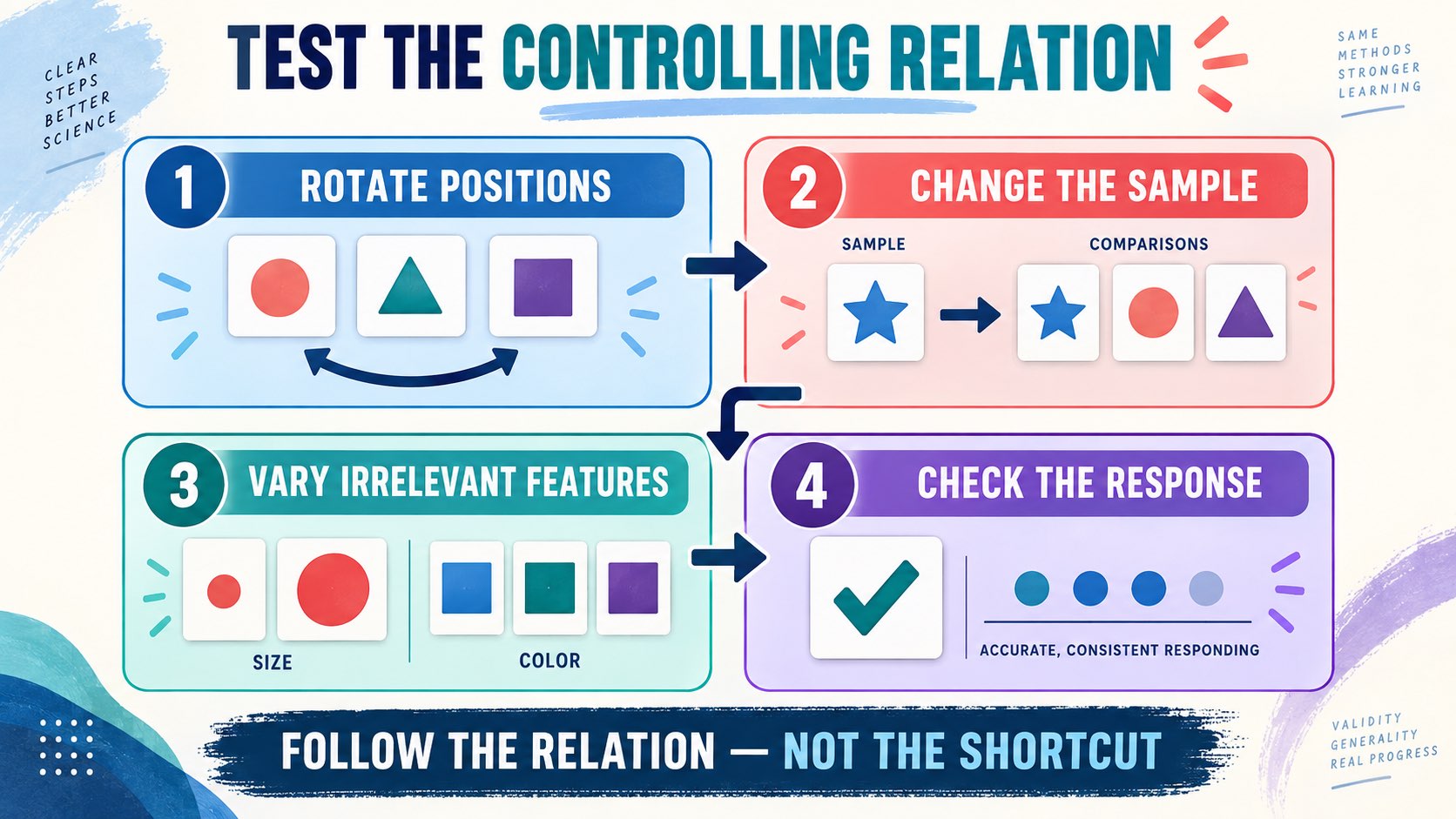
- Vary one dimension: rotate positions, change noncritical features, or use new exemplars while holding the intended relation constant.
- Test the sample: in a conditional task, change the sample while keeping comparison options similar and check whether selection changes appropriately.
- Test nonexamples: present an S-delta or an incorrect comparison and measure whether the learner withholds the response.
- Probe generalization: use new people, materials, voices, and settings only when they fit the target skill and the individualized plan.
- Check integrity: verify that the instructor delivered the sample, prompt, delay, and consequence according to the written procedure.
Suppose a learner selects the left comparison on 90% of trials. That accuracy does not prove either type of discrimination. Rotate the positions and vary the sample. If the learner follows the left position, position may be controlling the response. If the learner changes selections when the sample changes, the data support a conditional relation. If the learner selects the same physical feature across samples, the planned conditional relation may not be controlling the behavior.
Peer-reviewed work on simple and conditional discrimination training illustrates why the arrangement and the data both matter. A separate auditory-visual conditional discrimination comparison shows why generalization probes should be interpreted in relation to the trained arrangement. Studies have used reading, auditory-visual, and matching-to-sample tasks, but their findings should not be turned into a universal protocol for every learner. Use the published evidence to sharpen the question you ask of the data: which stimulus relation was taught, which relation was tested, and which relation actually predicted responding?
How can a BCBA design discrimination training?
Start with the target relation and define the response and consequence. For a simple discrimination, arrange the relevant SD and S-delta and prevent irrelevant features from being perfectly correlated with reinforcement. For a conditional discrimination, specify the sample, comparison set, relation, prompt procedure, and error-correction plan. Then evaluate whether the learner is responding to the intended relation across planned exemplars.
- Vary positions: rotate correct and incorrect choices so location cannot become a shortcut.
- Use multiple exemplars: vary size, color, voice, materials, and people while preserving the target relation.
- Make the sample functional: in a conditional task, arrange trials so changing the sample changes which comparison contacts reinforcement.
- Fade prompts with criteria: measure prompt level and set decision rules before moving to less support.
- Plan transfer tests: evaluate untrained combinations only after the target relation and response are clearly defined.
- Protect assent and communication access: select socially valid targets and avoid treating a single error as evidence of a learner deficit.
When the learner responds accurately only with a particular prompt, location, or display format, describe the observed stimulus control rather than assuming the discrimination has generalized. A BCBA may need to revise the arrangement, add relevant nonexamples, or consult on the skill-acquisition plan. The correct exam answer is usually the one that identifies the controlling relation and the data needed to verify it.
What are the BCBA exam traps?
- Calling every array conditional: multiple stimuli can be presented in a simple discrimination if one cue has a stable direct function.
- Calling every instruction simple: a verbal sample can change which response or comparison is correct, creating a conditional relation.
- Confusing conditional discrimination with equivalence: a matching arrangement does not by itself demonstrate symmetry, transitivity, or an equivalence class.
- Ignoring the sample: if the sample changes the correct comparison, it is central to the analysis even when the learner appears to respond accurately.
- Missing position bias: stable accuracy at one location may reflect faulty stimulus control rather than the intended discrimination.
- Using difficulty as the definition: simple and conditional refer to the stimulus relation, not how easy the task feels.
- Choosing an intervention before identifying the error: first analyze the trial components, then decide what needs to change.
Quick review: Simple discrimination asks whether one stimulus or condition directly controls the response. Conditional discrimination asks whether a sample or context changes which comparison or response is correct. Draw the trial, identify the sample and comparisons, rotate irrelevant features, and check what actually predicts reinforcement. For additional scenario practice, try the free BCBA mock exam. It is a study resource and does not claim to reproduce official BACB questions.
Simple vs conditional discrimination ABA FAQ
What is the simplest difference? In a simple discrimination, one stimulus or condition directly signals the response requirement. In a conditional discrimination, another stimulus or context changes which response or comparison is correct. Is matching to sample always conditional discrimination? A typical matching-to-sample arrangement is conditional because the sample changes which comparison is correct. Still, classify the actual trial structure and programmed contingency rather than relying only on the task name.
Can a conditional discrimination have only one comparison? The label depends on the relation and contingency, not simply the number of physical comparison cards. If another stimulus changes which response is correct, analyze the conditional relation even when the display is simplified.
How can I tell whether a learner learned the intended discrimination? Vary irrelevant dimensions, rotate positions, test planned nonexamples, and change the sample in conditional trials. Look for responding that follows the intended stimulus relation rather than a prompt, location, or superficial feature.
How is this related to the existing conditional-discrimination topic? The conditional-discrimination concept is the same, but this page targets the comparison search intent: it gives simple discrimination equal space and provides a scenario-to-label decision rule for BCBA study.
Take the Free BCBA Mock Exam
When you are ready to apply the idea, use the free practice resource below for additional feedback. Take the Free BCBA Mock Exam



