

“Some Current Dimensions of ABA” is the title of the foundational paper that introduced the seven dimensions of applied behavior analysis. For today’s BCBA learner, the useful question is not whether the seven dimensions have disappeared. It is how to recognize them, connect them to current exam language, and use evidence to judge whether an ABA program is actually strong.
Table of Contents
- Some Current Dimensions of ABA: The 7-Dimension Snapshot
- Historical Foundation Versus Current BCBA Exam Language
- The Evidence Behind Each Dimension
- Use the Dimensions as a Current Program Audit
- How the Dimensions Appear in Exam Scenarios
- Turn the Framework Into a Study Loop
- Frequently Asked Questions
- Sources and Verification Notes
- Quick Review Checklist
- Take the Free BCBA Mock Exam
If you searched for some current dimensions of ABA, you may be looking for more than a memorized list. You may need to remember the original seven dimensions, understand why they still matter, and avoid treating that historical framework as if it were the same thing as the current BCBA Test Content Outline. This guide keeps those jobs separate.
The seven dimensions are a quality lens: applied, behavioral, analytic, technological, conceptually systematic, effective, and generality. The current BCBA exam blueprint is organized into content domains and task statements. The two frameworks can inform one another, but they are not a one-to-one replacement for one another. That distinction is especially important when a question asks you to choose the best measurement, design, intervention, or generalization decision.
Some Current Dimensions of ABA: The 7-Dimension Snapshot
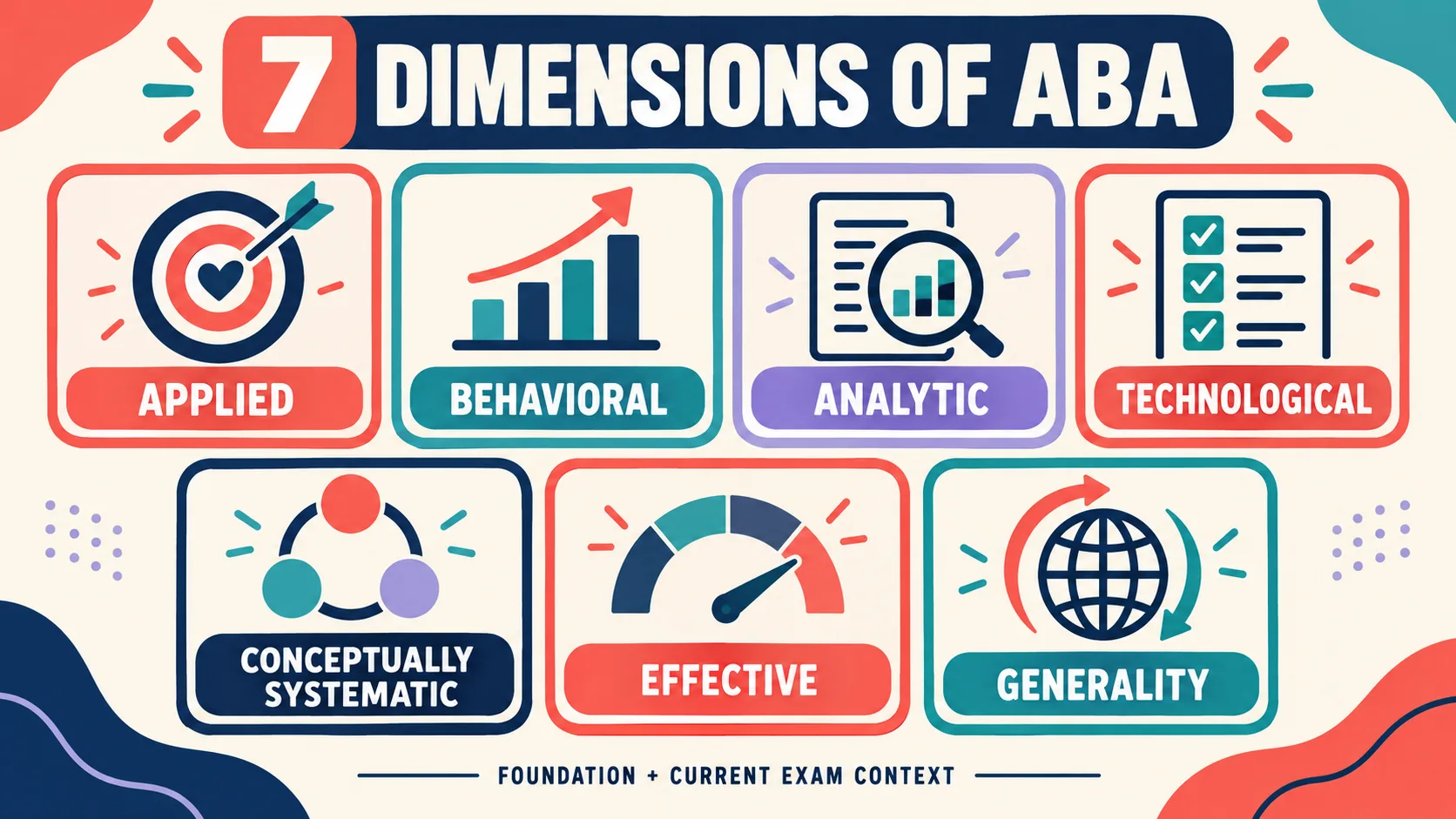
The phrase “current dimensions” comes from the 1968 article by Donald Baer, Montrose Wolf, and Todd Risley. “Current” described the state of applied behavior analysis at that point in the field’s development; it does not mean that the paper is a current exam outline. The seven dimensions remain a compact way to ask whether a behavior-analytic project is connected to meaningful behavior, supported by data, described clearly, and likely to matter outside the original training setting.
| Dimension | Plain-language question | Evidence to look for |
|---|---|---|
| Applied | Does the target matter to the learner, family, organization, or community? | A socially meaningful target, stakeholder priorities, and a reason the change is worth pursuing. |
| Behavioral | Is the target observable, measurable, and tied to the person’s behavior? | An operational definition, a defensible measurement system, and data that reflect the target. |
| Analytic | Does the design show whether the intervention is responsible for the change? | A suitable experimental design, repeated measurement, and a logical interpretation of level, trend, and variability. |
| Technological | Could another trained practitioner implement the procedure from the description? | Steps, materials, decision rules, and enough detail to support treatment integrity. |
| Conceptually systematic | Can the intervention be explained with behavioral principles rather than a list of disconnected tricks? | A clear link among the assessment, behavioral principle, procedure, and expected relation. |
| Effective | Did the change reach a meaningful level, not merely a statistically or visually noticeable one? | Outcome data, practical significance, social validity, and a decision about whether the goal was met. |
| Generality | Does the improvement maintain, spread across people or settings, or transfer to related behavior? | Maintenance checks, generalization probes, programming across contexts, and a plan for fading support. |
Historical Foundation Versus Current BCBA Exam Language
The seven dimensions and the current BCBA Test Content Outline serve different purposes. The 1968 paper is a conceptual foundation for judging applied behavior-analytic work. The current outline is an official exam blueprint that describes the content candidates are expected to know. It is organized into current domains such as measurement, assessment, skill acquisition, behavior reduction, documentation, and ethics rather than into seven historical dimensions.
| Seven-dimension lens | Where it often shows up in current study | What not to assume |
|---|---|---|
| Applied | Selecting meaningful targets, honoring client values, and considering social validity. | That a target is automatically important because a provider selected it. |
| Behavioral | Operational definitions, measurement, data display, and interobserver agreement. | That a broad label such as “noncompliance” is a sufficient definition. |
| Analytic | Single-case design, functional assessment, intervention evaluation, and interpretation of data. | That correlation alone proves a functional relation. |
| Technological and conceptually systematic | Writing procedures, treatment integrity, intervention selection, and principle-based reasoning. | That a named package is clear enough without observable steps or decision rules. |
| Effective and generality | Outcome review, maintenance, generalization, stakeholder feedback, and ethical decision-making. | That any improvement is meaningful or that transfer will happen without programming. |
For exam preparation, use the current BACB outline as the authority for what is tested. Use the seven dimensions as a crosswalk that helps you evaluate the quality of an answer. If a study resource presents the seven dimensions as the entire current exam blueprint, treat that claim cautiously and check the current official outline before relying on it.
The Evidence Behind Each Dimension
Applied: start with a meaningful problem: An applied target has practical importance for the person or the people affected by the behavior. A strong exam answer usually makes the stakeholder need visible. If two interventions could reduce the same behavior, the applied question asks which target and outcome matter in daily life, not merely which one is easiest to count.
Behavioral: define and measure the behavior: Behavioral means the subject matter is behavior that can be observed and measured. A definition should tell two trained observers what counts and what does not. Then the measurement system should fit the dimension of behavior: frequency, rate, duration, latency, interval measures, or another defensible option. If the wording is vague, improve the definition before drawing a conclusion from the graph.
Analytic: connect change to the intervention: An analytic project does more than show that a line moved. It uses a design that supports a reasoned statement about the relation between the independent and dependent variables. In scenario questions, look for repeated demonstrations, planned comparisons, or a design that fits the safety and practical constraints. Do not overclaim from a simple before-and-after comparison.
Technological: make the procedure implementable: A technological description is precise enough for a trained practitioner to follow. It includes materials, antecedent instructions, response definitions, consequence steps, prompting or fading rules, and criteria for changing the plan. “Use reinforcement” is a principle-level phrase, not a complete implementation protocol.
Conceptually systematic: explain the behavioral logic: A procedure is conceptually systematic when its components can be related to behavioral principles. The goal is not to insert jargon. The goal is to show why the procedure should alter the relevant contingencies or teach the relevant response. A good explanation links the assessment result to the selected intervention and to the expected change in behavior.
Effective: ask whether the outcome is good enough: Effectiveness is about meaningful change, not just any visible change. Review level, trend, variability, goal criteria, stakeholder judgment, and unintended effects. A statistically impressive result can still be too small to improve the person’s life. Conversely, a clinically important improvement should be described with enough data to support the claim.
Generality: plan transfer instead of hoping for it: Generality may involve maintenance over time, generalization across people or settings, or transfer to related behaviors. Program it deliberately: vary examples, practice with relevant people, probe new settings, thin prompts, and schedule follow-up checks. “The learner can do it in therapy” is not evidence that the skill will occur at school, work, or home.
Use the Dimensions as a Current Program Audit
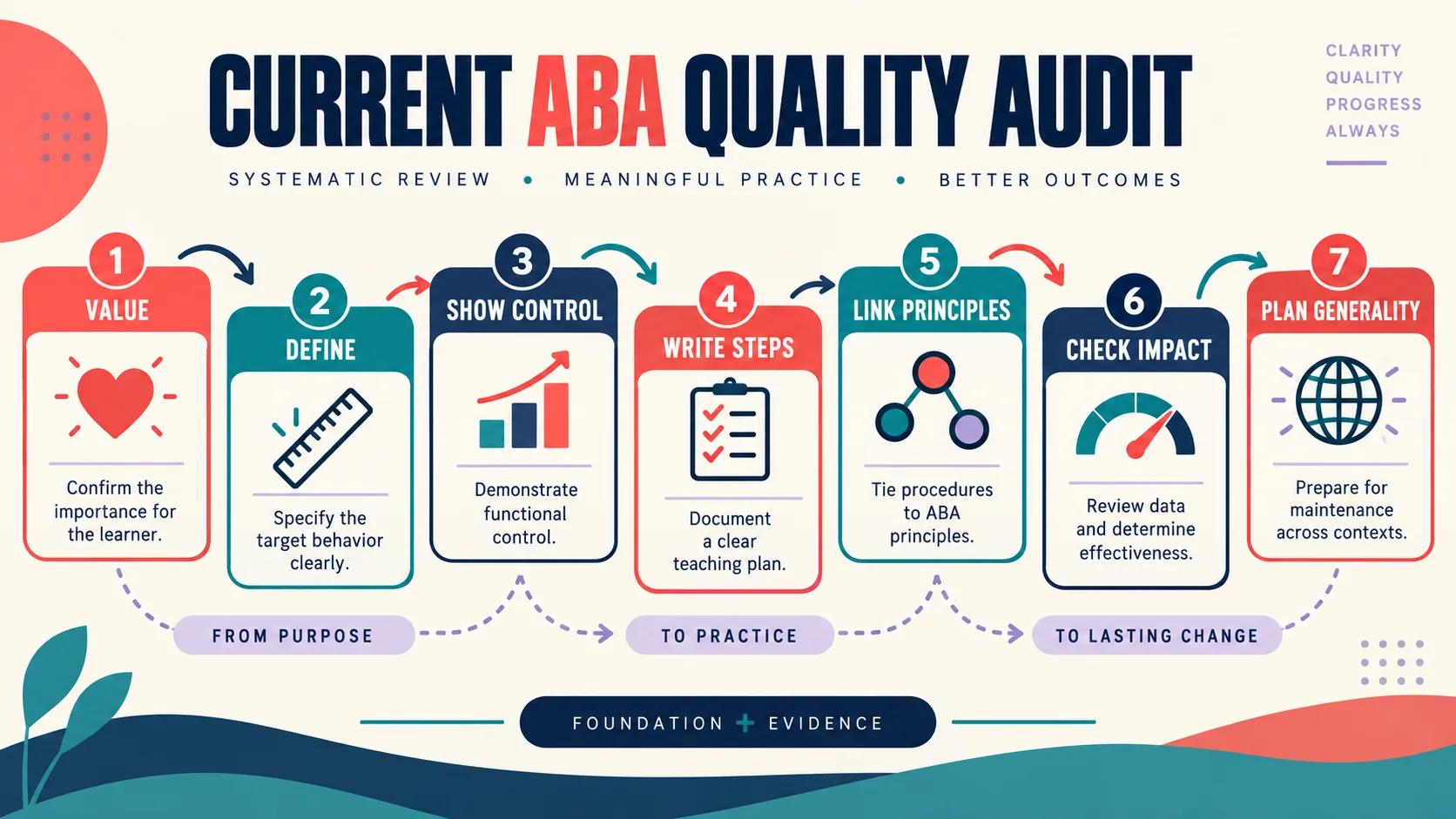
The seven dimensions become more useful when they function as an audit rather than a flashcard list. For any intervention or study scenario, ask the following questions in order:
- Value: Who benefits if the target changes, and how was that priority established?
- Define: Can two observers identify and measure the target consistently?
- Show control: What design or comparison supports the conclusion that the intervention mattered?
- Write steps: Could an appropriately trained implementer follow the procedure as written?
- Link principles: What behavioral relation explains each major component?
- Check impact: Did the outcome meet a meaningful criterion without unacceptable side effects?
- Plan generality: Where, with whom, and when will the change be checked next?
This sequence can expose an incomplete answer quickly. For example, a scenario may describe a carefully measured target and a strong data display, but if the goal is not meaningful to the client, the applied dimension is weak. Another scenario may have an attractive intervention package, but if the steps are not written clearly, technological integrity is uncertain. The best answer usually repairs the missing evidence rather than adding an unrelated technique.
How the Dimensions Appear in Exam Scenarios
Use the wording of the scenario to identify which dimension is under pressure:
- “The family says the goal is not important” points toward the applied dimension and social validity.
- “Observers disagree about what counts” points toward the behavioral dimension and operational definition.
- “The behavior changed after a new program, but no design was used” points toward the analytic dimension and a need for stronger evaluation.
- “Staff were told to use a token system but received no steps” points toward technological clarity and treatment integrity.
- “The plan includes a preference assessment but the response did not increase” reminds you that preference is not the same as reinforcement effectiveness.
- “The skill occurs only with one therapist” points toward generalization and maintenance programming.
These are not seven isolated answers. One scenario can involve several dimensions at once. Choose the dimension that matches the decision asked in the final sentence. Then select the evidence or next step that most directly addresses that gap.
Turn the Framework Into a Study Loop
To study this topic efficiently, do not reread the seven definitions without applying them. Build a short loop:
- Read the scenario once and underline the target behavior, intervention, and outcome.
- Label the dimension that is strongest and the dimension that is missing or weakest.
- Write one piece of evidence that would repair the weakness.
- Explain why the tempting alternative does not answer the question.
- Practice the same distinction in a new setting so the concept generalizes to the exam.
When you are ready to test the distinction under time pressure, use the free BCBA Mock Exam. After each item, record not only whether your answer was correct, but also which dimension or current exam domain controlled the decision. That turns a missed question into a targeted study task.
Frequently Asked Questions
Are the seven dimensions still relevant to BCBA exam preparation?: Yes, as a foundational framework for evaluating applied behavior-analytic work. They should not be treated as a substitute for the current BACB Test Content Outline. Use the official outline for the current exam blueprint and the seven dimensions for conceptual discrimination.
What are the “current dimensions” in the original article?: The original article identified applied, behavioral, analytic, technological, conceptually systematic, effective, and generality. The word “current” belongs to the historical title and should not be read as a promise that the paper is a newly updated exam document. Which dimension is about generalization?: Generality. It includes maintenance over time, generalization across people or settings, and transfer to related behavior. In practice, the plan should specify how those outcomes will be checked.
Does effective mean the behavior changed at all?: No. Effectiveness asks whether the change is meaningful enough for the stated goal and acceptable to the people affected. Review the data alongside goal criteria, social validity, treatment integrity, and possible side effects.
Is the seven-dimension framework the same as the current BCBA exam domains?: No. They overlap conceptually but have different origins and structures. The current BACB outline is the authority for exam content; the seven dimensions are a historical and conceptual quality framework.
Sources and Verification Notes
This article was checked against the original paper, the current BACB BCBA Test Content Outline, the BACB examination information page, and the BACB ethics-code resource. Because exam outlines and administrative requirements can change, verify the official BACB materials before relying on any date-sensitive exam detail.
- Baer, Wolf, and Risley (1968), Some Current Dimensions of Applied Behavior Analysis.
- BACB BCBA Test Content Outline, 6th edition.
- BACB Examination Information.
- BACB Ethics Codes and related information.
Quick Review Checklist
Use this final checklist to turn some current dimensions of aba into exam-ready reasoning. The goal is not to memorize a label in isolation; it is to identify the relevant evidence and explain why the best answer fits the scenario. Key ideas to review:
- State the central definition or decision point for some current dimensions of aba in your own words.
- Identify the detail that makes some current dimensions of aba different from its closest related ABA term.
- Separate the observable facts in a scenario from assumptions that are not supported by the facts.
- Write one example and one nonexample so you can recognize the concept in a new setting.
Exam application checks:
- Ask what the question is actually requesting before comparing the answer choices.
- Mark the antecedent, response, consequence, or other evidence that supports the selected answer.
- Look for a distractor that describes a related process but does not answer the specific question.
Final self-check:
- Explain how you would verify the interpretation with clear observations or data.
- Change one detail in the scenario and decide whether your answer should change.
- Give a one-sentence rationale that a supervisor or study partner could evaluate.
Take the Free BCBA Mock Exam
A useful next step is to apply this idea in a fresh set of BCBA-style practice questions and review the feedback. Take the Free BCBA Mock Exam



