

Conditional discrimination in ABA occurs when the correct response depends on another stimulus or context. A comparison can be correct on one trial and incorrect on another because the sample or cue changes the relation. Simple discrimination uses one stimulus to signal the response.
In matching to sample, a learner sees a sample, receives comparisons, and selects the matching or trained relation. A circle sample may make circle correct; a triangle sample may change the answer. Examine sample, comparisons, response, and consequence—not location.
Conditional Discrimination in ABA: Definition and Core Relation
A conditional discrimination occurs when one stimulus changes the function of another. The sample or context determines which comparison is S+ and which are S− for that trial.
Typically, a sample appears before two or more comparisons. Consequence depends on matching or the trained relation, which may be identity-based or arbitrary, such as selecting a dog picture after hearing “dog.”
| Term | Meaning | Example |
|---|---|---|
| Sample or conditional stimulus | The stimulus that changes which comparison is correct. | A picture of a circle shown before the comparison array. |
| Comparison stimuli | The available choices from which the learner selects. | Circle, triangle, and square cards. |
| S+ | The comparison correlated with reinforcement for that sample or context. | The circle is correct when the circle is the sample. |
| S− | A comparison that is not reinforced for that trial relation. | Triangle and square are incorrect in the circle trial. |
| Conditional relation | The sample or context determines which comparison functions as S+. | The correct comparison changes when the sample changes. |
Exam clue: the stimulus-control relation is not fixed across trials; sample, context, or instruction determines the correct response.
Simple vs Conditional Discrimination in ABA
In simple discrimination, one stimulus dimension directly signals the response, such as green meaning touch and red meaning do not touch. In conditional discrimination, another stimulus changes a comparison’s role.
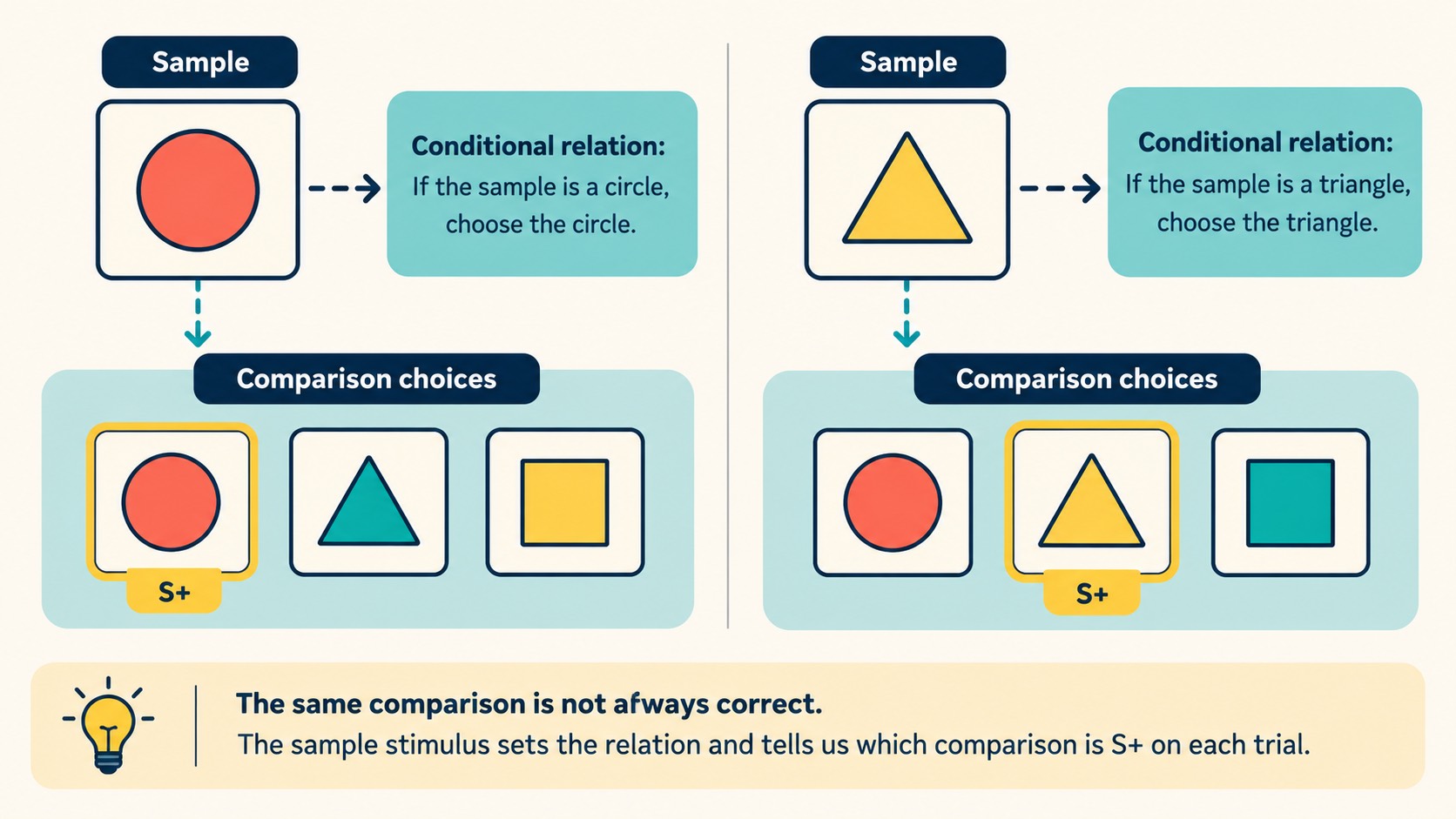
With circle and triangle comparisons, a circle sample may reinforce circle selection and a triangle sample may reinforce triangle selection. The card’s function depends on the sample.
| Feature | Simple discrimination | Conditional discrimination |
|---|---|---|
| Controlling relation | One stimulus or dimension directly signals the response. | One stimulus changes the function of another stimulus or choice. |
| Correct choice | May remain stable across trials. | Changes when the sample or context changes. |
| Typical arrangement | Choose or respond in the presence of one SD and SΔ. | Sample followed by an array of comparison stimuli. |
| Common example | Touch the red card when red signals reinforcement. | Match the comparison to the current sample. |
| Common error | Responding when the SΔ is present. | Position bias or choosing a comparison without attending to the sample. |
See the site’s simple versus conditional discrimination guide for a broader comparison.
Sample, Comparison, S+, and S−: How to Label a Trial
The sample is not automatically S+. The comparison correlated with reinforcement for the current sample is S+; other comparisons may function as S−. The sample is conditional when it changes comparison functions.
Stimulus roles depend on the arrangement. A card can be S+ in one relation and S− in another; describe contingencies rather than permanent physical labels.
| Trial element | Question to ask | Example |
|---|---|---|
| Sample | What stimulus or instruction is presented first? | A picture of an apple. |
| Comparison array | What choices are available? | Apple, car, and banana pictures. |
| Current S+ | Which choice contacts reinforcement for this sample? | Apple when the sample is an apple. |
| Current S− | Which available choices do not contact the programmed reinforcement? | Car and banana in the apple trial. |
| Response | What does the learner do to demonstrate selection? | Touches, points to, or hands over the apple card. |
| Consequence | What follows correct, incorrect, or prompted responding? | Reinforcement, correction, or a programmed neutral consequence. |
Do not call a comparison S+ because it is salient or was previously correct. Ask what consequence is correlated with it under the current sample.
Matching-to-Sample and Conditional Discrimination Examples
Matching-to-sample teaches and assesses conditional discrimination. Identity matching uses physical similarity; arbitrary matching uses a learned relation, such as a spoken word controlling picture selection.
It also occurs in daily routines: clothing based on weather, communication based on a question, or a tool based on a task. Define sample, comparisons, response, and consequence.
| Example | Sample or context | Correct comparison or response |
|---|---|---|
| Identity matching | Picture of a circle. | Select the matching circle. |
| Arbitrary matching | Spoken “dog.” | Select the trained picture of a dog. |
| Receptive instruction | “Give me the spoon.” | Select the spoon from several objects. |
| Community choice | “It is raining” or visible rain. | Select an umbrella or raincoat from available items. |
| Functional communication | Partner presents a choice or asks a question. | Use the response that matches the current communicative relation. |
The target is learning the relation, not merely touching a card. Generalization may require varied exemplars, people, materials, locations, and response forms.
Teaching a Conditional Discrimination Step by Step
Begin with a clear task analysis and reinforcement for attending to relevant stimuli. Use prompts, error correction, and fading while checking that the sample—not position, color, size, or an unintended prompt—controls responding.
As accuracy improves, vary comparison location, exemplars, and distractors. Always choosing left may show position bias; matching one fixed set does not prove generalization.
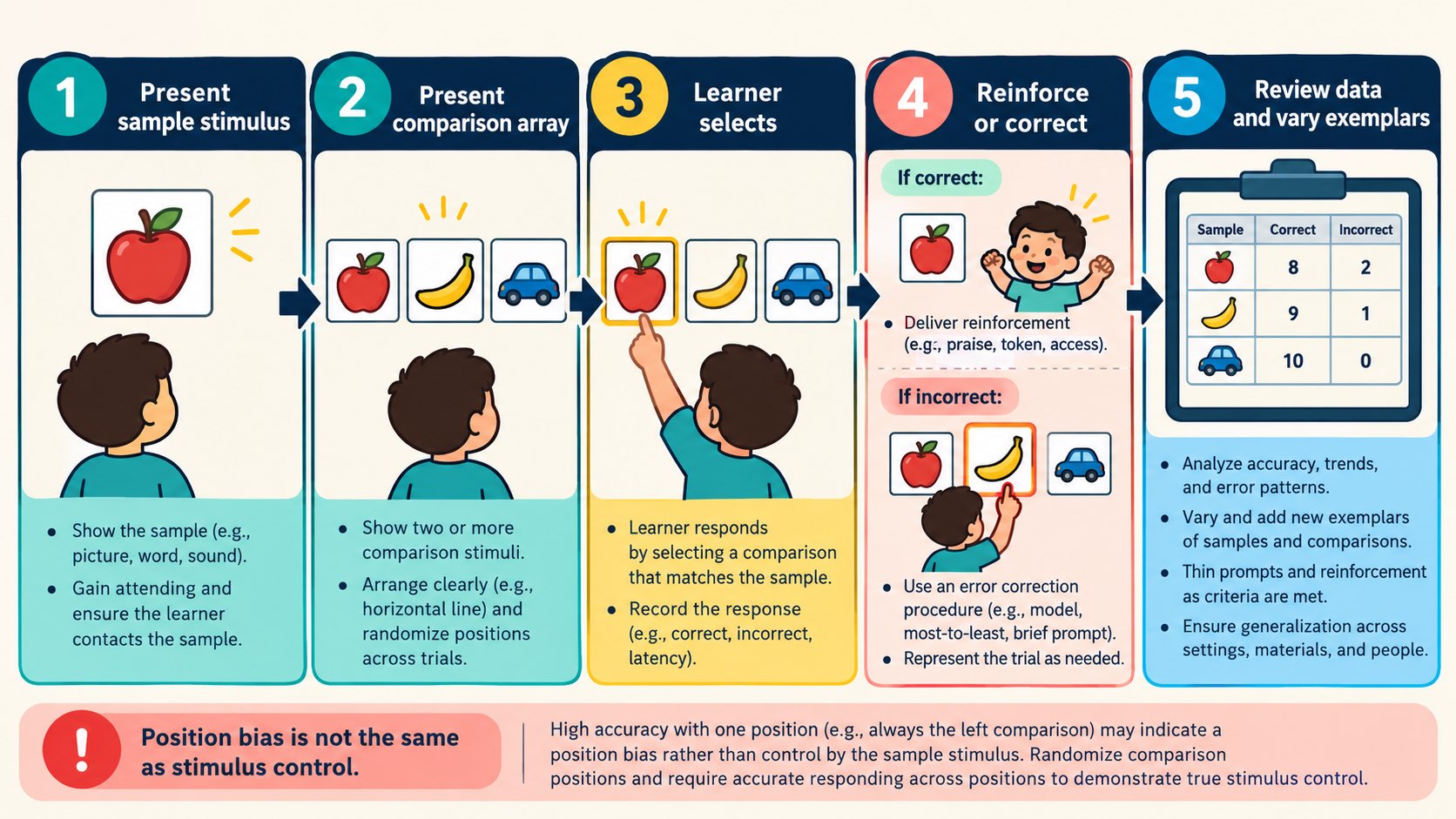
| Teaching step | Instructional move | Data to review |
|---|---|---|
| 1. Present the sample | Gain attending and present a clear sample or instruction. | Attending, sample exposure, and prompt level. |
| 2. Present comparisons | Show the array and vary positions across trials. | Array order, distractors, and comparison salience. |
| 3. Prompt if needed | Use a planned prompt and fade it systematically. | Independent versus prompted accuracy. |
| 4. Deliver consequence | Reinforce correct responding and use the approved correction procedure for errors. | Consequence consistency and learner affect. |
| 5. Program variation | Vary exemplars, people, materials, and settings as appropriate. | Generalization and maintenance across conditions. |
| 6. Check stimulus control | Randomize positions and test novel combinations. | Accuracy by sample, comparison, position, and prompt level. |
Individualize instruction within the behavior plan, supervision, and ethics. Arrange clear opportunities, usable communication, reinforcement, and data-based revision rather than forcing repeated errors.
Assessing Stimulus Control and Common Error Patterns
Accuracy can hide control by sample, fixed position, prompt, size, or salience. Vary irrelevant features and examine combinations.
Error patterns guide adjustment: sample-change errors suggest weak conditional attending; position-change errors suggest bias; novel-exemplar errors suggest narrow training.
| Error pattern | Possible controlling variable | Next assessment or teaching move |
|---|---|---|
| Always selects the left position | Position bias. | Randomize positions and reinforce accurate selections across locations. |
| Selects the same comparison for every sample | Failure to attend to the sample or a dominant card bias. | Check sample attending, reduce salience differences, and teach the relation explicitly. |
| Accurate only with one card set | Narrow stimulus control or limited generalization. | Add exemplars and test across people, materials, and settings. |
| Accurate only with a prompt | Prompt dependency. | Fade prompts and measure independent responding separately. |
| Errors increase with distractors | Array complexity or competing stimulus control. | Adjust array size, teach scanning, and increase discrimination gradually. |
Stimulus control requires systematic change with relevant conditions and accuracy when irrelevant features vary. One correct response is insufficient.
Conditional Discrimination, Equivalence, and Related Concepts
Conditional discrimination supports matching, receptive language, and equivalence instruction, but is not stimulus equivalence. Equivalence requires tested relations such as reflexivity, symmetry, and transitivity; one match proves none of that.
Generalization concerns transfer across stimuli, people, settings, or responses. Simple discrimination uses direct stimulus control; conditional discrimination describes dependency on another stimulus or context.
| Concept | Core question | How it relates |
|---|---|---|
| Conditional discrimination | Which comparison or response is correct given this sample or context? | The current article’s central relation. |
| Simple discrimination | Which stimulus directly signals reinforcement for a response? | Does not require another stimulus to change the relation. |
| Stimulus equivalence | Do trained and tested relations form an equivalence class? | May use conditional discrimination procedures but requires specific tests. |
| Generalization | Does the learned response occur across relevant variations? | Can be an outcome goal after conditional discrimination training. |
| Stimulus control | Which stimulus conditions reliably alter responding? | Describes the functional control demonstrated by data. |
See the site’s stimulus-equivalence guide when relevant, and use current BACB materials for exact task-list language.
Measurement, Data, and Ethical Teaching Decisions
Measure more than final accuracy when prompts, errors, or generalization matter. Record independent and prompted accuracy, latency, error type, position, sample, array, and consequence as needed.
Ethical teaching protects assent, dignity, communication, reinforcement quality, and the ability to pause or ask for help. Errors may reflect unclear samples, inaccessible materials, effort, or inconsistent prompts; review BACB ethics and supervision.
| Measure | What it can show | Interpretation caution |
|---|---|---|
| Independent accuracy | Whether the learner selects the programmed comparison without prompts. | Check whether position or an unintended cue controls responding. |
| Prompted accuracy | Whether the learner can respond with instructional support. | Do not count prompted and independent responses as equivalent mastery. |
| Error type | Whether errors are linked to sample, array, position, or distractors. | Use error patterns to adjust instruction rather than assign a trait label. |
| Latency | How quickly the learner responds after the relevant cue. | Long latency can reflect attending, uncertainty, response effort, or motivation. |
| Generalization | Whether the relation transfers across exemplars, people, places, and materials. | Program and test meaningful variations deliberately. |
| Social validity | Whether the target and teaching arrangement matter to the learner and team. | Evaluate acceptability and meaningful use, not just accuracy. |
Use data to continue, change prompts, adjust arrays, teach prerequisites, add exemplars, or revise goals. Seek functional learning, not scores from accidental control.
BCBA Exam Traps and Practice Checklist
On exams, identify sample/cue, comparisons, current S+, S− choices, and consequence. Ask whether the correct response changes when the sample changes.
| Exam clue | Likely concept | Reasoning move |
|---|---|---|
| The correct choice changes when the sample changes. | Conditional discrimination. | Identify the sample-dependent relation. |
| A single stimulus directly signals reinforcement. | Simple discrimination. | No second stimulus is needed to change the choice. |
| The learner always chooses the left comparison. | Position bias. | Vary positions before claiming stimulus control. |
| A comparison is reinforced only for one sample. | Current S+ under that conditional relation. | Do not assign a permanent S+ label to the card. |
| New stimuli or people are introduced. | Generalization programming or testing. | Check whether the learned relation transfers. |
| Untrained relations emerge after training and testing. | Possible stimulus equivalence outcome. | Look for reflexivity, symmetry, and transitivity evidence. |
Checklist:
- Define the sample or context.
- Define the comparison array.
- State what makes a choice S+.
- Identify S− choices.
- Randomize positions.
- Separate independent and prompted responses.
- Inspect error patterns.
- Vary exemplars.
- Plan generalization.
- Check meaningful and ethical implementation.
Conditional Discrimination FAQ
These answers summarize the core distinctions.
| Question | Short answer | Remember |
|---|---|---|
| What is conditional discrimination in ABA? | A stimulus controls responding depending on another stimulus or context. | The correct response is conditional on the sample or cue. |
| What is the classic example? | Matching-to-sample with a sample followed by comparison choices. | The comparison that is S+ can change across trials. |
| What is the difference from simple discrimination? | Simple discrimination does not require a second stimulus to determine which choice is correct. | Ask whether the correct response changes with the sample. |
| What is position bias? | Responding based on location rather than the intended stimulus relation. | Randomize comparison positions and inspect data. |
| Does one correct match prove stimulus equivalence? | No. Equivalence requires specific trained and tested relations. | Do not overinterpret a single matching performance. |
| What should a BCBA measure? | Independent accuracy, prompts, errors, position, latency, generalization, and social validity as appropriate. | Use measures that answer the instructional question. |
Conditional discrimination means the sample or context changes which stimulus is relevant; practice with the free BCBA mock exam and current BACB outline.



