
What Is a Stimulus Class in ABA?
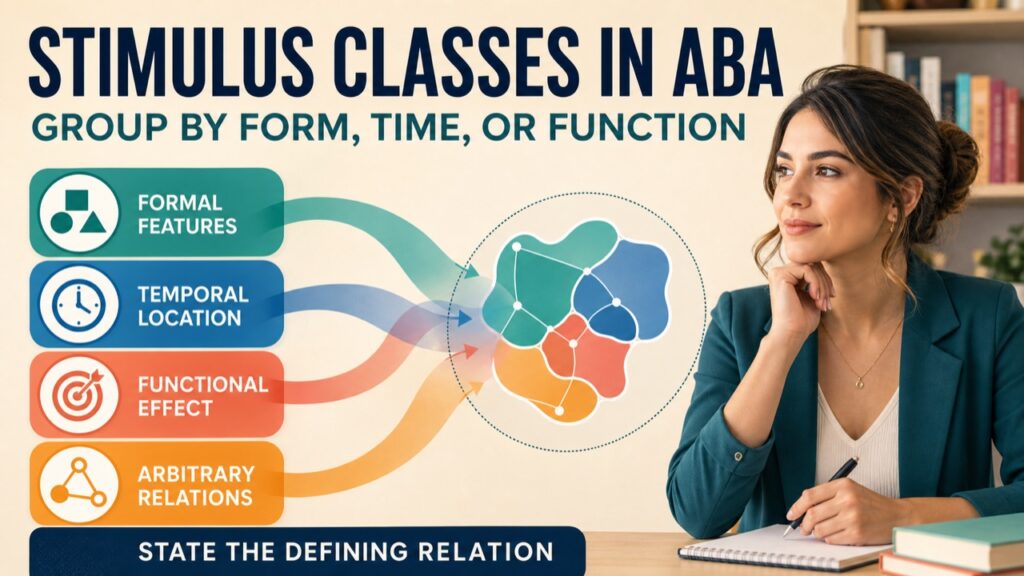
In applied behavior analysis, a stimulus class is a group of stimuli that share specified common elements along formal, temporal, and/or functional dimensions. The analyst must state the dimension or relation used to define the group. A formal class can be described by physical properties, a temporal class by location in time relative to behavior, and a functional class by a common effect on behavior. These bases can overlap, but one does not prove another.
Table of Contents
- What Is a Stimulus Class in ABA?
- Types of Stimulus Classes
- Distinguishing Stimulus Classes from Related Concepts
- Common Traps When Studying Stimulus Classes
- Stimulus Classes and Stimulus Control
- Practical ABA Examples of Stimulus Classes
- Study Checklist for Stimulus Classes
- Why Understanding Stimulus Classes Matters
- Test Your Knowledge with Our Free BCBA Mock Exam
- References and Further Reading
Behavioral function and practical class membership depend on the organism’s learning history and the current context. Physically different stimuli may participate in a learned class, while physically similar stimuli may control different behavior. The spoken word “dog,” the printed word, and a picture could participate in an arbitrary stimulus class after relevant relations are trained and demonstrated. Giving them the same name is suggestive, but a shared label alone does not demonstrate transfer of function or stimulus equivalence.
Types of Stimulus Classes
Formal, temporal, and functional describe dimensions along which a stimulus class may be specified. “Arbitrary” highlights learned relations among stimuli that need not resemble one another physically; it is not simply a fourth mutually exclusive dimension. The same event can be grouped differently for different analytic questions. A red circle might join a formal class defined by color, occur in a temporal class defined by a specified interval before responding, and acquire a discriminative function with other cues after a relevant reinforcement history.
Formal Stimulus Classes: A formal stimulus class is specified by physical properties such as wavelength or color, shape, size, intensity, texture, or spatial location. An analyst could define a set of red objects as a formal class based on a stated color range. That descriptive grouping does not establish that the learner detects the relevant feature or that every member has the same behavioral function. Teaching and testing are needed before claiming common control over a learner’s response.
Temporal Stimulus Classes: A temporal stimulus class is specified by when events occur in relation to a response or another event. Antecedent events occupy a different temporal location from consequences, and a more precise class might include cues presented within a stated interval before a target response. Sharing a temporal position does not by itself establish a common discriminative, reinforcing, or punishing function. Those functions require evidence from the relevant contingency and learning history.
Functional Stimulus Classes: A functional stimulus class is defined by a shared effect on behavior, even when members look or sound different. If a smile, thumbs-up, and brief praise each increase the future probability of a specified response under relevant conditions, the consequences may be analyzed as members of a functional class. The label follows demonstrated effects; praise is not a reinforcer merely because a practitioner intends encouragement. Context matters because one event can acquire different functions across responses, people, motivating conditions, and histories.
Arbitrary Stimulus Classes: An arbitrary stimulus class contains physically dissimilar stimuli related through a learning history or socially arranged convention. Conditional-discrimination training is one way to establish relations among printed words, spoken words, pictures, or abstract forms. An equivalence class is a rigorously tested kind of arbitrary stimulus class in which class-consistent responding demonstrates the relevant emergent relations, commonly discussed through reflexivity, symmetry, and transitivity. Other arbitrary or functional classes should not be called equivalence classes without those tests.
Distinguishing Stimulus Classes from Related Concepts
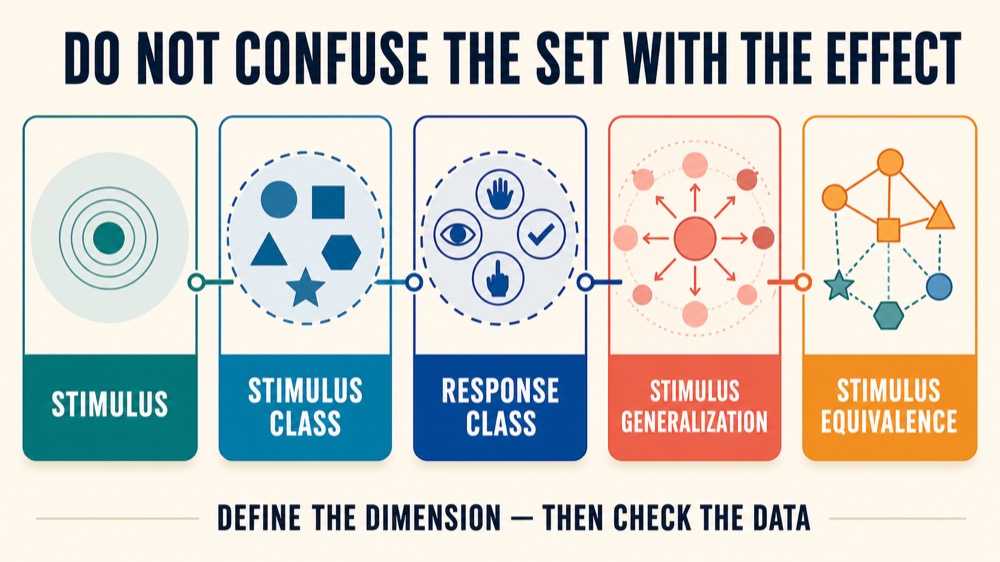
Stimulus classes are often confused with single stimuli, response classes, stimulus generalization, and stimulus equivalence. The following bullet points clarify these distinctions.
- Single stimulus versus stimulus class: One red ball is an individual stimulus. A class requires a stated common dimension or relation across multiple stimuli; a formal class of red objects need not already evoke one common response.
- Response class versus stimulus class: A response class groups responses by shared form or function, whereas a stimulus class groups environmental events by specified formal, temporal, or functional elements. The two kinds of classes participate in behavioral relations but are not interchangeable.
- Stimulus generalization versus stimulus class: Stimulus generalization describes a pattern in which responding trained in the presence of one stimulus occurs in the presence of other stimuli. A stimulus class names a set and its defining relation. Generalization data may help reveal relevant stimulus dimensions, but the two concepts are not synonyms.
- Stimulus equivalence versus arbitrary stimulus class: Stimulus equivalence is demonstrated through class-consistent responding on trained and emergent relations. It is one experimentally defined kind of arbitrary class, not evidence that every arbitrary or functional grouping has equivalence properties.
Understanding these differences helps clarify how stimuli control behavior. For more on stimulus control, see our article on stimulus control in ABA.
Common Traps When Studying Stimulus Classes
Students often make mistakes when learning about stimulus classes. Here are the most common traps to avoid:
- Confusing formal with functional classes: Just because stimuli look alike does not mean they function alike for the learner. Always verify through behavioral observation.
- Assuming temporal classes are permanent: Temporal relations can change with new contingencies; a stimulus that signals reinforcement today may not do so tomorrow if the schedule changes. Reassess regularly.
- Equating arbitrary classes with equivalence: While equivalence classes are arbitrary, not all arbitrary classes demonstrate reflexivity, symmetry, and transitivity. Use equivalence tests to confirm.
- Forgetting learning history: A stimulus class is defined by the organism’s past and current context, not by external features alone. What works for one learner may not work for another.
Awareness of these traps will improve your study efficiency.
Stimulus Classes and Stimulus Control
Stimulus classes are closely related to stimulus control, but a stimulus is not inherently an SD or S-delta. A discriminative function is demonstrated when a response occurs more often in the presence of one stimulus or class than another because of a history of differential reinforcement. Spoken, written, and gestured versions of “sit down” might acquire a common function for one learner, but that grouping must be shown through responding rather than assumed from adult intent.
Teaching with multiple exemplars can broaden control, while discrimination training can sharpen which dimensions matter. Analysts should measure responding to trained examples, novel examples, and nonexamples so that overgeneralization and restricted control are visible. For a deeper discussion, see stimulus generalization in ABA.
Practical ABA Examples of Stimulus Classes
Formal example: A teaching set contains blocks, cards, and cups within a defined blue color range, along with nonblue examples. The materials can be described as a formal stimulus class by color. Correct selection across trained and novel blue items provides evidence that color, rather than one object shape, controls the learner’s response.
Temporal example: In a laboratory timing task, several otherwise different cues are presented exactly five seconds before an opportunity to respond. They can be grouped by that specified temporal location. Additional data would be needed before calling them discriminative stimuli or claiming that they share another behavioral function.
Functional example: A spoken request, a picture exchange, and an activated speech-generating device each occasion a staff member to provide assistance after training. For that staff member in that context, the three request forms may function as a stimulus class controlling the help response, despite their different physical forms.
Arbitrary-class example: A learner is taught selected conditional relations among a numeral, a quantity, and a printed number word. Unreinforced probes then assess emergent class-consistent relations. Passing the planned probes supports an equivalence-class interpretation; direct training alone does not establish the full relation.
Study Checklist for Stimulus Classes
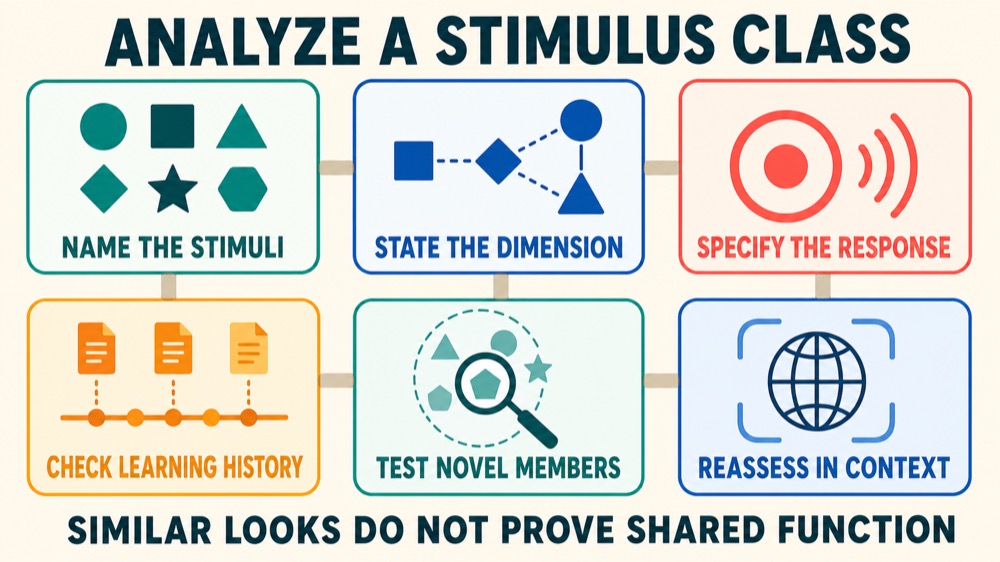
- Define stimulus class and identify examples from your own practice or case studies.
- List the four types: formal, temporal, functional, arbitrary.
- Explain how a single stimulus can belong to multiple classes simultaneously (e.g., a red circle can be formal, temporal, and functional).
- Differentiate stimulus class from response class, stimulus generalization, and stimulus equivalence using clear definitions.
- Describe how tests of trained and emergent relations can document an equivalence class without treating every arbitrary class as equivalent.
- Create original teaching scenarios that illustrate each type, such as using red objects for formal class, a timer for temporal class, smiles for functional class, and word-picture matching for arbitrary class.
- Identify common exam traps and practice with BCBA-style questions.
Use this checklist to guide your study sessions.
Why Understanding Stimulus Classes Matters
The current BCBA Test Content Outline (6th ed.) includes identifying and distinguishing stimuli and stimulus classes, alongside related stimulus-control concepts. Outside certification study, the distinction affects teaching design: formal similarity can guide exemplar selection, functional data can show which cues control a response, and carefully tested arbitrary relations can support generative learning. The useful question is not merely “Which type is this?” but “What evidence defines this class for this learner in this context?”
Test Your Knowledge with Our Free BCBA Mock Exam
Ready to practice? Our Free BCBA Mock Exam offers realistic questions and instant feedback to help you master stimulus control and other key concepts. This practice tool covers a broad range of topics and lets you assess your readiness. Note that the mock exam does not contain questions specifically on this article, but it will help you apply your knowledge across different scenarios. Prepare with confidence and track your progress.
References and Further Reading
- Behavior Analyst Certification Board, BCBA Test Content Outline (6th ed.)
- Naming, the Formation of Stimulus Classes, and Applied Behavior Analysis
- Eye Movements Along the Establishment of Functional Stimulus Classes
- Meaningful Stimuli and the Enhancement of Equivalence Class Formation
Next step for BCBA exam prep
Turn this topic into exam-day practice
Use this topic as a focused review, then test it in exam-style conditions with a free mock before deciding whether five full-length mocks are the right next step.
Start the Free BCBA Mock ExamContinue with Five Full-Length Mocks — $99
Review the included materials and access details before ordering. No pass guarantee is implied.



