

Short answer: Fixed duration reinforcement delivers reinforcement after a behavior has occurred continuously for a specified, unchanging amount of time. If the requirement is FD 30 seconds, the learner must engage in the defined response for 30 consecutive seconds before the reinforcer is available. The requirement is based on the duration of the response, not simply the passage of time and not a fixed number of responses.
Table of Contents
- What is fixed duration reinforcement?
- How does the contingency work?
- What are fixed duration reinforcement examples?
- How is fixed duration different from other schedules?
- What data should a BCBA examine?
- How should you solve the BCBA exam question?
- What are the common BCBA exam traps?
- Fixed duration reinforcement FAQ
- Take the Free BCBA Mock Exam
The fastest way to solve a fixed duration reinforcement question is to ask, “What must happen immediately before reinforcement?” If the answer is “the behavior has continued without interruption for the stated duration,” think fixed duration. If the first response after a time interval produces reinforcement, think fixed interval. If reinforcement arrives after a clock-based delay without requiring the behavior, think fixed time. Those distinctions matter more than the label alone. Table of Contents
What is fixed duration reinforcement?
Fixed duration reinforcement is a schedule in which reinforcement is contingent on a response continuing for a fixed amount of time. The duration value is known and does not change from one successful opportunity to the next. The behavior must meet the operational definition and remain in progress for the entire requirement. If the response stops before the requirement is met, the contingency is not completed unless the written procedure says otherwise.
For example, under FD 20 seconds, “on-task behavior” cannot mean merely sitting near a worksheet. The behavior must be defined in observable terms, such as writing or manipulating the assigned materials as specified by the program, and it must continue for 20 consecutive seconds. After the requirement is met, the programmed reinforcer becomes available. A new opportunity then begins according to the arrangement.
This is different from a fixed-time schedule. A fixed-time schedule delivers a reinforcer after a fixed time has elapsed, independent of whether the target response occurred at that moment. It is also different from a fixed-interval schedule, in which the first response after a fixed interval has elapsed produces reinforcement. The current BACB BCBA Test Content Outline includes time-based reinforcement and measurement of duration, so the exam may test both the schedule definition and the measurement logic.
How does the contingency work?
A fixed duration contingency has three parts: a clearly defined response, a continuous duration requirement, and a consequence that follows successful completion. The fixed value is not a vague goal such as “work longer.” It is a measurable requirement such as “remain engaged with the assigned task for 30 consecutive seconds.” The definition should also identify what counts as a break, what resets the timer, and when reinforcement is delivered.
- Response: specify what the learner must do in observable terms, such as vocalizing, remaining seated, or manipulating task materials.
- Continuity: require the response to remain present for the entire duration; an interruption may reset the clock depending on the procedure.
- Fixed value: use the same programmed duration for the schedule being described, such as FD 10 seconds or FD 2 minutes.
- Contingent outcome: deliver the programmed reinforcer only after the response-duration requirement is met.
The word “fixed” describes the duration criterion, not necessarily every feature of the teaching arrangement. A BCBA might later thin or change a schedule based on data, or compare fixed and mixed-duration conditions in a research design. But within one stated FD condition, the duration requirement is constant. Avoid adding a clinical recommendation just because a question gives a schedule label; first identify the contingency and the measured outcome.
What are fixed duration reinforcement examples?
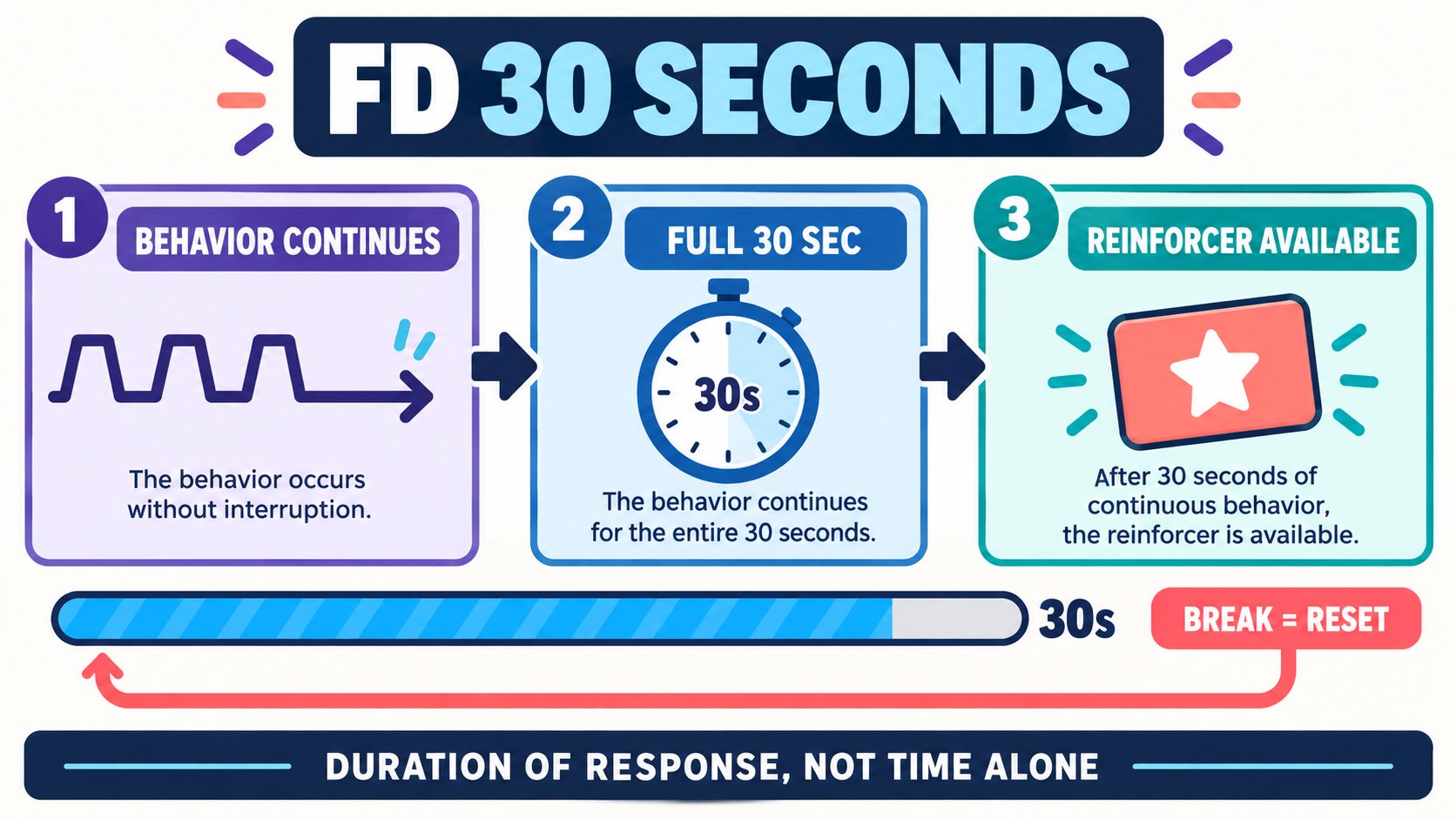
Example 1: sustained task engagement. A learner receives access to a preferred activity after engaging with a defined academic task continuously for 30 seconds. The requirement is FD 30 seconds because the response must persist for a set duration. If the learner stops at 24 seconds, the requirement has not yet been met under the stated rule.
Example 2: remaining in a designated area. A program defines “remain in the group area” as having the learner’s body within the marked area, with feet on the floor and participation materials available. Under FD 60 seconds, reinforcement follows a full minute of continuous occurrence. The operational definition matters: merely being in the room is not automatically the target response.
Example 3: a sustained communication response. Suppose the target is a continuous vocal imitation that must last for five seconds before the programmed consequence is available. The duration requirement is fixed if every successful opportunity uses five seconds. The response form, onset, offset, and interruptions need to be defined so that different observers can score it consistently.
Example 4: continuous physical effort. In a laboratory or instructional arrangement, a learner may be asked to hold a response key down for a fixed duration before a reinforcer is delivered. This is not a fixed ratio because the requirement is not a number of presses. It is not fixed interval if reinforcement depends on the response continuing throughout the criterion.
These examples are classification exercises, not universal treatment recommendations. In practice, the response definition, reinforcer, duration value, reset rule, learner preference, and safety context must be individualized. Research on duration schedules has examined continuous behavior and the amount of behavior required before access to reinforcement; it does not establish one best schedule for every learner. The Journal of Applied Behavior Analysis study of fixed- and mixed-duration schedules is useful for understanding the distinction between duration requirements and interval requirements.
How is fixed duration different from other schedules?
Most errors happen when a learner notices the word “fixed” but misses the dimension that is fixed. Ask whether the requirement is a duration of behavior, an elapsed interval followed by a response, a time delivery independent of responding, or a number of responses.
| Schedule | What must happen? | Exam clue |
|---|---|---|
| Fixed duration (FD) | The defined behavior continues for a fixed duration, such as 30 consecutive seconds. | The response must persist throughout the requirement. |
| Variable duration (VD) | The behavior continues for a changing duration value, often around a planned average. | The response-duration requirement changes across opportunities. |
| Fixed interval (FI) | After a fixed time has elapsed, the first eligible response produces reinforcement. | The response need not occur continuously throughout the interval. |
| Fixed time (FT) | The reinforcer is delivered after a fixed time regardless of whether the target response occurred. | The delivery is response-independent. |
| Fixed ratio (FR) | A fixed number of responses is completed, such as every five correct responses. | Count responses; do not time continuous responding. |
The most important comparison is fixed duration versus fixed interval. Both include a fixed time value, but FD requires the response to continue for the entire value, whereas FI makes the first response after the interval eligible. Fixed duration versus fixed time is another common trap: FD is response-dependent and duration-based; FT is response-independent and time-based. A schedule can only be classified correctly after those dimensions are separated.
What data should a BCBA examine?
Start with an operational definition and a measurement system that can capture both successful and unsuccessful attempts. Because the schedule depends on response duration, duration recording is usually central to the classification. Frequency or count alone cannot show whether the behavior continued for the required time. The BACB outline also distinguishes temporal dimensions such as duration and latency, so do not substitute one measure for another.
- Define onset and offset: specify the observable event that starts the timer and the event that ends the response.
- Record continuous duration: measure how long each response episode lasts, including attempts that end before the criterion.
- Mark the schedule value: record the fixed requirement, such as FD 30 seconds, on the data sheet and in the session note.
- Record resets: note whether a brief interruption restarts the duration requirement and whether that rule was applied consistently.
- Track reinforcement delivery: document whether the reinforcer followed a completed duration and whether any delivery occurred outside the contingency.
- Check procedural integrity: compare implementation with the written rule before interpreting a low success rate as a learner variable.
For a simple decision, calculate the proportion of opportunities that meet the full duration and examine the distribution of response durations. A learner may have many attempts but few completed FD requirements, or a small number of long responses that meet the criterion. Those patterns have different implications for interpretation. Do not infer mastery from mean duration alone if the target requires continuous responding and interruptions are clinically meaningful.
How should you solve the BCBA exam question?
Use a four-step read. First, circle the behavior that must occur. Second, underline whether the stem says “continuously,” “for X seconds,” “after X minutes,” or “after X responses.” Third, identify whether a response is required at the end of the time period. Fourth, check whether the time or response requirement changes across trials.
- If the behavior must last for a constant value, choose fixed duration.
- If the first response after a constant time is reinforced, choose fixed interval.
- If reinforcement arrives at a constant time independent of behavior, choose fixed time.
- If reinforcement follows a constant response count, choose fixed ratio.
Example question: “A student earns a break after remaining engaged with the worksheet continuously for 45 seconds. The requirement is the same each opportunity.” The best classification is FD 45 seconds. If the stem instead says, “After five minutes have passed, the next correct response earns a break,” the clue is FI. If it says, “A break is delivered every five minutes whether or not the student is working,” the clue is FT. The nouns in the scenario are less important than the contingency verbs.
What are the common BCBA exam traps?
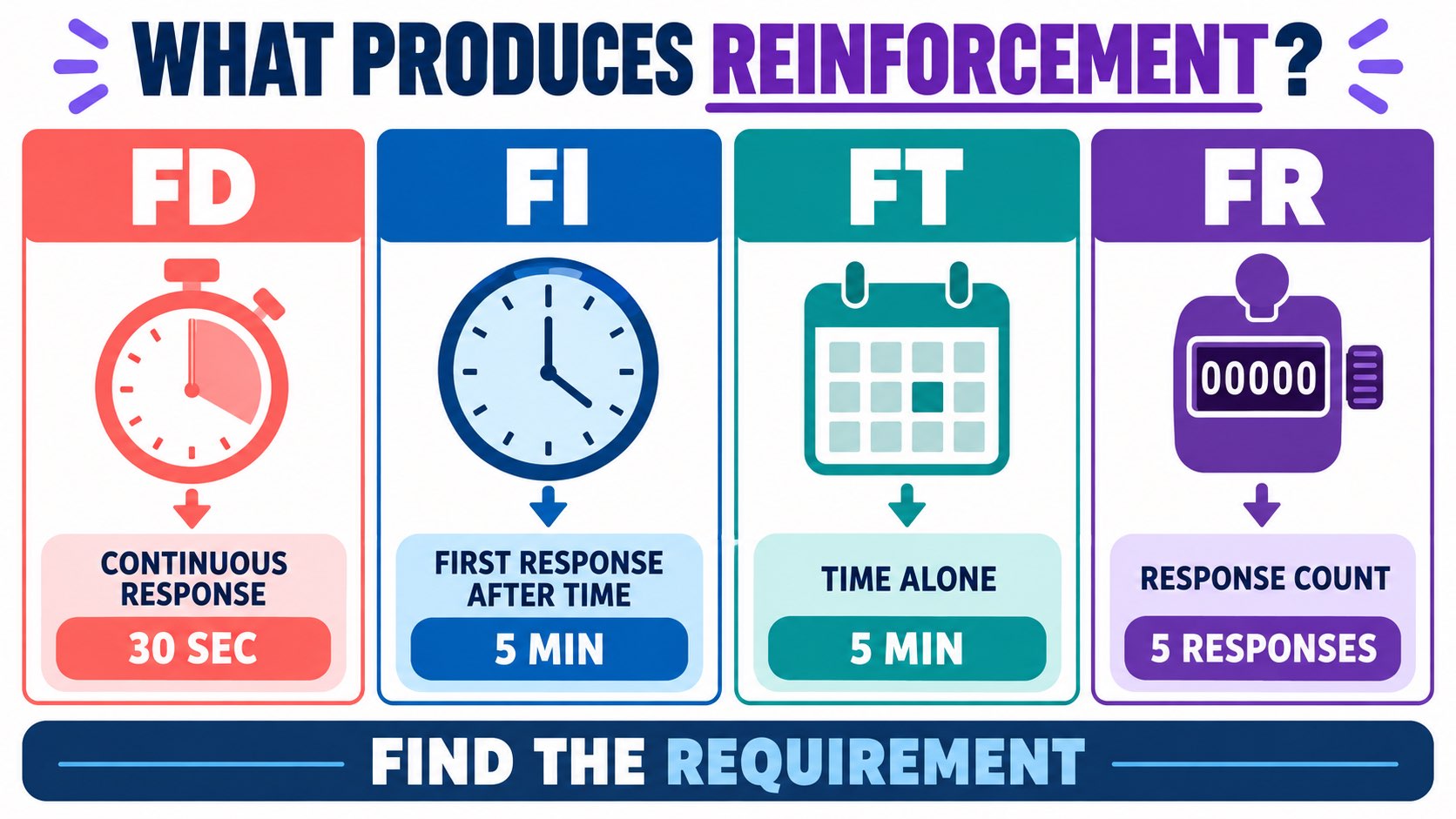
- Confusing duration with interval: both involve time, but FD requires continuous behavior while FI waits for an eligible response after time passes.
- Confusing fixed duration with fixed time: FD is response-dependent; FT delivers the reinforcer independent of the response.
- Counting responses instead of timing them: an FR schedule counts responses, while FD measures how long the behavior persists.
- Ignoring the word “continuously”: a response that occurs briefly at several points may not meet a continuous-duration requirement.
- Assuming fixed means the schedule never changes: “fixed” describes the stated condition; a later schedule change is a new condition that must be identified.
- Turning a classification question into a treatment prescription: first identify the schedule and measurement dimension; do not claim that one duration value is universally appropriate.
- Skipping the operational definition: “engaged,” “calm,” or “participating” must be defined before duration data can be interpreted.
Quick review: Fixed duration reinforcement means a defined response must continue for a constant amount of time before reinforcement. The response is continuous, the value is fixed, and the consequence is contingent on completing the duration. Compare the requirement with fixed interval, fixed time, variable duration, and fixed ratio before selecting an answer. For additional schedule-classification practice, use the free BCBA mock exam. It is a study resource and does not claim to reproduce official BACB questions.
Fixed duration reinforcement FAQ
Is fixed duration the same as fixed interval? No. Fixed duration requires the response to continue for the stated duration. Fixed interval makes the first eligible response after the interval produce reinforcement; the response does not have to occur continuously during the interval.
Is fixed duration the same as fixed time? No. Fixed time is response-independent: reinforcement is delivered after a fixed time whether or not the target response occurred. Fixed duration is response-dependent and requires the response to persist for the duration criterion.
What is an easy fixed duration example? Under FD 30 seconds, a learner earns the programmed reinforcer after engaging in the operationally defined response continuously for 30 seconds. A break before 30 seconds means the requirement was not completed under that attempt.
What measurement is most relevant? Measure the duration of each response episode and whether it met the fixed criterion. Also record interruptions, resets, reinforcement delivery, and procedural integrity so the data reflect the stated contingency.
Can fixed duration be used in a clinical program? A duration-based contingency may be studied or used when it fits an individualized, socially valid plan, but the schedule label alone does not determine whether it is appropriate. Use assessment data, client preferences, safety considerations, and qualified supervision when making practice decisions.
Take the Free BCBA Mock Exam
When you are ready to apply the idea, use the free practice resource below for additional feedback. Take the Free BCBA Mock Exam



