

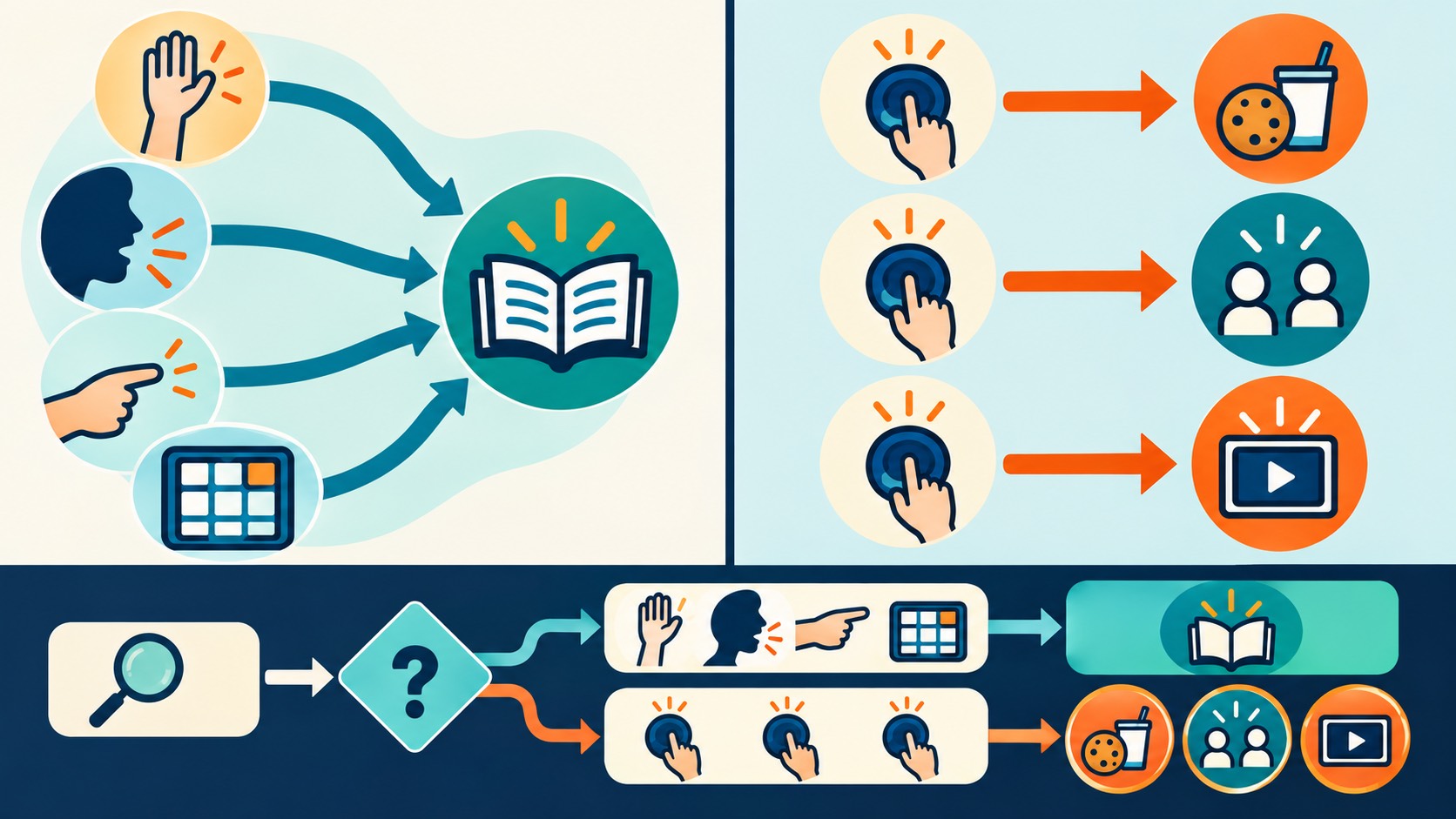
A response class in ABA is a group of responses related by a defining feature, most often a shared function or a shared topography. “Response class” is broader than a single action: saying “break,” handing over a break card, and pointing to a break icon may belong to the same functional response class when they produce the same outcome. A topographical response class, by contrast, groups responses that look alike even when their functions differ.
BCBA exam questions often ask you to distinguish behavior, response, and response class. The reliable strategy is to identify the level of analysis: a broad activity or category, one discrete instance, or a group of responses connected by form or function. This guide explains the distinction, measurement implications, examples, and common B.1 exam traps.
What Is a Response Class in ABA?
A response class is a set of responses that share a relevant relation. In a functional response class, the members produce the same consequence or serve the same purpose. In a topographical response class, the members share observable form or physical features. The phrase alone does not always tell you which relation is intended, so read the scenario for clues about function, form, or both.
| Level | Working definition | Example |
|---|---|---|
| Behavior | An activity of an organism considered as a broad analytic subject. | Communication during a classroom activity. |
| Response | One occurrence or instance of behavior. | One spoken “help” at 10:15 a.m. |
| Response class | A group of responses related by function, form, or another stated dimension. | Saying “help,” pressing a help button, or handing over a help card. |
The purpose of the classification is practical. If several responses contact the same reinforcer, teaching only one form may not capture the learner’s full repertoire. If several responses look similar but serve different functions, treating them as one class may produce an inaccurate intervention. A good behavior analyst states the relation that defines the class.
Behavior: The Broad Analytic Subject
Behavior is the activity an organism does in interaction with its environment. In applied behavior analysis, the analyst usually narrows a broad label into an observable and measurable target. “Behavior” can therefore refer to a broad domain, a category of activity, or a target response class, depending on context.
For example, “classroom participation” is a useful area of concern but not yet a precise measurement target. It could include raising a hand, answering a question, looking at materials, writing, and following instructions. Each may have a different topography and may contact different consequences. Before collecting data, define which response or response class counts as participation.
| Broad label | Why it is incomplete | More precise next step |
|---|---|---|
| Noncompliance | It may include many different responses and does not state the relevant task or time window. | Define the instruction, latency limit, and observable actions scored as noncompliance. |
| Communication | Speech, signs, gestures, devices, and cards may all be included. | Specify the communication response class and the function it should contact. |
| Aggression | Hitting, kicking, pushing, and throwing may have different topographies or functions. | Define each response or group only when the measurement and intervention logic justify it. |
| On-task behavior | Looking, manipulating materials, writing, and sitting may not always reflect the same skill. | Specify the observable components and the context in which they count. |
A broad behavior label is not automatically wrong. It becomes a problem when the team uses it as if everyone would score the same events. The operational-definition guide can help convert a broad label into a measurable definition.
Response: One Instance of Behavior
A response is one occurrence of behavior. If a student says “help” once, that is one response. If the student says “help” three times in a five-minute period, the analyst can count three responses, provided the measurement rule defines when one response ends and another begins.
The response level is useful for event recording, frequency, rate, latency, and other direct measures. It also prevents a common mistake: treating a whole class of behaviors as if it were one event. A single response can belong to one or more conceptual classes at the same time. A spoken request may be one response, a member of a functional communication class, and part of a topographical verbal class.

| Scenario | One response | Possible class membership |
|---|---|---|
| The learner points to the “break” icon once. | One pointing response. | Functional break-request class; pointing topographical class. |
| The learner hands over a card. | One card-exchange response. | Functional break-request class; card-exchange topographical class. |
| The learner says “break, please.” | One vocal request response. | Functional break-request class; vocal-verbal topographical class. |
On an exam, words such as “each time,” “one instance,” “the individual occurrence,” or “count the number of” usually point toward response. Words such as “group,” “same function,” “different forms,” or “shared effect” usually point toward response class.
Functional Response Classes
A functional response class contains responses that produce the same kind of environmental effect. The forms may be very different. A learner may say “my turn,” reach toward the item, use a communication device, or hand over a request card. If each response reliably produces access to the same activity and the analyst is grouping them by that effect, they form a functional response class.
Functional classes are central to function-based intervention. A replacement response is usually selected because it can access the same reinforcer as the challenging response. The team should still define the response clearly, because the fact that responses share a function does not mean they can be scored interchangeably in every program.
| Response form | Shared function | Likely functional class |
|---|---|---|
| Says “break,” points to a break card, or selects a break icon. | Obtains a brief escape from an appropriate task. | Functional break-request response class. |
| Raises a hand, taps a help button, or says “help.” | Obtains assistance with a difficult step. | Functional help-request response class. |
| Gives a greeting, waves, or signs hello. | Initiates social interaction. | Functional greeting response class. |
| Hits, screams, or throws materials. | May produce attention, escape, or another consequence. | Only a functional class after assessment supports the shared effect. |
Do not infer a shared function from similar appearance. Two forms that look different may serve the same function, but two forms that look alike may contact different consequences. The functional analysis guide provides the assessment context for testing those hypotheses.
Topographical Response Classes
A topographical response class groups responses by their observable form or physical characteristics. For example, “hand-to-object contact” could include touching, pushing, tapping, and grabbing if the operational definition uses a shared physical feature. The responses may have different functions in different situations.
Topographical classes are useful when the intervention or measurement is about the form itself. A motor-skills program may target a class of hand movements; a safety plan may define a class of contact responses that must be blocked or redirected. The analyst should not assume that topographical similarity means functional similarity.
| Grouping basis | What members share | Typical use |
|---|---|---|
| Functional | Consequence or effect on the environment. | Function-based replacement communication and intervention selection. |
| Topographical | Observable form, movement pattern, or physical feature. | Motor skills, safety definitions, and form-specific measurement. |
| Temporal | A relation across time, such as responses within a defined interval. | Specialized analysis when timing is the relevant dimension. |
| Contextual | Responses grouped within a specified setting or task. | Descriptive analysis, provided the context is clearly stated. |
Some textbooks use “response class” mainly for functional groupings, while others discuss topographical response classes explicitly. On a BCBA item, use the relation provided in the stem. If the stem says “different forms but the same function,” choose functional response class. If it says “same observable form,” choose topographical response class.
Writing Definitions and Collecting Data
Classification affects measurement. If the team wants to count a functional response class, it must specify which forms are included, when each begins and ends, and whether repeated forms count as separate responses. If the target is topographical, the definition should describe observable features without relying on inferred intent.
| Definition element | Question to answer | Example |
|---|---|---|
| Form | What does the response look or sound like? | Touches another person with an open hand. |
| Function or effect | What consequence or environmental effect makes the class relevant? | Produces access to help after an appropriate request. |
| Start and stop | When does one response begin and end? | One vocal request ends after 3 seconds without another request. |
| Context | Where and under what conditions does the definition apply? | During independent writing tasks longer than two minutes. |
| Exclusions | What similar events do not count? | Accidental contact while walking past a peer is excluded. |
For a functional class, avoid definitions that simply say “attempts to escape” or “seeks attention.” Those phrases describe a hypothesis rather than what an observer can score. Pair the functional hypothesis with observable response forms and collect data on the consequence that follows.
Why Response Classes Matter for Intervention
Response classes help the analyst select an intervention at the right level. If several behaviors produce the same reinforcer, changing one topography may not reduce the broader functional class. If a replacement response is taught, it should be efficient enough to compete with the challenging response and should contact the same function when appropriate.
For example, if a learner throws materials, pushes work away, and drops to the floor to escape tasks, the intervention should not assume that treating only throwing addresses all escape-maintained responses. The team can define each response separately for safety and measurement while analyzing whether they form a broader functional class.
| Intervention question | Response-class implication | Clinical decision |
|---|---|---|
| Are several forms maintained by the same reinforcer? | They may be members of one functional class. | Assess the class while preserving topography-specific safety data. |
| Does the replacement access the same function? | The replacement is functionally matched. | Reinforce and prompt the replacement systematically. |
| Do similar forms have different functions? | They should not be collapsed automatically. | Use context and consequence to separate the classes. |
| Is the program teaching a physical skill? | Topography may be the critical relation. | Define the movement pattern and measure it directly. |
Response-class analysis also supports generalization. A learner may use speech in one setting and a device in another; if both forms serve the same communication function, the team can plan across modes without treating the different forms as unrelated behaviors.
BCBA Exam Traps for B.1
The BACB BCBA Test Content Outline, 6th edition lists B.1 as “identify and distinguish among behavior, response, and response class.” The item may provide an everyday scenario, a clinical vignette, or a definition-writing task. Start by locating the unit of analysis before considering function or intervention.
| Trap | Why it fails | Corrective question |
|---|---|---|
| Calling one occurrence a response class | A class requires a group or category, not one event. | Are multiple responses being grouped? |
| Calling every broad label “behavior” | The item may be describing a set of functionally related responses. | Is the label being used as a measurable target or a broad domain? |
| Assuming similar form means same function | Topography and function are different relations. | What consequence follows each response? |
| Assuming different form means different class | Different forms can share a function. | Do the responses produce the same relevant effect? |
| Using inferred intent as a definition | “Seeking attention” is not directly observable by itself. | What observable response and consequence can be measured? |
A quick mnemonic is “broad, one, group”: behavior is the broad subject, response is one instance, and response class is a group connected by an identified relation. Then add the second question: is the group connected by form or function?
Response Class: Final Definition Test
If you can name the members of the group and explain the relation that connects them, you have reached the right level of analysis. If you cannot identify the observable response, the relevant consequence, or the shared form, the label is still too broad for reliable measurement.
Response Class Checklist and FAQ
Use this review sequence when a BCBA question asks you to classify a behavior:
- Identify whether the stem describes a broad activity, one occurrence, or a group.
- For a group, identify the relation: function, topography, time, or context.
- Separate observable description from a functional hypothesis.
- Check whether each member can be measured consistently.
- Preserve separate data when different forms carry different safety or clinical implications.
- Choose an intervention that matches the relevant response class and its function.
- Check whether one response can belong to more than one class.
- Use examples and nonexamples in the operational definition.
- Do not infer function from appearance alone.
- Use direct data to test a presumed shared function.
| Question | Short answer |
|---|---|
| What is a response? | One occurrence or instance of behavior. |
| What is a functional response class? | Different or similar response forms that produce the same relevant consequence or serve the same purpose. |
| What is a topographical response class? | Responses grouped because they share observable form or physical features. |
| Can one response belong to more than one class? | Yes. A single event can be part of functional and topographical classes. |
| Why does the distinction matter? | It determines how behavior is defined, measured, analyzed, and treated. |
For more practice, review the site’s topography in ABA guide, the stimulus-class guide, and the free BCBA mock exam. The essential distinction is straightforward: a response is one event; a response class is a group; and the reason the group belongs together must be stated rather than assumed.



