
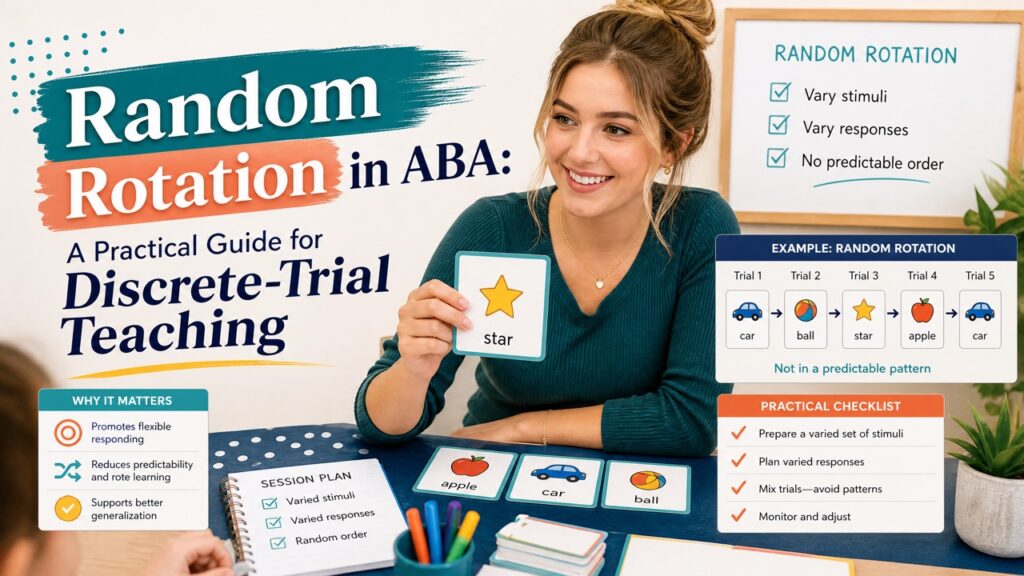
Random rotation is a teaching procedure used in discrete-trial teaching (DTT) to vary the order of stimulus presentations or tasks unpredictably. Instead of presenting the same target repeatedly in a predictable sequence, the instructor intermixes trials so the learner cannot anticipate what comes next. This approach is commonly used in discrimination training to help learners respond to the current instruction rather than to a pattern of previous trials. In this guide, you will learn what random rotation in ABA means, how it differs from blocked rotation, when to use it, and how to measure its effects. You will also find a practical example, decision points, and a study checklist to support your understanding. Table of Contents
Table of Contents
- What Is Random Rotation in ABA?
- Random Rotation vs. Blocked Rotation
- When to Use Random Rotation
- How to Implement Random Rotation in DTT
- Random Rotation and Generalization
- Random Rotation vs. Interleaving
- Study Checklist for Your BCBA Exam
- Conclusion
- Reference
What Is Random Rotation in ABA?
Random rotation is a stimulus presentation procedure in which the order of target stimuli or task demands is varied across trials without a predictable pattern. For example, when teaching a learner to identify a dog and a cat, a random rotation would present instructions like “Show me cat,” “Show me dog,” “Show me cat,” “Show me dog” in a mixed sequence, ensuring that the same stimulus is not presented in consecutive trials. The purpose is to prevent the learner from responding based on the previous trial’s order and to require attention to the current discriminative stimulus.
Random rotation is contrasted with blocked rotation, where the same stimulus is presented for several consecutive trials before switching. While blocked rotation can be useful during initial acquisition, random rotation is typically introduced after the learner has shown initial mastery of each target. It helps assess whether the learner has truly discriminated between stimuli rather than relying on a sequence cue.
Random Rotation vs. Blocked Rotation
To understand random rotation, it is helpful to compare it with blocked rotation. In a blocked rotation, the therapist presents the same stimulus for a set number of trials (e.g., five trials of “dog” followed by five trials of “cat”). This allows repeated practice of the same response, which can build fluency. However, blocked rotation can inadvertently teach the learner to respond based on the preceding trial’s pattern rather than the current instruction. For example, if the learner always sees “dog” for five trials, they may learn to point to the dog card whenever they hear any instruction, because the previous trial was also “dog.”
Random rotation, in contrast, intermixes target stimuli unpredictably, making the current instruction the only reliable cue for a correct response. This is essential for achieving true discrimination and preventing response chains. The following list summarizes key differences:
- Blocked rotation: Same stimulus presented for many trials; may lead to positional or sequence cues.
- Random rotation: Stimuli intermixed unpredictably; reduces reliance on pattern and promotes attention to the instruction.
- Blocked rotation is useful for initial teaching, while random rotation is for testing and solidifying discrimination.
- Random rotation is a teaching strategy, not a measurement tool; use probe trials to assess accuracy.
When to Use Random Rotation
Random rotation is typically introduced after the learner has demonstrated initial mastery of each target in a blocked format. For instance, if a learner can correctly identify a dog when presented alone at 80% accuracy or higher, you might then begin mixing trials with a cat. This sequencing helps avoid frustration and ensures the learner has the prerequisite attending skills.
However, using random rotation too early can impede acquisition if the learner has poor attending or cannot tolerate errors. In such cases, it is better to use errorless teaching procedures (e.g., immediate prompting and fading) before implementing random rotation. To measure its effectiveness, conduct probe sessions where you present random-mixed trials without reinforcement and record independent correct responses. A high percentage (e.g., 85% or more) suggests strong discrimination.
How to Implement Random Rotation in DTT
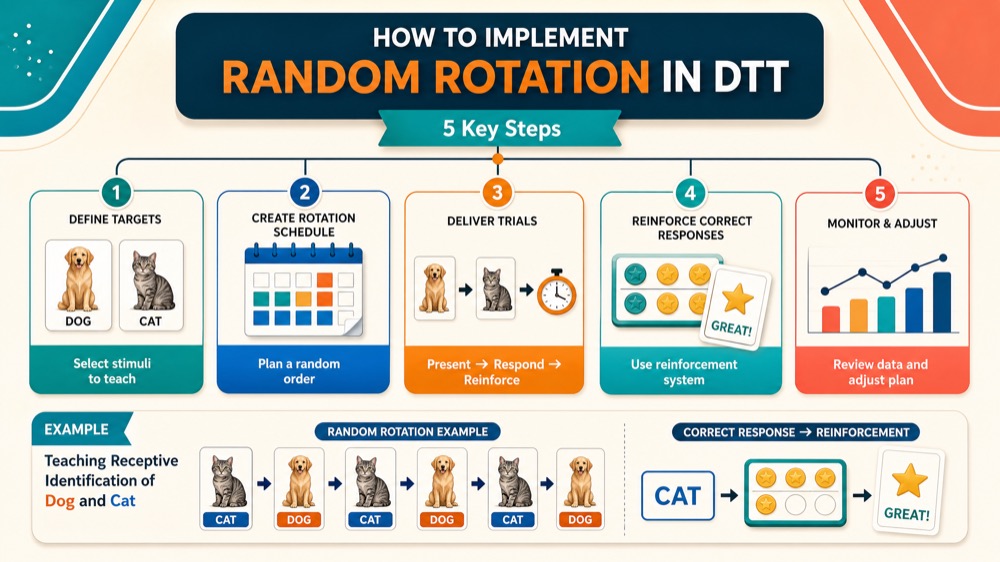
Implementing random rotation requires careful planning. Here are practical steps and examples to guide you. Example: Teaching Receptive Identification of Dog and Cat: Suppose you are teaching a child to receptively identify two picture cards: a dog and a cat. You would first teach each card individually in a blocked format until the child responds correctly on at least 80% of trials for each. Then, you would introduce random rotation. In a random rotation session, you might present trials in this order: “Show me cat,” “Show me dog,” “Show me cat,” “Show me dog,” “Show me dog,” “Show me cat.” The key is that the same stimulus is not presented in consecutive trials, and the order is unpredictable.
You would provide reinforcement for correct responses and implement error correction (e.g., model, prompt, re-present) for incorrect ones. After several sessions, you can probe with novel stimuli (e.g., different pictures of the same animals) to assess generalization. Decision Points and Measurement: Use the points below as a quick study guide.
- When to introduce: After the learner shows initial mastery in blocked format (e.g., 80% correct).
- How to measure: Use probe trials that intermix target stimuli without reinforcement; record independent correct responses.
- Adjusting difficulty: If errors increase, fade back to a less demanding format or increase discriminability (e.g., use more distinct stimuli).
- Reinforcement schedule: Use continuous reinforcement during teaching, but thin reinforcement during probes to test pure stimulus control.
Common Traps to Avoid: Use the points below as a quick study guide.
- Using random rotation too early can slow acquisition; ensure basic attending is intact.
- Confusing random rotation with interleaving—interleaving may involve different tasks, while random rotation focuses on unpredictable order of similar stimuli.
- Believing random rotation automatically produces generalization—you must still probe with novel stimuli.
- Treating random rotation as a measurement procedure; it is a teaching strategy, so separate probes are necessary.
Random Rotation and Generalization
Random rotation can help assess and promote generalization, but it does not guarantee it. Generalization refers to the learner’s ability to respond correctly to untrained stimuli or in untrained settings. By intermixing trials, you reduce the likelihood of the learner relying on sequence cues, thereby increasing the chance they are responding to the actual stimulus.
However, to assess generalization, you must vary other dimensions, such as the physical characteristics of stimuli (e.g., different dog pictures) or the environment. For example, after mastering dog and cat with specific cards, you might present a novel dog photo or a different cat illustration. If the learner responds correctly, that is evidence of stimulus generalization. For more on this, see our guide on stimulus generalization in ABA.
Random Rotation vs. Interleaving
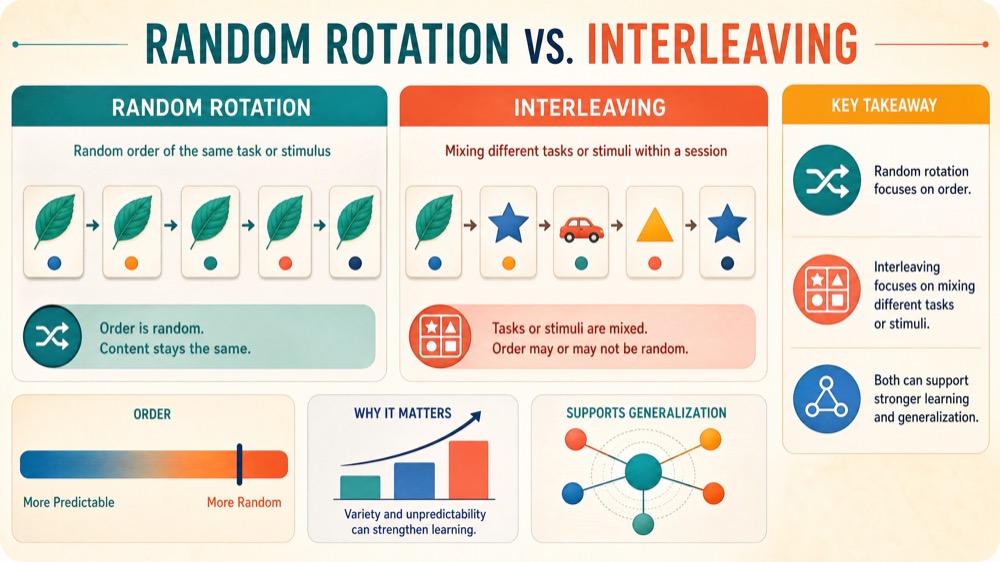
Random rotation is sometimes used interchangeably with interleaving, but they are not always the same. Interleaving refers to mixing different types of tasks or stimuli within a session, which may or may not be random. For example, you might interleave math problems with spelling words. Random rotation focuses on the unpredictability of the order, but it is typically applied to similar types of stimuli (e.g., two or more target stimuli in a discrimination task).
In DTT, random rotation is a specific form of interleaving. The distinction matters because the underlying behavioral processes may differ. Random rotation primarily enhances discrimination and prevents sequential responding, whereas interleaving can also promote other learning outcomes. Always clarify the procedural definition you are using in your practice.
Study Checklist for Your BCBA Exam
Use this checklist to consolidate your knowledge of random rotation in ABA:
- Define random rotation and its purpose in DTT.
- Differentiate random rotation from blocked rotation and interleaving.
- Identify when to introduce random rotation (after initial mastery).
- Describe how to measure its effect using probe trials.
- Explain the role of stimulus control and SD vs. S-delta in random rotation.
- List common exam traps and avoid them.
Remember that the BCBA Test Content Outline (6th ed.) includes skill acquisition procedures, but it may not use the exact term “random rotation.” It is essential to understand the concept and how it fits within broader teaching strategies. You can practice applying such concepts with our free BCBA mock exam, which provides practice and feedback to guide your studies.
Conclusion
Random rotation in ABA is a practical and powerful technique for strengthening discrimination skills in discrete-trial teaching. By varying stimulus order unpredictably, you help learners attend to the instruction and avoid pattern-based responding. The key is to use it after initial acquisition, measure its effects with probe trials, and avoid common pitfalls. Incorporate generalization planning, and you will see robust learning outcomes. For more study support, take our free BCBA mock exam and get detailed feedback on your performance. Ready to practice? Take our free BCBA mock exam and receive detailed feedback to guide your studies.
Reference
Next step for BCBA exam prep
Turn this topic into exam-day practice
Use this topic as a focused review, then test it in exam-style conditions with a free mock before deciding whether five full-length mocks are the right next step.
Start the Free BCBA Mock Exam
Continue with Five Full-Length Mocks — $99
Review the included materials and access details before ordering. No pass guarantee is implied.



