

What Is Stimulus Generalisation?
Stimulus generalisation is a core concept in Applied Behavior Analysis (ABA) that describes when a response learned in the presence of one stimulus also occurs in the presence of similar stimuli. For example, a child who learns to say ‘please’ when asking for a cookie from Mom may also say ‘please’ when asking for a cookie from Dad, even though that specific request wasn’t taught with Dad. This spreading of responding across similar situations is essential for making learning functional and meaningful in everyday life.
Table of Contents
- What Is Stimulus Generalisation?
- Examples of Stimulus Generalisation in ABA
- Exam Relevance and Common Traps
- How to Program for Stimulus Generalisation
- Quick Checklist for Exam Prep
- Summary
In ABA, we often talk about a stimulus generalisation gradient: the more similar a new stimulus is to the original training stimulus, the more likely the response will occur. As similarity decreases, so does the probability of the response. Understanding this gradient helps behavior analysts predict and program for meaningful generalisation rather than leaving it to chance.
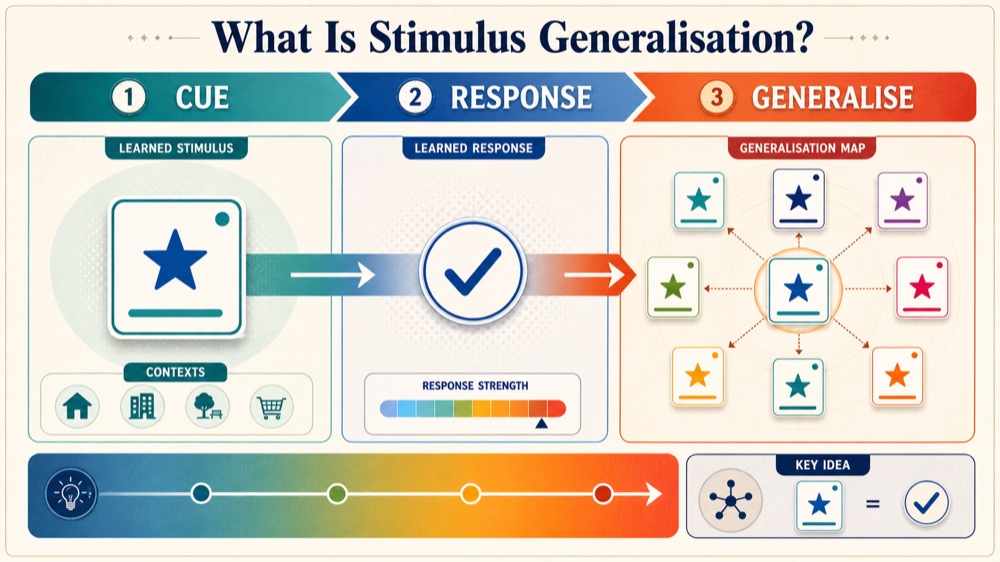
Definition in ABA Context: Formally, stimulus generalisation is defined as the occurrence of a response in the presence of a stimulus that shares physical or functional features with the original discriminative stimulus (SD). For instance, if a client learns to mand for ‘cookie’ in the presence of a chocolate chip cookie, they may also mand for ‘cookie’ when shown a sugar cookie. The response has generalised across similar antecedent stimuli.
The term is closely related to the concept of generalisation gradient, which depicts how response strength varies with stimulus similarity. A steep gradient means the response is limited to stimuli nearly identical to the training stimulus; a flat gradient indicates broad generalisation. Behavior analysts often aim for a moderate gradient that balances generalisation with necessary discrimination.
Stimulus Generalisation vs. Stimulus Discrimination: While stimulus generalisation involves responding to a range of similar stimuli, stimulus discrimination is the opposite: responding occurs only in the presence of a specific stimulus and not to others. For example, a child learns to say ‘red’ only when shown a red crayon, not a blue one. Both processes are crucial. Generalisation allows skills to transfer to new settings, while discrimination prevents irrelevant or dangerous responses.
Think of them as two sides of the same coin. On the BCBA exam, you may be asked to identify whether a scenario describes generalisation or discrimination. A key hint: if the client responds to untrained but similar stimuli, it’s generalisation; if they respond only to the exact trained stimulus, it’s discrimination. Practitioners must program for both to achieve meaningful behavior change.
Examples of Stimulus Generalisation in ABA
Seeing real-world examples helps solidify the concept. Below are three ABA scenarios using the ABC (Antecedent-Behavior-Consequence) model with hypothesized function, illustrating how stimulus generalisation plays out in therapy.
Example 1: Toilet Training with Different Toilets: Antecedent: Child enters a public restroom with a different style of toilet (e.g., automatic flush, different color). Behavior: Child sits on the toilet and urinates. Consequence: Parent provides praise and a preferred reinforcer. Function: social positive reinforcement (praise) and automatic reinforcement (relief). This shows generalisation across settings because the response (urinating on the toilet) occurred with a novel toilet that was similar to the home toilet. To promote this, therapists teach loosely by varying bathroom environments during training.
Example 2: Greeting Different People: Antecedent: An unfamiliar adult approaches the child at a park. Behavior: Child says ‘hello’ and waves. Consequence: The adult smiles and says ‘hello’ back. Function: social positive reinforcement. This is a classic example of stimulus generalisation: the greeting response was originally taught with familiar adults (parents, therapists) and now occurs with new people. However, overgeneralisation can happen—the child might greet strangers in unsafe contexts. Therapists then teach discrimination (e.g., only greet adults when a parent is nearby).
Example 3: Fear of the Dark after a Sting: Antecedent: A dark room (similar to the dimly lit area where a bee sting occurred). Behavior: Crying, clinging to parent, attempting to leave. Consequence: Parent turns on the light and comforts the child. Function: negative reinforcement (escape from fear). Here, the fear response generalises from the original sting context to any dark space. The stimulus generalisation gradient is evident: very dark rooms evoke strong fear, while slightly dim rooms may evoke less. Treatment involves systematic desensitisation and discrimination training to help the child distinguish safe darkness from the dangerous situation.
Exam Relevance and Common Traps
The BCBA exam frequently tests your understanding of stimulus generalisation. You’ll need to not only define it but also identify it in scenarios and know how to program for it. Below are key exam insights and common pitfalls to avoid.
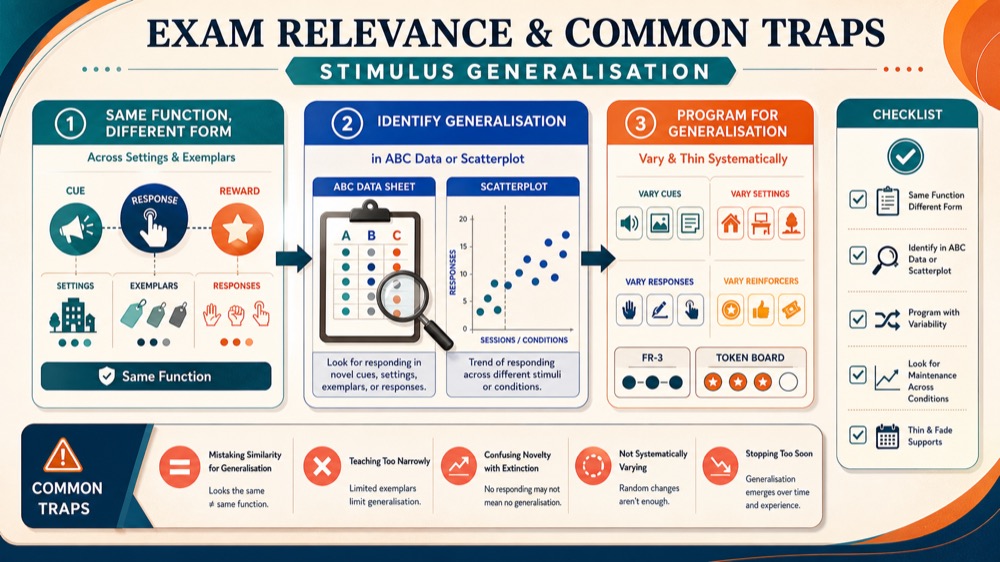
How Stimulus Generalisation Appears on the BCBA Exam: In the BACB 6th Edition Task List, stimulus generalisation is covered under Domain B (Concepts and Principles) and Domain G (Intervention). Expect scenario-based questions where you must:
- Identify generalisation: Given a description of a client’s behavior, determine if it illustrates stimulus generalisation or discrimination.
- Select programming strategies: Choose the best method (e.g., teaching loosely, multiple exemplars) to promote generalisation.
- Evaluate outcomes: Determine if a behavior change has generalised across settings, people, or materials.
Practice questions often ask: ‘The client exhibits the target behavior in the presence of a novel stimulus that is similar to the training stimulus. This is an example of ______.’ The answer is stimulus generalisation.
Common Exam Traps: Watch out for these common mistakes:
- Confusing generalisation with discrimination: A scenario where the client responds only to the exact training stimulus is discrimination, not generalisation.
- Assuming generalisation happens automatically: Without planned programming, generalisation often fails. The exam may test your knowledge of intentional strategies.
- Overgeneralisation as a negative: While generalisation is usually desired, overgeneralisation (e.g., saying ‘hello’ to every stranger) can be problematic. Know when to teach discrimination.
- Mixing up stimulus and response generalisation: Remember that stimulus generalisation involves different antecedents evoking the same response; response generalisation involves the same antecedent evoking different but functionally equivalent responses.
How to Program for Stimulus Generalisation
Effective ABA interventions intentionally program for generalisation rather than hoping it occurs. Here are three evidence-based strategies you should know for the exam and practice.
Teaching Loosely: Vary non-critical aspects of the teaching environment—such as the instructor, setting, time of day, materials—while keeping the critical SD constant. For example, when teaching a child to identify the color red, use red toys, red clothing, and red pictures across different rooms. This prevents the response from coming under the control of irrelevant stimuli (e.g., only the red toy in the therapy room).
Using Multiple Exemplars: Train across multiple examples of the target stimulus class. If teaching receptive identification of ‘dog,’ show pictures of different breeds (Labrador, poodle, terrier) and even real dogs. This increases the likelihood that the child will respond to any dog, not just the one from training. Multiple exemplar training is a powerful tool to promote broad stimulus generalisation.
Programming Common Stimuli: Include stimuli from the natural environment in the training setting. For instance, if the goal is for a student to raise their hand in a general education classroom, have them practice raising their hand with actual classroom desks, a real bell, and typical peer distractions. This bridges the gap between training and the target setting.
For more on related concepts, see our guide on discriminative stimuli and stimulus control.
Quick Checklist for Exam Prep
Use this checklist to ensure you’ve covered the essentials for the BCBA exam:
- Define stimulus generalisation and distinguish it from discrimination.
- Explain the stimulus generalisation gradient.
- Identify examples in ABC format with hypothesized function.
- Know at least three strategies to program for generalisation (teach loosely, multiple exemplars, common stimuli).
- Recognise overgeneralisation and how to address it.
- Practice scenario-based questions from mock exams.
Summary
Stimulus generalisation is a fundamental concept in ABA that enables learned behaviors to transfer across relevant situations. On the BCBA exam, you must be able to define it, identify it in scenarios, and select appropriate programming strategies. Common traps include confusing it with discrimination and assuming it will occur without planning. Use the checklist above for a quick review, and visit our free BCBA mock exam to test your knowledge. For further reading, the BACB website provides official task list resources.



