
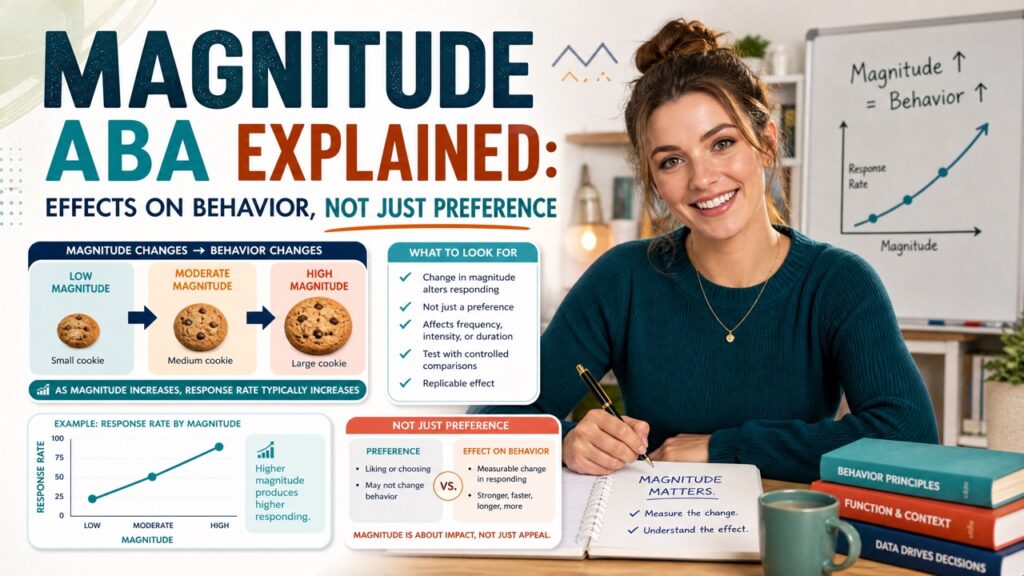
What Is Magnitude of Reinforcement in ABA?
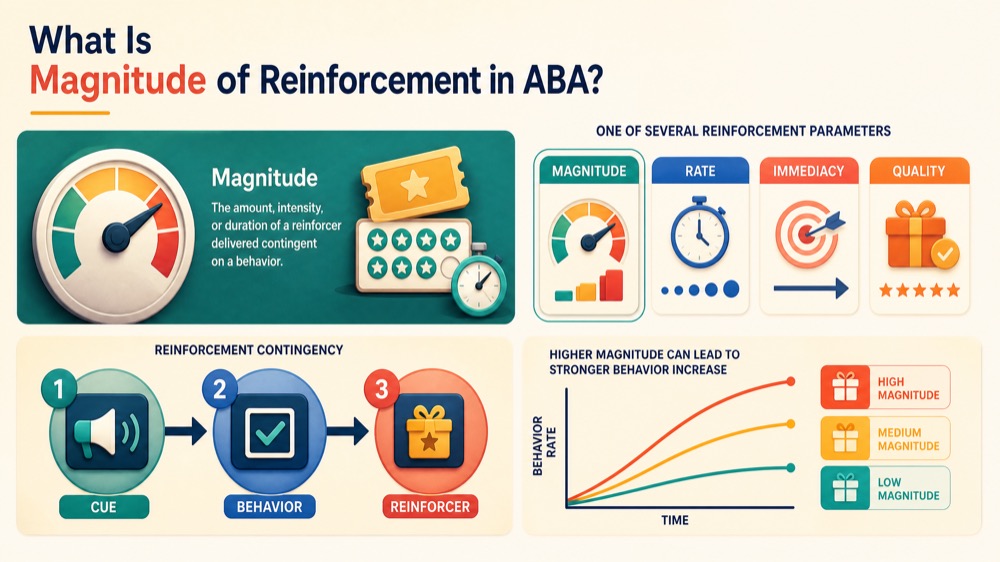
In applied behavior analysis, magnitude of reinforcement refers to the amount, intensity, or duration of a reinforcer delivered contingent on a behavior. It is one of several reinforcement parameters, alongside rate, immediacy, and quality. As a programmed property of the contingency, magnitude is what the behavior analyst arranges: giving one token versus five tokens, or providing 30 seconds of access to a preferred toy instead of two minutes. Understanding magnitude aba is essential because it directly influences response strength, but the relationship is not always straightforward. Table of Contents
Table of Contents
- What Is Magnitude of Reinforcement in ABA?
- How Magnitude Affects Response Strength
- Magnitude vs. Preference: Why They’re Different
- Original Example: One Token vs. Five Tokens
- Clinical Implications: Applying Magnitude in DRA and NCR
- Common Traps and Misconceptions
- Interpreting Data from Magnitude Manipulations
- Study Checklist for Magnitude ABA
- Common Pitfalls to Avoid
- How the BACB Task List Relates
- Assess Your Understanding with a Free BCBA Mock Exam
- Reference
Technically, magnitude is a dimension of the reinforcer itself, not a property of the behavior. For example, if a teacher says “you earned five minutes of iPad time,” the magnitude is five minutes. If praise is delivered with high enthusiasm, the magnitude might be the intensity of that praise. However, magnitude should not be confused with reinforcer efficacy or preference. Efficacy refers to how well a reinforcer strengthens behavior, while preference is determined by an individual’s choice under concurrent schedules. Magnitude is just one factor that contributes to efficacy but does not guarantee it.
How Magnitude Affects Response Strength
Generally, increasing the magnitude of reinforcement leads to an increase in response strength, but this relationship is often nonlinear. In many applied settings, a larger reinforcer produces higher response rates, but only up to a point. Beyond that, satiation may occur, or contrast effects may emerge. For example, if a child usually receives one sticker for completing a chore, suddenly offering five stickers may dramatically increase compliance. However, if the child already has a large supply of stickers, the reinforcer loses its value, and response rates may drop despite the larger magnitude.
This nonlinearity has important implications for behavior analysts. Simply assuming that “more is always better” can lead to ineffective interventions. Instead, you must consider motivating operations (MOs) and the individual’s current state. For instance, offering a large amount of food as a reinforcer right after lunch may be less effective than offering a small snack because satiation reduces the reinforcing value. Likewise, contrast effects can occur when a change in magnitude is relative to expected outcomes. A child who usually gets five tokens may respond less when only one is given, even if one token is normally reinforcing.
Magnitude vs. Preference: Why They’re Different
A common misconception is that magnitude is the same as reinforcer preference. In reality, preference refers to the relative value an individual places on one reinforcer compared to others, often assessed via preference assessments or concurrent schedules. Magnitude is the amount of that reinforcer, which can influence preference but is not identical to it. For example, a child may prefer playing with a peer over receiving a sticker, but if you increase the magnitude of the sticker (e.g., five stickers), it may become more competitive. Yet a larger magnitude of a low-preference item may still be less effective than a small magnitude of a high-preference item.
From a clinical standpoint, distinguishing magnitude from preference is critical. A behavior analyst might assess preference using a paired-choice assessment, but that alone does not tell you how much of the reinforcer to use. You will still need to manipulate magnitude empirically to find the sweet spot. For instance, in a concurrent schedule, you could offer one token on the left response option and five tokens on the right. If the child allocates more responses to the right, you have evidence that the larger magnitude is more valued. However, this also depends on other parameters like effort and delay.
Original Example: One Token vs. Five Tokens
Consider a classroom where a student can earn tokens for completing math problems. On a concurrent schedule, the student can choose between two response options: Option A delivers one token per problem, and Option B delivers five tokens per problem. With all else being equal (immediacy, effort, quality), you might expect the student to allocate more responses to Option B. However, the actual pattern may vary. If the tokens are exchanged for backup reinforcers like extra recess, the larger magnitude may produce a higher response rate. But if the student is already satiated on the backup reinforcer, the five-token option may lose its advantage.
This example illustrates that magnitude effects are not just about arithmetic. The five-token condition might produce a higher response rate initially, but over time, the contrast between the two options could shift preference. Alternatively, the student might respond equally on both if the five-token option requires more effort (e.g., more challenging problems). Therefore, when interpreting data from a magnitude manipulation, you must look at response allocation and rate across sessions, not just a single observation.
Clinical Implications: Applying Magnitude in DRA and NCR
Magnitude manipulations are common in differential reinforcement of alternative behavior (DRA) and noncontingent reinforcement (NCR). In DRA, you reinforce an alternative behavior with a larger magnitude to make it more competitive than the problem behavior. For example, if a child engages in tantrums to escape tasks, you might reinforce compliance with five minutes of break, while ignoring tantrums. The larger magnitude may increase the likelihood of compliance. However, this must be individualized; what works for one child may not work for another. A function-based assessment is essential to identify the reinforcer and appropriate magnitude.
In NCR, you provide reinforcers on a time-based schedule, independent of behavior. Magnitude plays a role in how long the reinforcer’s effect lasts. For example, if you deliver 30 seconds of attention every five minutes, the behavior may decrease, but the effect may be stronger with 90 seconds of attention. However, larger magnitudes may also lead to satiation more quickly, reducing overall effectiveness. Therefore, it’s important to monitor data and adjust magnitude based on response patterns. Avoid assuming that a fixed magnitude will work across individuals or settings.
Common Traps and Misconceptions
- Assuming a linear dose-response: Larger magnitude does not always produce proportionally higher responding; satiation and contrast can cause plateaus or reversals.
- Confusing magnitude with preference: Preference is about choice, whereas magnitude is about the amount; they are separate constructs.
- Ignoring motivating operations: The same reinforcer type with the same magnitude can have different effects depending on establishing operations, such as deprivation or satiation.
- Believing a specific magnitude is universally effective: There is no standard number; magnitude is arbitrary and defined by the observer.
- Assuming magnitude effects are permanent: Behavior can adapt, and the discriminable difference may change as the individual becomes accustomed to larger magnitudes.
- Overlooking data patterns: Always analyze level, trend, and variability in cumulative records or bar graphs to understand magnitude effects.
Interpreting Data from Magnitude Manipulations
When you manipulate magnitude, you should display and analyze data systematically. Cumulative records are particularly useful because slope changes indicate changes in response rate immediately after a magnitude change. For example, if the cumulative record shows a steeper slope after increasing the magnitude, that suggests an increase in response rate. However, you must also examine within-session patterns: a burst of responding followed by a plateau might indicate satiation. Bar graphs can show average response rates across conditions, but they may obscure variability.
It is also important to distinguish whether a magnitude change produces a true behavior change or a temporary contrast effect. For instance, if you switch from five tokens to one token, responding might initially drop sharply due to negative contrast, even if one token is normally reinforcing. This is a meaningful effect, but it does not mean the one token is ineffective; it may just be a relative change. By observing over time, you can assess whether the response stabilizes at a new level. Use multiple data points and replications to confirm the effect.
Study Checklist for Magnitude ABA
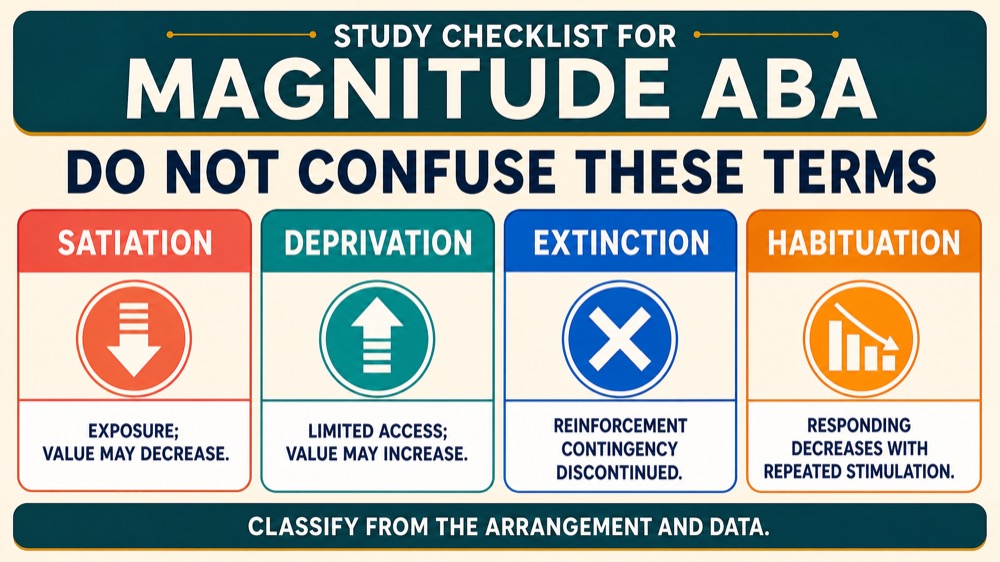
- Define magnitude of reinforcement as a parameter (amount, intensity, duration) and distinguish it from rate, immediacy, and quality.
- Explain how magnitude can affect response strength, but not always linearly.
- Provide examples of nonlinear effects, such as satiation and contrast.
- Differentiate magnitude from reinforcer efficacy and preference.
- Describe how to manipulate magnitude in DRA and NCR, with a focus on individual variability.
- Interpret data from magnitude manipulations using cumulative records and bar graphs, attending to level, trend, and variability.
- Recognize that magnitude is defined arbitrarily; there is no fixed number of deliveries.
- Understand the BACB Task List (6th ed.) within measurement and display, and how magnitude fits into reinforcement parameters.
Common Pitfalls to Avoid
- Do not claim that larger magnitude always leads to proportionally higher response rates.
- Do not say magnitude is synonymous with preference.
- Do not assert a BACB-mandated number of reinforcer deliveries.
- Do not assume magnitude effects are identical for everyone.
- Do not imply that magnitude always works the same way in every program.
- Do not say this topic is guaranteed on the BCBA exam; it is not explicitly named in the BACB outline.
How the BACB Task List Relates
The BACB Task List (6th ed.) does not explicitly mention “magnitude of reinforcement,” but it falls under reinforcement parameters and measurement. In the task list, you are expected to measure behavior and design interventions that manipulate consequences. Understanding magnitude is crucial for measuring the effectiveness of reinforcers and making data-based decisions. For example, if a behavior plan includes providing praise as a reinforcer, you might need to vary the intensity or duration to find a magnitude that works. Familiarizing yourself with concepts like stimulus control and generalization will also help you apply magnitude in broader contexts.
To deepen your understanding, review our articles on stimulus control and stimulus generalization, as these are related to how reinforcers acquire their effect. Remember, magnitude is just one piece of the puzzle; always consider the whole contingency.
Assess Your Understanding with a Free BCBA Mock Exam
Ready to test your knowledge of magnitude aba and other key concepts? Take our free BCBA mock exam to gauge your readiness. The exam includes questions on reinforcement parameters, data interpretation, and applied behavior analysis techniques. After completing it, you’ll get detailed feedback to target your study sessions. Don’t miss this opportunity to strengthen your exam preparation.
In summary, magnitude aba is a key concept that behavior analysts must understand to design effective interventions. It affects response strength but not always linearly, and it is distinct from preference. By applying the principles discussed here, you can improve your clinical practice and exam performance.
Reference
Next step for BCBA exam prep
Turn this topic into exam-day practice
Use this topic as a focused review, then test it in exam-style conditions with a free mock before deciding whether five full-length mocks are the right next step.
Start the Free BCBA Mock Exam
Continue with Five Full-Length Mocks — $99
Review the included materials and access details before ordering. No pass guarantee is implied.



