

In Applied Behavior Analysis (ABA), the accuracy of your data is the foundation for every clinical decision. When data are inconsistent, you risk drawing faulty conclusions about intervention effectiveness. One subtle but significant threat to data reliability is observer drift. This article explains what observer drift in ABA is, how it differs from related concepts, how to detect it, and how to prevent it from compromising your measurement system. Whether you are a practicing BCBA or a student preparing for the exam, understanding observer drift is essential for maintaining measurement fidelity and making data-driven decisions. Table of Contents
Table of Contents
- What Is Observer Drift in ABA?
- Types of Observer Drift
- Why Observer Drift Matters
- How to Detect Observer Drift
- Best Practices to Prevent Observer Drift
- Observer Drift vs. Observer Bias
- Common Traps and Misconceptions
- How to Study Observer Drift for the BCBA Exam
- Study Checklist for Observer Drift
- Conclusion
- Reference
What Is Observer Drift in ABA?
Observer drift is a gradual, unintended change in how an observer applies a measurement system over time. It occurs when an observer’s recording of behavior deviates from the original operational definition, leading to inconsistent data collection. This drift can happen without the observer’s awareness, often because of fatigue, boredom, or natural shifts in interpretation. The key feature is that the observer’s criteria for what constitutes a response slowly changes, so that data collected later are not comparable to data collected earlier.
For example, imagine an observer is recording “hitting” defined as any physical contact using an open hand. In the first few sessions, they record every instance, including gentle touches. After several weeks, they might unintentionally begin recording only forceful contacts, missing the gentler taps. This change in what counts as a response is a classic example of observer drift. The behavior itself has not changed, but the measurement has, which can make it appear that the intervention is more effective than it actually is.
Types of Observer Drift
Observer drift is not a single phenomenon; it can manifest in different ways. Understanding these types helps you pinpoint where drift might be occurring in your own data collection. There are two primary types: definitional drift and observational drift.
Definitional Drift: Definitional drift occurs when the observer’s interpretation of the operational definition changes over time. This can happen if the definition is ambiguous, or if the observer begins to include or exclude behaviors that were originally specified differently. For instance, a definition may state “aggression” as any hitting, kicking, or throwing objects. Over time, an observer might start including loud vocalizations, even though they are not in the definition, or they might start ignoring low-intensity hits because they seem inconsequential. This type of drift directly changes what is recorded.
Observational Drift: Observational drift refers to changes in the observer’s attention or sensitivity to the target behavior. This can happen when the observer becomes fatigued, distracted, or overly familiar with the behavior. For example, an observer who initially notices every instance of self-stimulatory hand-flapping might, after many sessions, only notice the most obvious occurrences, missing quick or subtle ones. This is not a change in the definition but a change in the observer’s vigilance. Both types of drift can occur simultaneously, and they both undermine the reliability of your data.
Why Observer Drift Matters
Observer drift threatens both the accuracy and reliability of your measurement. When the application of the definition changes, the data no longer reflect the actual occurrence of the behavior. This can lead you to make incorrect conclusions about whether an intervention is working, which is a serious concern in clinical practice. For instance, if an observer’s recording becomes more lenient over time, you might wrongly conclude that a behavior is decreasing when it is actually unchanged.
It is important to note that observer drift is not necessarily intentional. It is not the same as falsifying data or deliberately changing the criteria. Rather, it is often a subtle, unintentional process driven by factors like ambiguous definitions, observer fatigue, or lack of ongoing feedback. Furthermore, observer drift affects the recorded data, not necessarily the true behavior. The behavior itself may remain unchanged, but the way it is measured changes, which can distort your analysis. This is why it is critical to actively monitor for drift and implement prevention strategies.
How to Detect Observer Drift
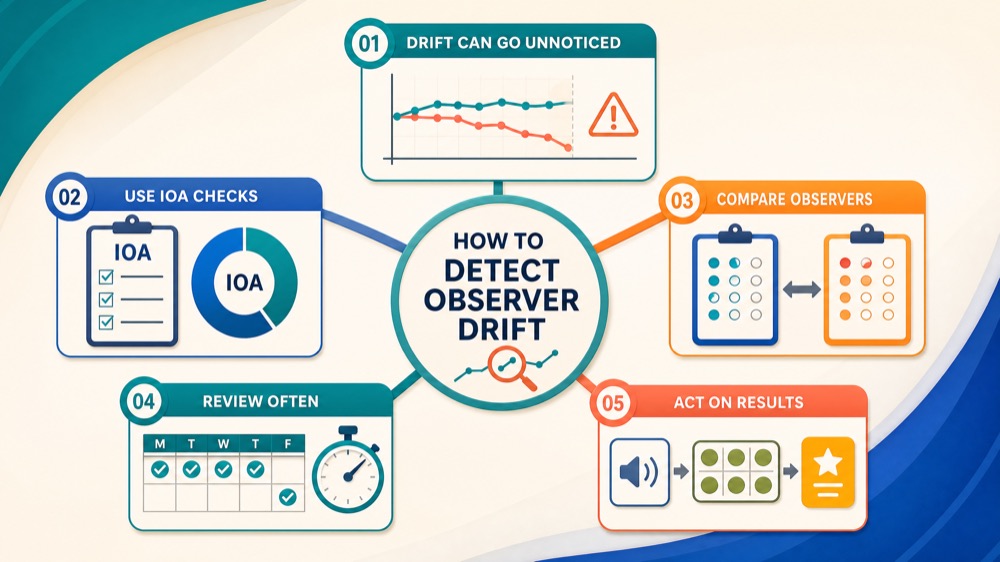
Because observer drift can go unnoticed, you need systematic methods to detect it. The most common and effective approach is to use interobserver agreement (IOA) checks. IOA involves two independent observers recording the same behavior simultaneously, and then comparing their data. Regular IOA checks provide a quantitative way to assess reliability and can reveal drift if agreement declines over time.
Here is a worked example: Suppose two observers record a behavior across 10 intervals. They agree on 8 out of 10 intervals. The IOA is calculated as (agreements / total intervals) × 100 = (8/10) × 100 = 80%. If your IOA starts at 95% but gradually drops to 75% across sessions, this decline may indicate that one or both observers have drifted. Regularly calculating IOA and tracking it over time is a powerful detection method. Other detection methods include:
- Comparing data across sessions: Look for unexpected changes in data patterns that cannot be explained by the intervention or other environmental variables. A sudden shift in baseline or intervention data may signal drift.
- Periodically reviewing operational definitions: Ensure that observers are still using the same criteria as when they started. This can be done through informal quizzes or by asking the observer to explain the definition in their own words.
- Using video recordings: Review recorded sessions to check if the observer’s scoring aligns with the definition. This is especially useful when live observation is not possible, or when you need to verify accuracy after a suspected drift.
Best Practices to Prevent Observer Drift
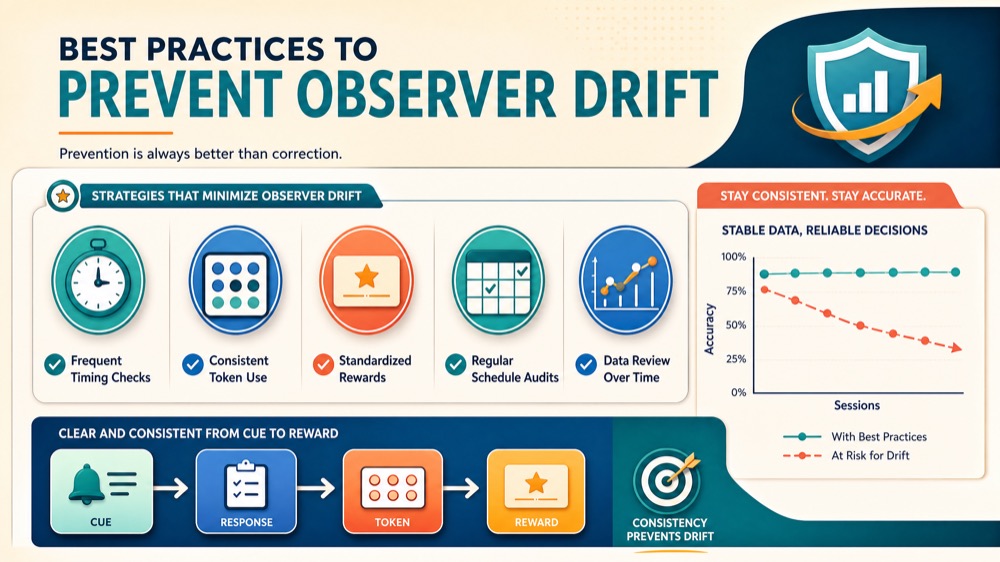
Prevention is always better than correction. Implementing the following strategies can minimize the risk of observer drift in your practice. These practices are not only useful for clinicians but also for BCBA exam candidates to understand as part of measurement topics.
- Use clear, written operational definitions: A precise, unambiguous definition reduces room for interpretation. Include examples and non-examples. For instance, define “on-task behavior” with specific observable actions and clearly state what is not on-task, such as looking away for more than three seconds.
- Provide initial and periodic retraining: Regularly review the definition and scoring procedures, especially after a break or when data patterns change. Retraining can be as simple as having observers watch a video and practice scoring, then comparing their scores to a master key.
- Conduct periodic IOA checks: Schedule IOA assessments throughout the study, not just at the beginning. While the ideal frequency varies by context, regular checks help detect drift early. For example, you might aim for IOA on at least 20% of sessions, with checks spread across the entire study duration.
- Maintain observer motivation: Fatigue and boredom can accelerate drift, so ensure observers take breaks and stay engaged. Rotate observers if possible, or give them varied tasks to maintain alertness.
- Use checklists or data sheets: Having a visual reminder of the definition can keep observers anchored. Some data sheets have the operational definition printed on the top, which serves as a constant reference.
Observer Drift vs. Observer Bias
Observer drift is often confused with observer bias, but they are distinct concepts. Observer bias refers to a systematic error in observation due to the observer’s expectations or beliefs. For example, an observer who expects a behavior to increase may unconsciously record more instances of it. Observer drift, on the other hand, is a change over time in the application of the measurement system, independent of expectations. While both threaten data reliability, they require different interventions. Bias may be addressed through blinding or careful training, while drift is often addressed through retraining and consistent IOA.
Consider this distinction in practice: If you are measuring a child’s compliance, and you believe a new intervention is working well, you might unknowingly record more instances of compliance after the intervention begins—this is observer bias. In contrast, if you initially defined compliance as any request completion within 10 seconds, but after a month you start recording only completions within 5 seconds, that is observer drift. Both can skew your data, but they arise from different mechanisms.
Common Traps and Misconceptions
There are several misconceptions about observer drift that can lead to ineffective prevention strategies. Being aware of these can help you avoid them in your own practice and on the exam. Below are some common traps:
- Myth: Observer drift is always intentional faking of data. In reality, it is often unintentional and subtle, making it even more dangerous because it goes undetected.
- Myth: Observer drift can be prevented by using more observers. Simply adding observers does not guarantee consistency; all observers can drift together, especially if they share the same interpretation errors.
- Myth: Observer drift only occurs in momentary time sampling. It can occur in any measurement system, including event recording, duration, or latency. Any time an observer is involved, drift is possible.
- Myth: Observer drift is the same as observer bias. As noted, they are distinct, though related. Drift is about changes over time; bias is about expectation-driven errors.
- Myth: Observer drift always works the same way in all contexts. Its manifestation can vary depending on the behavior, setting, and definition. For example, drift may be more pronounced in complex behaviors with many dimensions.
How to Study Observer Drift for the BCBA Exam
Observer drift is a core topic in the measurement section of the BCBA exam. To master it, you need to go beyond rote memorization and understand how it applies to real-world scenarios. Here are some study strategies to help you prepare effectively.
Connect to Stimulus Control: Observer drift relates to stimulus control in that the operational definition serves as a discriminative stimulus (SD) for scoring behavior. When the definition is clear, it exerts good control over observer behavior. If the definition is vague, it may lose control over time, leading to drift. For more on stimulus control, see our article on stimulus control in ABA. Additionally, stimulus generalization can be involved in observer drift if the observer starts responding to similar but not identical behaviors.
Practice with Scenarios: Look for practice questions that describe a measurement system and ask you to identify whether drift is occurring, or what the best prevention strategy is. You can find such questions in our free BCBA mock exam to test your knowledge.
Use Active Recall: After reading this article, write down everything you remember about observer drift from memory. Then check your notes for gaps. This active recall technique strengthens retention and helps you identify what you need to review further.
Study Checklist for Observer Drift
As you prepare for the BCBA exam, use this checklist to solidify your understanding of observer drift. Check off each item as you master it:
- Define observer drift and describe its key features (gradual, unintentional, changes application of measurement system).
- Distinguish between definitional and observational drift, and provide an example of each.
- Explain why observer drift threatens measurement fidelity and data reliability.
- Calculate IOA using the interval-by-interval method (agreements / intervals × 100).
- Describe at least three methods to detect observer drift.
- List at least four prevention strategies (clear definitions, retraining, IOA checks, etc.).
- Differentiate observer drift from observer bias with an example.
- Apply the concept to a novel scenario: “What could cause the data to change? Is it the intervention or the observer?”
- Understand how observer drift relates to stimulus control and generalization.
Conclusion
Observer drift is a subtle but serious threat to the validity of behavioral measurement. It can occur without the observer’s knowledge, leading to inaccurate data and poor clinical decisions. By understanding its nature, using IOA to detect it, and implementing proactive prevention strategies, you can maintain high standards of measurement fidelity. Remember that observer drift is not about blaming the observer; it is about creating systems that support reliable, trustworthy data. As you continue your studies, keep this concept in mind and always question the integrity of your measurement. To put your knowledge to the test, try our Free BCBA Mock Exam. It offers practice questions and feedback to help you identify areas for improvement. Good luck with your studies!



