

How much ABA is too much? There is no single hour number that answers the question for every learner. A responsible decision considers meaningful goals, the learner’s participation and assent, data trends, treatment quality, safety, family priorities, school and community life, sleep and health context, and whether the current plan is producing useful progress. More scheduled time is not automatically better, and fewer hours are not automatically safer or more effective.
Table of Contents
- What Is the Short Answer to “How Much ABA Is Too Much?”
- What Does ABA Intensity Mean?
- What Signs Suggest the Plan Needs Review?
- Why Does Quality Matter More Than a Fixed Hour Target?
- What Questions Should Families Ask the Team?
- How Should a BCBA Think About Intensity?
- What Are the BCBA Exam Takeaways?
- Frequently Asked Questions
- Sources for Further Study
- Take the Free BCBA Mock Exam
This article is an educational BCBA study and decision-making guide, not a treatment recommendation for a specific person. Service intensity must be individualized by qualified professionals using current assessment, the treatment plan, collaboration, applicable rules, and ongoing data review. Families and learners should be able to ask how the proposed intensity connects to goals and how the plan will be revised if the fit is poor.
What Is the Short Answer to “How Much ABA Is Too Much?”
ABA may be too much when the intensity is not producing meaningful, measurable benefit relative to its burden, when the learner cannot participate safely or meaningfully, when important goals or daily-life opportunities are crowded out, or when the plan continues by habit despite data showing a need for change. It may also be too little when priority goals remain unaddressed, the learner needs more supported practice, or the team cannot implement the plan with enough consistency to evaluate it. Both directions require review rather than a reflexive increase or decrease.
“Too much” is therefore a fit question. The relevant comparison is not simply hours on a calendar. Ask what happens during those hours: Are the activities individualized? Are the targets socially meaningful? Is there time for breaks, communication, relationships, sleep, school, play, and ordinary family life? Does the learner have an accessible way to assent, decline, request a pause, or communicate discomfort? Is the team measuring outcomes that matter to the learner and family?
Concerns should be specific. “The schedule feels intense” is important information, but the team can investigate it more effectively when it is paired with observations such as fatigue after sessions, missed meals, reduced participation in preferred routines, increased distress during transitions, limited generalization, or a plateau in priority goals. A concern is not proof that ABA is harmful, but it is a reason to listen, review, and collect better information.
What Does ABA Intensity Mean?
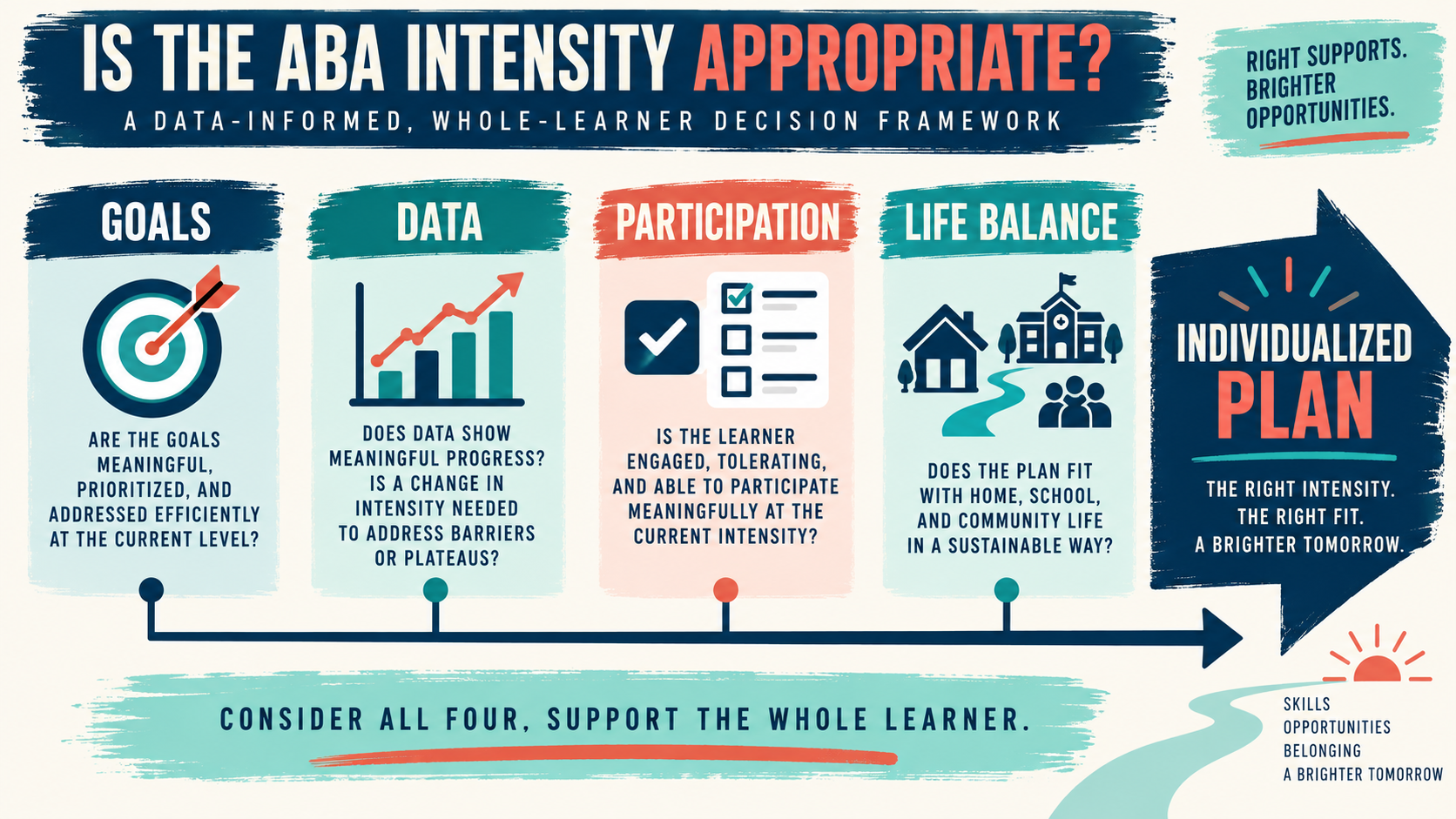
Intensity can refer to several dimensions: hours per week, sessions per day, number of learning opportunities, response effort, staffing, treatment duration, how much of the day is structured, or how much support is needed across settings. Two plans with the same weekly hours can feel and function very differently. One might use short, varied opportunities embedded in daily routines; another might concentrate long blocks of adult-directed work with little recovery time.
Research on early intensive ABA-based intervention has often compared different service levels, but the evidence does not support treating one historical schedule as a universal prescription. A systematic review and individual-participant meta-analysis found that the evidence for some outcomes is limited and that the effect of intensity is not a simple answer for every learner. More recent reviews and health-system evidence reports continue to emphasize individualized goals, quality, and uncertainty about a universal dose-response rule.
| Dimension | Question to ask | Evidence to review |
|---|---|---|
| Goals | What meaningful skills or safety priorities justify the plan? | Individualized, observable targets with review dates and stakeholder priorities. |
| Data | Is the current intensity associated with useful progress? | Valid measures, trends, treatment integrity, maintenance, and generalization—not one impressive data point. |
| Participation | Can the learner participate meaningfully and communicate a pause, choice, help, or decline? | Observable engagement, distress signals, communication access, assent indicators, and recovery. |
| Life balance | Does the plan leave room for sleep, school, family, play, community, and other services? | Schedule impact, caregiver capacity, transitions, attendance, and access to ordinary routines. |
These dimensions also matter for BCBA exam reasoning. A question that presents a fixed number of hours without assessment, goals, data, or individual context is often testing whether the learner recognizes an unsupported one-size-fits-all recommendation.
What Signs Suggest the Plan Needs Review?
A single hard session does not establish that the treatment intensity is wrong. Look for patterns and ask what other variables may be involved, including sleep, pain, medication changes, illness, transportation, staffing, task difficulty, communication access, or an inconsistent procedure. The following signals are reasons to review the plan with the responsible team, not automatic reasons to stop services or change hours without assessment.
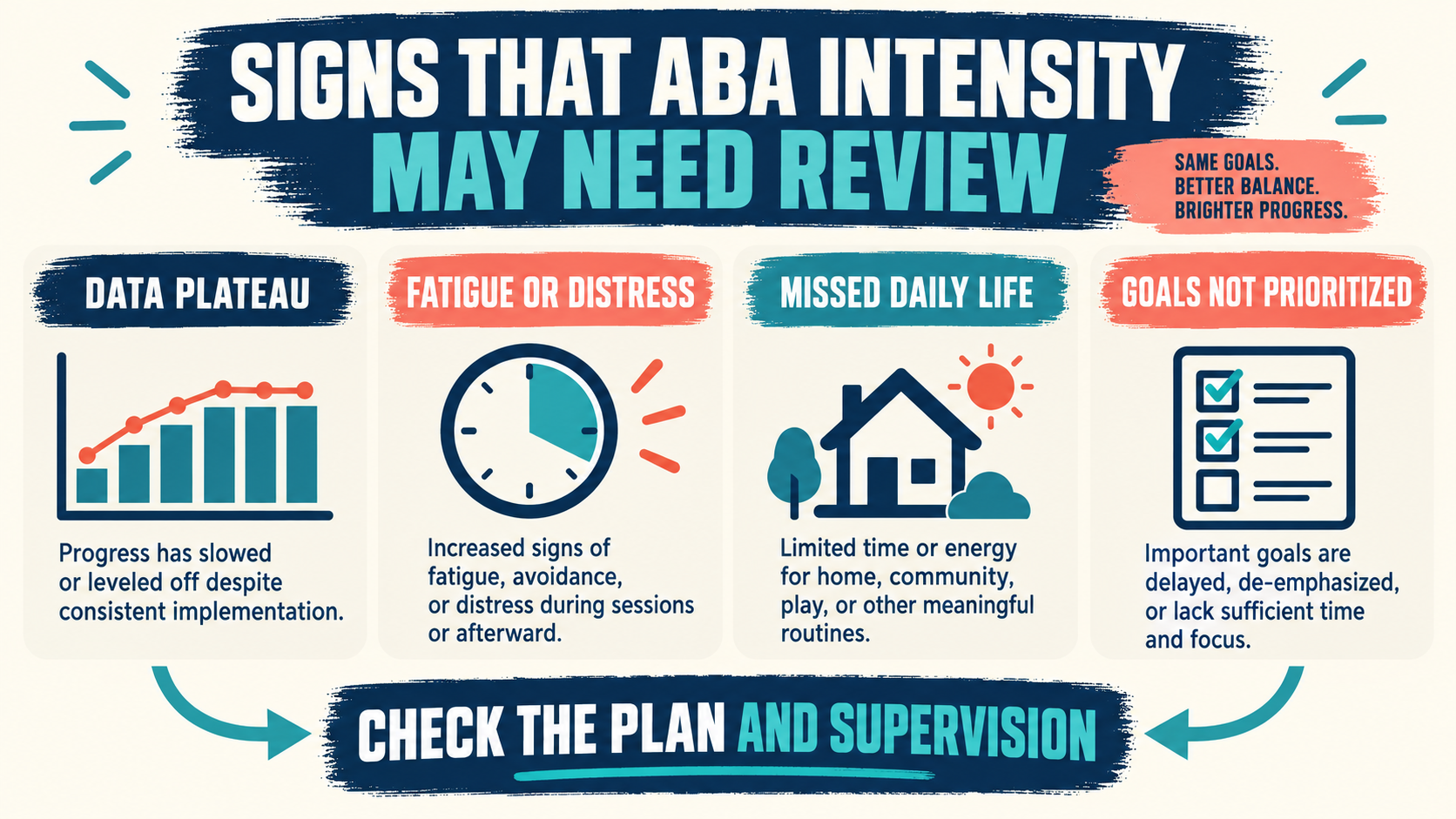
- Progress plateaus: priority goals show little change across an appropriate period despite consistent implementation, or the targets are not actually being measured in a usable way.
- Repeated fatigue or distress: the learner shows persistent signs of overload during or after sessions, has difficulty recovering, or cannot communicate a break or change in an accessible way.
- Important life activities disappear: the schedule leaves little time for sleep, school participation, family connection, play, community access, or other meaningful supports.
- Goals are not prioritized: many hours are filled with low-value practice while communication, independence, safety, or the learner’s own meaningful priorities receive insufficient attention.
- Generalization is missing: performance improves only in the therapy room or with one provider, so the total schedule is not translating into usable everyday skills.
- Attendance and implementation break down: the intensity is so difficult to sustain that sessions are frequently missed, staff turnover is high, or the plan cannot be delivered with fidelity.
Review should also consider whether the issue is not the number of hours but the design of the hours. A poor operational definition, weak reinforcer, inaccessible communication response, excessive prompting, or goals that lack social validity can make an otherwise reasonable schedule ineffective. The right response may be to change targets, teaching conditions, measurement, staff training, or setting—not simply to add or remove time.
Why Does Quality Matter More Than a Fixed Hour Target?
More time creates more potential learning opportunities, but it also creates more exposure to a poorly designed plan if the goals, procedures, or relationships are not working. Quality means the intervention is based on assessment, uses competent implementation, measures meaningful outcomes, and adapts when the data or the learner’s experience says the fit is poor.
Quality also includes the way the service is delivered. A plan can be behavior analytic and still need improvement if it treats compliance as the only outcome, ignores communication, uses unnecessary restrictions, or measures adult convenience rather than meaningful change. Ethical practice includes compassion, dignity, integrity, competence, and benefit. The BACB Ethics Code is a professional reference for those responsibilities.
Ask whether the plan is becoming more efficient over time. As a learner acquires skills, the team may fade prompts, move practice into natural routines, teach caregivers or other partners, reduce unnecessary restrictions, and prioritize generalization. A plan that has no mechanism for review or fading deserves questions. Fading does not mean abandoning support; it means using data to adjust support to current needs.
What Questions Should Families Ask the Team?
Families and learners do not need to calculate a perfect number on their own. They can ask for a clear explanation of how the proposed intensity connects to the person’s goals and daily life:
- What specific goals require this level of support, and how will we know whether they are improving?
- Which measures will be reviewed, how often, and who will explain the trend?
- How will the learner communicate choice, help, a break, discomfort, or a request to stop?
- What will sessions look like in practice, and how much time is spent in teaching, play, movement, communication, and ordinary routines?
- How does the plan include generalization across people, settings, materials, and naturally occurring opportunities?
- What would cause the team to reduce, redesign, or increase the intensity?
- How will the schedule protect sleep, school, family time, community life, and other needed services?
- What is the process for raising a concern, requesting records, or getting a second clinical review?
A good team should be able to answer these questions without treating them as resistance. Questions improve shared decision-making and may reveal that the plan needs a clearer rationale, better data, a different setting, or a more manageable schedule.
How Should a BCBA Think About Intensity?
A BCBA can organize the decision as a repeated cycle: assess, prioritize, implement, measure, review, and adjust. Begin with the learner’s needs, strengths, preferences, communication, safety, and meaningful outcomes. Define the skills or behavior precisely. Select a teaching arrangement that fits the context. Then examine not only whether a response occurs, but whether the change is durable, generalized, socially important, and worth the effort required.
Intensity is a treatment variable, not a badge of seriousness. It should be linked to a clinical rationale that the team can explain and revisit. If the data are flat, first check measurement and treatment integrity. If integrity is adequate, examine the assessment, reinforcer, task difficulty, prompting, response effort, setting, and goal quality. If the learner is distressed, assess possible medical or environmental contributors and listen to the learner’s communication before treating distress as a behavior to overcome.
When a change is considered, document the reason, expected outcome, measurement plan, review date, and coordination needed. A gradual fade, a change in setting, caregiver training, consultation, or a revised target may be more appropriate than a simple increase or decrease in hours. Decisions should be made by qualified professionals in collaboration with the learner and family, not by a generic internet rule.
For the narrower question of how a planned reduction is documented, see the site’s titration plan ABA guide. That page covers reduction criteria, replacement supports, and monitoring; this article focuses on deciding when the current intensity needs review.
What Are the BCBA Exam Takeaways?
For a BCBA exam question about ABA intensity, avoid the most confident-sounding fixed-number answer unless the stem provides the context that justifies it. Look for the answer that:
- connects intensity to individualized assessment and socially meaningful goals;
- uses data, treatment integrity, maintenance, and generalization to evaluate progress;
- protects dignity, assent, communication, safety, and participation;
- considers caregiver capacity, school, community, sleep, health, and other services;
- includes a review or adjustment process rather than treating the schedule as permanent.
The evidence base is more nuanced than “more hours always works” or “any intensive ABA is automatically too much.” A careful answer recognizes uncertainty, individual differences, quality, and the need for ongoing data-based decisions. For additional practice with BCBA scenario reasoning, the free BCBA mock exam is a separate study tool. It is not official BACB content and does not guarantee a certification result.
Frequently Asked Questions
Is 40 hours of ABA automatically too much?: No. A number by itself cannot determine whether a plan fits a particular learner. The team must examine goals, intensity dimensions, quality, participation, health and safety, life balance, data, and applicable requirements. A fixed number should not be presented as a universal prescription.
Is fewer ABA hours always better?: No. A lower schedule may leave important needs unaddressed or provide too few opportunities to evaluate a skill. The question is whether the intensity is justified by individualized goals and whether the plan is producing meaningful, sustainable outcomes.
What should I do if my child seems exhausted after ABA?: Record the pattern and bring it to the responsible clinical team. Ask them to review session structure, goals, breaks, communication access, sleep and health factors, staffing, and data. Seek appropriate medical help for urgent health concerns. Do not make a treatment change based only on a general internet article.
Who decides how many ABA hours are appropriate?: The qualified clinical team should make an individualized recommendation with the learner and family, using assessment, goals, data, professional competence, and applicable service requirements. A payer authorization or a clinic minimum is not the same thing as a complete clinical rationale.
How can I tell whether ABA is helping?: Ask for clear data on meaningful targets, independent versus prompted performance, generalization, maintenance, participation, and the review schedule. Progress should be interpreted with context and should lead to adjustments when the plan is not a good fit.
Sources for Further Study
- BACB Ethics Code for Behavior Analysts — dignity, benefit, integrity, competence, and client-protection reference.
- Evidence Base for Applied Behavior Analysis — current health-system evidence discussion of intensity and dose-response uncertainty.
- ABA Industry Guidelines and Standards of Care — individualized goals and treatment-intensity context.
- Results of an Individual Participant Data Meta-Analysis — systematic-review evidence on early intensive ABA-based interventions.
- Intensive behavioural interventions based on applied behaviour analysis — international collaborative review.
- Behavioral approach to autism spectrum disorder: quality versus quantity — recent narrative discussion of individualized quality and intensity.
Take the Free BCBA Mock Exam
If you want a low-pressure way to check your recall, use the free practice resource below. Take the Free BCBA Mock Exam



