
A sample functional analysis report should let a qualified reader see the question, the tested conditions, the data, the integrity of the procedures, and the limits of the conclusion. It should not read like a diagnosis, a generic FBA summary, or a blank form with no explanation of how the evidence supports the decision.
Table of Contents
- What Is a Sample Functional Analysis Report?
- How Is Functional Analysis Different From an FBA?
- What Should the Report Include?
- What Does a Fictional Report Example Look Like?
- How Do You Interpret the Results?
- What Reporting Mistakes Should You Avoid?
- How Does This Connect to the BCBA Exam?
- Sample Functional Analysis Report FAQ
- Sources and Date Check
- Take the Free BCBA Mock Exam
When students search for a sample functional analysis report, they are often looking for one of two things: a model for organizing the report or help deciding whether a result actually demonstrates a behavioral function. Those are related questions, but they are not the same as asking for a fill-in-the-blank clinical form.
A useful report makes the evidence traceable. Someone reviewing it should be able to move from the referral question to the operational definition, from the definition to the programmed conditions, and from the conditions to the data and decision. The document should also show what was not tested, what was interrupted, and what remains uncertain. This article uses a fictional educational example so that the structure is clear without exposing a real client’s information.
What Is a Sample Functional Analysis Report?
A sample functional analysis report is an educational model of how to communicate the results of a functional analysis. In applied behavior analysis, a functional analysis evaluates programmed environmental conditions to test whether changes in those conditions are associated with changes in a defined response class. The report is the record of the question, procedures, exposure, data, interpretation, limitations, and next decision.
It is not automatically a functional behavior assessment, treatment plan, diagnosis, or authorization document. A broader FBA may combine record review, interviews, rating scales, direct observation, and other assessment methods. A functional analysis is one type of assessment that uses an experimental arrangement. A strong report names the method instead of using “FA,” “FBA,” and “assessment” as interchangeable labels.
The report also should not be copied as a clinical protocol. The BACB’s current materials identify behavior assessment and interpretation as part of BCBA preparation, but an exam outline does not replace supervision, consent or assent procedures, risk assessment, local policy, or professional judgment. The purpose of a sample is to show transparent reasoning.
How Is Functional Analysis Different From an FBA?
Start by identifying what evidence the report claims to use. An interview-based or descriptive FBA can suggest patterns in antecedents and consequences. A functional analysis goes further by arranging and comparing conditions under controlled procedures. The wording of the conclusion must match that level of evidence.
- Record review and interview: describe information sources and inform hypotheses, but do not by themselves demonstrate a functional relation.
- Direct observation: documents what occurred in a setting and may reveal descriptive correlations.
- Functional analysis: compares programmed conditions and a control or comparison condition to evaluate differentiation in the measured response.
- Functional communication or treatment planning: may follow assessment, but it is a separate clinical decision that should be documented separately from the assessment result.
This distinction prevents a common reporting error: labeling a collection of interviews and ABC observations as a functional analysis simply because the report uses the word “function.” The method section should tell the reader what was actually done.
What Should the Report Include?
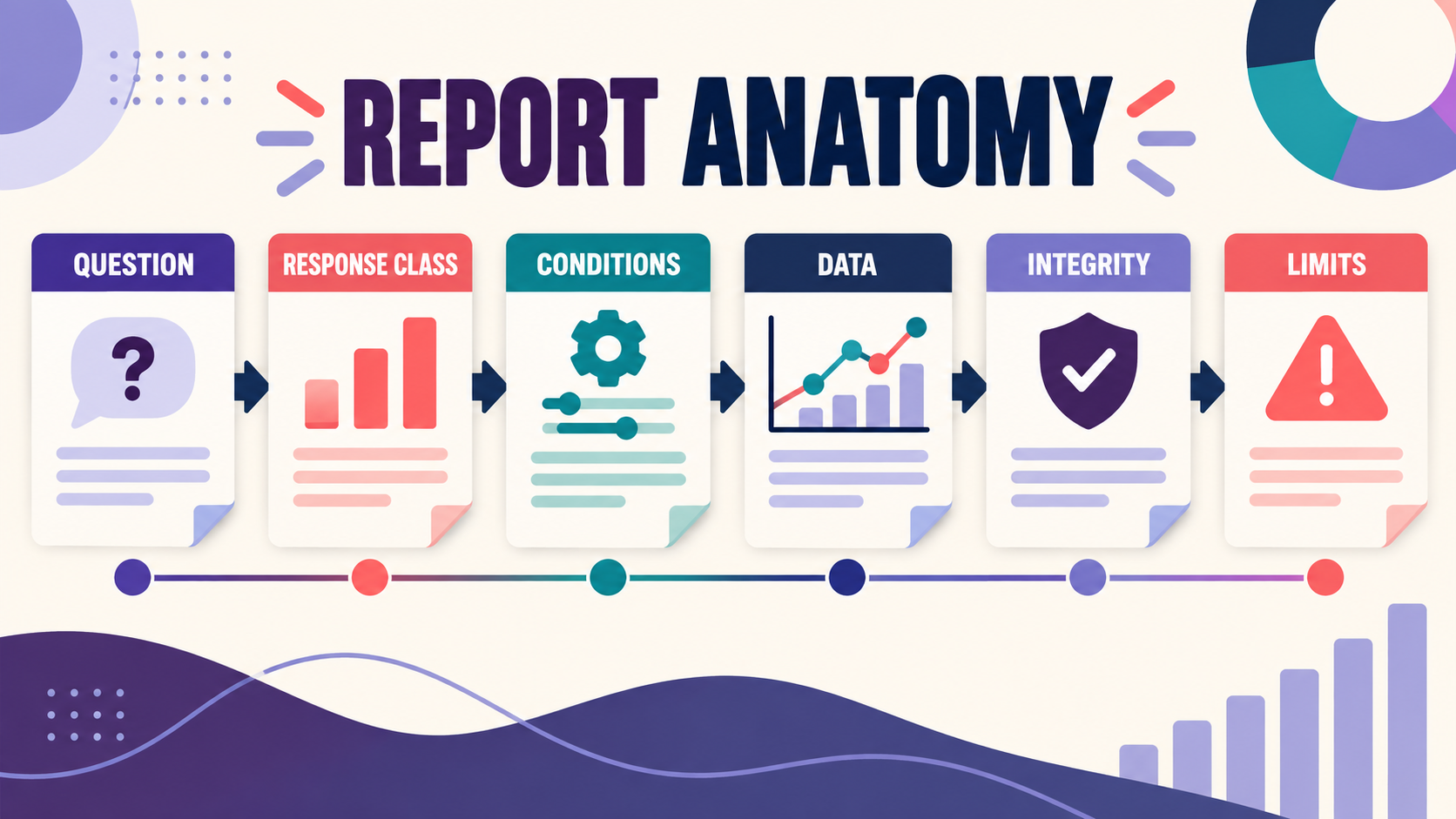
A practical report can be organized into the sections below. The exact headings will vary by setting, payer, institution, and clinical purpose, but the evidence questions should remain visible.
| Report section | Evidence to show | Question it answers |
|---|---|---|
| Referral and priority | The assessment question, client priority, setting, and reason for review. | Why was this assessment considered? |
| Response class | A measurable operational definition, examples, nonexamples, and measurement system. | What behavior was counted? |
| Conditions and procedure | The programmed events, control comparison, materials, session format, and order or design. | What was manipulated and compared? |
| Exposure and data | Session counts, valid and invalid units, raw or summarized data, graph, and denominators. | How much evidence was available? |
| Integrity and safety | Procedural-integrity checks, observer agreement when used, stop events, adverse events, and missingness. | Can the result be interpreted responsibly? |
| Interpretation and next step | Differentiation, uncertainty, alternatives, bounded recommendations, and communication plan. | What does the evidence support—and what does it not support? |
The most important feature is the connection between sections. A graph without a clear response definition is hard to interpret. A conclusion without exposure counts hides how much evidence exists. A recommendation without limitations makes a result sound more certain than it is.
What Does a Fictional Report Example Look Like?
Consider this deliberately simplified example. It is not a clinical template and does not tell anyone how to conduct an assessment.
Assessment question: Does the defined response class occur at a higher level in one tested social condition than in the control comparison? Response class: The fictional report defines one observable response class with a count-based measure and lists examples and nonexamples. Exposure: Twelve planned sessions were scheduled. Ten were valid and interpretable, one stopped under a pre-established safety rule, and one was invalid after a documented procedural deviation.
Result statement: The graph shows higher responding in the attention condition than in the control condition across the valid sessions. The report describes this as differentiation within the tested arrangement, not as proof that the same pattern occurs in every setting.
Notice what the example does not do. It does not hide the two noninterpretable units, turn a fictional number into a universal cutoff, or claim that the response has one function in all contexts. It also does not include a name, birth date, address, school, insurance identifier, or other unnecessary personal information. A sample report should teach organization without encouraging the publication of protected information.
How Do You Interpret the Results?
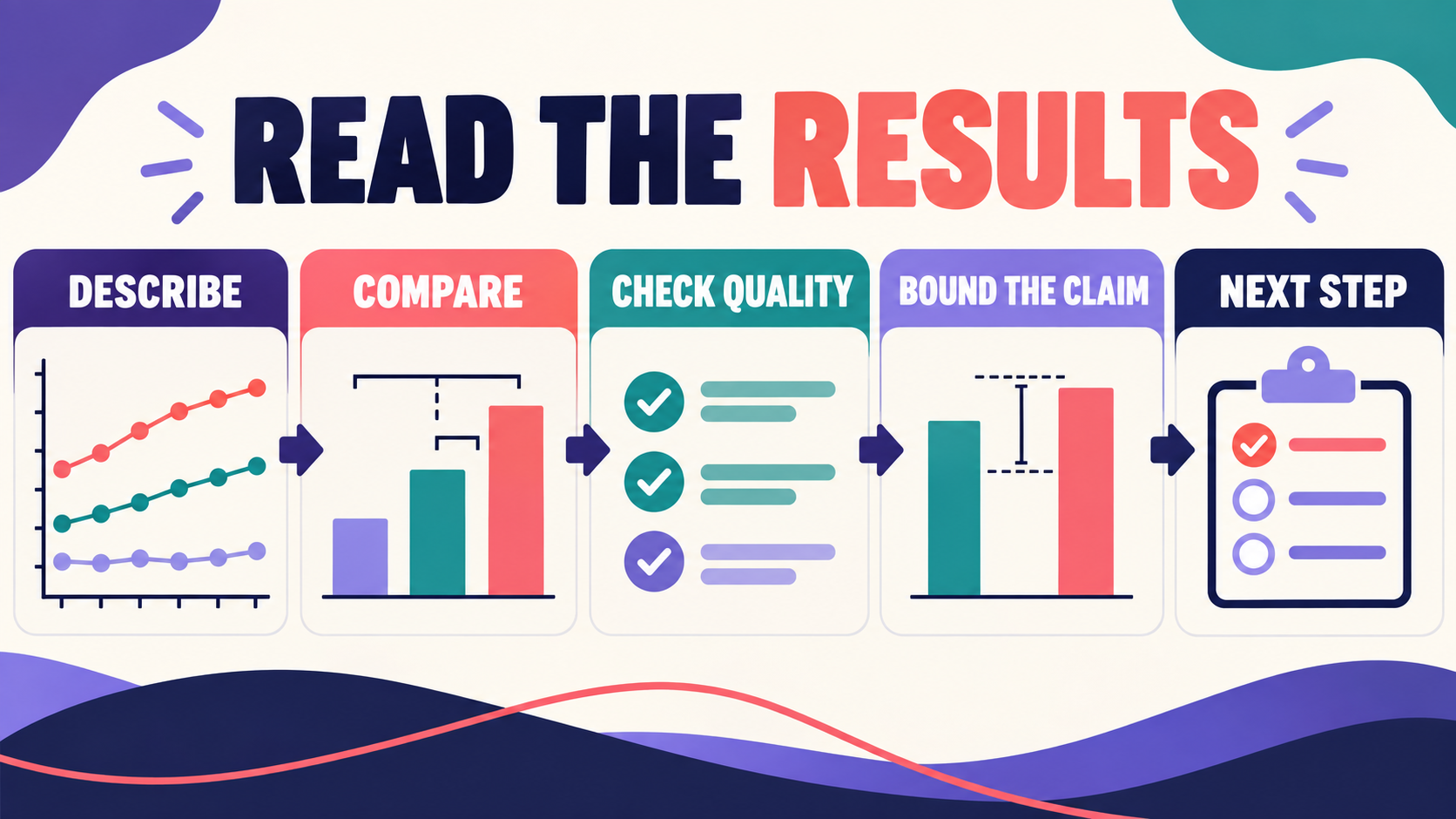
Read the report in layers. First, verify that the graph and narrative refer to the same response class and measurement system. Next, check which conditions were actually run, how much exposure each condition received, and whether the data include interruptions or missing sessions. Only then should you evaluate differentiation.
- Describe before explaining: state the observable pattern before naming a possible function.
- Stay inside the tested unit: limit the conclusion to the defined response, participant, setting, procedures, and conditions represented in the report.
- Check the comparison: ask whether the control condition was described clearly enough to understand the contrast.
- Look for data quality: review procedural integrity, observer agreement when collected, missingness, invalid sessions, and stop events.
- Separate assessment from treatment: a functional relation can inform a next step, but it does not make a treatment recommendation self-executing.
Interpretation is strongest when the report includes uncertainty rather than burying it. For example, “the valid sessions showed differentiation in the programmed attention condition” is more precise than “the behavior is attention-maintained.” The shorter statement may be reasonable in a later clinical conversation, but the report should preserve the boundaries that make the inference defensible.
What Reporting Mistakes Should You Avoid?
Many weak examples look polished because they have headings and a graph. The problem is that the evidence chain is incomplete. Before treating a report as a study model, look for these warning signs:
- The report calls an interview or ABC observation a functional analysis without describing programmed comparisons.
- The response definition is vague, subjective, or different from the behavior shown on the graph.
- Conditions are named but the antecedent, consequence, control comparison, or session arrangement is not explained.
- Only averages are shown, with no session count, denominator, invalid unit, missing data, or exposure information.
- A result is generalized to a diagnosis, a person’s entire history, or every setting without supporting evidence.
- Safety, assent, stop rules, procedural deviations, or adverse events are omitted because they make the example less tidy.
- The conclusion jumps directly to a treatment plan and does not identify alternative explanations or the next review point.
Use the current BACB handbook, your supervisor’s requirements, and the policies that govern the setting when a real report is being prepared. A report can be educationally clear and still require local review before it is used in practice.
How Does This Connect to the BCBA Exam?
The BACB’s current sixth-edition Test Content Outline is effective January 1, 2025 and includes behavior-assessment knowledge within the BCBA examination content. A question may ask you to distinguish a descriptive assessment from a functional analysis, select the most defensible interpretation of a graph, or identify which missing detail limits a conclusion.
Use a simple exam screen: identify the response measure, identify the programmed conditions, verify the comparison, inspect the data quality, and choose the conclusion that makes the smallest claim supported by the evidence. If an answer generalizes beyond the tested conditions or skips a safety and ethics fact in the stem, be cautious. For additional scenario practice, the free BCBA mock exam is an independent study aid, not an official BACB product and not a substitute for the current Test Content Outline, handbook, supervision, or clinical judgment.
Sample Functional Analysis Report FAQ
Is a functional analysis report the same as an FBA report?: No. An FBA is a broad assessment process that may include several information sources. A functional analysis is a specific experimental assessment arrangement. The report should name the method and avoid treating them as synonyms.
Can I download a sample and use it for a real client?: Use a sample only to study organization and reasoning. A real report must follow the qualified professional’s supervision, the setting’s policies, applicable consent and privacy requirements, and the current evidence available for that client.
What should the graph in a functional analysis report show?: It should match the operational definition and measurement system, label the conditions clearly, and make the session-level evidence interpretable. The report should also explain valid, invalid, missing, or stopped units instead of showing a cleaned-up graph with no context.
What is the biggest mistake when reading a sample report?: Overgeneralizing. A differentiated pattern supports a conclusion about the tested arrangement. It does not automatically prove a diagnosis, a universal function, or a treatment effect in an untested environment.
Sources and Date Check
This article was reviewed on September 29, 2026 against the BACB Task Lists and sixth-edition Test Content Outline page, the current BCBA Handbook, the BACB supervision and training resources, and current professional guidance on reporting functional-analysis results within tested conditions. Requirements, forms, and professional guidance can change; verify the live official BACB materials before using a report in practice or preparing an application.
Take the Free BCBA Mock Exam
If you want a low-pressure way to check your recall, use the free practice resource below. Take the Free BCBA Mock Exam



