

BCBA STUDY GUIDE · RBT SUPERVISION In ABA, how many times should the BCBA visit an RBT? Put another way, how often should a BCBA visit an RBT? This is an RBT supervision frequency question, and the better answer is not a generic weekly visit number. The current BACB RBT requirements describe a monthly supervision structure, a minimum percentage of service hours, real-time contacts, and direct observation. A BCBA or other qualified RBT supervisor may also need to observe more often when the client, procedure, setting, risk, or performance data call for it.
Table of Contents
- How Often Should a BCBA Visit an RBT?
- What Does the BACB Require for RBT Supervision Frequency?
- Does a Visit Have to Be in Person?
- What Determines a Sensible Visit Frequency?
- What Should Happen During Supervision?
- Who Can Supervise an RBT?
- How Does This Differ from the 2027 BCBA Changes?
- What Are Signs That Supervision Needs Attention?
- What Are the BCBA Exam Takeaways?
- Frequently Asked Questions
- Sources for Further Study
- Take the Free BCBA Mock Exam
How Often Should a BCBA Visit an RBT?
The current BACB RBT Handbook does not answer the question as “a BCBA must visit every Tuesday” or “the BCBA must be physically present once per week.” Instead, it describes ongoing supervision that must occur each calendar month when an RBT is providing behavior-analytic services. The handbook states that the RBT must receive supervision for at least 5% of the hours spent providing those services during the month.
The structure also includes at least two face-to-face, real-time contacts per month. At least one of those contacts must include observation of the RBT providing services. At least one contact must be individual; the other may be a small interactive group meeting within the handbook’s limits. In-person, on-site observation is preferred, but compliant real-time video conferencing may be used when appropriate and allowed by applicable law or policy.
So the practical answer is: at least the applicable monthly minimum, plus whatever additional supervision is needed for competent, ethical, client-specific service delivery. A “visit” is only one possible format. Supervision includes observation, feedback, modeling, review of written materials, evaluation of service effects, and support for technical and ethical problem-solving.
What Does the BACB Require for RBT Supervision Frequency?
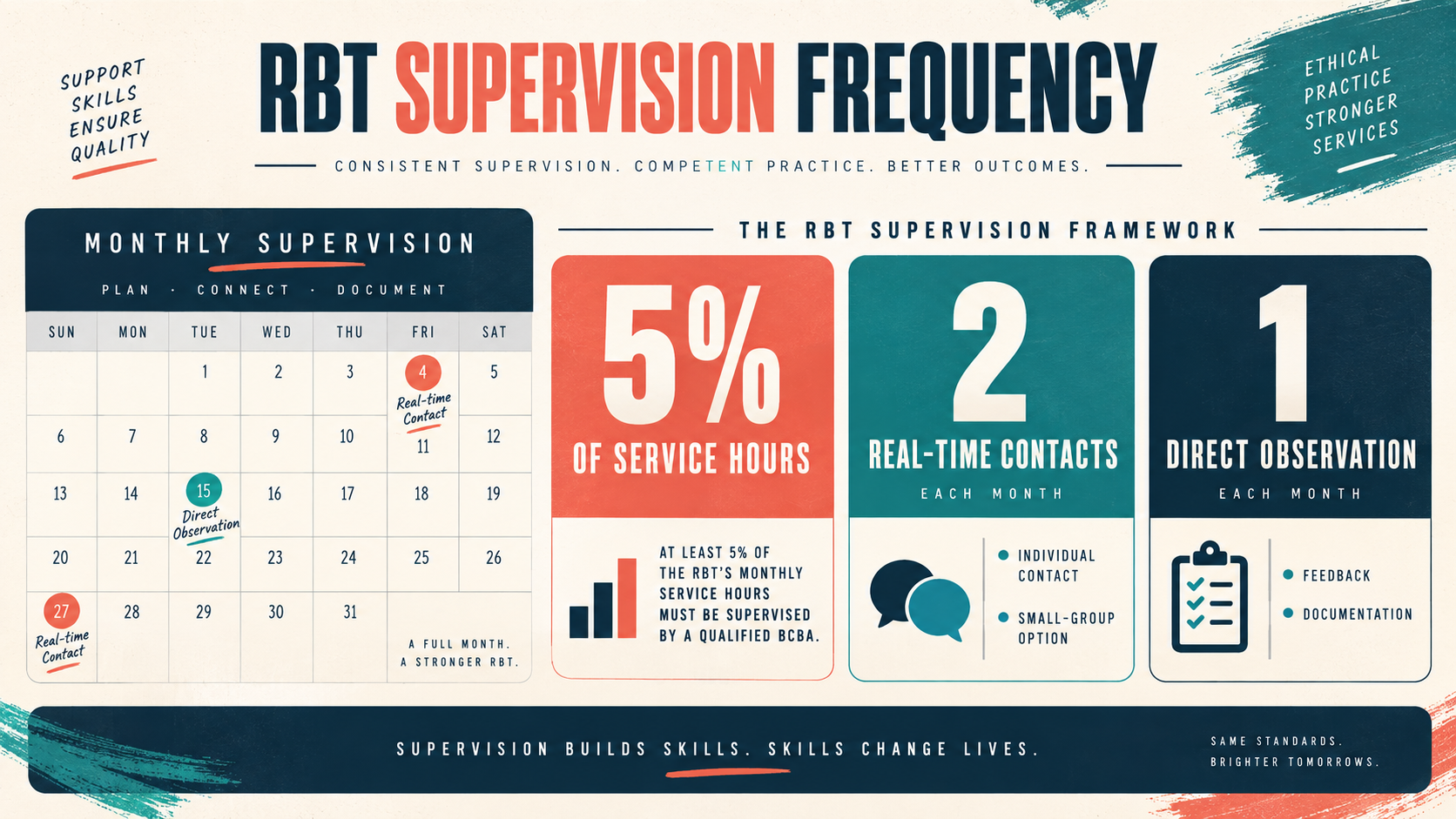
For an RBT who is actively practicing, the current handbook describes several requirements that should be kept together rather than reduced to a single visit count:
| Requirement area | Current handbook point | What it means in practice |
|---|---|---|
| Monthly amount | At least 5% of the RBT’s behavior-analytic service hours each calendar month | The number of supervision hours changes with the hours actually worked |
| Real-time contacts | At least two face-to-face, real-time contacts each month | Phone calls or email alone do not replace the required contact structure |
| Direct observation | The supervisor must observe the RBT providing services in at least one monthly meeting | The supervisor needs client-specific knowledge of how services are delivered |
| Individual contact | At least one of the two contacts must be individual | A group meeting cannot replace every individual supervision contact |
These are certification-maintenance requirements, not a complete clinical schedule. An organization, payer, state rule, treatment plan, risk profile, or supervisor’s professional judgment may require more frequent observation or consultation. The RBT Handbook should be checked for the current version, and an RBT should ask the responsible supervisor when a local policy appears different from the BACB requirement.
Does a Visit Have to Be in Person?
“Visit” often implies that the BCBA must physically enter the clinic or home. The current handbook’s wording is more precise: supervision must involve face-to-face, real-time contacts, and one monthly meeting must include observation of service delivery. The handbook prefers in-person, on-site observation, but it also says that observation may occur through webcams, video conferencing, or similar means instead of physical presence when the arrangement is compliant.
That does not mean that any video is supervision. A recording that is watched later, a camera that runs without real-time interaction, or a quick check-in without observation and feedback may not satisfy the same function. The supervisor should be able to see enough of the relevant service, interact in real time, protect confidentiality, and give feedback that is specific to the client and the RBT’s performance. Telehealth rules, privacy obligations, employer procedures, state requirements, and payer policies may add conditions. The article is therefore a study guide, not permission to choose a remote format without checking those requirements.
What Determines a Sensible Visit Frequency?
The minimum monthly structure is a floor, not a recommendation that every RBT should receive exactly two brief contacts. A supervisor may reasonably schedule more frequent contact when:
- the RBT is new to the role, client, setting, or intervention;
- a new program, assessment, prompting procedure, or safety plan is being introduced;
- the client’s behavior or health risk requires close monitoring;
- data show an unexpected plateau, rapid change, treatment-integrity problem, or possible harm;
- the RBT requests coaching or reports an ethical, scope, communication, or safety concern;
- multiple supervisors or settings create coordination risk;
- the supervisor lacks enough direct knowledge to make a sound clinical decision.
Conversely, a lower-intensity week does not erase the monthly requirement or justify supervision that is disconnected from the client. The supervisor still needs a system for tracking service hours, supervision dates and duration, the format of each contact, direct observations, supervisor names, and the relationship to the client. Good scheduling makes the record easy to audit and makes supervision useful between contacts.
What Should Happen During Supervision?
A supervision meeting should do more than confirm that the RBT arrived. It should create an opportunity to observe performance and improve it. Depending on the client and plan, a supervisor may:
- review a clearly defined target and the data being collected;
- observe implementation and check treatment integrity;
- model or rehearse a skill through behavioral skills training;
- give immediate, behavior-specific feedback;
- review session notes and data sheets for accuracy and privacy;
- check whether the intervention is producing meaningful effects;
- discuss assent, communication access, dignity, and the learner’s experience;
- identify what should be escalated to the BCBA, caregiver, employer, or another professional.
The purpose is not to turn every supervision meeting into a performance test. It is to make the RBT’s work safer, more consistent, and more effective while keeping the supervisor accountable for the services under their oversight. A short visit that produces clear observation, practice, and feedback may be more useful than a longer meeting that never looks at the actual service.
Who Can Supervise an RBT?
The keyword says “BCBA,” but the BACB structure is role-based. A qualified BCBA or BCaBA may serve as an RBT Supervisor under the current requirements, and an organization may use an RBT Requirements Coordinator structure when multiple supervisors are involved. The relevant supervisor must have enough client-specific knowledge to inform the RBT’s clinical direction, and the relationship must be reflected in the BACB records as required.
The supervisor also needs the required supervision training before providing supervision. The BACB supervision page directs supervisors of RBTs and others who require ongoing supervision to complete an 8-hour supervision training based on the current Supervisor Training Curriculum Outline. Always verify the current handbook and supervision page because role requirements and forms can change.
How Does This Differ from the 2027 BCBA Changes?
This distinction is easy to miss. The 2027 BCBA requirements concern eligibility and maintenance requirements for people pursuing or holding BCBA certification, including supervised fieldwork pathways. They are not a replacement for the RBT’s ongoing-supervision rules.
Under the BACB’s 2027 overview, standard supervised fieldwork is listed as 2,000 hours with 5% supervision, while concentrated supervised fieldwork is listed as 1,500 hours with 7.5% supervision. The same overview describes observation of the trainee with a client per supervisory period and new 2027 monthly and final fieldwork forms. Those numbers belong to BCBA fieldwork, not to the question of how often a BCBA should visit an RBT.
For an exam answer, first identify the person being supervised: an RBT providing services, a trainee accruing BCBA fieldwork, a BCaBA, or someone in another role. Then apply the correct handbook and requirements. Mixing the RBT 5% monthly rule with the 2027 BCBA fieldwork table is a category error.
What Are Signs That Supervision Needs Attention?
- There is no qualified supervisor or coordinator on record for a client the RBT is serving.
- The organization counts email or a prerecorded video as the only supervision contact.
- No one observes service delivery during the required monthly structure.
- The RBT cannot explain when supervision occurred, what feedback was given, or where it was documented.
- Supervision is generic and never addresses the actual client, data, procedures, or ethical concerns.
- Hours are split across organizations without meeting the applicable requirements at each organization.
If a concern exists, the RBT should raise it with the supervisor or coordinator and review the current BACB handbook. The RBT Handbook explains documentation and self-reporting responsibilities; it also warns that substantial noncompliance can have serious certification consequences. This page does not provide legal advice or determine whether a specific arrangement is compliant.
What Are the BCBA Exam Takeaways?
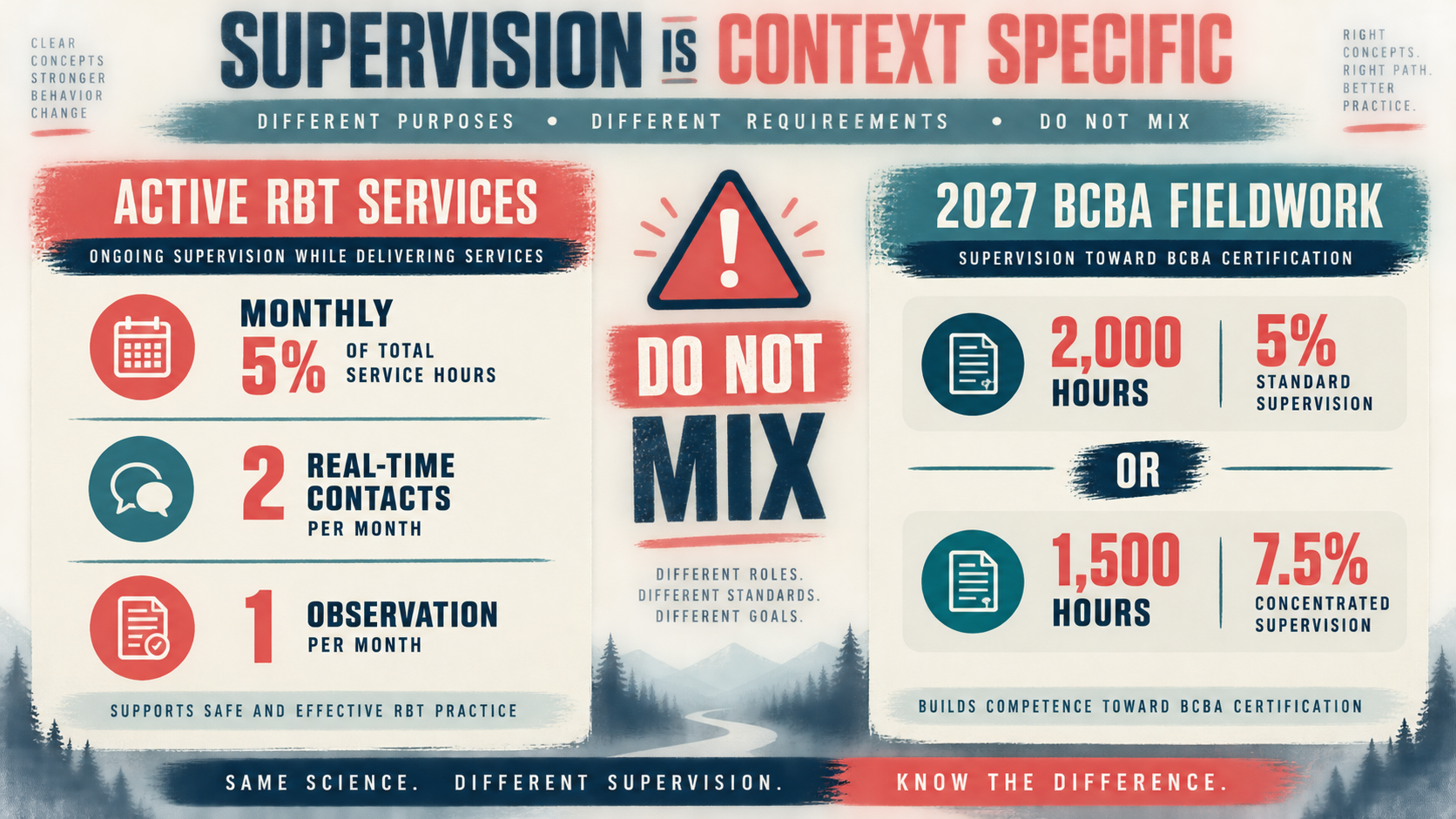
For a BCBA exam question that asks how often a BCBA should visit or supervise an RBT, look for the answer that separates minimum certification requirements from individualized clinical judgment:
- RBT supervision is ongoing and organized by calendar month when the RBT is practicing.
- The current RBT handbook describes 5% of behavior-analytic service hours, at least two real-time face-to-face contacts, and observation in at least one contact.
- One of the two contacts must be individual; the other may be a qualifying small-group meeting.
- In-person observation is preferred, but compliant real-time remote observation can be possible.
- More supervision may be needed when risk, novelty, data, or performance concerns increase.
- 2027 BCBA fieldwork requirements are a different framework and should not be substituted for RBT supervision rules.
For additional scenario practice, the site’s free BCBA mock exam is an independent study tool. It is not official BACB content and does not guarantee certification results.
Frequently Asked Questions
Does the BCBA have to visit the RBT every week?: Not as a universal BACB rule stated in those words. The current RBT structure is monthly and includes a minimum amount of supervision, two real-time contacts, and observation in at least one contact. A supervisor may schedule weekly or more frequent contact when the client or service requires it.
Can RBT supervision happen through telehealth?: Compliant real-time video conferencing may be possible under the current handbook, but the arrangement must meet applicable law, privacy, organization, payer, and BACB requirements. A passive recording or non-interactive camera feed is not automatically supervision.
Is the RBT 5% rule the same as the 2027 BCBA 5% fieldwork rule?: No. Both figures can appear in BACB materials, but they apply to different roles and measurement frames. The RBT rule is based on monthly behavior-analytic service hours; the 2027 BCBA figure is part of a supervised-fieldwork pathway. Identify the role before applying a percentage.
Sources for Further Study
- BACB Registered Behavior Technician Handbook — current RBT ongoing-supervision, contact, observation, documentation, and audit requirements.
- BACB Supervision, Assessment, Training, and Oversight — supervisor qualifications, resources, and required supervision training.
- BACB 2027 BCBA Requirements — official fieldwork and certification-transition overview.
- BACB BCBA Supervising Resources — current BCBA handbook and supervision resources.
For targeted review, use our RBT supervision frequency practice questions to apply the concept in exam-style scenarios.
Take the Free BCBA Mock Exam
If you want a low-pressure way to check your recall, use the free practice resource below. Take the Free BCBA Mock Exam



