A titration plan ABA article should answer one practical question: how will the team gradually adjust the intensity of applied behavior analysis services while protecting progress, safety, generalization, and continuity of care? In ABA, titration usually refers to a planned change in service intensity, such as reducing hours or moving toward less intensive supports. It is not a drug-dose schedule, and it should not be an automatic calendar-based cut.
Table of Contents
- Titration Plan ABA: The Quick Answer
- What a Titration Plan Is Designed to Do
- A Data-Based Titration Workflow
- What Belongs in the Written Titration Plan
- How to Choose Reduction Criteria
- Titration Plan vs. Discharge Plan
- Documentation and Payer Rules
- Common Mistakes in an ABA Titration Plan
- Review Checklist
- FAQ
- Take the Free BCBA Mock Exam
A strong plan connects measurable goals, current data, mastery and generalization, caregiver readiness, service-hour criteria, and transition supports. The exact documentation requirements can vary by state, payer, contract, and clinical setting. Use the current rule or authorization standard that applies to the case rather than treating one payer policy as universal. Table of Contents
Titration Plan ABA: The Quick Answer
A titration plan for ABA services is an individualized, measurable plan for changing service intensity over time. It explains when hours, sessions, settings, or supports may be reduced, maintained, increased, or paused; what data will guide each decision; how caregivers and other providers will be prepared; and what the team will do if skills weaken or risk increases.
The word gradual matters, but gradual does not mean “reduce by the same number of hours every month.” A learner may be ready for fewer direct hours in one goal area while still needing support for safety, communication, generalization, or caregiver implementation. A defensible plan is responsive to the learner’s current needs rather than a fixed percentage. For a BCBA exam question, the strongest plan usually includes:
- individualized, socially meaningful goals and baseline data;
- observable criteria for mastery, maintenance, and generalization;
- specific rules connecting progress to service-intensity decisions;
- caregiver training and practice in natural routines;
- alternative or less intensive supports for the next phase; and
- a monitoring and revision rule if progress stalls or regression appears.
What a Titration Plan Is Designed to Do
The purpose is not to make services smaller as quickly as possible. The purpose is to match support to the learner’s changing needs while maintaining meaningful outcomes. A well-designed plan helps the team answer three related questions.
Is the learner making meaningful progress? Review direct data for skill acquisition and behavior reduction, not only attendance or a general impression that sessions are going well. The data should correspond to the goals and settings named in the treatment plan.
Can progress survive with less intensive support? Skills may look strong in a clinic with a highly trained technician but fail to generalize to home, school, community routines, different materials, or different communication partners. Titration should consider maintenance and generalization before reducing the support that makes the skill possible.
What will replace the fading support? A reduction in direct ABA hours may be paired with caregiver training, consultation, school supports, natural-environment practice, community resources, or another clinically appropriate service. Removing a service without planning the next support can create a gap rather than independence.
The intensity decision also needs client and family input. A lower number of hours is not automatically a better outcome if it removes access to a socially significant skill or places an unrealistic burden on caregivers. Conversely, continuing a high intensity only because it is familiar is not data-based decision making.
A Data-Based Titration Workflow
Use this sequence when designing or reviewing a titration plan. It keeps the reduction decision connected to assessment, intervention, and follow-up.
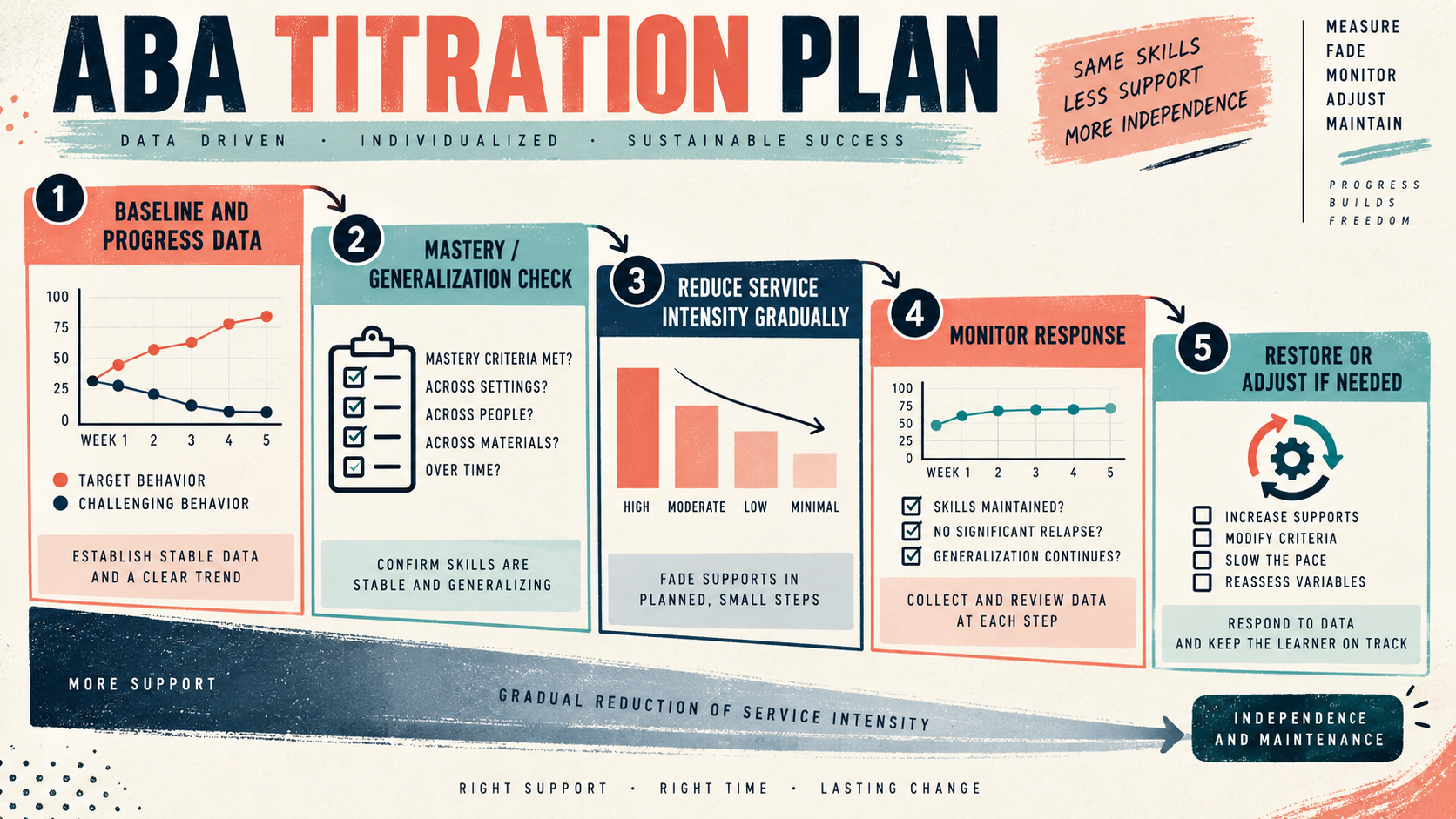
- Define the current baseline and progress picture. Identify the goal, measurement system, baseline level, current level, trend, variability, and relevant settings. Separate skill acquisition, behavior reduction, caregiver performance, and safety data instead of collapsing them into one score.
- Check mastery, maintenance, and generalization. Ask whether the learner performs the skill across people, environments, materials, and time. Confirm that important behavior-reduction gains are durable and that replacement or adaptive skills are available when support is faded.
- Select a small, justified change. Specify what will change: direct hours, session frequency, staff support, setting, caregiver coaching, or another component. A smaller step is often easier to evaluate than several simultaneous changes.
- Prepare the next support level. Train caregivers or other team members, rehearse natural routines, communicate with collaborating providers, and make sure the learner can contact reinforcement and assistance without the former level of direct support.
- Monitor and respond. Set a review date and define what counts as stable progress, meaningful regression, increased risk, or implementation difficulty. Maintain the reduction, slow it, restore support, or revise the plan based on the data.
Notice that the workflow is reversible. A titration plan is not a promise that hours will only move downward. If the data show regression, new risk, or a failure to generalize, the ethical and clinical response may be to pause the reduction, increase support temporarily, or reassess the treatment plan.
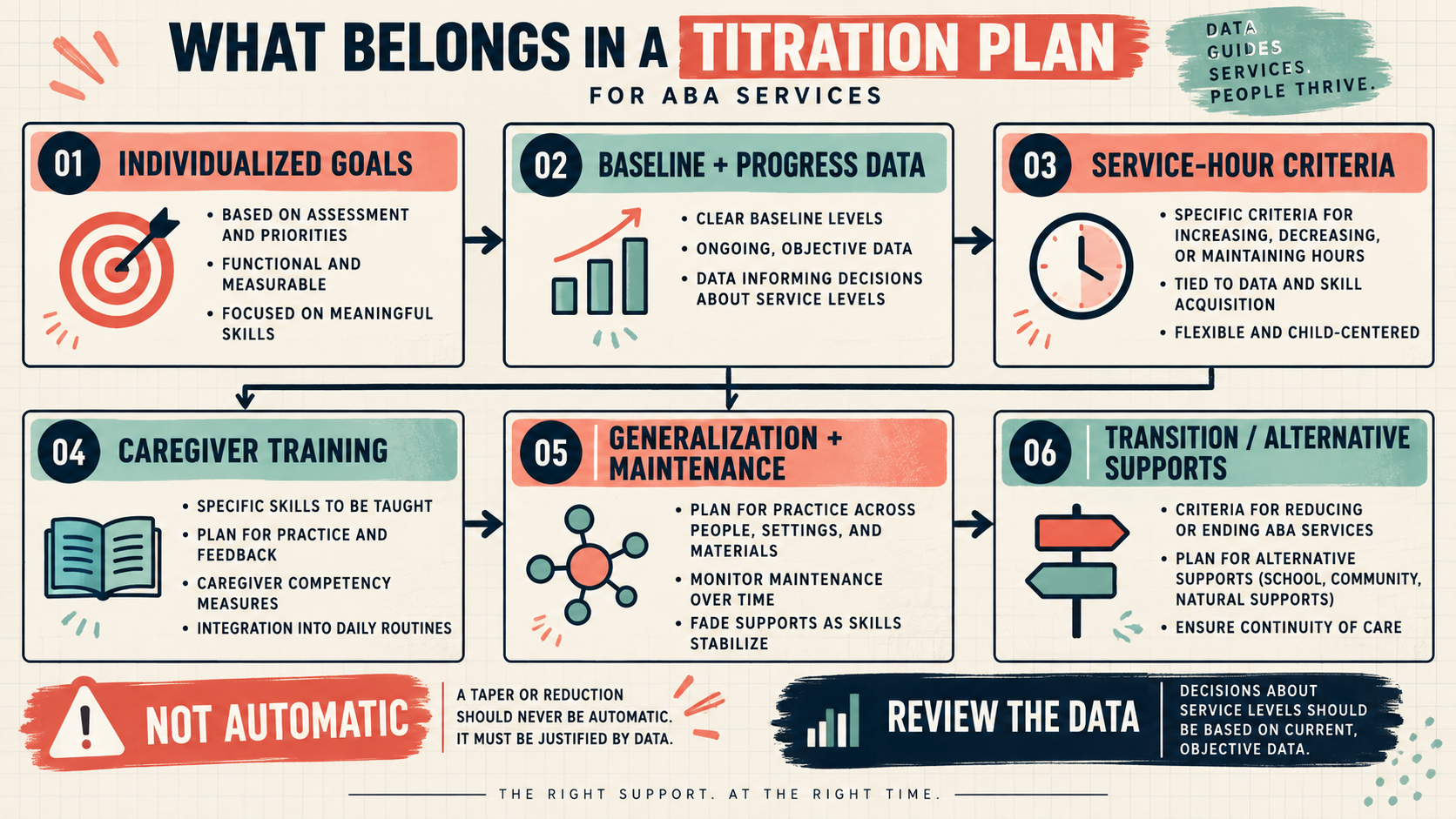
What Belongs in the Written Titration Plan
A phrase such as “reduce services as the client improves” is too vague for consistent implementation or review. The written plan should make the decision rule understandable to the team and to an authorization reviewer without pretending that every learner follows the same timeline.
| Plan component | What to specify | Why it matters |
|---|---|---|
| Goals and priorities | Observable goals, baseline, mastery criteria, and social significance. | The team can judge progress against meaningful outcomes rather than hours alone. |
| Intensity criteria | Which data support reducing, maintaining, increasing, or pausing service hours. | A change is tied to evidence rather than an arbitrary date or percentage. |
| Generalization and maintenance | Settings, people, materials, time, and follow-up conditions to be checked. | Clinic performance alone may overestimate readiness for less support. |
| Caregiver and team training | Skills to teach, practice opportunities, feedback, and competency measures. | The next support level is prepared before direct service is removed. |
| Transition and continuity | Alternative services, school or community supports, contacts, and handoff steps. | The learner and family do not lose needed support during the change. |
| Review and safety rule | Review interval, regression signal, risk threshold, and the action if criteria are not met. | The plan can adapt instead of continuing an unsafe reduction. |
How to Choose Reduction Criteria
Good criteria are specific enough to guide a decision but flexible enough to respect individual differences. For example, “reduce direct hours when the learner demonstrates the target communication response at a defined level across home and clinic routines, caregivers implement the protocol with competency, and no meaningful safety regression is observed during the review period” is more useful than “reduce when ready.” Consider the following dimensions:
- Performance: accuracy, independence, rate, latency, or another measure that matches the goal.
- Consistency: trend and variability across several observations, not one unusually strong session.
- Generality: performance across people, places, materials, and natural routines.
- Maintenance: whether the skill remains available after prompts or dense reinforcement are reduced.
- Caregiver implementation: whether the support person can use the plan accurately and knows when to seek help.
- Risk: whether reducing support could increase dangerous behavior, missed communication, medical concerns, or loss of essential independence.
Do not use a single mastery percentage as a universal answer. A high percentage in one setting may not justify fewer hours if the skill is not generalized or if safety depends on close support. Likewise, a learner may need reduced direct teaching but continued consultation or caregiver coaching.
Titration Plan vs. Discharge Plan
These plans are related but not identical. A titration plan describes how service intensity changes during the transition. A discharge plan describes the conditions and process for ending ABA services or transferring to another level of support. Titration can occur without immediate discharge, and a discharge plan should explain what support remains afterward.
Keeping the terms separate prevents two common errors. First, a team might write a discharge date without showing how the learner will move through intermediate support levels. Second, it might lower hours without naming who will teach the learner and caregivers to maintain the gains. A complete transition section links the step-down schedule to realistic goals, alternative supports, continuity, and follow-up. For the separate search intent “ABA discharge plan,” the emphasis should be the end-of-service or transfer process. This page stays focused on the data-based adjustment of service intensity before, during, and after a step-down.
Documentation and Payer Rules
State and payer documents can make titration requirements more concrete. For example, the Centene Applied Behavior Analysis clinical policy describes transition planning with caregiver and care-team input, gradual step-down, specific titration goals, service-hour criteria, discharge or transfer goals, and recommended services after discharge. Oklahoma’s ABA policy resources also illustrate how a treatment plan may be expected to include a specific plan to fade services over time.
Those examples do not create one nationwide ABA rule. They show why the BCBA should check the applicable authorization form, state regulation, contract, and current clinical standard. Document the source of the requirement and explain how the proposed reduction fits the learner’s data.
A review packet commonly needs updated goal data, graphs or summaries that show treatment changes, caregiver participation, generalization information, coordination attempts, and the reason for the requested intensity. Keep the language objective: state what was measured, what changed, what the team expects, and what will happen if the expected response does not occur.
Common Mistakes in an ABA Titration Plan
- Automatic hour reduction: cutting the same number of hours every authorization period without tying the change to data.
- Clinic-only readiness: assuming strong performance with familiar staff proves generalization.
- Confusing attendance with progress: treating completed sessions as evidence that the learner no longer needs support.
- No caregiver competency check: expecting families to maintain a program without training, practice, feedback, or a way to ask for help.
- No reversal rule: reducing services without defining what regression or safety change would trigger a pause or reassessment.
- Premature discharge: naming an end date before arranging alternative supports and continuity.
- Overpromising certainty: presenting a projected timeline as guaranteed when the learner’s response to a service change is not yet known.
Review Checklist
- Are the goals observable, measurable, individualized, and socially meaningful?
- Does the plan show baseline, current progress, trend, and relevant variability?
- Are mastery, maintenance, and generalization checked across meaningful contexts?
- Does the plan say exactly what service component will change?
- Are the criteria for reducing, maintaining, increasing, or pausing support written?
- Are caregiver training, practice, feedback, and competency measures included?
- Are alternative services or natural supports named before the step-down?
- Is there a review date and a response to regression or increased risk?
- Does the documentation reflect the applicable state, payer, and organizational requirements?
- Has the learner’s and family’s input been considered and documented?
FAQ
What is a titration plan in ABA?: It is an individualized plan for changing ABA service intensity over time, usually through a gradual reduction or adjustment supported by progress data, mastery, generalization, caregiver readiness, and transition planning.
Is an ABA titration plan the same as a discharge plan?: No. Titration describes the step-down or adjustment process. Discharge describes ending or transferring services and the supports that remain. A treatment plan may include both, but they answer different questions.
Does the BACB require one standard number of hours for titration?: Do not assume a universal number. Service intensity should be individualized and may also be shaped by state rules, payer policies, contracts, clinical data, client priorities, and available supports. Check the current requirements that apply to the case.
What data should guide service reduction?: Use data that match the goals, such as independent skill performance, behavior reduction, generalization, maintenance, caregiver implementation, and safety indicators. A single percentage or one strong session is rarely enough by itself.
What should happen if skills regress after hours are reduced?: The plan should already define a response, such as pausing the reduction, restoring a support, reassessing the intervention, increasing caregiver coaching, or coordinating with other providers. The correct action depends on the learner’s data and risk, but a reversible plan is safer than an irreversible promise.
A sound titration plan ABA framework is data-based, individualized, gradual, and reversible. It treats reduced service intensity as a clinical decision that must preserve meaningful skills and safety—not as an automatic administrative cut. Use the current rules for the case, review progress across real settings, prepare the next support level, and revise the plan when the data say the learner needs something different. To practice distinguishing service-planning decisions from distractors, try our free BCBA mock exam.
Take the Free BCBA Mock Exam
When you are ready to apply the idea, use the free practice resource below for additional feedback. Take the Free BCBA Mock Exam