
A topographical response class ABA question is about grouping responses by shared observable form. It is different from a functional response class, where different forms may be grouped because they produce the same environmental outcome.
Table of Contents
- What Is a Topographical Response Class?
- How Is Topography Different From a Response Class?
- What Is the Difference Between Topographical and Functional Classes?
- Why Does the Class Definition Matter for Measurement?
- How Do You Write a Topographical Definition?
- Can the Same Topography Have Different Functions?
- How Does Response-Class Thinking Support Skill Acquisition?
- How Do You Check Generalization Across a Response Class?
- What Are Common Topographical Response-Class Mistakes?
- How Is Topographical Response Class ABA Tested on the BCBA Exam?
- What Is the Bottom Line?
- Quick Review Checklist
- Take the Free BCBA Mock Exam
Topographical response class ABA refers to a group of responses that share a defined physical form or movement pattern. The group is created for an analytic purpose: the behavior analyst states which features make the responses members of the class and records them consistently. Form alone does not establish why a response occurs or what consequence maintains it.
That last sentence is the exam trap. A person can press a button to obtain music, press a button to obtain a snack, or press a button to obtain attention. The physical form can be similar while the function differs. Conversely, a person can request a break by speaking, signing, pointing to an AAC message, or handing over a card. Those forms differ, but they may belong to the same functional response class if they produce the same relevant outcome under the defined conditions.
The BCBA Test Content Outline includes distinguishing behavior, response, and response class and selecting observable, measurable definitions. The BACB Ethics Code also matters because a definition should not exclude an accessible communication form merely because it looks different from a preferred response.
What Is a Topographical Response Class?
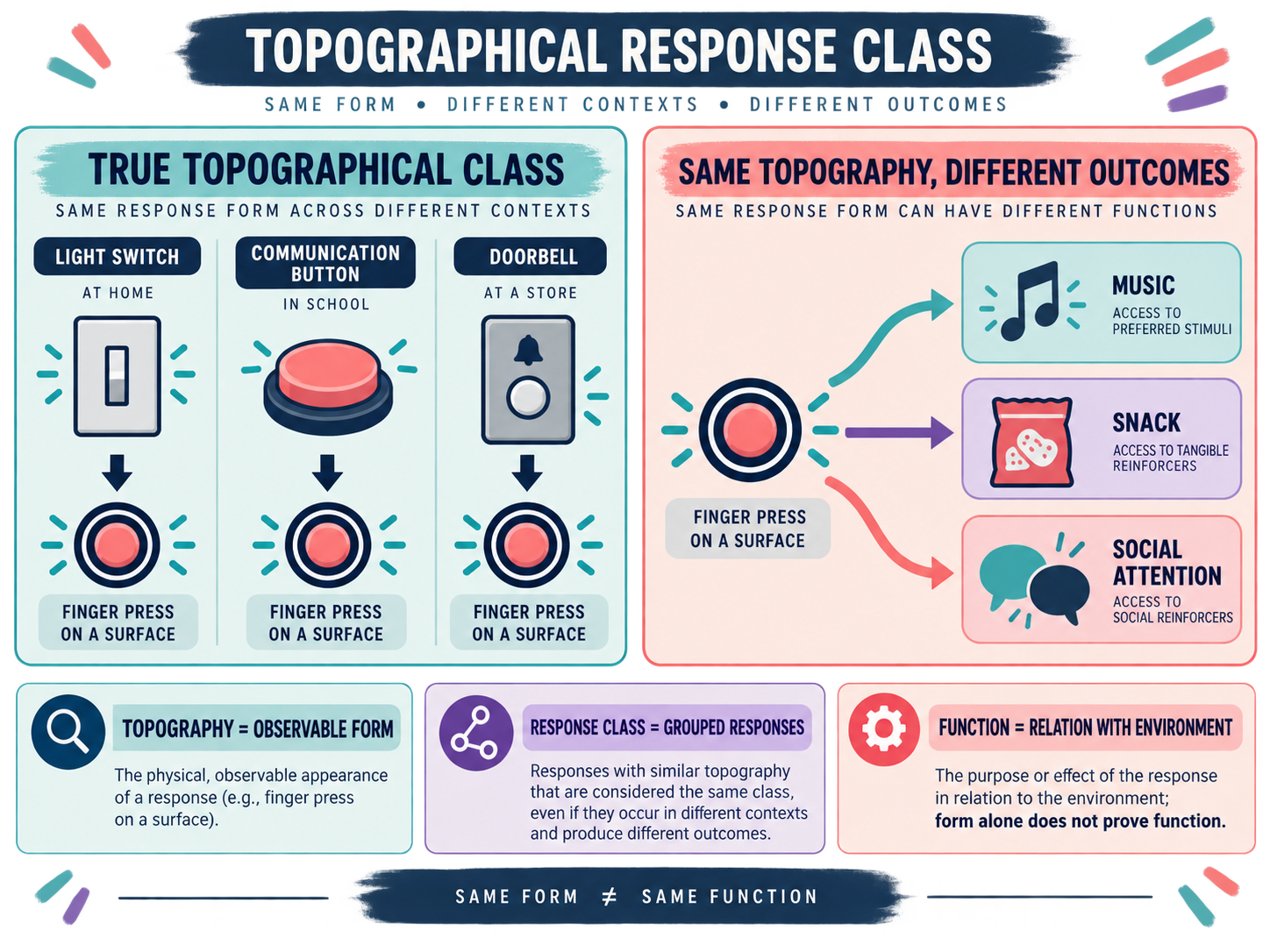
A topographical response class contains responses that share relevant physical characteristics. For example, a team might define a class as “brief contact of a fingertip with a designated surface that depresses or activates it.” Pressing a light switch, pressing a communication button, and pressing a doorbell can look different in context, but the selected response form—finger contact and pressure on a surface—can be grouped if that is the measurement question.
The group needs boundaries. Does a palm press count? Does holding the button down count? Does touching the surface without enough pressure count? A definition should answer those questions with observable onset, offset, force, duration, or product criteria when they matter. Without boundaries, observers may create different classes while using the same label.
How Is Topography Different From a Response Class?
Topography describes the form of one response or a set of response features. A response class is the analytic group created from responses that share a relevant property. A single response can be described topographically and then grouped with other responses when the class rule is met.
For example, “raises an open hand above shoulder level for at least one second” is a topographical definition. If the team groups open-hand raise, index-finger raise, and closed-fist raise under a broader “hand raised” rule, that broader grouping might be a topographical response class only if the shared features are clearly specified. If instead the team groups spoken “help,” a hand raise, and an AAC message because each produces help, that is a functional grouping, not a topographical one.
What Is the Difference Between Topographical and Functional Classes?
Topographical classes group by how the response looks. Functional classes group by what the response does in relation to the environment, often the outcome it produces. The same response can be a member of more than one class depending on the question and definition.
| Concept | Grouping rule | Example | What it cannot prove alone |
|---|---|---|---|
| Topography | Observable form or movement features | Finger contacts a surface with enough pressure to depress it | The response’s function or maintaining consequence |
| Topographical response class | Multiple responses share the defined form | Comparable finger presses across different buttons | That all members have the same function |
| Functional response class | Different forms produce the relevant common outcome | Speech, sign, AAC, or card that all request a break | That every form is interchangeable in every context |
| Function | Relation between behavior and environmental events | A response reliably produces escape from a task | Its cause cannot be inferred from appearance alone |
Why Does the Class Definition Matter for Measurement?
A class definition determines what gets counted together. If a team wants to know whether all forms of a break request are increasing, it may define a functional response class and record speech, sign, AAC, and card exchange as separate forms within one aggregate. If it wants to know whether a particular motor pattern is decreasing, it may record only the topographical class.
Keep the form-level data when practical. An aggregate line can rise while one form disappears and another replaces it. That may be desirable functional communication, or it may indicate that a new form is not accessible across settings. The decision cannot be made from the total alone.
How Do You Write a Topographical Definition?
Describe what another trained observer can see or hear. Include the response unit and boundaries. A topographical definition for “throwing an item” might specify that an object leaves the person’s hand, travels at least a stated distance, and lands away from the starting location. A definition for “hand press” might specify contact, force, surface, and completion.
Include examples and nonexamples when the boundary is easy to misunderstand. A quick tap that does not activate the button may be a nonexample if activation is required. Holding the button down for 10 seconds may be scored differently from a brief press if duration changes the outcome. The class is only as reliable as the rule observers apply.
Can the Same Topography Have Different Functions?
Yes. Form is not function. A learner may tap a table to obtain attention in one context, to access an item in another, or as automatically maintained sensory stimulation. The topographical description can be identical while the consequence and relevant antecedent differ. A behavior analyst must examine the context and response-consequence relation rather than infer function from appearance or a label such as “attention seeking.”
The reverse is also possible: different forms can serve one function. A learner may push a break card forward, say “break,” gesture toward the exit, or use an AAC button. If each response reliably accesses a break under the relevant conditions, the forms may be treated as a functional response class. That does not mean the team should require one form or ignore accessibility, preference, communication rights, or safety.
How Does Response-Class Thinking Support Skill Acquisition?
Response-class thinking helps the team define what counts as a successful replacement or generalized skill. If the goal is functional communication, reinforcing only one arbitrary form may create unnecessary prompt dependence. A plan may teach several response forms, arrange clear outcomes, and then test whether the learner can communicate across people, settings, and materials.
For a topographical skill, the team may need more precise shaping or task analysis. For example, the target may require a particular motor sequence for safety or equipment use. The teaching plan should state why that form is necessary and whether an adaptation could provide the same access with less effort. The class label should serve a meaningful goal, not become a reason to suppress harmless variation.
How Do You Check Generalization Across a Response Class?
Plan probes that vary relevant stimuli and response forms. For a topographical class, vary the surface, material, or setting while holding the form rule constant. For a functional class, vary the communication form and the natural context while checking whether the same outcome remains available. Record which form occurred, what support was used, and whether the outcome was delivered as planned.
Generalization is not proved by a single new example. Look for performance across appropriate people, materials, places, and time. Also check whether the response remains effective when a specific prompt or training material is removed. If the response occurs only with one adult’s gesture, the class may not yet be under the intended natural control.
What Are Common Topographical Response-Class Mistakes?
- Calling a form a function: “crying” describes appearance; it does not identify why the response occurs.
- Grouping different forms as topographical: speech, hand raising, and AAC may share a function without sharing form.
- Assuming one form has one function: pressing, hitting, or vocalizing can produce different outcomes in different contexts.
- Writing a vague class boundary: “aggressive behavior” does not tell observers what actions qualify.
- Dropping form-level data: an aggregate can hide response substitution, access differences, or an emerging communication form.
- Ignoring accessible alternatives: a preferred form is not automatically the only acceptable way to communicate.
How Is Topographical Response Class ABA Tested on the BCBA Exam?
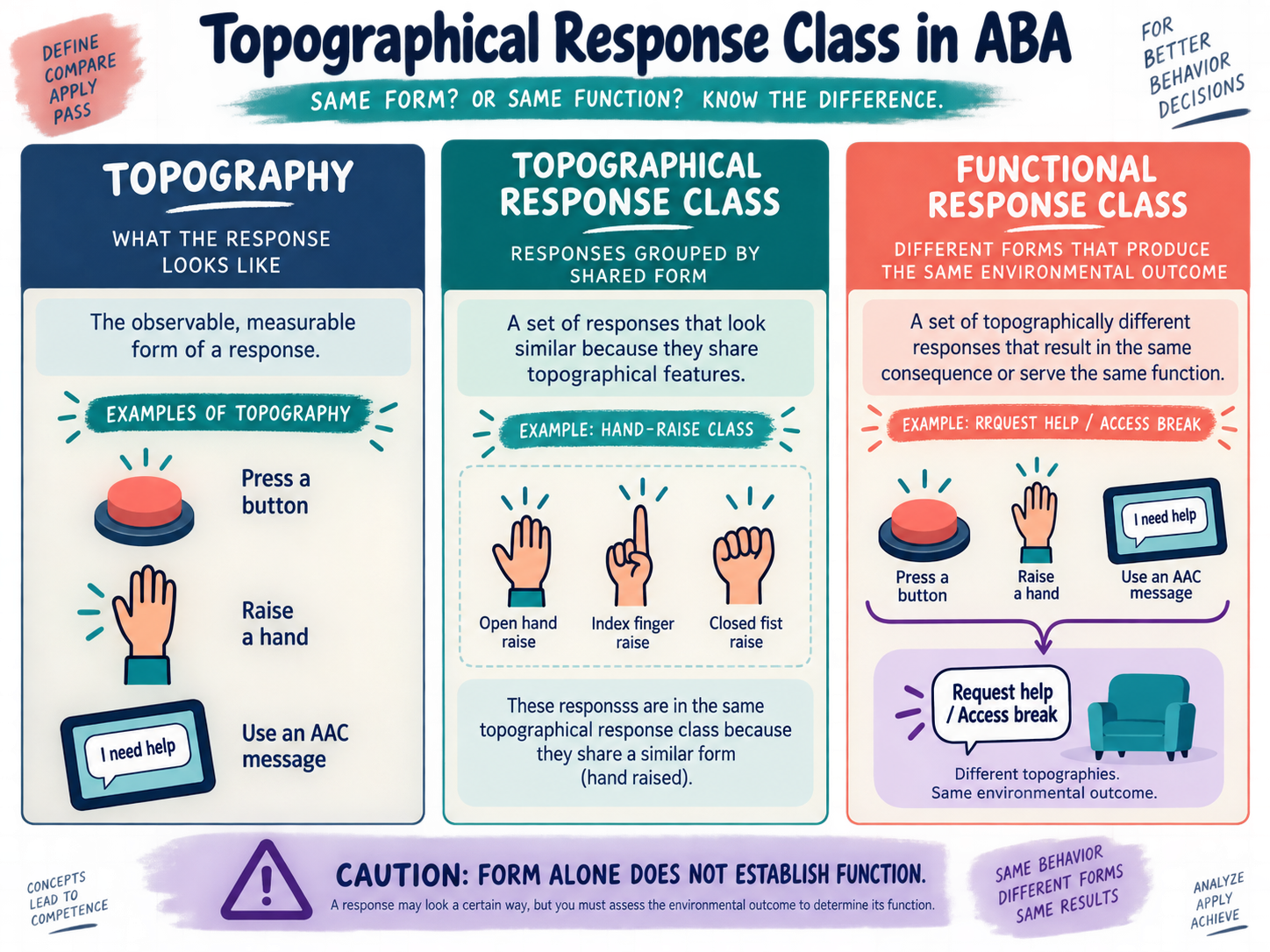
Read the stem for the grouping rule. If the options are “open-hand raise, index-finger raise, and fist raise” and the question says they share the physical form of raising a hand, topography is the relevant concept. If the options are “saying help, handing over a card, and selecting an AAC message” and each produces assistance, the grouping is functional.
Do not select a function merely because an event follows the response. A consequence in one observation is not enough to demonstrate a maintaining relation. When the answer requires function, look for assessment data suited to that claim. When the answer requires measurement, choose an operational definition that another observer could apply.
What Is the Bottom Line?
Topographical response class ABA questions are about observable form and the rule used to group responses. Define the form precisely, keep it separate from function, preserve form-level data when it affects decisions, and recognize that different forms may serve one communication outcome. The safest exam answer is the one that respects both measurement precision and the learner’s access to meaningful communication.
For a structured review of response classes, measurement, and related BCBA concepts, try the free BCBA mock exam. Practice can sharpen the distinction between topography, class membership, and function; it does not replace assessment, supervision, or individualized decision making.
For targeted review, use our topographical response class ABA practice questions to apply the concept in exam-style scenarios.
Quick Review Checklist
Use this final checklist to turn topographical response class ABA into exam-ready reasoning. The goal is not to memorize a label in isolation; it is to identify the relevant evidence and explain why the best answer fits the scenario. Key ideas to review:
- State the central definition or decision point for topographical response class ABA in your own words.
- Identify the detail that makes topographical response class ABA different from its closest related ABA term.
- Separate the observable facts in a scenario from assumptions that are not supported by the facts.
- Write one example and one nonexample so you can recognize the concept in a new setting.
Exam application checks:
- Ask what the question is actually requesting before comparing the answer choices.
- Mark the antecedent, response, consequence, or other evidence that supports the selected answer.
- Look for a distractor that describes a related process but does not answer the specific question.
Final self-check:
- Explain how you would verify the interpretation with clear observations or data.
- Change one detail in the scenario and decide whether your answer should change.
- Give a one-sentence rationale that a supervisor or study partner could evaluate.
Take the Free BCBA Mock Exam
When you are ready to apply the idea, use the free practice resource below for additional feedback. Take the Free BCBA Mock Exam



