
Nonparametric analysis ABA usually asks whether behavior changes when an intervention is present compared with when it is absent. That ABA experimental-analysis meaning is different from a nonparametric statistical test, which uses methods that make fewer distributional assumptions. Knowing which meaning a question uses is the key to answering it correctly.
Table of Contents
- What Does Nonparametric Analysis Mean in ABA?
- What Is a Nonparametric Analysis ABA Example?
- How Does Nonparametric Differ From Parametric Analysis?
- Is Nonparametric Analysis an Experimental Design?
- What Does Nonparametric Mean in Statistics?
- How Should You Choose the Right Meaning?
- What Data Should You Collect?
- How Is Nonparametric Analysis Tested on the BCBA Exam?
- What Mistakes Should You Avoid?
- What Professional Boundaries Matter?
- Nonparametric Analysis ABA FAQ
- Take the Free BCBA Mock Exam
This distinction matters because ABA study materials use “parametric” and “nonparametric” to describe different experimental questions about an independent variable. In statistics, the same words can describe how scores are analyzed. A strong BCBA answer defines the question first, identifies the independent and dependent variables, and only then chooses the analysis label. This guide uses the current BCBA Test Content Outline for study context. The examples are simplified learning illustrations, not individualized clinical protocols or a recommendation to use a particular statistical test. Table of Contents
What Does Nonparametric Analysis Mean in ABA?
In the common ABA experimental-analysis use, nonparametric analysis evaluates whether a treatment or other independent variable produces a functional change in behavior. The independent variable is treated as a condition—often intervention present versus intervention absent—rather than as a graded amount that is systematically increased or decreased.
Think of a light switch rather than a dimmer. The question is, “Does the intervention work under these conditions?” The analyst compares behavior in the relevant conditions and looks for a replicated change in the dependent variable. The term describes the experimental question, not a claim that the data are unmeasurable or that the analyst should ignore the graph.
For example, a BCBA might compare a baseline condition with a treatment condition to evaluate whether a token board is associated with improved task completion. If the goal is only to determine whether the package changes behavior, the analysis is nonparametric in this ABA sense. If the BCBA varies the number of tokens to determine which amount works best, the question becomes parametric.
Always read the scenario closely. A nonparametric ABA analysis can be conducted within a reversal, multiple-baseline, multielement, or another single-case design. “Nonparametric” names the question about the intervention level; it does not name the phase arrangement by itself.
What Is a Nonparametric Analysis ABA Example?
Imagine that a learner leaves the instructional area during independent work. After an approved assessment and individualized plan, a team evaluates a reinforcement intervention. The team first records the target behavior under baseline conditions, then introduces the intervention, and later replicates the change according to the selected design.
The analysis question is: Does the intervention change the rate of leaving? The intervention is either delivered according to the planned condition or it is not. The team is not yet asking whether two tokens, five tokens, or eight tokens produce the best outcome. That makes the intervention-level question nonparametric in the ABA sense.
- Independent variable: the defined intervention condition.
- Dependent variable: the operationally defined rate, frequency, duration, or latency of leaving.
- Comparison: behavior under the intervention condition versus the relevant comparison condition.
- Decision: whether the data support a functional relation and an appropriate next step.
The word “nonparametric” does not mean “no parameters exist.” The team still defines the intervention, sets measurement rules, specifies the session context, and decides how to interpret the data. It means the independent variable is evaluated as a condition rather than a continuum of magnitudes.
How Does Nonparametric Differ From Parametric Analysis?
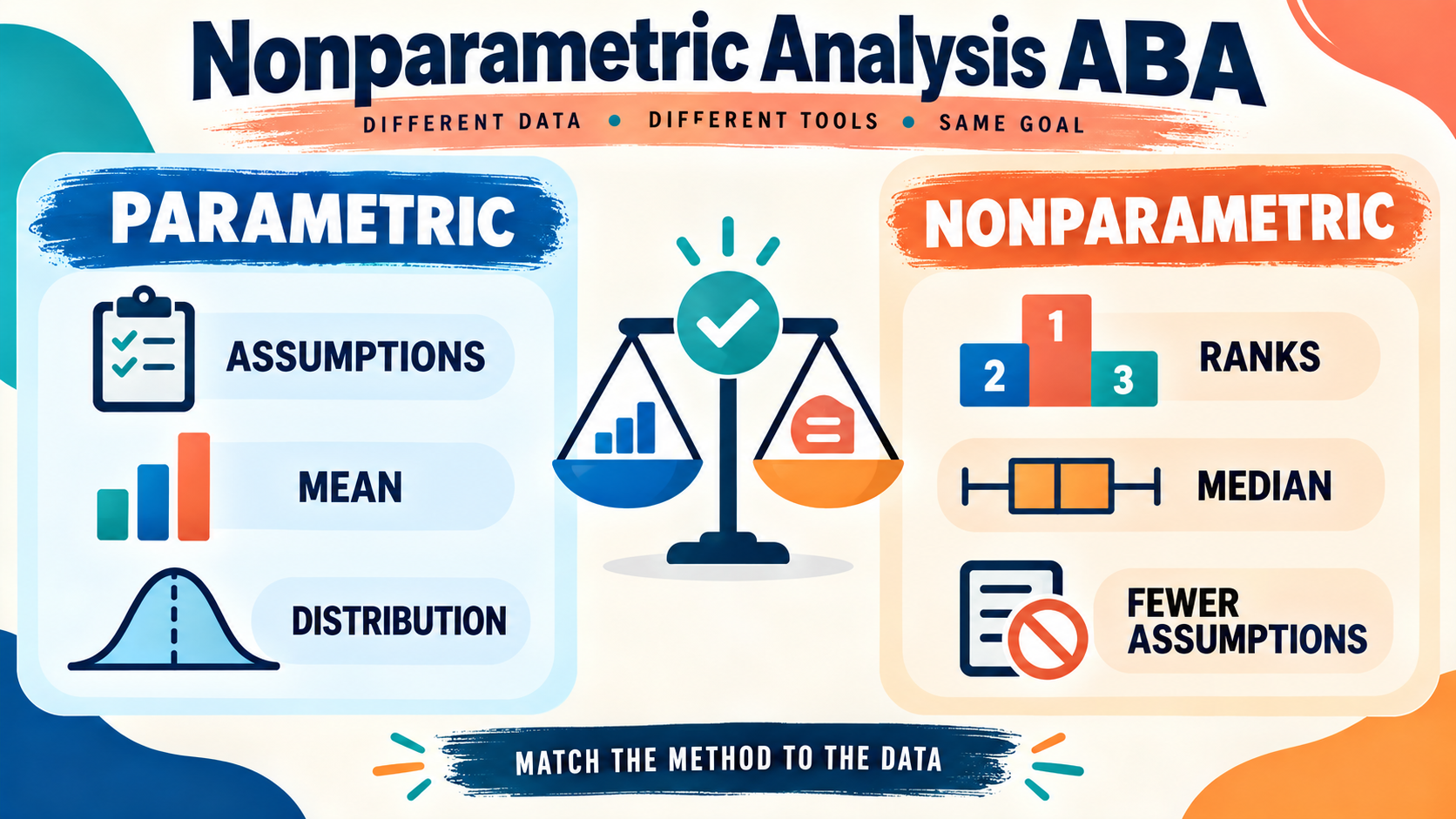
The cleanest contrast is the question being asked about the independent variable. A nonparametric analysis asks whether an intervention or condition changes behavior. A parametric analysis varies the magnitude or level of the independent variable to learn which value, intensity, duration, or amount produces the best outcome.
| Feature | Nonparametric ABA analysis | Parametric ABA analysis |
|---|---|---|
| Main question | Does the intervention change behavior? | Which value or level of the intervention works best? |
| Independent variable | Often treated as present versus absent or as distinct conditions. | Systematically varied across levels or magnitudes. |
| Example | Token board versus no token board. | Two, five, or eight tokens to identify the most efficient level. |
| Output | Evidence about whether the condition produces a change. | Evidence about the relation between a level and the outcome. |
These analysis types can appear in the same clinical decision sequence. A team may first establish that an intervention is useful, then conduct a carefully planned parametric analysis to optimize its level. Do not call the second question nonparametric simply because the data are graphed on a single-case graph.
Is Nonparametric Analysis an Experimental Design?
No. Nonparametric analysis is best treated as an analysis question or type, not as a complete experimental design. The design describes how conditions are arranged and how experimental control is demonstrated. A reversal design might show baseline, treatment, withdrawal, and reintroduction. A multiple-baseline design might stagger intervention across behaviors, settings, or participants. Either design can be used to investigate whether an intervention changes behavior, provided the arrangement is appropriate, ethical, feasible, and implemented with adequate integrity. The analysis label and the design label answer different questions:
- Analysis type: What question are we asking about the independent variable?
- Experimental design: How are conditions arranged to evaluate prediction, verification, and replication?
- Measurement system: How is the dependent variable recorded so that changes can be interpreted?
A BCBA exam item may include all three layers. Separate them before selecting an answer. A reversal is not automatically parametric or nonparametric; the independent-variable question determines that part.
What Does Nonparametric Mean in Statistics?
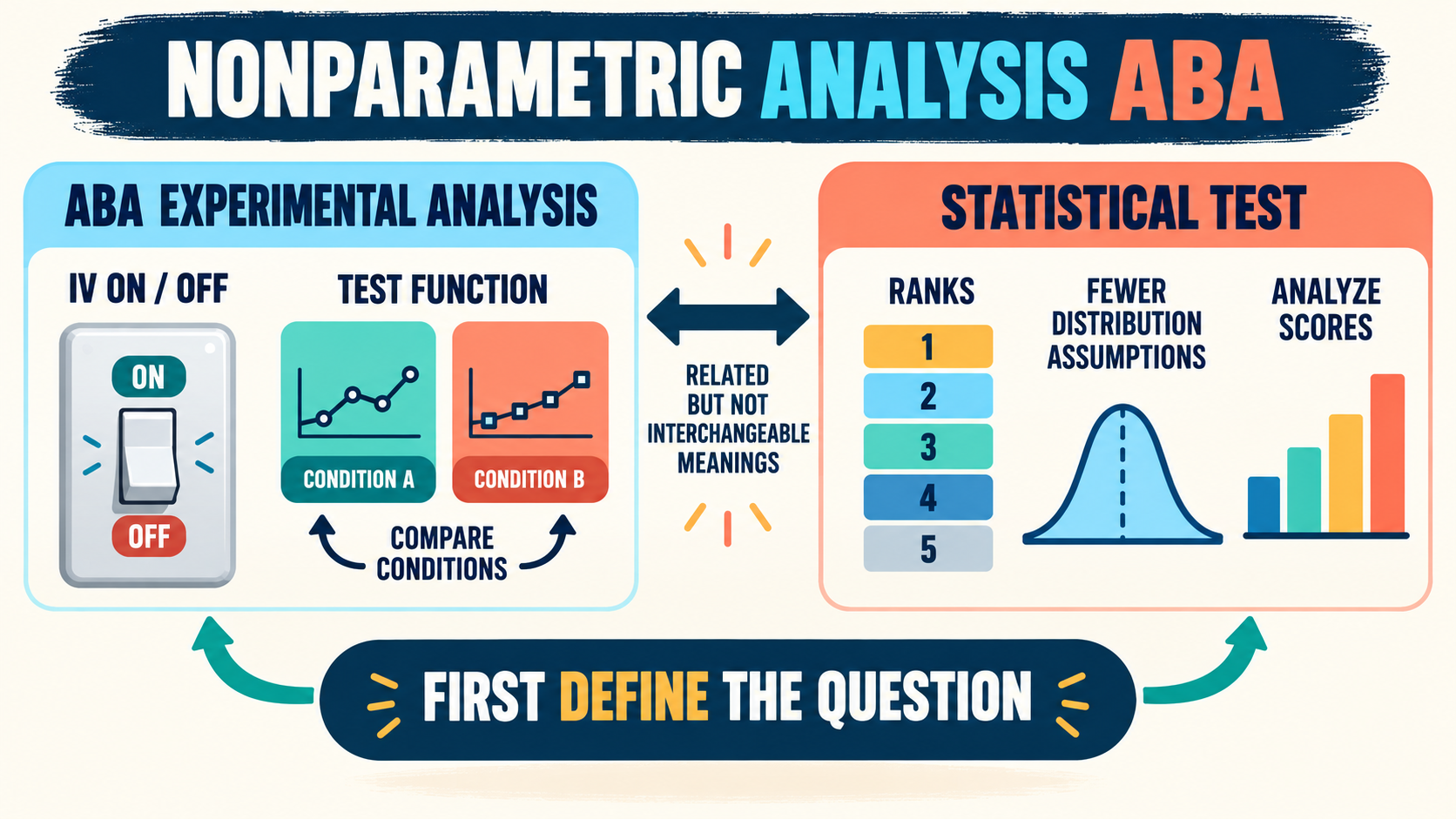
In statistics, a nonparametric test generally makes fewer assumptions about the distribution of the scores than a parametric test. Some methods use ranks, medians, permutations, or randomization procedures. This meaning is legitimate in behavior-analytic research, including research with small samples or single-case data, but it is not the same meaning as the ABA experimental-analysis distinction above.
For example, a researcher may use a randomization test or another nonparametric statistical method to evaluate data from an alternating-treatments or functional-analysis study. That statistical choice does not automatically tell you whether the underlying experimental question was parametric, nonparametric, comparative, or component. First identify what the intervention was designed to test; then consider how the data were analyzed. The difference can be summarized this way:
- ABA analysis type: describes whether the independent variable is evaluated as a condition or across levels.
- Statistical method: describes how observed scores are summarized or tested and what assumptions the method makes.
- Single-case visual analysis: describes how level, trend, variability, immediacy, overlap, and consistency are examined on a graph.
Do not assume that “nonparametric” always means “rank-based test.” Look for nearby words such as distribution, median, ranks, randomization, or p-value. Those clues usually indicate the statistical meaning.
How Should You Choose the Right Meaning?
Use a question-first process when the wording is ambiguous:
- Find the target. Is the item asking about the intervention’s presence, its magnitude, or a statistical test?
- Find the independent variable. Is it on/off, or is its intensity systematically changed?
- Find the data language. Do you see ranks, normality, distribution, medians, or randomization?
- Separate design from analysis. Identify whether the scenario uses reversal, multiple baseline, multielement, or another design.
- Answer at the requested level. Do not give a statistical label when the item asks for the experimental question.
When a prompt says “the BCBA wants to know whether the treatment works,” the ABA experimental-analysis meaning is likely. When it says “the scores are skewed and the researcher uses ranks,” the statistical meaning is likely. When it says “the analyst varies the number of tokens,” look for parametric analysis.
What Data Should You Collect?
A nonparametric ABA analysis still requires precise, representative measurement. Define the target behavior in observable terms, choose a measurement dimension that matches the question, and record enough sessions or opportunities to evaluate the pattern. A graph should make condition changes and relevant data features visible.
Useful records may include frequency, rate, duration, latency, percentage of opportunities, or another justified measure. Also track implementation fidelity when the intervention has multiple steps. If the treatment was not delivered as planned, a flat outcome cannot be interpreted as evidence that the intervention itself had no effect.
For the BCBA exam, remember that data collection and visual analysis are not optional decorations. The analysis type helps frame the independent-variable question, while the measurement system and design provide the evidence needed to evaluate change. Avoid deciding that a condition “worked” from one dramatic data point.
How Is Nonparametric Analysis Tested on the BCBA Exam?
For a question using nonparametric analysis ABA, ask whether the independent variable is simply present or absent while the analyst evaluates whether behavior changes. If yes, the answer is likely nonparametric analysis in the ABA experimental-analysis sense.
- Intervention versus no intervention: look for a nonparametric analysis question.
- Different amounts or intensities: look for a parametric analysis question.
- Which parts of a treatment package matter: look for a component-analysis question.
- Which of two or more interventions works better: look for a comparative-analysis question.
- Ranks, medians, distribution, or randomization: consider statistical nonparametric methods instead.
One common trap is to treat every “ABA” question as a withdrawal design. The word ABA may describe a reversal arrangement, but it does not by itself tell you whether the intervention was evaluated parametrically or nonparametrically. Another trap is to confuse “nonparametric” with “no measurement.” The intervention still needs an operational definition, a measurement system, and an interpretable graph.
What Mistakes Should You Avoid?
First, do not use the statistical definition automatically. The exact keyword attracts both meanings, and BCBA study questions often use the intervention-level meaning. Second, do not call a design “nonparametric” merely because it has two phases. The question about the independent variable is the deciding feature.
Third, do not confuse a treatment package with a single independent variable. If a team removes one component at a time to determine what is effective, that is a component question. If it varies the amount of one component, that is a parametric question. Finally, do not infer functional control from a visual change without considering replication, implementation fidelity, measurement quality, and alternative explanations.
What Professional Boundaries Matter?
Experimental analysis should be individualized, supervised, and ethically justified. Do not remove an effective support, restrict access to communication, or manipulate a person’s necessities simply to make a textbook example fit. The learner’s assent, consent, dignity, safety, communication access, and socially meaningful goals remain central.
Use the free BCBA mock exam as a study checkpoint for separating analysis types, designs, and measurement decisions. It is a study aid, not an official BACB product and not a substitute for supervision or individualized assessment.
Nonparametric Analysis ABA FAQ
What is nonparametric analysis in ABA?: In the common ABA experimental-analysis sense, it asks whether behavior changes when an intervention or condition is present compared with when it is absent. It focuses on the intervention-level question rather than on selecting the best magnitude of the intervention.
What is the difference between parametric and nonparametric analysis in ABA?: Nonparametric analysis asks whether an intervention works as a condition. Parametric analysis systematically varies the magnitude, intensity, duration, or amount of the independent variable to determine which level is most effective.
Is nonparametric analysis the same as a nonparametric statistical test?: No. A nonparametric statistical test generally makes fewer distributional assumptions and may use ranks, medians, permutations, or randomization. That statistical meaning is separate from the ABA experimental-analysis meaning, although both can appear in behavior-analytic research. Is a reversal design automatically nonparametric?: No. A reversal design describes how conditions are arranged. Whether the analysis is parametric or nonparametric depends on the question asked about the independent variable.
What is the fastest BCBA exam clue?: Look for the manipulation. Intervention present versus absent points toward the ABA nonparametric question; several intervention levels point toward parametric analysis; ranks or distributional assumptions point toward statistical nonparametric methods.
Nonparametric analysis ABA is easiest when you separate three layers: the question about the independent variable, the experimental design used to demonstrate control, and the method used to analyze the data. Define the target, read the manipulation, and follow the evidence before choosing a label.
Take the Free BCBA Mock Exam
If you want a low-pressure way to check your recall, use the free practice resource below. Take the Free BCBA Mock Exam



