

BCBA mentorship can help a trainee or newly certified behavior analyst build judgment, confidence, and a realistic professional-development plan. It should not be confused with formal supervised fieldwork, required ongoing supervision, or a promise that a mentor can sign hours or guarantee an exam result. The right arrangement starts by naming the role, the rules, the goals, and the limits.
Table of Contents
- What Does BCBA Mentorship Mean?
- Mentorship vs. Supervision vs. Consultation
- A BCBA Mentorship Selection Map
- What Should You Verify Before Choosing a Mentor?
- Mentorship for BCBA Candidates
- Mentorship for New BCBAs
- Privacy, Conflicts, and Ethical Boundaries
- The BCBA Exam Angle
- Common Mistakes
- BCBA Mentorship FAQ
- Take the Free BCBA Mock Exam
This is an educational guide, not an endorsement of a particular mentor or provider. Requirements can change, and the current BACB Handbook, relevant handbook section, supervisor, employer, program, and jurisdiction should control any certification or practice decision. Table of Contents
What Does BCBA Mentorship Mean?
BCBA mentorship is structured or informal professional support from a more experienced behavior analyst or another qualified professional. It may help someone think through cases, practice communication, plan development, explore career options, strengthen leadership, or prepare for the transition from coursework to independent work. Mentorship can be valuable because behavior analysis is learned through decisions in context, not only by memorizing definitions.
The problem is that “mentor” is not a single BACB role. Some programs use mentorship to describe formal supervision, some use it for optional career coaching, and some use it as marketing for case consultation. Those services can overlap, but the name alone does not tell you whether the person can supervise fieldwork, sign a form, provide consultation, or give advice on a particular case.
Before you enroll or exchange payment, ask one direct question: What exact service is being provided, and which requirement or learning goal is it meant to support? If the answer is “all of the above,” ask for a written scope and a current BACB reference.
Mentorship vs. Supervision vs. Consultation
The BACB’s supervision, assessment, training, and oversight resources distinguish roles connected to supervising future behavior analysts, supervising ongoing services, assessing RBTs, and training certificants. The following table is a plain-language comparison. It is not a substitute for the current handbook.
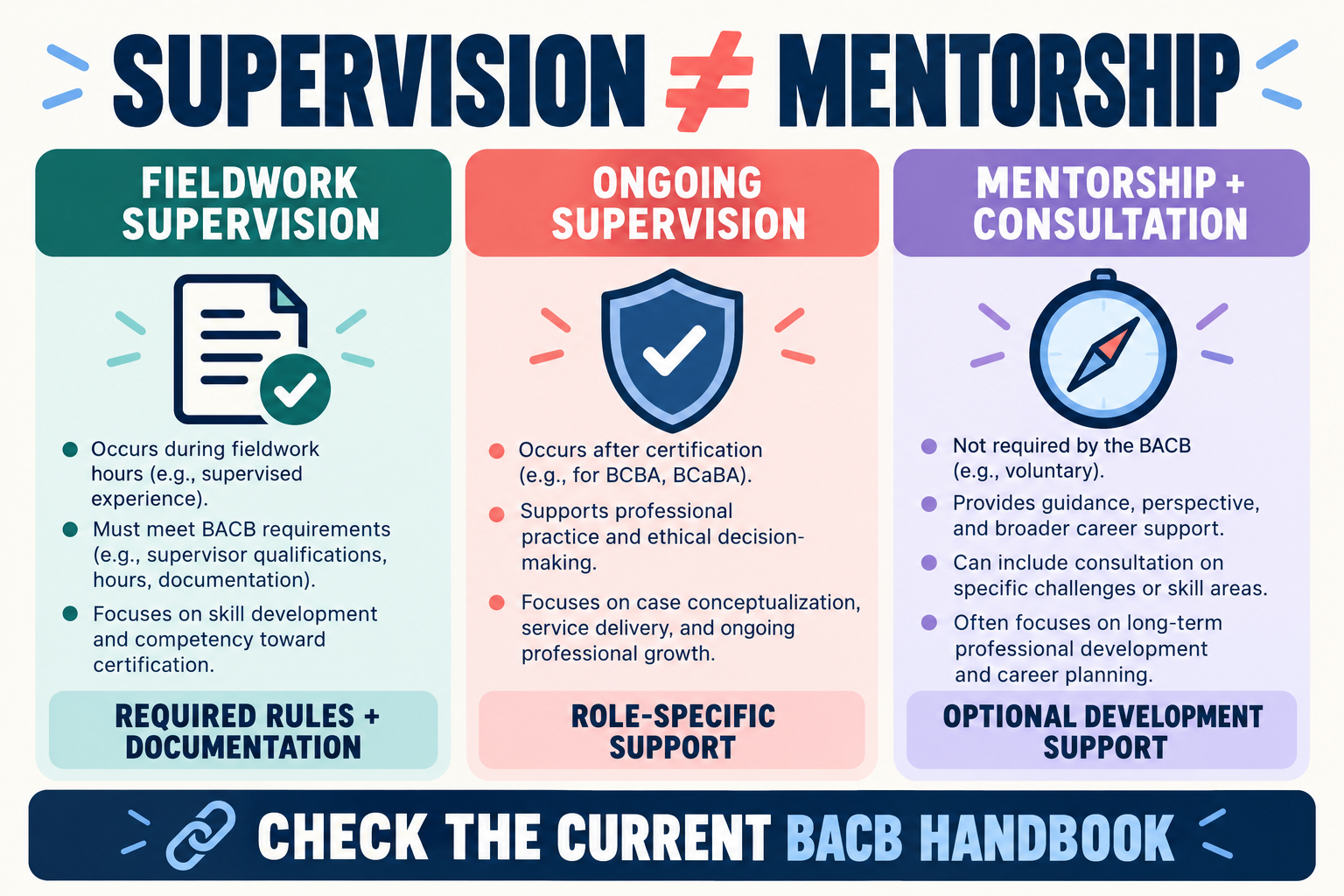
| Support type | What it may do | What to verify |
|---|---|---|
| Fieldwork supervision | Oversee qualifying experience for BCBA or BCaBA certification and provide the documentation required by the applicable pathway. | Supervisor qualifications, current handbook rules, contract, hours, observations, feedback, and forms. |
| Ongoing supervision | Support role-specific service delivery or the work of a certificant who must receive supervision under applicable requirements. | Which credential and role trigger the requirement, who is responsible, and how contacts are documented. |
| Mentorship | Offer optional professional-development guidance, reflection, career support, or a trusted perspective. | Whether the arrangement is optional, what it includes, the mentor’s competence, privacy terms, and conflicts of interest. |
| Consultation | Provide focused input on a defined question, case, skill, or professional decision. | Who owns the case, what records can be shared, who makes the final decision, and whether consultation is being mislabeled as supervision. |
A mentor may also be a qualified supervisor, but the relationship still needs a clear agreement. A paid mentor who is not providing qualifying supervision cannot turn informal conversations into fieldwork hours after the fact. Conversely, a fieldwork supervisor has responsibilities that go beyond being a friendly career guide.
A BCBA Mentorship Selection Map
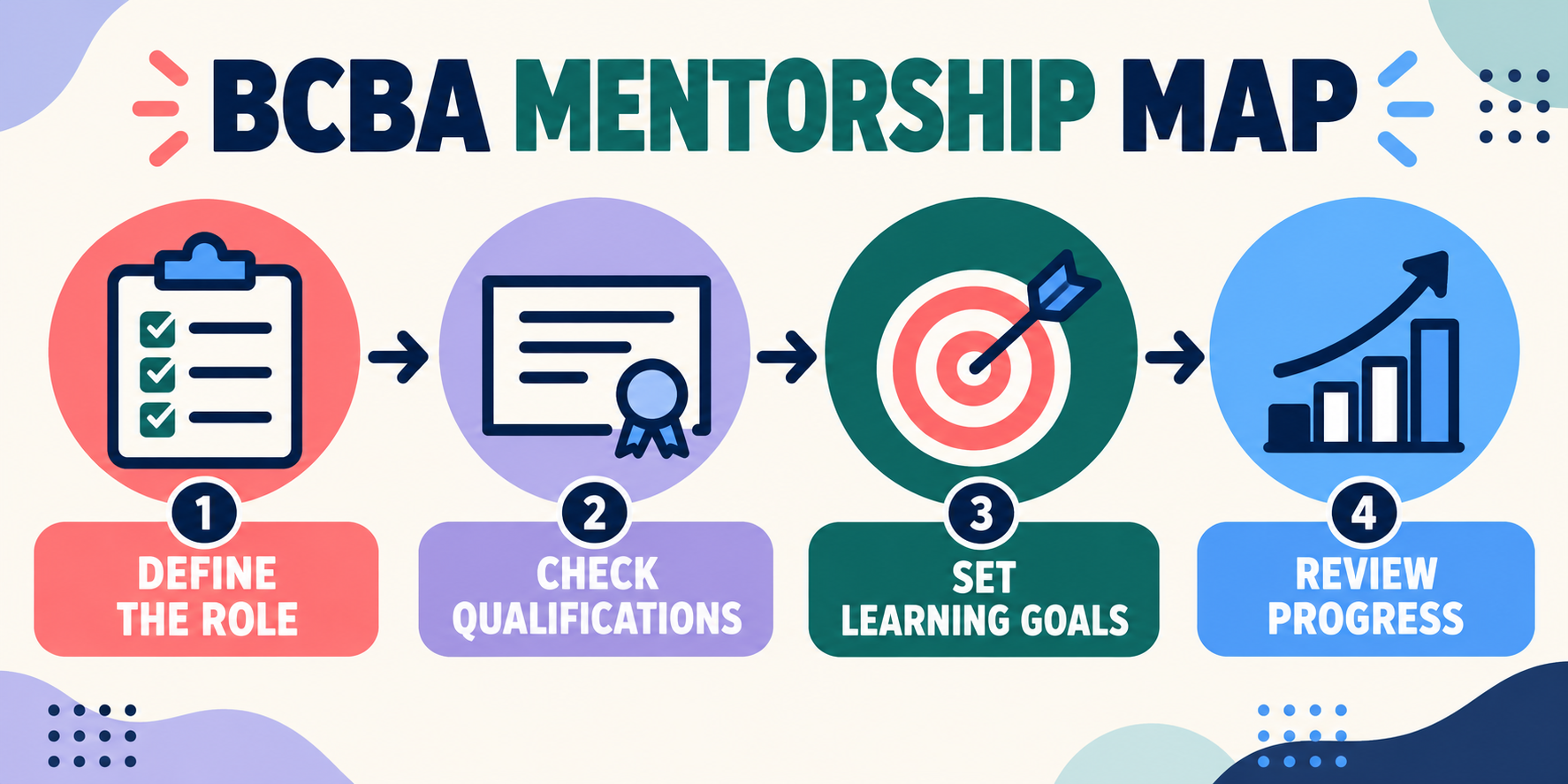
Use a four-step screen before choosing a person or program:
- Define the role: write down whether you need fieldwork supervision, exam study support, first-year consultation, leadership development, or a focused skill conversation.
- Check qualifications: verify the person’s current credential or license when relevant, experience with your population and setting, and ability to explain the limits of the service.
- Set learning goals: choose observable outcomes such as writing an operational definition, conducting a graph review, practicing a feedback conversation, or building a case-presentation routine.
- Review progress: decide how often you will review goals, what evidence shows improvement, what happens if the fit is poor, and how either party can end the arrangement.
The map protects you from buying an attractive label without a usable learning plan. It also gives a mentor something concrete to respond to. “Make me a better BCBA” is a direction; “review one data-based decision and one ethical communication each month” is a goal that can be observed and revised.
What Should You Verify Before Choosing a Mentor?
Experience is relevant, but years in the field alone do not prove that a mentor is right for your goals. Ask the following questions in a short introductory call:
- What populations, settings, and behavior-analytic tasks do you currently practice?
- Are you offering mentorship, consultation, fieldwork supervision, or a combination with separate terms?
- If I need qualifying supervision, which current BACB requirements and forms will govern the relationship?
- How do you protect confidential information, and what should I remove before discussing a case?
- How do you handle a question outside your competence or a disagreement with an employer or another professional?
- What is the meeting frequency, response time, cancellation policy, price, and process for changing or ending the arrangement?
Look for specific answers rather than a promise of “insider knowledge” or a guaranteed pass. A responsible mentor should be comfortable saying, “I need to check the current handbook,” “That requires a licensed professional,” or “I cannot evaluate this case without the right consent and records.” Those statements are signs of boundaries, not weakness.
Mentorship for BCBA Candidates
If you are still pursuing certification, formal supervision is the first question. The BCBA Handbook and the pathway that applies to your application date control the degree, coursework, fieldwork, application, and examination requirements. A mentor can help you understand a concept, rehearse a presentation, or plan study time, but optional mentorship does not automatically create qualifying hours. Use mentorship to turn fieldwork into deliberate learning. Bring a de-identified situation and ask:
- What is the operational definition, and what information would make it more precise?
- Which measurement system fits the decision, and what pattern would change the plan?
- How can I explain the intervention and the learner’s choices in plain language?
- What part of this situation is within my role, and when should I ask my formal supervisor or another professional?
Keep the chain of responsibility clear. Your formal supervisor is responsible for qualifying supervision within the agreed arrangement. A separate mentor should not direct a live case in a way that conflicts with the supervising BCBA or employer without a transparent process for resolving the difference.
Mentorship for New BCBAs
The first year after certification can expose gaps that coursework did not make visible: prioritizing a caseload, writing concise recommendations, leading a meeting, giving corrective feedback, handling disagreement, or deciding when data are not yet strong enough to support a change. Mentorship can provide a low-stakes place to rehearse those skills. Choose goals that improve practice rather than status. For example, ask a mentor to review how you:
- separate a referral question from an intervention preference;
- explain graphs and limitations to a caregiver, teacher, or team;
- build generalization and maintenance into a plan;
- document a consultation, disagreement, risk concern, or referral;
- support supervisees with instruction, observation, modeling, rehearsal, and feedback.
Mentorship should make your professional judgment more independent over time. If every decision must be approved by a mentor indefinitely, clarify whether you actually need formal supervision, case consultation, or a different work arrangement.
Privacy, Conflicts, and Ethical Boundaries
The current BACB Ethics Code resources provide the professional frame for competence, client welfare, confidentiality, informed choices, integrity, and effective collaboration. A mentorship relationship does not remove those duties. It can create new risks when a mentor is also your employer, evaluator, supervisor, friend, business partner, or paid consultant.
Before discussing cases, decide what information can be shared and how it will be protected. Use the minimum necessary detail, remove identifying information, and follow employer, payer, legal, and consent requirements. Do not upload records to a mentor’s personal platform just because it is convenient. If the mentor is not part of the client’s service team, the mentor may be able to discuss principles and a fictionalized example but not review identifiable clinical material.
Pay attention to pressure. A mentor should not ask you to misstate hours, copy another person’s work, hide an error, bypass informed consent, or continue a service outside competence. If the relationship includes supervision, confirm who is accountable for the case and the documentation. If it is only mentorship, do not let marketing language imply that the mentor is your certifying authority.
The BCBA Exam Angle
BCBA mentorship is not a substitute for studying the current BCBA Test Content Outline, but a good mentor can help you practice the reasoning the exam requires. Ask the mentor to challenge your answer with a different function, measurement system, setting event, ethical conflict, or generalization problem. For each practice scenario, explain:
- what the observable target is and how it would be measured;
- what information is missing before selecting an intervention;
- which answer protects client welfare, dignity, consent or assent when applicable, and scope;
- how you would evaluate, generalize, maintain, and revise the plan; and
- which current BACB document or supervisor should settle a requirement question.
When you are ready to measure your core preparation, try the free BCBA mock exam. Use your error log as the agenda for mentorship: terminology, measurement, application, ethics, supervision, or reading the scenario too quickly.
Common Mistakes
- Calling every mentor a supervisor: ask which BACB requirement, if any, the relationship satisfies.
- Buying a guarantee: no mentor can promise certification, a passing score, or a particular career outcome.
- Choosing by popularity alone: match the mentor’s competence, setting, communication style, and boundaries to your goal.
- Sharing identifiable records: use consent, privacy procedures, and the minimum necessary information.
- Letting an outside mentor override the formal supervisor: resolve conflicts through the documented chain of responsibility.
- Keeping goals vague: define what you will practice, what evidence will show improvement, and when the arrangement will be reviewed.
BCBA Mentorship FAQ
Is BCBA mentorship required for certification?: Optional mentorship is not a universal substitute for the degree, coursework, supervised fieldwork, application, or examination requirements. If a program uses the word mentorship for a formal qualifying arrangement, verify the exact pathway and documentation against the current BACB Handbook.
Can a mentor sign my BCBA fieldwork hours?: Only a person serving in a qualifying supervisory arrangement and meeting the applicable requirements should sign or verify fieldwork documentation. A casual mentor cannot make hours count merely by reviewing a case or meeting with you. Confirm the supervisor relationship, contract, observations, and forms before accruing hours.
How is mentorship different from consultation?: Mentorship is often broader and development-oriented, while consultation usually addresses a defined professional or case question. Either arrangement should state its purpose, privacy limits, fees, responsibilities, and scope. Neither label automatically replaces required supervision.
How do I find a good BCBA mentor?: Start with your actual goal, then ask potential mentors about their current qualifications, relevant settings, service type, confidentiality process, meeting structure, and handling of scope questions. Speak with more than one person if possible, request written terms, and choose the arrangement that gives you observable learning goals and a safe way to review fit.
Bottom line: BCBA mentorship works best when it is clearly labeled, goal-based, privacy-aware, and connected to the right level of supervision or consultation. Use the current BACB requirements for certification decisions, a qualified supervisor for qualifying fieldwork, and mentorship for the professional judgment and reflection that grow around those formal requirements.
Take the Free BCBA Mock Exam
If you want a low-pressure way to check your recall, use the free practice resource below. Take the Free BCBA Mock Exam



