

How do you write session notes in ABA? Start with an accurate record of what happened, what was measured, what procedures were used, how the client responded, and what the data suggest for the next session. A useful note is objective and specific without becoming a transcript. It connects the session to current goals while protecting privacy and avoiding unsupported conclusions.
Table of Contents
- What Should an ABA Session Note Do?
- What Are the Main Parts of a Session Note?
- How Do You Make an ABA Note Objective?
- How Do You Write Session Notes in ABA Step by Step?
- What Should RBT and BCBA Notes Emphasize?
- What Documentation Mistakes Should You Avoid?
- A Quick ABA Session-Note Checklist
- Frequently Asked Questions
- Sources for Further Study
- Quick Review Checklist
- Take the Free BCBA Mock Exam
Requirements vary by role, payer, state, employer, and service code, so this guide is an educational documentation framework—not a universal billing template or legal opinion. Always follow the current treatment plan, supervision instructions, organizational policy, and applicable regulations. The goal is to make the record useful to the clinical team and faithful to the session that actually occurred.
What Should an ABA Session Note Do?
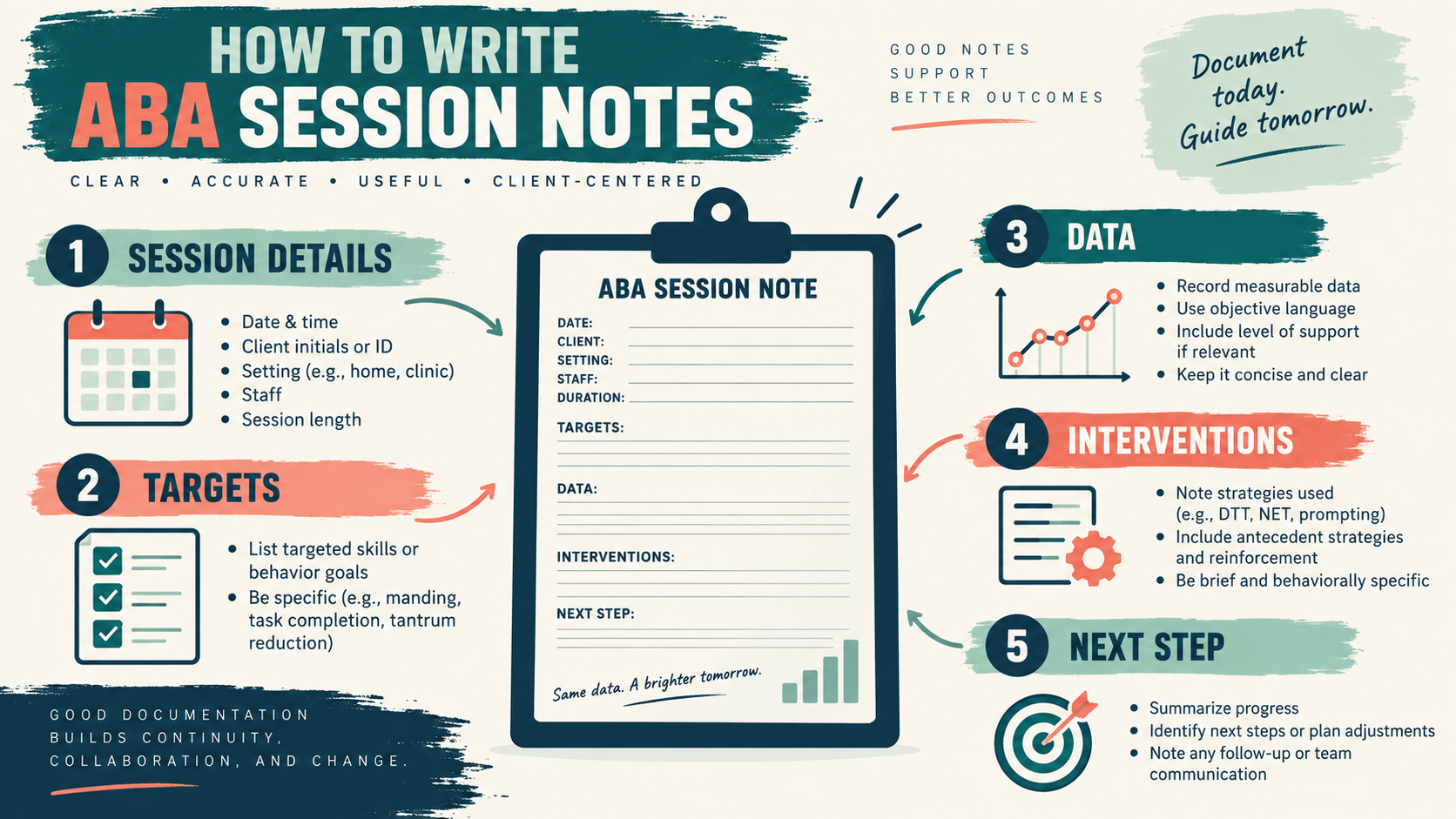
An ABA session note should let an informed reader reconstruct the clinically relevant parts of the session without guessing. It should identify the service context, connect activities to goals, summarize the data collected, describe the intervention as it was implemented, and record the client’s observable response. It should also show what the team will review or do next when that is part of the writer’s role.
A note is not a diary entry and not a place to vent. “The client had a bad day” does not tell the next provider what happened. A stronger sentence might say, “During the 30-minute transition program, the client left the work area twice for 45 and 70 seconds; the visual schedule and a gestural prompt were used, and the client returned after requesting a break.” The second sentence gives a measurable event, context, support, and response without assigning a mood or intention.
Good documentation supports continuity of care, data review, supervision, and appropriate communication. It does not prove that an intervention was effective merely because the note sounds confident. The note should distinguish observation from interpretation and report missing data or implementation barriers when they matter.
What Are the Main Parts of a Session Note?
Use the format required by the practice or service code, but make sure the record answers the same basic questions. The exact fields may differ; the reasoning should remain consistent.
| Part | What to record | Quality check |
|---|---|---|
| Session details | Date, start and end time, location, service context, provider, and required participants. | Do the logistics match the schedule and the service record? |
| Targets | Skills or behavior-reduction targets addressed, stated in the language of the plan. | Can another provider tell what was actually worked on? |
| Data | Frequency, duration, latency, percentage, trial count, prompt level, or another approved measure. | Is the number tied to a defined response, denominator, and observation period? |
| Procedures and response | Teaching steps, prompts, reinforcement, environmental supports, client response, and barriers. | Does the note describe what was implemented rather than what was intended? |
| Next step | A data-based follow-up, supervisor review, caregiver communication, or plan-consistent continuation. | Is the next step within the writer’s role and supported by the session record? |
Do not insert every raw trial into a narrative note if the approved data system already stores the trial-level record. Summarize the relevant pattern and make sure the note points to the source data according to local procedure. Avoid copying a previous note and changing only the date; a repeated goal can still have different performance, prompts, events, and next steps.
How Do You Make an ABA Note Objective?
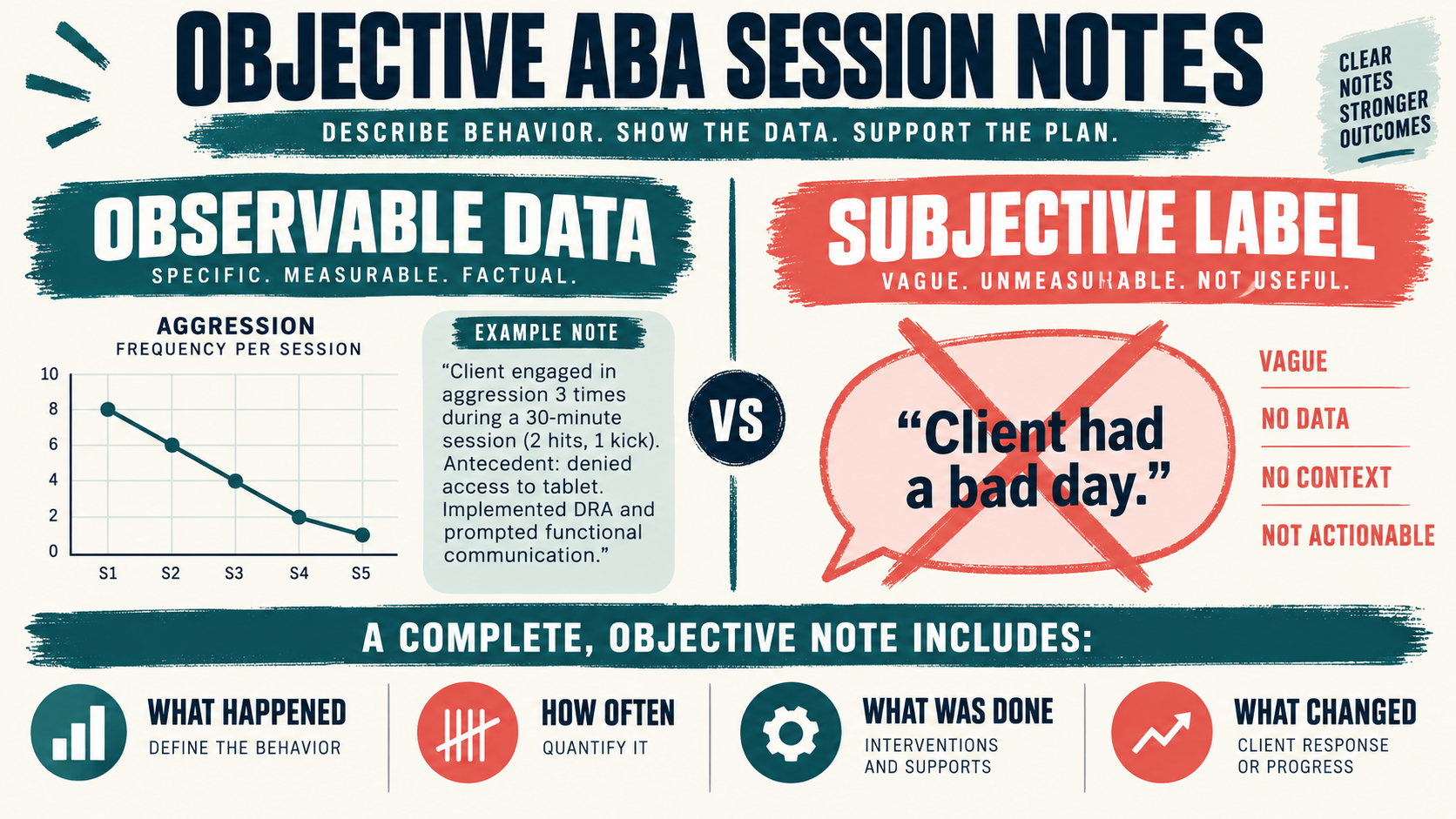
Objective writing uses observable actions, measurable dimensions, and neutral descriptions. It does not mean removing all clinical reasoning. It means showing which observation supports the interpretation. Replace global adjectives with details a second reader could verify.
| Avoid | Use instead | Why it is stronger |
|---|---|---|
| “The client was uncooperative.” | “After the instruction, the client pushed the materials away and did not begin within 30 seconds.” | Names the observable response and time window. |
| “The client had a great session.” | “The client completed 18 of 20 matching trials independently and needed a model prompt on two trials.” | Connects the summary to target data and prompt level. |
| “The intervention worked.” | “Independent requests increased from 4 of 10 opportunities at baseline to 7 of 10 opportunities today; continue review of the trend.” | Reports the data and avoids claiming causation from one session. |
Be precise about prompts. “Needed help” does not show whether the prompt was verbal, gestural, modeled, or physical, nor whether the response was independent. If a safety event, medical concern, injury, medication issue, or unusual change occurred, document it through the required reporting path as well as in the session record when policy calls for it. Do not hide important events inside vague language.
How Do You Write Session Notes in ABA Step by Step?
- Confirm the session frame. Check the date, time, location, service type, people present, and the plan or programs scheduled for the session. Record interruptions or changes that affect interpretation.
- List the targets actually addressed. Use the current plan’s labels and operational definitions. Do not imply that every program was run if time, materials, client choice, or safety prevented it.
- Pull the relevant data. Include the measure, number of opportunities or observation length, independent versus prompted performance, and any meaningful trend. Check that the denominator and time window are clear.
- Describe implementation. State which teaching procedures, prompts, reinforcement arrangements, antecedent supports, or environmental changes were used. Keep the description at the level supported by the writer’s role and training.
- Describe the client’s response. Report what the client did, how the response changed, and what consequence or support followed. Avoid inferring motives, emotions, or internal states without a documented source.
- Explain the next step. Identify what should be reviewed, practiced, communicated, or adjusted according to the plan and supervision structure. A next step may be “continue data collection and discuss the pattern with the BCBA,” not an unauthorized treatment change.
- Review before signing. Check names, dates, times, numbers, pronouns, copied text, required signatures, and privacy. Make corrections through the approved amendment process; do not silently rewrite a signed clinical record.
A compact note can still be complete. For example: “During the home session from 3:00–4:00 p.m., the RBT targeted functional communication and transition tolerance. The client independently requested a break in 6 of 8 opportunities and needed a verbal prompt in 2 opportunities. During two transitions, the client left the area for 20 and 35 seconds; a visual schedule and choice of first activity were used. The client returned after the break request was honored. Continue collecting independent-request data and review transition patterns with the BCBA.” The exact wording must match the actual session; it is an illustration, not a copy-ready record.
What Should RBT and BCBA Notes Emphasize?
An RBT or other technician generally documents direct implementation, data, observable client responses, prompts, reinforcement, barriers, and communication required by the plan. The note should not invent an assessment conclusion or independently change treatment because the data were difficult. Raise concerns through the supervision pathway.
A BCBA note may include assessment interpretation, caregiver training, program review, supervision, clinical decision-making, and plan updates within the analyst’s competence and authority. Even then, interpretation should be connected to data and the reason for the decision. “Reviewed progress” is weaker than “Reviewed the last four sessions of duration data; the mean decreased from 12 minutes to 7 minutes, so the team will continue the current teaching sequence and check generalization next week.”
When multiple providers contribute, keep the roles clear. A note should show who observed, who implemented, who provided supervision, and whose interpretation is being recorded. Do not use another person’s signature, credentials, or account. Follow the organization’s rules for co-signatures and late entries.
What Documentation Mistakes Should You Avoid?
- Vague labels: replace “agitated,” “noncompliant,” or “did well” with observable actions and data.
- Missing context: a percentage without opportunities, observation time, prompt level, or target definition is hard to interpret.
- Cloned notes: repeated wording can hide changes in performance and may create a record that does not reflect the actual session.
- Unsupported causation: one session can show what happened today; it rarely proves that a procedure caused a long-term change.
- Overpromising compliance: do not claim that a note meets every payer or state requirement without checking the current rule and service context.
- Privacy errors: include only necessary information, use approved systems, and do not place identifiable client details in an unapproved template or public example.
- Silent edits: preserve the audit trail and use the organization’s correction process after a note is signed.
The BACB Ethics Code for Behavior Analysts is an important professional reference for accurate communication, competence, client dignity, and protection of confidential information. It does not replace the current rule, contract, or policy that applies to a specific service.
A Quick ABA Session-Note Checklist
Before finalizing, ask:
- Are the date, time, location, service context, and people present accurate?
- Are the targets tied to the current plan and described in observable terms?
- Does each number have a measure, denominator, duration, or observation window?
- Did I separate independent responding from prompted responding?
- Did I record what was implemented and how the client responded?
- Did I avoid unsupported labels, diagnosis claims, or assumptions about intent?
- Is the next step within my role and connected to the data?
- Did I protect privacy and follow the approved signature and correction process?
For BCBA exam preparation, remember the same logic: define the response, select the measure, connect the data to the decision, and distinguish what was observed from what is hypothesized. For additional practice with measurement and documentation-related reasoning, the free BCBA mock exam is a separate study resource. It is not official BACB content and does not guarantee a certification result.
Frequently Asked Questions
What should be included in an ABA session note?: Include the session frame, targets addressed, relevant data, procedures implemented, observable client response, barriers or unusual events, and a plan-consistent next step. Follow the required format for the service and organization.
How can I make an ABA note objective?: Describe what a reader could observe or verify. Use measurable counts, percentages, durations, latencies, prompt levels, and time windows instead of global judgments such as “good,” “bad,” or “uncooperative.”
Should an RBT write the same kind of note as a BCBA?: Both should be accurate and objective, but the emphasis differs. RBT notes generally focus on direct implementation and client response. BCBA notes may include assessment, supervision, caregiver training, and data-based clinical decisions within the analyst’s role.
Can I use a template for ABA session notes?: A template can protect consistency, but it should prompt real session details rather than encourage copy-and-paste text. Review every field, remove irrelevant defaults, and use the approved amendment process for corrections.
Sources for Further Study
- BACB Ethics Code for Behavior Analysts — professional and confidentiality reference.
- BACB BCBA Test Content Outline — current study context for measurement, assessment, and behavior change.
- ABA Session Notes: Examples, Templates and How to Write Them — current practitioner comparison and examples.
- ABA Session Notes: Components, Examples, Templates & Tips — documentation components and note-writing discussion.
- How to Take Effective ABA Session Notes — objective language, data, and continuity-of-care considerations.
Quick Review Checklist
Use this final checklist to turn how do you write session notes into exam-ready reasoning. The goal is not to memorize a label in isolation; it is to identify the relevant evidence and explain why the best answer fits the scenario. Key ideas to review:
- State the central definition or decision point for how do you write session notes in your own words.
- Identify the detail that makes how do you write session notes different from its closest related ABA term.
- Separate the observable facts in a scenario from assumptions that are not supported by the facts.
- Write one example and one nonexample so you can recognize the concept in a new setting.
Exam application checks:
- Ask what the question is actually requesting before comparing the answer choices.
- Mark the antecedent, response, consequence, or other evidence that supports the selected answer.
- Look for a distractor that describes a related process but does not answer the specific question.
Final self-check:
- Explain how you would verify the interpretation with clear observations or data.
- Change one detail in the scenario and decide whether your answer should change.
- Give a one-sentence rationale that a supervisor or study partner could evaluate.
Take the Free BCBA Mock Exam
If you want a low-pressure way to check your recall, use the free practice resource below. Take the Free BCBA Mock Exam



