
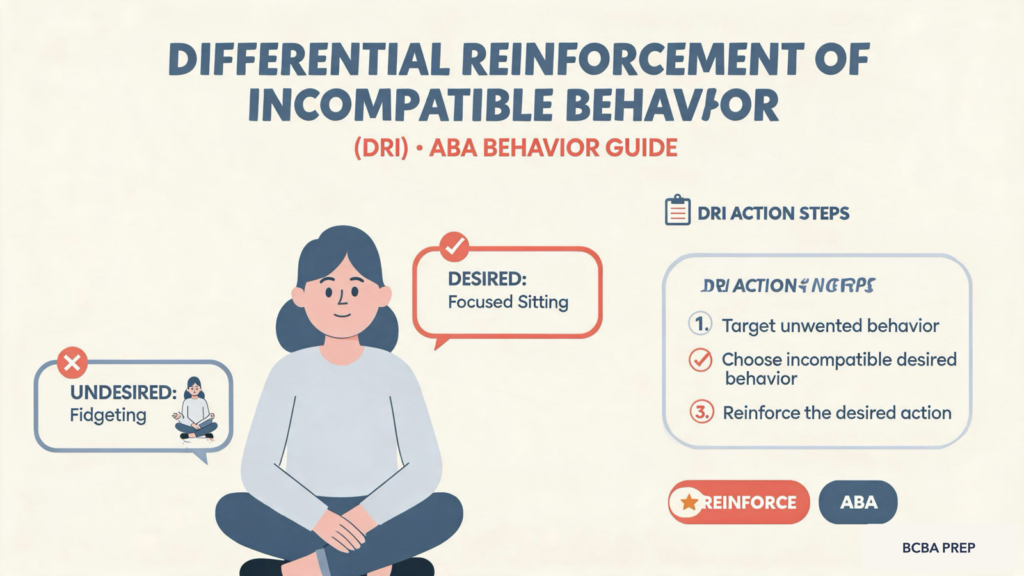
What Is Differential Reinforcement of Incompatible Behavior (DRI)?
Differential reinforcement of incompatible behavior (DRI) is a procedure in which a behavior that is physically incompatible with the target behavior is reinforced, while the target behavior is placed on extinction. Because the two behaviors cannot occur simultaneously, increasing the replacement behavior automatically decreases the problem behavior.
Practice this concept
Table of Contents
- What Is Differential Reinforcement of Incompatible Behavior (DRI)?
- DRI in Practice: Worked Examples with ABC Data
- Exam Relevance and Common Traps
- Quick Checklist for Implementing DRI
- Summary and Next Steps
For example, if a child frequently leaves their seat, reinforcing the behavior of sitting (which is incompatible with standing/walking) reduces out-of-seat behavior. DRI is a subtype of differential reinforcement that emphasizes physical incompatibility.
DRI vs DRA vs DRO: Key Distinctions
- DRI (Incompatible): The replacement behavior is physically incompatible with the target (e.g., sitting vs. standing). Only the incompatible behavior is reinforced.
- DRA (Alternative): The replacement behavior serves the same function but does not have to be physically incompatible; any alternative behavior can be reinforced (e.g., requesting a break instead of screaming).
- DRO (Other): Reinforcement is delivered if the target behavior does not occur for a specified interval; no specific replacement is selected.
On the BCBA exam, remember that in DRI the replacement behavior must be topographically incompatible with the target, whereas DRA allows any functionally equivalent alternative.
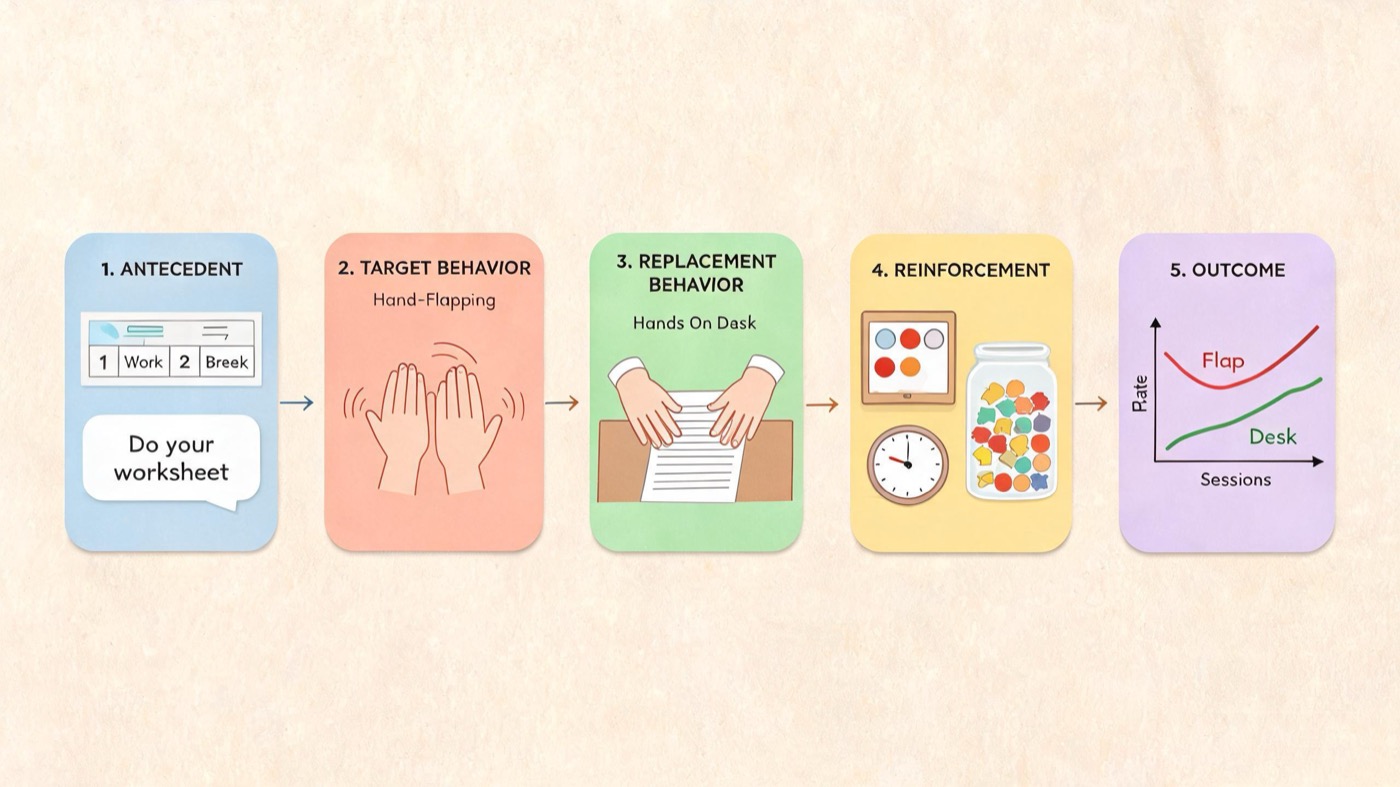
DRI in Practice: Worked Examples with ABC Data
Example 1: Reducing Hand-Flapping in a Classroom
Target behavior: Hand-flapping (sensory/automatic reinforcement). Replacement behavior: Keeping hands on desk (incompatible with flapping). Antecedent: During independent work, the teacher says ‘Do your worksheet.’ Behavior: The student flips their paper and flaps hands. Consequence (baseline): No immediate consequence; behavior maintained by automatic sensory input. Intervention: Every 30 seconds of hands-on-desk, the teacher provides a preferred sensory item (e.g., fidget toy). Hand-flapping results in no reinforcement. Over time, the student engages in hands-on-desk more frequently, reducing flapping.
Example 2: Decreasing Out-of-Seat Behavior During Circle Time
Target behavior: Out-of-seat during circle time (escape from demands). Replacement behavior: Sitting in chair (incompatible with standing/leaving). Antecedent: Teacher begins reading a story. Behavior: The student stands up and walks away. Consequence (baseline): Teacher stops reading and redirects (attention and escape). Intervention: The student earns a sticker for each minute of sitting. After collecting 5 stickers, they get a 2-minute break (escape). Out-of-seat results in no break and no attention. Sitting increases, out-of-seat decreases.
Example 3: Replacing Vocal Stereotypy with Quiet Activity
Target behavior: Vocal stereotypy (automatic reinforcement). Replacement behavior: Engaging in a quiet activity like drawing (incompatible with vocalizing). Antecedent: During free time, the student has access to drawing materials. Behavior: The student begins humming and making noises. Consequence (baseline): No external consequence; internal auditory stimulation maintains the behavior. Intervention: The student is taught to draw when they feel the urge to vocalize. Each drawing session is followed by access to preferred music (matched stimulation). Vocal stereotypy is ignored. Drawing increases and stereotypy reduces.
Exam Relevance and Common Traps
DRI is a frequent topic on the BCBA exam. Candidates often confuse DRI with DRA or overlook the function of the target behavior. Below are three common traps to avoid.
Trap 1: Confusing DRI with DRA
In DRA, the alternative behavior does not need to be physically incompatible; it only needs to serve the same function. For example, reinforcing requesting a break (DRA) for a child who elopes to escape tasks is DRA, not DRI, because requesting and eloping are not physically incompatible. In DRI, the replacement directly prevents the target from occurring. Exam question tip: If the replacement makes it impossible to engage in the target at the same time, it is DRI.
Trap 2: Forgetting to Verify the Replacement Behavior Is Less Effortful
The incompatible behavior must be less effortful than the target behavior, or the client will not adopt it. If the replacement requires too much effort, the problem behavior may persist. Example: Requiring a child to stay seated for 10 minutes when they usually stand every 2 minutes is too demanding. Instead, start with a short duration and gradually increase.
Trap 3: Not Considering the Function
DRI is only effective if the replacement behavior provides the same reinforcer as the target. If a child flaps hands for sensory input, reinforcing hand-flapping with attention (social function) will not reduce the behavior. Match the replacement to the function. For escape-maintained behavior, the replacement should lead to a break; for attention-maintained behavior, the replacement should lead to attention.
Quick Checklist for Implementing DRI
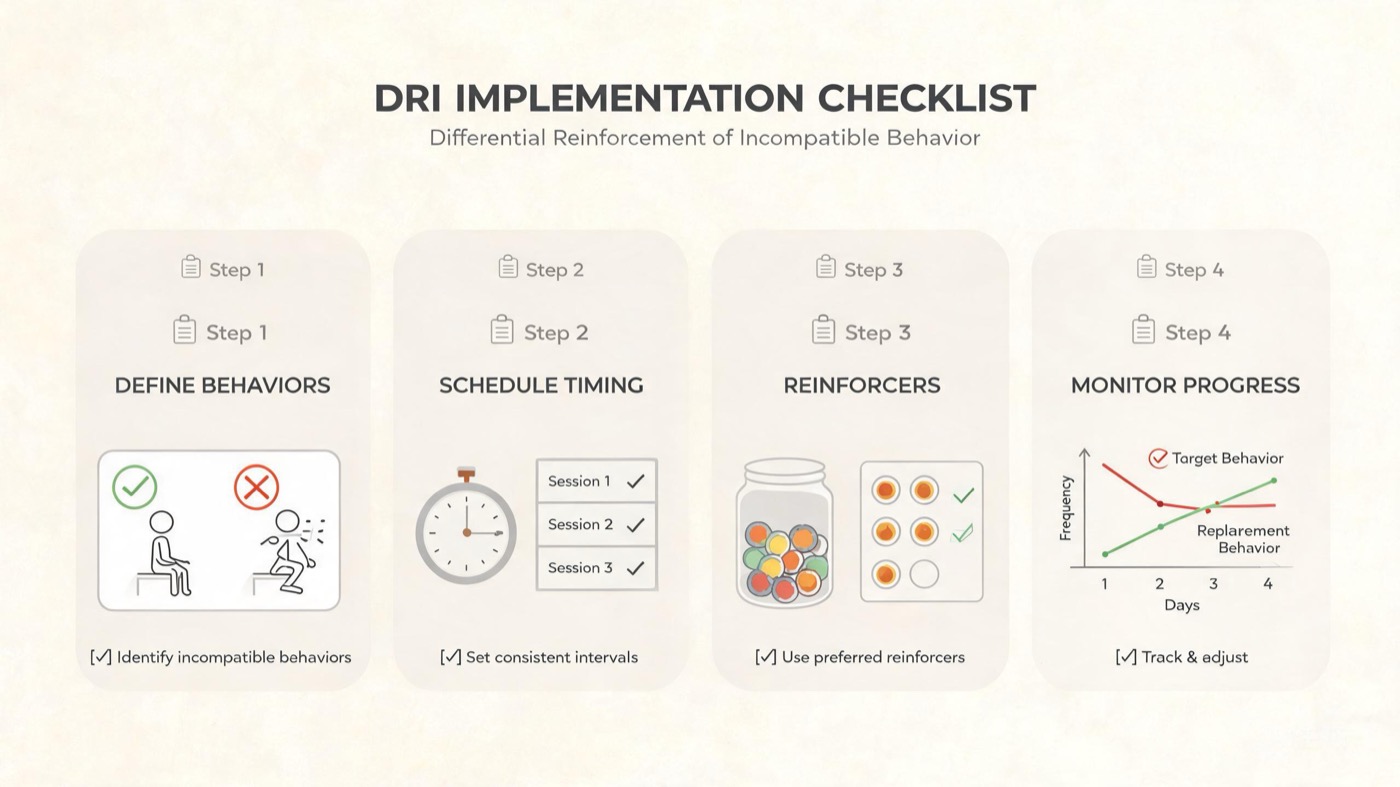
Use this checklist when designing a DRI intervention or answering exam questions:
- Define the target behavior in observable, measurable terms.
- Identify the function through functional assessment (e.g., ABC data, FA).
- Select an incompatible behavior that cannot occur at the same time as the target.
- Ensure the replacement is less effortful or at least equal in response effort.
- Reinforce the replacement consistently using the same reinforcer that maintained the target.
- Place the target behavior on extinction (never reinforce it).
- Monitor data to confirm the target decreases and replacement increases.
- Plan for generalization and maintenance to ensure lasting change.
Summary and Next Steps
Differential reinforcement of incompatible behavior is a powerful, function-based procedure that reduces problem behavior by reinforcing a physically incompatible alternative. On the BCBA exam, the key distinction from DRA is the requirement of physical incompatibility. Always remember to match the function, ensure the replacement is practical, and use extinction for the target.
To deepen your understanding, practice with mock questions that ask you to identify DRI from a scenario. For more on differential reinforcement, check out our comprehensive guide to DRA, DRO, DRI, DRL, and DRH. Also review the four functions of behavior to strengthen your conceptual skills. For additional study, consult the BACB website for the current Task List.
Consistent practice with real-world examples will solidify your ability to apply DRI in clinical settings and ace related exam questions.



