
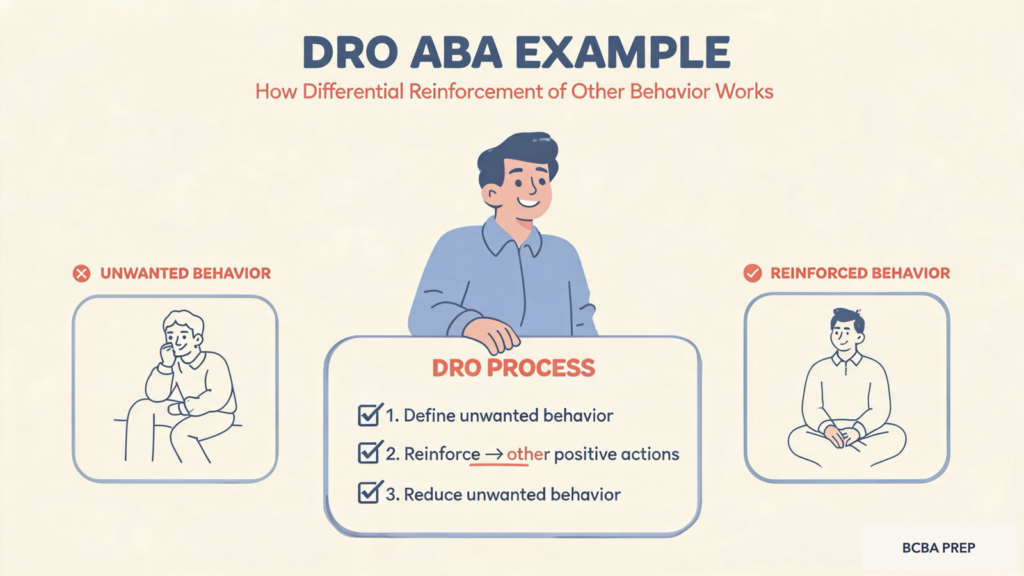
What Is DRO in Applied Behavior Analysis?
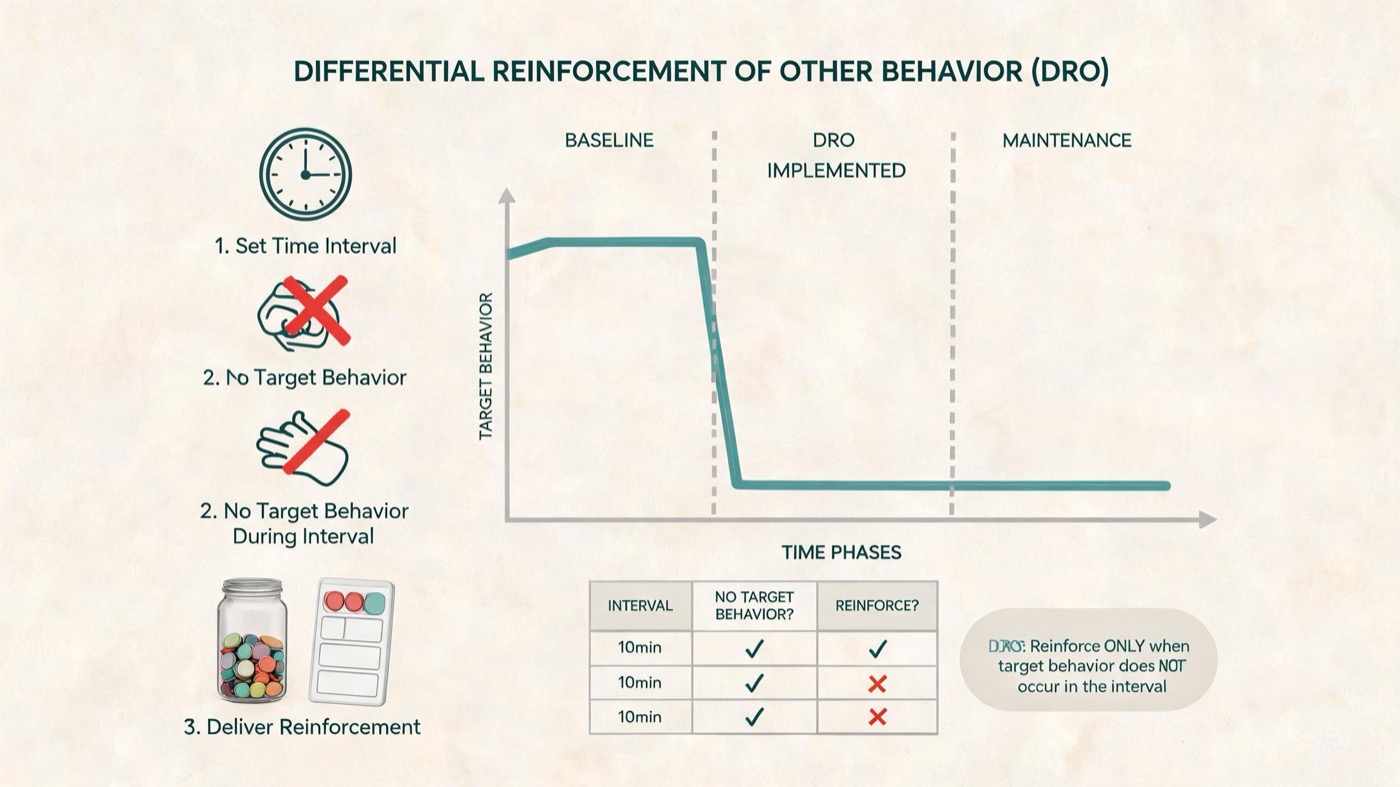
Differential Reinforcement of Other Behavior (DRO) is a procedure in which reinforcement is delivered contingent on the absence of the target behavior during a specified time interval. The term ‘other behavior’ means any behavior other than the problem behavior. DRO is a core intervention for reducing challenging behaviors while still providing reinforcement.
Practice this concept
Use the related differential reinforcement questions to compare DRO with other procedures.
Table of Contents
- What Is DRO in Applied Behavior Analysis?
- DRO ABA Example: 3 Real-World Scenarios
- How to Implement DRO: A Step-by-Step Guide
- Exam Relevance: DRO Questions on the BCBA® Exam
- DRO Implementation Checklist
- Final Summary
Key Components of a DRO Procedure
To implement DRO correctly, a practitioner must define the target behavior, set an interval based on baseline data, and deliver a potent reinforcer at the end of each interval if the target behavior did not occur. If the target behavior occurs during the interval, the timer resets, and no reinforcement is delivered.
DRO vs. DRI vs. DRA: What’s the Difference?
In DRI (Differential Reinforcement of Incompatible Behavior), you reinforce a behavior that cannot occur simultaneously with the problem behavior (e.g., sitting vs. out-of-seat). DRA (Differential Reinforcement of Alternative Behavior) reinforces a specific appropriate behavior that may not be incompatible. DRO is broader: it reinforces the omission of the target behavior without specifying an alternative.
For more on differential reinforcement types, see our differential reinforcement BCBA exam guide.
DRO ABA Example: 3 Real-World Scenarios
Below are three DRO ABA examples with ABC data (antecedent, behavior, consequence) and hypothesized function to show how DRO is applied in different settings.
Example 1: Reducing Out-of-Seat Behavior in a Classroom
ABC Data: Antecedent = Independent math worksheet, Behavior = Leaves seat without permission, Consequence = Teacher redirects (gives attention). Hypothesized function: Attention. DRO procedure: Reinforce any in-seat behavior (e.g., raising hand, working quietly) every 5 minutes. If the student stays seated for the entire interval, they earn 2 minutes of free time. If out-of-seat occurs, timer resets.
Example 2: Decreasing Hand-Flapping During Group Instruction
ABC Data: Antecedent = Teacher-led group math lesson, Behavior = Hand flapping, Consequence = Teacher sends student to cool-down area (escape from task). Hypothesized function: Escape. DRO procedure: Reinforce task engagement without hand flapping for 3 minutes. Deliver a token for each interval; exchange tokens for a break from work.
Example 3: Addressing Aggression in a Toddler
ABC Data: Antecedent = Parent denies access to a toy, Behavior = Hitting parent, Consequence = Parent gives the toy (access to tangible). Hypothesized function: Access to tangibles. DRO procedure: Reinforce appropriate request or calm behavior for 2 minutes. If no hitting occurs, the toddler receives the desired toy for 30 seconds.
How to Implement DRO: A Step-by-Step Guide
Follow these steps to design a DRO intervention that is both effective and ethical.
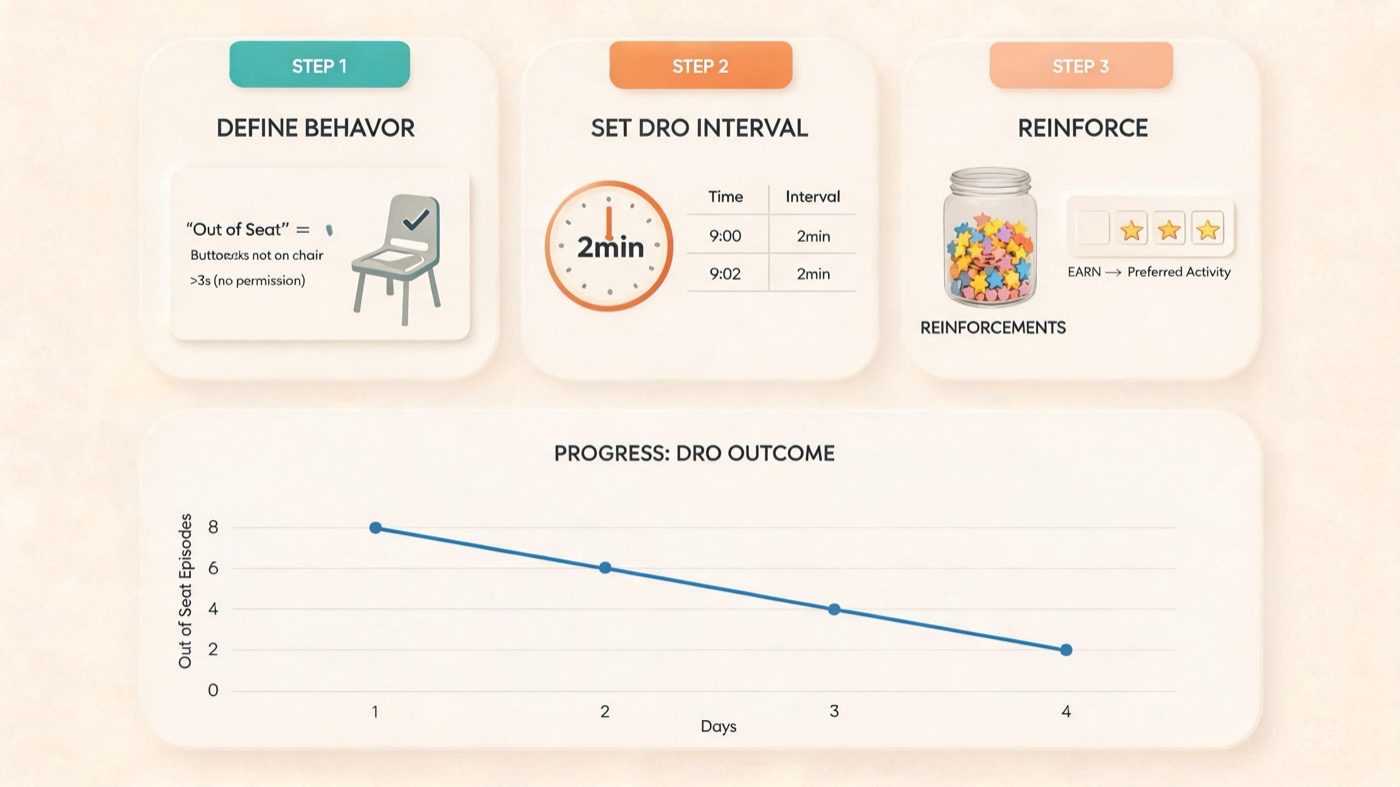
Step 1: Define the Target Behavior
Write an operational definition that is measurable and observable (e.g., ‘out of seat’ means buttocks not in contact with chair for more than 3 seconds without permission).
Step 2: Determine the DRO Interval
Use baseline data to set the initial interval. A common approach is to set the interval slightly shorter than the average inter-response time (IRT) to ensure the learner can succeed.
Step 3: Select and Deliver Reinforcers
Choose reinforcers that are highly preferred based on a preference assessment. Deliver the reinforcer immediately at the end of the interval if the target behavior did not occur. Use a statement like ‘Great job keeping your hands down!’ to pair praise with the tangible.
Step 4: Collect Data and Adjust Interval
Track occurrences of the target behavior using frequency or interval recording. As the behavior decreases, gradually increase the DRO interval to thin the schedule of reinforcement.
Exam Relevance: DRO Questions on the BCBA® Exam
The BCBA exam frequently tests DRO with questions on procedure design, data collection, and troubleshooting. Understanding function-based DRO is essential for choosing the right intervention.
Common Exam Traps and How to Avoid Them
- Confusing DRO with extinction: Extinction involves withholding all reinforcement for the target behavior; DRO delivers reinforcement for absence. DRO often includes extinction, but not always.
- Forgetting to reinforce the absence: A common mistake is to only reset the timer and not provide reinforcement after successful intervals. Reinforcement must be delivered consistently.
- Using too short or too long an interval: Too short may be impractical; too long may reduce reinforcement density. Base interval on baseline IRT.
- Not considering function: DRO works best when the reinforcer used is matched to the function of the target behavior (e.g., attention for attention-maintained behavior).
BCBA®-Style Practice Prompt
Prompt: A 7-year-old student with autism engages in tantrums (crying, flopping) to escape math worksheets. Baseline data show tantrums occur once every 4 minutes on average. Design a DRO procedure and explain how you would collect data.
Answer Guide: Define tantrum operationally. Set initial DRO interval at 3 minutes. Reinforcer: 1-minute break (escape). Deliver break immediately if no tantrum occurs during interval. Use partial interval recording to track tantrums. If successful, increase interval gradually.
DRO Implementation Checklist
Use this quick reference when studying or designing interventions:
- Define target behavior operationally.
- Collect baseline data to determine average IRT.
- Select a reinforcer matched to function.
- Set initial interval slightly shorter than baseline IRT.
- Deliver reinforcer immediately after each successful interval.
- Reset timer if target behavior occurs; do not reinforce.
- Monitor progress and increase interval as behavior decreases.
- Consider combining DRO with DRA or DRI for faster effects.
For a comprehensive review of differential reinforcement, visit our Differential Reinforcement ABA guide. Also, see the BACB’s official website for ethical guidelines on using reinforcement.
Final Summary
DRO is a versatile, evidence-based procedure to reduce challenging behaviors by reinforcing their absence. Practitioners must use function-based reinforcers, appropriate intervals, and systematic data collection to ensure success. For BCBA candidates, mastering DRO involves understanding its distinction from other differential reinforcement procedures and avoiding common exam traps. Use the checklist above and practice with real-world DRO ABA examples to build fluency.
Next step for BCBA exam prep
Turn this topic into exam-day practice
Use this topic as a focused review, then test it in exam-style conditions with a free mock before deciding whether five full-length mocks are the right next step.
Start the Free BCBA Mock Exam
Continue with Five Full-Length Mocks — $99
Review the included materials and access details before ordering. No pass guarantee is implied.



