
What Does ‘Operant’ Mean in ABA?
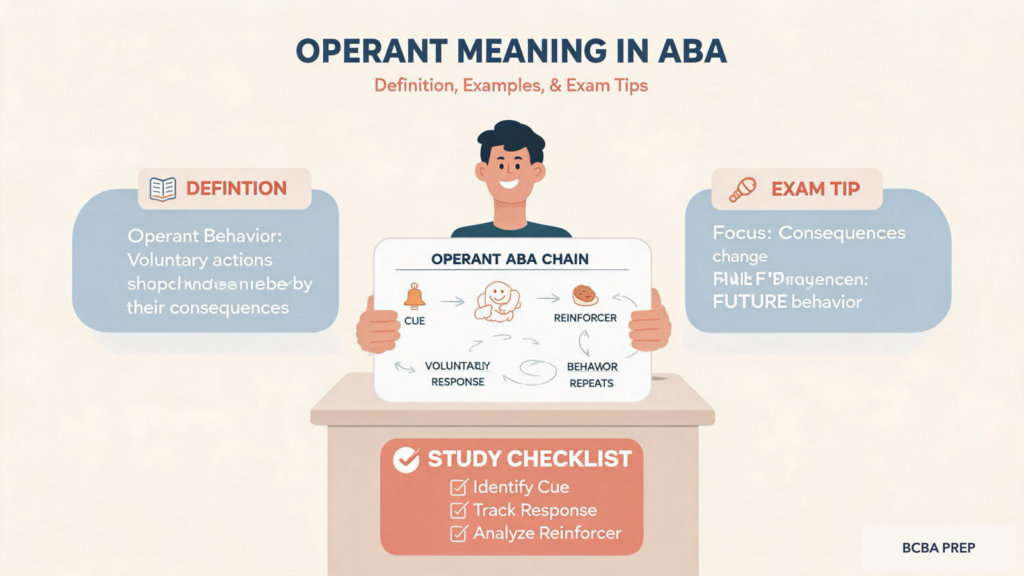
In Applied Behavior Analysis (ABA), the operant meaning refers to behavior that is controlled by its consequences. Unlike reflexes or elicited responses, operant behavior is emitted voluntarily and shaped by what happens after it occurs. The environment delivers reinforcement or punishment, which increases or decreases the likelihood of the behavior happening again.
Table of Contents
- What Does ‘Operant’ Mean in ABA?
- Two Real-World Operant Examples with ABC Analysis
- Why Understanding Operant Meaning Matters for the BCBA Exam
- Additional Real-World Operant Example
- Quick Checklist: Is the Behavior an Operant?
- Conclusion and Final Summary
- References
Operant behavior is best understood through the three-term contingency (ABC): Antecedent, Behavior, Consequence. The antecedent sets the occasion, the behavior is the action, and the consequence determines future strength. B.F. Skinner first described operant conditioning as the foundation of ABA.
Operant vs. Respondent Behavior
A common source of confusion on the BCBA exam is distinguishing operant from respondent behavior. Operant behavior is emitted and shaped by consequences. Respondent behavior is elicited by antecedent stimuli and is reflexive (e.g., salivating when food is presented, eye blink). For example, a child crying because a loud noise startles them is respondent; a child crying to get a parent’s attention is operant.
Operants are defined by their function in the environment. If a behavior is sensitive to reinforcement or punishment, it is operant. This distinction is critical for designing effective interventions.
For more foundational knowledge, see our guide on respondent vs. operant behavior.
Two Real-World Operant Examples with ABC Analysis
Understanding operant behavior is easier when you see it in action. Here are two practical ABC examples that frequently appear on the BCBA exam.
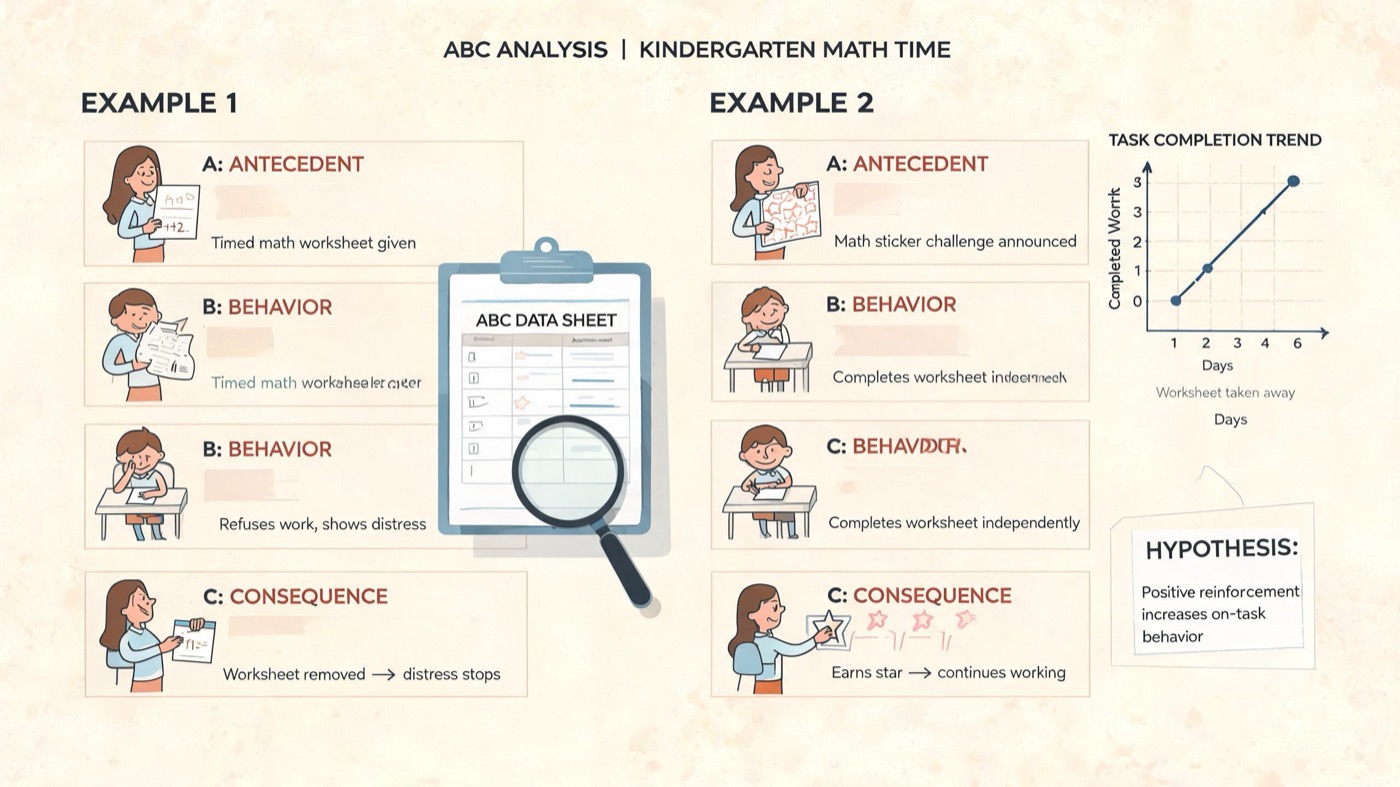
Example 1: Tantrum Behavior in a Classroom
Setting: A kindergarten classroom during math time.
- Antecedent: Teacher gives a worksheet to a student.
- Behavior: Student throws the worksheet, cries, and bangs the desk.
- Consequence: Teacher removes the worksheet and tells the student to take a break.
The function of this operant is escape from demand. The consequence (removing the demand) reinforces the tantrum behavior, making the student more likely to tantrum again when given work. This is a classic example of negative reinforcement.
Example 2: Requesting a Snack Using a Picture Card
Setting: Home kitchen, a toddler who uses PECS (Picture Exchange Communication System).
- Antecedent: Child sees a bowl of crackers on the counter.
- Behavior: Child picks up a picture of crackers and hands it to the parent.
- Consequence: Parent gives the child a cracker.
The function is access to tangible. The consequence of receiving the snack reinforces the picture-exchange behavior. Over time, the behavior is shaped toward more precise communication. This operant is socially significant and increases independence.
These examples show how the same behavior (crying) can be operant or respondent depending on its controlling consequences. The ABC analysis is a core skill for the BCBA exam.
Why Understanding Operant Meaning Matters for the BCBA Exam
The BCBA exam frequently tests your ability to identify operant behavior in vignettes, match consequences to functions, and distinguish operant from respondent. Mastering the operant meaning is essential for scoring well.
Common Exam Traps
Many test-takers fall for these pitfalls:
- Confusing operant with respondent: A vignette describing reflexive salivation or eye blink is respondent, not operant. If the behavior is elicited automatically by a stimulus, it cannot be operant.
- Identifying the wrong function: An identical behavior (e.g., hitting) can have different functions across clients. Always look at the consequence that follows.
- Overlooking the three-term contingency: Some questions present only the behavior and consequence; you must infer the antecedent from context.
- Misreading extinction: When reinforcement stops, operant behavior decreases (extinction). This is not respondent extinction.
How to Study Operants Effectively
Use these strategies to solidify your understanding:
- Practice ABC charts daily with real scenarios from your supervision hours.
- Use flashcards for key terms: operant, respondent, three-term contingency, automatic vs. socially mediated reinforcement.
- Take mock questions that require function identification. Our free mock exam practice questions are a great start.
- Describe examples aloud to a study partner; teaching reinforces your own understanding.
For a deeper dive into consequence-based learning, see how consequence affects behavior in ABA.
Additional Real-World Operant Example
Here is a third example to reinforce the concept:
Example 3: Turning Off an Alarm Clock
Setting: A bedroom in the morning.
- Antecedent: Alarm clock rings loudly.
- Behavior: Person presses the snooze button.
- Consequence: The loud noise stops.
This operant is maintained by negative reinforcement (removal of aversive sound). The behavior is emitted voluntarily and is strengthened by the consequence. This simple example shows operant behavior in daily life.
Quick Checklist: Is the Behavior an Operant?
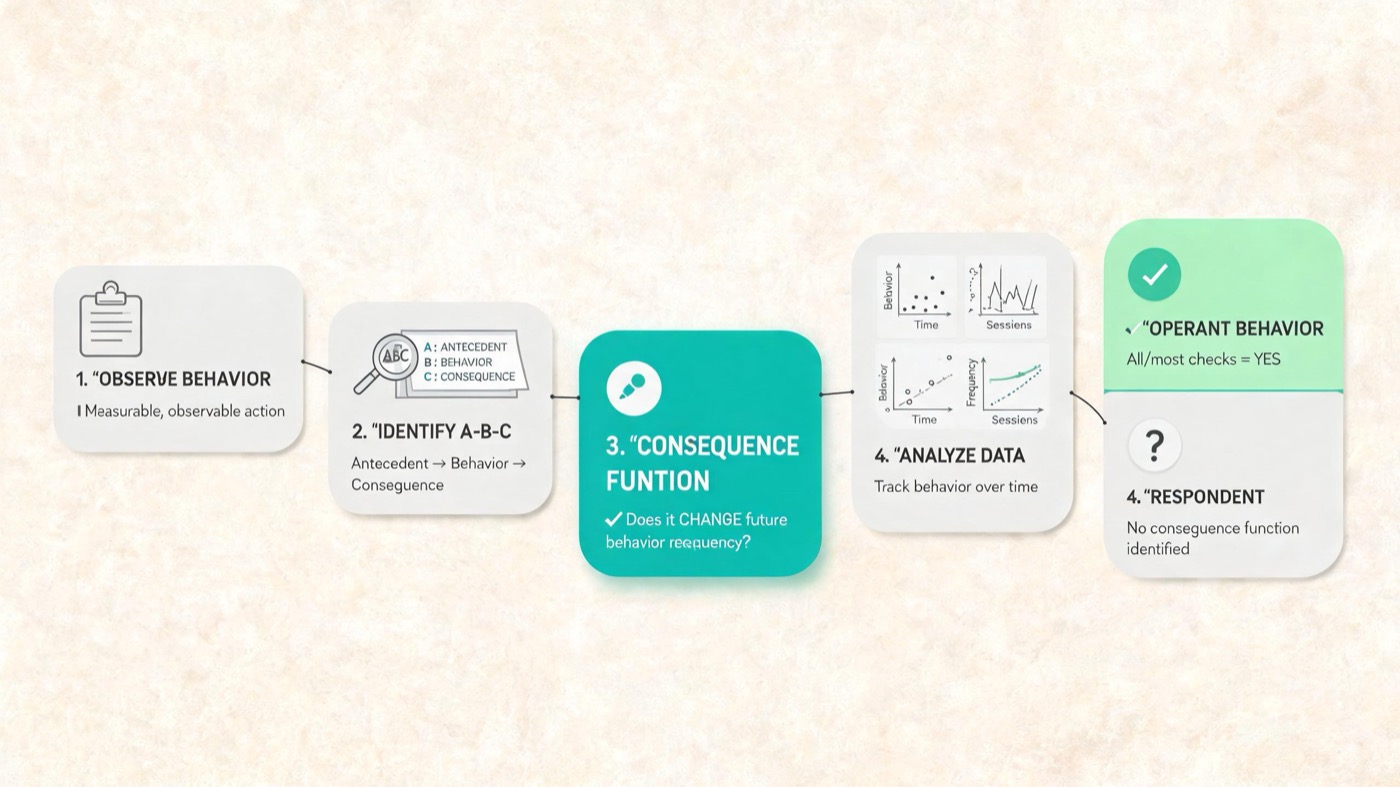
Use this checklist to quickly evaluate any behavior on the exam:
- Is the behavior emitted voluntarily? (Not a reflex or involuntary response)
- Does a consequence follow the behavior? (Reinforcement or punishment)
- Is the behavior sensitive to changes in consequences? (Frequency increases/decreases)
- Can you identify a clear function? (Escape, attention, tangible, automatic)
- Is there a three-term contingency? (Antecedent-Behavior-Consequence)
If you answered yes to all or most, the behavior is operant. If you cannot identify a consequence function, it may be respondent.
Conclusion and Final Summary
The operant meaning in ABA is behavior that is influenced by its consequences. It is the bedrock of behavior change programs. On the BCBA exam, you will be expected to identify operant vs. respondent behavior, analyze ABC contingencies, and select appropriate interventions.
Remember these key points:
- Operant behavior is emitted and shaped by consequences.
- Use the three-term contingency (ABC) for analysis.
- Watch for exam traps: confusing operant with respondent, misidentifying function, and ignoring automatic reinforcement.
- Practice with real-world examples to build fluency.
For additional preparation, explore our BCBA exam prep guide and check out the BACB’s official resources for the Task List. With consistent practice, you will master operant concepts and ace this section of the exam.
References
Complete BCBA Exam Prep
Turn this topic into exam-day practice
Practice concepts in context with five full-length 6th Edition mock exams, two bonus practice exams, a 6th Edition study guide, and key-term flashcards—all in one $120 USD package.
Get the $120 All-in-One Prep Pack
Review everything included on the product page before ordering. No pass guarantee is implied.



