
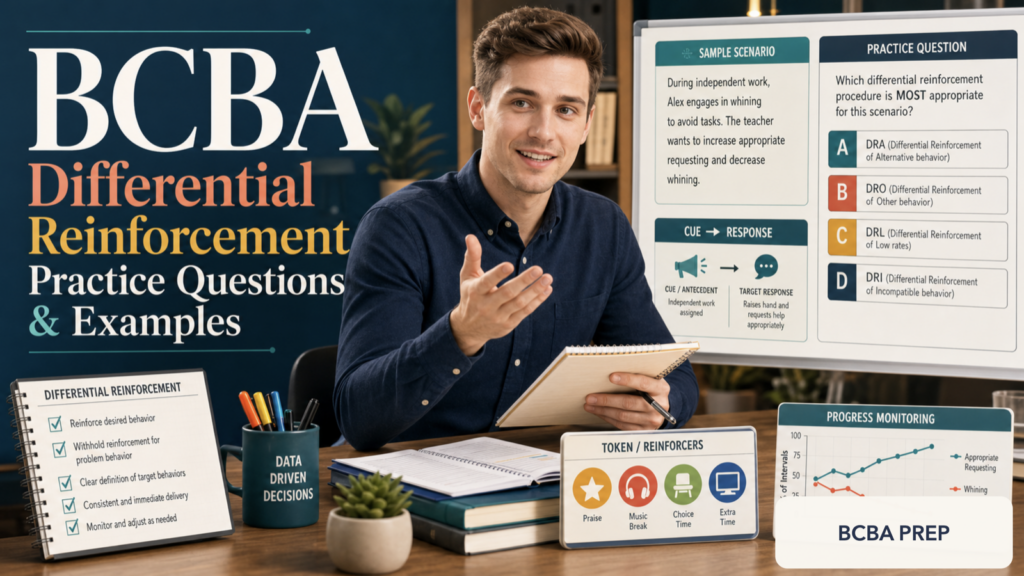
Video Study: Differential Reinforcement
Watch: DRA vs DRI vs DRO vs DRL: 20 BCBA Practice Questions (6th Edition)
Use this lesson as a visual study companion, then return to the definitions and examples below to apply the same concept to BCBA® exam questions.
Prefer a second pass? Open this lesson on YouTube.
What Are Differential Reinforcement Practice Questions?
Differential reinforcement is a key concept on the BCBA exam. These practice questions test your ability to identify and apply DRA, DRO, DRI, DRL, and DRD in real-world scenarios.
Table of Contents
- What Are Differential Reinforcement Practice Questions?
- 5 BCBA Differential Reinforcement Practice Questions
- Common Traps to Avoid
- Exam Preparation Checklist
- Ready for More?
- Frequently Asked Questions
- References
Each question includes a scenario, four answer choices, a detailed rationale, and exam traps to watch for.

5 BCBA Differential Reinforcement Practice Questions
Test your knowledge with these exam-style questions. Answers and explanations follow each question.
Question 1:
Scenario: A child frequently whines to gain access to a tablet. The behavior analyst instructs parents to provide the tablet only when the child asks politely (without whining) and to ignore whining.
Prompt: Which differential reinforcement procedure is being implemented?
- A. DRA (Differential Reinforcement of Alternative Behavior)
- B. DRO (Differential Reinforcement of Other Behavior)
- C. DRI (Differential Reinforcement of Incompatible Behavior)
- D. DRL (Differential Reinforcement of Low Rates)
Correct Answer: A
Why This Answer Is Correct: DRA reinforces a specific alternative behavior (polite request) while withholding reinforcement for the problem behavior (whining).
Why the Other Options Are Wrong:
- DRO reinforces any behavior other than the target, not a specific alternative.
- DRI reinforces a physically incompatible behavior, but polite request is not physically incompatible with whining.
- DRL reinforces lower rates, but here the target is to eliminate whining entirely, not just reduce frequency.
Exam Trap: Confusing DRA with DRI. Remember: DRA reinforces any alternative response; DRI requires the alternative to be physically incompatible.
Question 2:
Scenario: A student with autism engages in hand-flapping during independent work. The teacher sets a timer for 5 minutes and delivers a reinforcer if no hand-flapping occurs during that interval.
Prompt: Which differential reinforcement procedure is being used?
- A. DRA
- B. DRO
- C. DRI
- D. DRD
Correct Answer: B
Why This Answer Is Correct: DRO delivers reinforcement if the problem behavior does not occur during a specified time interval. The absence of hand-flapping is reinforced.
Why the Other Options Are Wrong:
- DRA would require an alternative specific behavior.
- DRI would require a physically incompatible behavior.
- DRD (differential reinforcement of diminishing rates) is not a standard term; DRL is used for low rates, but here the goal is zero occurrence.
Exam Trap: DRO is often confused with DRL. DRO reinforces omission of behavior for a period; DRL reinforces lower rates.
Question 3:
Scenario: A client engages in excessive hand washing (40 times per day). The goal is to reduce hand washing to 5 times per day. The therapist provides a reinforcer only if hand washing occurs 5 or fewer times per day.
Prompt: What differential reinforcement procedure is this?
- A. DRA
- B. DRO
- C. DRL
- D. DRD
Correct Answer: C
Why This Answer Is Correct: DRL reinforces lower rates of the behavior. Here, the reinforcer is delivered when the rate is at or below a specified limit.
Why the Other Options Are Wrong:
- DRA would target an alternative behavior.
- DRO would reinforce the absence of hand washing for a period, not a reduced rate.
- DRD is not a standard term; this is DRL.
Exam Trap: DRO vs DRL: DRO aims for zero occurrence; DRL allows reduced but still some occurrence.
Question 4:
Scenario: A child engages in mouthing objects. The behavior analyst teaches the child to play with a toy that requires both hands, making mouthing impossible during that activity. The child receives praise for using the toy appropriately.
Prompt: Which procedure is being used?
- A. DRA
- B. DRO
- C. DRI
- D. DRL
Correct Answer: C
Why This Answer Is Correct: DRI reinforces a behavior that is physically incompatible with the problem behavior. Using both hands for a toy prevents mouthing simultaneously.
Why the Other Options Are Wrong:
- DRA would reinforce a different but not necessarily incompatible behavior.
- DRO reinforces the absence of mouthing but does not specify an alternative.
- DRL would reduce mouthing frequency, not replace it with an incompatible activity.
Exam Trap: If the alternative behavior makes the problem behavior physically impossible, it’s DRI.
Question 5:
Scenario: A teenager with brain injury frequently interrupts others. The team wants to reduce interruptions but not eliminate them entirely. They set a goal of no more than 3 interruptions per 30-minute session and provide a reward if that limit is met.
Prompt: Which differential reinforcement procedure is being applied?
- A. DRA
- B. DRO
- C. DRL
- D. DRH
Correct Answer: C
Why This Answer Is Correct: DRL reinforces low rates (≤3 interruptions per session). The behavior is allowed but at a reduced level.
Why the Other Options Are Wrong:
- DRA would require a specific alternative behavior.
- DRO would reinforce the absence of interruptions for a period, aiming for zero.
- DRH reinforces high rates, which is opposite of the goal.
Exam Trap: DRH (differential reinforcement of high rates) is the opposite; watch for the goal direction.
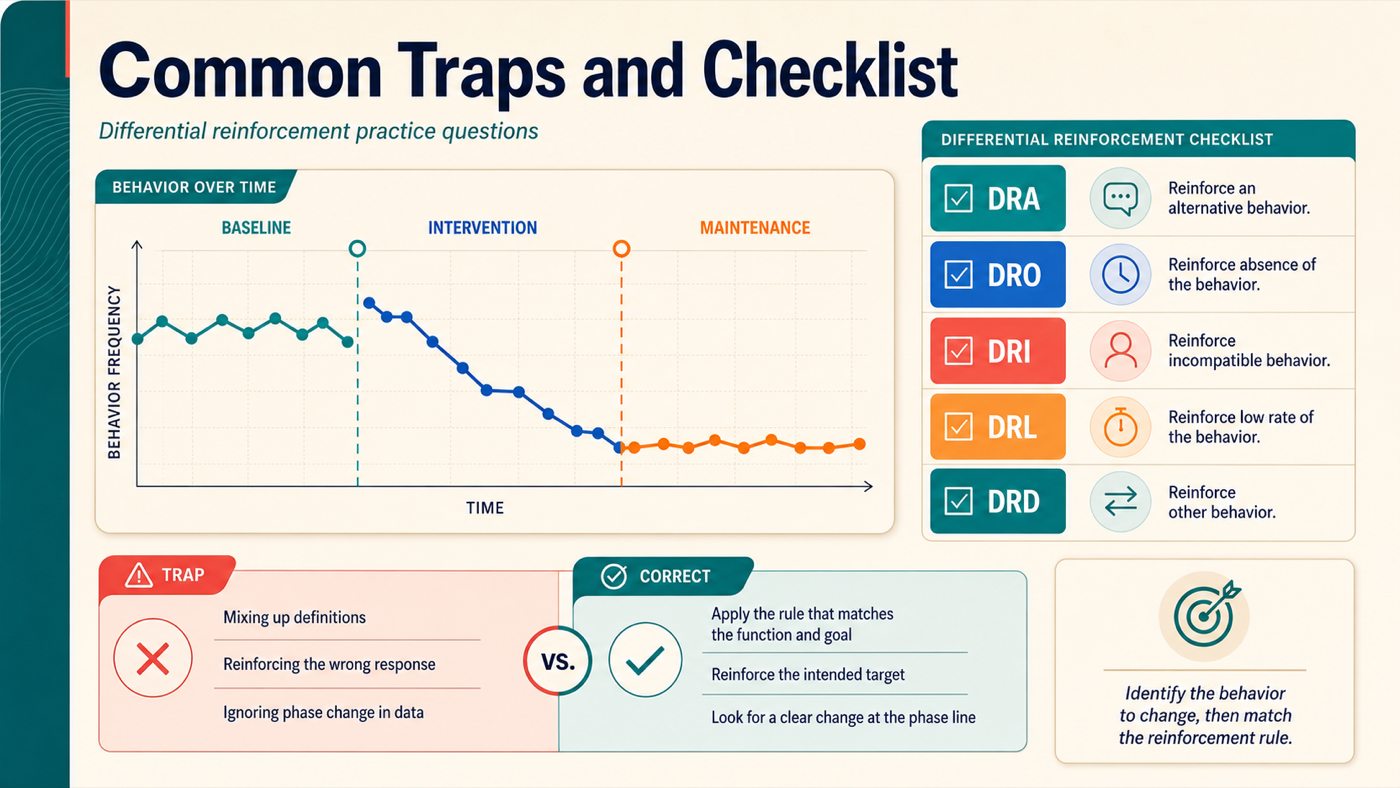
Common Traps to Avoid
These mistakes frequently appear in BCBA exam questions on differential reinforcement.
- Confusing DRI with DRA: DRI requires physical incompatibility; DRA does not.
- Using DRO when the goal is to reduce but not eliminate behavior (should be DRL).
- Selecting DRA when two behaviors are physically incompatible (actually DRI).
- Applying DRO to behaviors that occur at high rates without considering practicality.
Exam Preparation Checklist
- Define each type of differential reinforcement: DRA, DRO, DRI, DRL, DRH.
- Identify the target behavior and the desired outcome (increase, decrease, eliminate).
- Match the procedure to the behavioral goal: DRA for alternative, DRO for omission, DRI for incompatible, DRL for low rates.
- Practice with scenario-based questions to distinguish similar procedures.
- Review ethics: Obtain client consent and use least restrictive procedures.
Ready for More?
Download our free BCBA mock exam with 150+ questions to test your knowledge.
Take the Free BCBA Mock Exam
Click here to get instant access to the free BCBA mock exam and start practicing today!
Frequently Asked Questions
Q: What is the difference between DRA and DRI?
A: DRA reinforces any alternative behavior that is not the problem behavior. DRI reinforces a behavior that is physically incompatible with the problem behavior, making it impossible to perform both at once.
Q: When should I use DRO instead of DRL?
A: Use DRO when the goal is to completely eliminate a behavior (reinforce its absence during a time interval). Use DRL when the behavior is acceptable but needs to occur at a lower rate.
Q: Can a behavior be maintained with DRL?
A: Yes, DRL can be used to maintain a behavior at a low, acceptable rate, such as a few interruptions per session or limited food intake.
References
Next step for BCBA exam prep
Turn this topic into exam-day practice
You have reviewed the key ideas. Take a full-length practice test to see what you can apply under exam conditions, then use your results to choose your next study step.
Take the Free BCBA Mock Exam
Continue with Five Full-Length Mocks — $99
Start with the free mock if you are still measuring your readiness. No pass guarantee is implied.



