
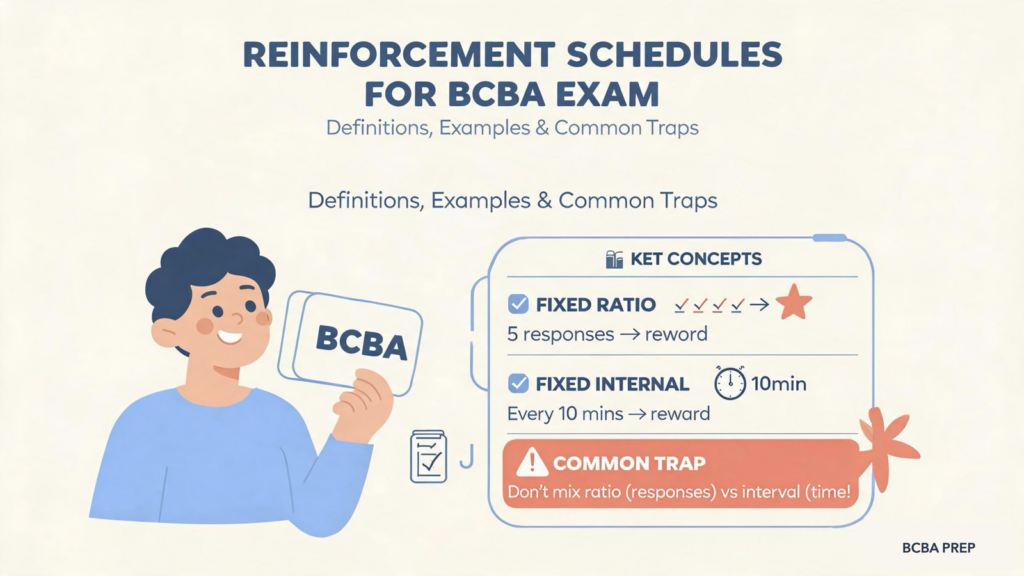
What Is a Reinforcement Schedule?
A reinforcement schedule is a rule that specifies which occurrences of a behavior will be followed by a reinforcer. In ABA, practitioners use schedules to strengthen desired behaviors and maintain them over time. Understanding different schedules is essential because they produce distinct patterns of responding, which directly affect how quickly a behavior is learned and how resistant it is to extinction.
Practice this concept
Table of Contents
- What Is a Reinforcement Schedule?
- Four Basic Reinforcement Schedules (FR, VR, FI, VI)
- BCBA Exam Tips: How to Remember & Differentiate
- Worked ABA Examples with ABC Analysis
- Reinforcement Schedule Quick Checklist
- Summary
- References
Continuous vs. Intermittent Reinforcement
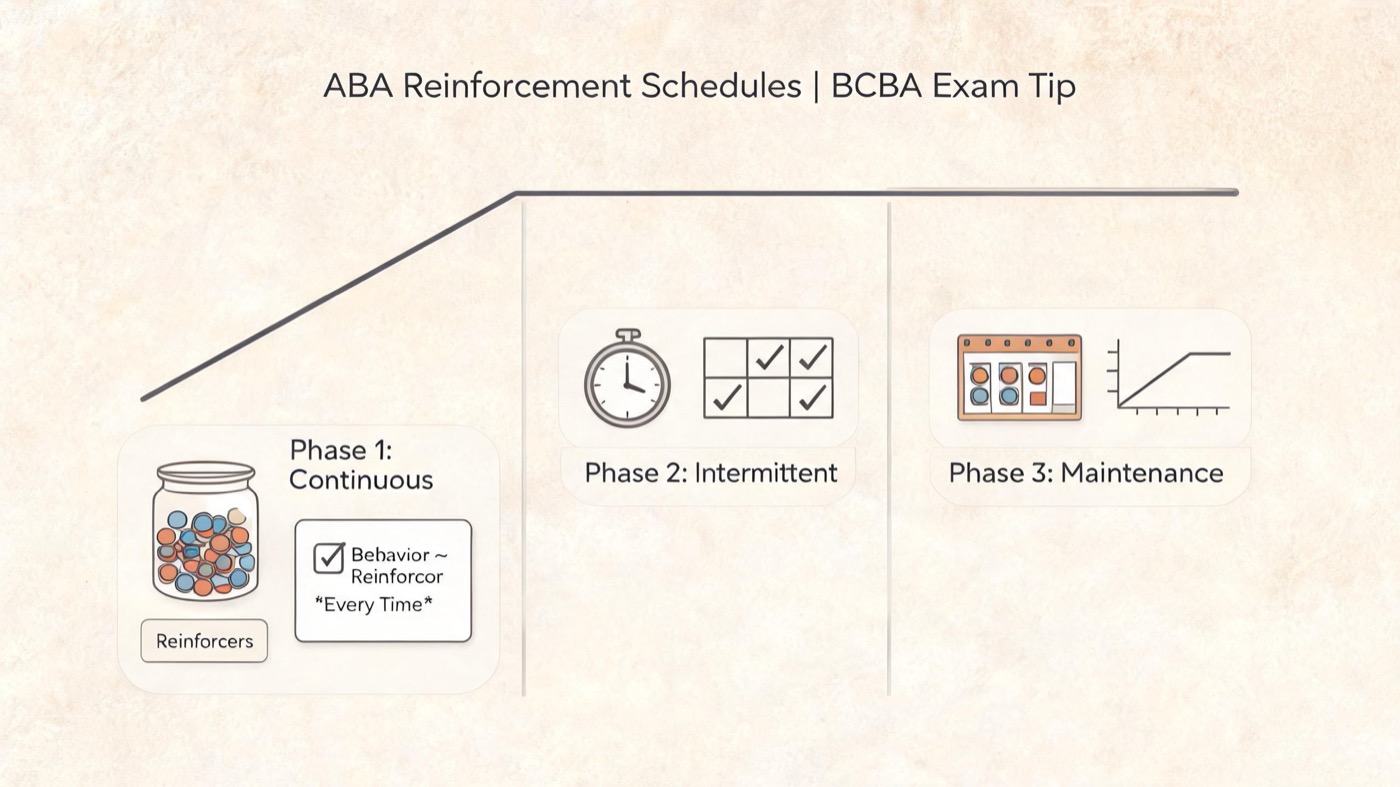
With continuous reinforcement (CRF), every correct response is reinforced. This schedule is ideal for initial skill acquisition because it provides immediate feedback. However, behaviors on CRF are more prone to extinction when reinforcement stops. In contrast, intermittent reinforcement delivers reinforcers only after some responses, not every time. Intermittent schedules create behaviors that are more durable and resistant to extinction. Most real-world ABA programs use intermittent schedules once a skill is established.
Intermittent schedules fall into two main categories: ratio schedules (based on number of responses) and interval schedules (based on time). Each category has a fixed and a variable version, giving us the four basic schedules: FR, VR, FI, and VI.
Four Basic Reinforcement Schedules (FR, VR, FI, VI)
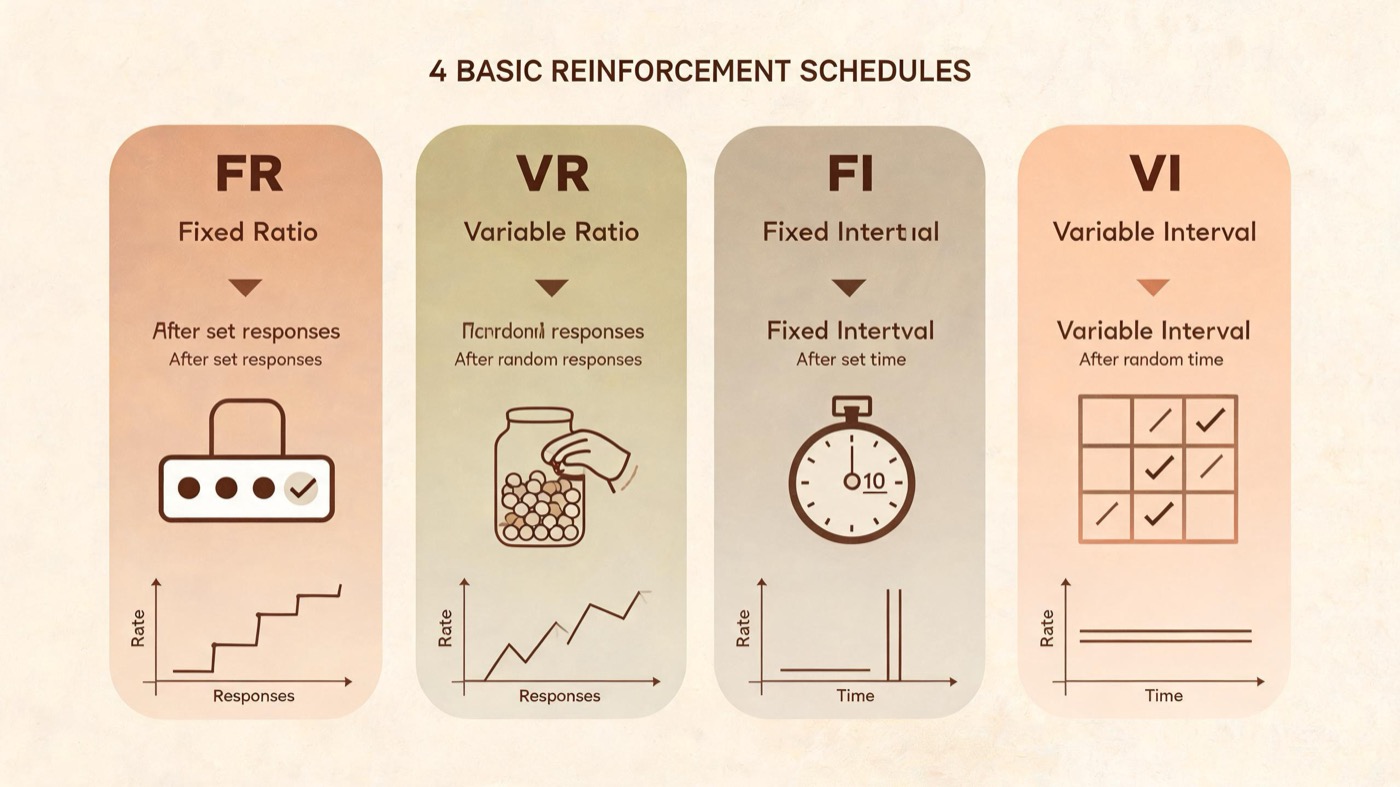
Fixed Ratio (FR)
In a fixed ratio schedule, reinforcement is delivered after a set number of responses. For example, an FR 5 schedule means every fifth response produces a reinforcer. The response pattern shows a high rate of responding with a characteristic post-reinforcement pause (a brief break after receiving the reinforcer). This pause is shorter when the ratio requirement is small. In ABC terms: Antecedent = teacher says ‘complete 5 problems’; Behavior = student completes math problems; Consequence = teacher gives a sticker. The hypothesized function is tangible/task completion.
Variable Ratio (VR)
Variable ratio schedules deliver reinforcement after an average number of responses, but the exact number changes each time. A VR 10 schedule means the number of responses required varies (e.g., 5, 15, 10) but averages 10. This schedule produces a high, steady rate of responding with no post-reinforcement pause. It is often compared to gambling because the unpredictability keeps the behavior strong. Example: A child raises her hand to answer questions; the teacher calls on her after an average of three hand-raises. Antecedent: teacher asks a question; Behavior: child raises hand; Consequence: teacher calls on her (praise). Function: attention.
Fixed Interval (FI)
With a fixed interval schedule, the first response after a fixed amount of time is reinforced. For instance, an FI 5-min schedule means that after 5 minutes, the first correct response earns a reinforcer. The typical response pattern is a scalloped curve: responding is low immediately after reinforcement, then gradually increases as the end of the interval approaches. This scallop is a key feature for identifying FI on a graph. Example: In a classroom, a student receives a token for the first on-task behavior after every 5-minute timer. Antecedent: timer signals interval ending; Behavior: student is on-task; Consequence: token delivered. Function: praise/tokens.
Variable Interval (VI)
A variable interval schedule provides reinforcement for the first response after an average time period that varies unpredictably. A VI 3-min schedule means the time intervals average 3 minutes but may be 1 minute, 5 minutes, etc. This schedule produces a low to moderate steady rate of responding without a scallop. Example: A therapist checks on a client working on a puzzle; the client receives a token for on-task behavior after an average of 3 minutes. Antecedent: therapist approaches; Behavior: client continues on-task; Consequence: token delivered. Function: praise.
BCBA Exam Tips: How to Remember & Differentiate
Mnemonics for the Four Schedules
Use these simple memory tricks: ‘R’ stands for Ratio (count responses), ‘I’ stands for Interval (time). Fixed = predictable, Variable = unpredictable. To recall response patterns: FR has a pause then high rate; VR has high steady rate without pause; FI has a scallop (low then high); VI has a low steady rate.
Common Exam Traps
The BCBA exam often tests your ability to identify schedules from graphs or descriptions. Watch out for these traps:
- Trap 1: Confusing FR and FI patterns. FR shows a post-reinforcement pause followed by a high, steady rate. FI shows a scallop where responding gradually increases after reinforcement. On a cumulative graph, FR looks like a ‘break-and-run’ pattern (flat pause then steep slope), while FI looks like a scalloped curve (gradually increasing slope).
- Trap 2: Misreading graph labels. The x-axis is always time, and the y-axis is cumulative responses. The slope of the line indicates response rate. A steep slope means high rate; a flat line means no responding.
- Trap 3: Assuming all variable schedules produce high rates. VR does produce high rates, but VI produces a low to moderate steady rate because the controlling variable is time, not response count.
- Trap 4: Ignoring the post-reinforcement pause in FR. Many students forget that FR schedules have a pause after reinforcement, especially with larger ratio requirements. This pause is absent in VR.
Understanding these nuances helps you answer scenario-based questions accurately. For more practice with schedule identification, check out our BCBA mock exam and the compound schedules guide.
Worked ABA Examples with ABC Analysis
Applying ABC analysis to real scenarios solidifies your understanding. Below are three examples covering different schedules.
Example 1: FR 5 in a Classroom
Setting: A student with math tasks. Antecedent: Teacher says ‘Complete five problems.’ Behavior: Student writes answers for five problems. Consequence: Teacher gives a sticker. Schedule: FR 5 (every fifth problem is reinforced). Hypothesized function: Tangible (sticker) and task completion. The student typically takes a short break after receiving the sticker, then resumes working.
Example 2: VI 3 min in a Clinic
Setting: Client engaged in a puzzle. Antecedent: Therapist sets a timer for an average of 3 minutes (range 1–5 min). Behavior: Client remains on-task (e.g., placing puzzle pieces). Consequence: Therapist delivers a token and praise. Schedule: VI 3 min. Hypothesized function: Praise/tokens (social positive reinforcement). The client’s on-task behavior occurs at a steady, moderate rate.
Example 3: FI 10 min in a Group Home
Setting: Adult with chores. Antecedent: Staff says ‘Your room must be tidy; I’ll check in 10 minutes.’ Behavior: Resident cleans the room, especially in the last minute before check. Consequence: Staff provides a preferred activity token for the first completed cleaning behavior after 10 minutes. Schedule: FI 10 min. Hypothesized function: Access to preferred activity (tangible). The scalloped pattern is clear: little cleaning right after token delivery, then gradual increase.
Reinforcement Schedule Quick Checklist
Before the exam, run through this checklist to reinforce key points:
- Identify whether the schedule is ratio (responses) or interval (time).
- Determine if the requirement is fixed (predictable) or variable (unpredictable).
- Recall the characteristic graph pattern for each schedule: FR = break-and-run, VR = high steady, FI = scallop, VI = low steady.
- Check for post-reinforcement pause (present in FR and sometimes FI, but not in VR or VI).
- Apply ABC analysis: what antecedent signals the schedule, what behavior is reinforced, and what consequence follows.
- Practice with mock questions to differentiate schedules from descriptions and graphs. Use our practice exams for additional scenarios.
Summary
Mastering the four basic reinforcement schedules is a core requirement for the BCBA exam. Remember the key distinctions: FR and VR are based on response count, while FI and VI are based on time. Fixed schedules produce predictable pauses (FR post-reinforcement pause, FI scallop), whereas variable schedules produce steady rates. Use the ABC framework to analyze real-life examples, and watch out for common traps like confusing FR and FI patterns. Consistent practice with graph interpretation and scenario questions will build your confidence. For a deeper dive into related topics, review our guide on differential reinforcement. Good luck!
References
Complete BCBA Exam Prep
Turn this topic into exam-day practice
Practice concepts in context with five full-length 6th Edition mock exams, two bonus practice exams, a 6th Edition study guide, and key-term flashcards—all in one $120 USD package.
Get the $120 All-in-One Prep Pack
Review everything included on the product page before ordering. No pass guarantee is implied.



