
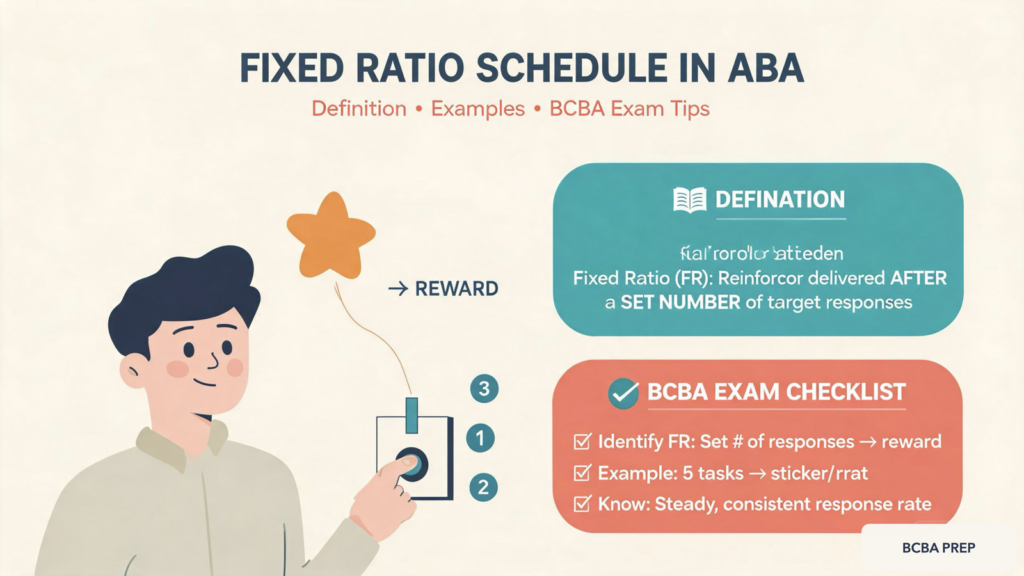
What Is a Fixed Ratio Schedule?
A fixed ratio schedule of reinforcement delivers a reinforcer after a specific, unchanging number of responses. This schedule is fundamental in Applied Behavior Analysis (ABA) and commonly tested on the BCBA exam. Understanding its characteristics helps behavior analysts design effective intervention plans.
Table of Contents
- What Is a Fixed Ratio Schedule?
- Real-World ABA Examples of Fixed Ratio Schedules
- Fixed Ratio Schedule and the BCBA Exam: What to Know
- Quick Checklist: Fixed Ratio Schedule Essentials
- Summary
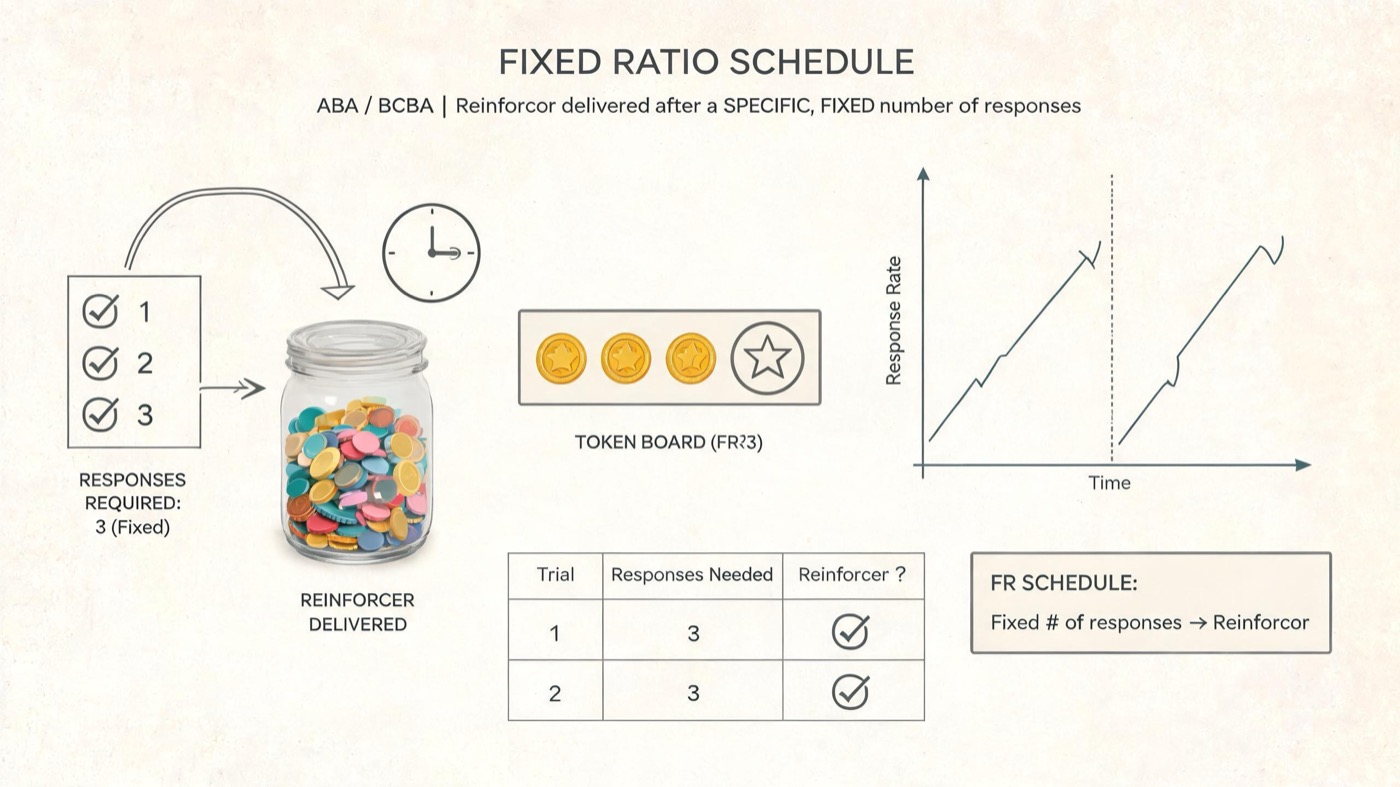
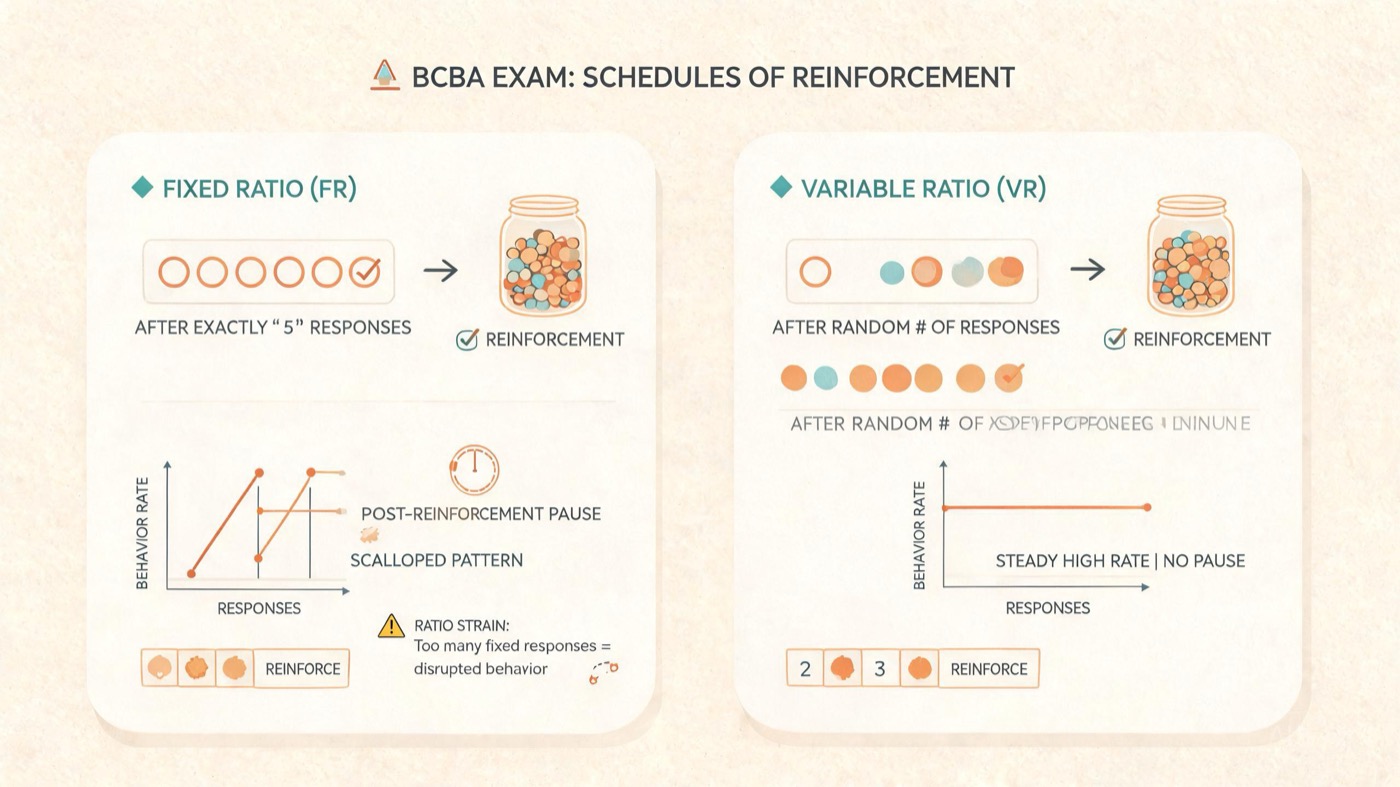
In a fixed ratio schedule, the requirement (the ‘ratio’) stays constant. For example, FR5 means reinforcement occurs after every 5th response. This schedule produces a high rate of responding, but it is often followed by a brief pause after reinforcement, known as the post-reinforcement pause. Another important concept is ratio strain, which occurs when the response requirement is increased too quickly, causing the behavior to decrease or stop.
Formal Definition
The formal definition from the BACB Task List states: ‘A schedule of reinforcement in which reinforcement is delivered after a fixed number of responses.’ Behavior analysts must be able to identify this schedule in various clinical and educational settings.
Key Characteristics
- Fixed number of responses: The same number of responses is required each time.
- High response rate: Learners typically respond quickly to earn reinforcement.
- Post-reinforcement pause: A brief break in responding immediately after reinforcement.
- Ratio strain risk: Increasing the ratio too abruptly can cause behavior to weaken.
- Predictable pattern: Responding is steady with a scalloped cumulative record.
Real-World ABA Examples of Fixed Ratio Schedules
Applying fixed ratio schedules in real settings helps clarify how they function. Below are two detailed ABC (Antecedent-Behavior-Consequence) examples, each with a hypothesized function.
Example 1: Token Economy in a Classroom
Setting: A classroom for students with autism. Target behavior: Raising hand before speaking. Schedule: FR5 – a token is given after every fifth hand-raise.
- Antecedent: Teacher says ‘Remember, raise your hand to speak.’
- Behavior: Student raises hand five separate times.
- Consequence: Student receives a token (tangible reinforcer).
- Hypothesized function: Tangible/attention – the token can be exchanged for a preferred item, and the teacher praises the behavior.
Over time, the student’s hand-raising becomes frequent and stable, with a short pause after receiving each token.
Example 2: Data Entry Task in Vocational Training
Setting: A vocational program for adults with developmental disabilities. Target behavior: Completing data entry forms accurately. Schedule: FR10 – a 5-minute break after every 10 forms completed.
- Antecedent: Supervisor says ‘Complete 10 forms, then take a break.’
- Behavior: Individual enters data on 10 forms.
- Consequence: Individual receives a 5-minute break (negative reinforcement – escape from task).
- Hypothesized function: Escape – the break removes the aversive task.
This schedule maintains a high rate of accurate data entry, but the individual often pauses briefly after each break begins.
Example 3: Fitness Training
Setting: An ABA clinic incorporating exercise goals. Target behavior: Completing sit-ups. Schedule: FR20 – a sticker is earned after every 20 sit-ups; after 3 stickers, a reward is given.
- Antecedent: Trainer says ‘Do 20 sit-ups.’
- Behavior: Client performs 20 sit-ups.
- Consequence: Client receives a sticker on a chart.
- Hypothesized function: Tangible – stickers accumulate toward a preferred activity.
Using a fixed ratio schedule here builds endurance and provides clear, immediate feedback.
Fixed Ratio Schedule and the BCBA Exam: What to Know
The BCBA exam frequently tests your ability to distinguish among schedules of reinforcement. Fixed ratio schedules appear in questions about post-reinforcement pause, ratio strain, and comparing FR to variable ratio (VR) schedules.
Common Exam Traps
- Confusing FR with VR: FR has a predictable pause after reinforcement; VR has almost no pause.
- Overlooking post-reinforcement pause: Many test-takers forget that FR schedules produce a brief pause, while VR schedules produce steady responding.
- Misidentifying ratio strain: Ratio strain is not extinction; it is a breakdown in responding due to an excessively high ratio requirement.
- Ignoring the cumulative record: The visual pattern for FR shows a fixed number of responses per reinforcement, often with a step-like shape.
Comparison With Variable Ratio Schedules
Both FR and VR schedules are ratio schedules, but they have key differences that the exam loves to test.
- Response pattern: FR – high rate with post-reinforcement pause; VR – high and steady rate with minimal pause.
- Resistance to extinction: FR – moderate resistance; VR – high resistance because reinforcement is unpredictable.
- Ratio strain: FR – more likely if ratio is increased abruptly; VR – less likely due to variability.
- Example: FR – free coffee after 10 punches; VR – slot machine pays off after an average of 10 pulls.
Understanding these differences helps behavior analysts choose the right schedule for their clients and avoid common pitfalls.
Quick Checklist: Fixed Ratio Schedule Essentials
Use this checklist to solidify your understanding before the exam or when designing interventions.
- Define FR schedule: Reinforcement after a fixed number of responses.
- Identify post-reinforcement pause: Recognize it in data graphs and scenarios.
- Recognize ratio strain: Know the signs (decreased responding, avoidance) and how to prevent it (gradual increases).
- Compare FR with VR: Be ready to explain differences in pattern, pause, and resistance to extinction.
- Apply ABC analysis: Practice writing examples with clear antecedent, behavior, consequence, and hypothesized function.
- Understand cumulative records: FR produces a step-like pattern; VR produces a steady slope.
For additional practice, review our guide to compound schedules of reinforcement and time-based reinforcement schedules to broaden your knowledge.
Summary
The fixed ratio schedule is a core concept in ABA that involves delivering reinforcement after a set number of responses. Key features include a high response rate, a brief post-reinforcement pause, and susceptibility to ratio strain. On the BCBA exam, you may be asked to identify FR schedules in vignettes, differentiate them from VR schedules, and apply the concept to real-world scenarios. Mastering these distinctions will boost your confidence and performance.
For further study, check the BACB website for official task list details and research articles on schedule effects.
Complete BCBA Exam Prep
Turn this topic into exam-day practice
Practice concepts in context with five full-length 6th Edition mock exams, two bonus practice exams, a 6th Edition study guide, and key-term flashcards—all in one $120 USD package.
Get the $120 All-in-One Prep Pack
Review everything included on the product page before ordering. No pass guarantee is implied.



