
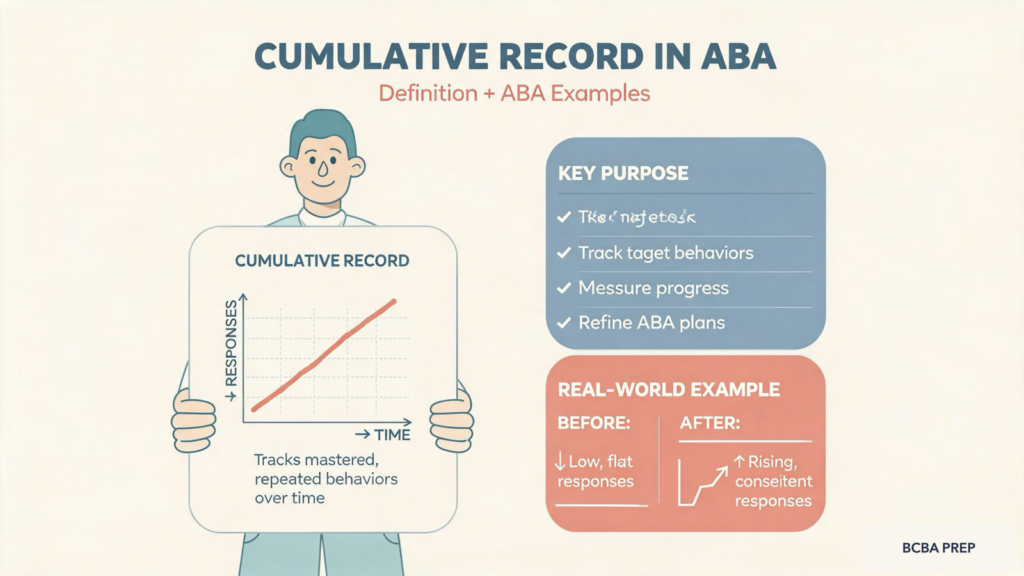
What Is a Cumulative Record?
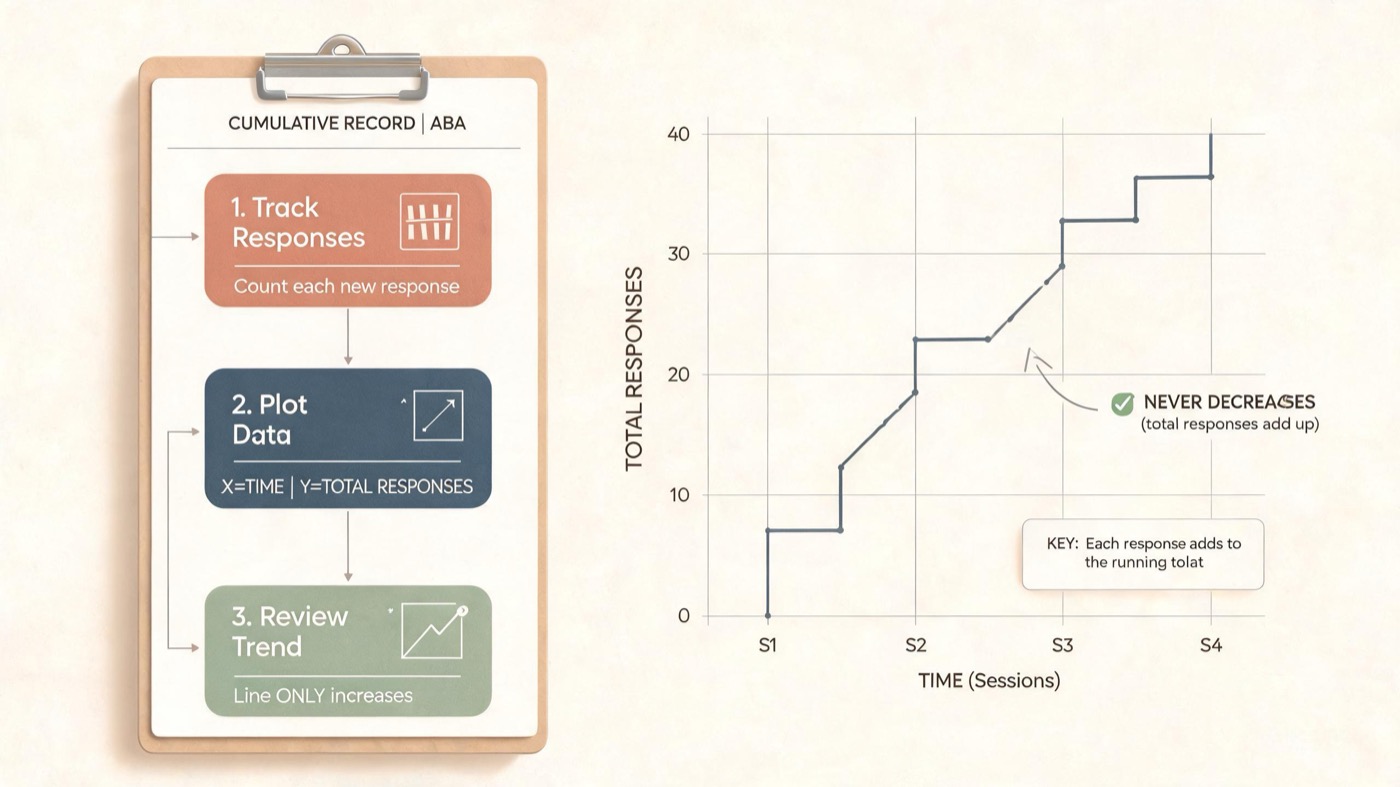
A cumulative record is a graph that shows the total number of responses plotted on the y-axis against time on the x-axis. Each new response adds to the previous total, so the line never goes down. This type of graph is commonly used in Applied Behavior Analysis (ABA) to visualize response rate and patterns continuously.
Table of Contents
- What Is a Cumulative Record?
- Cumulative Record Examples with ABC Analysis
- BCBA Exam Tips: Reading Cumulative Records under Time Pressure
- Quick Checklist for Cumulative Record Mastery
- Summary
Key Features
- Steepness indicates rate: A steep slope means a high rate of responding; a shallow slope means a lower rate. Flat segments indicate pauses or zero responses.
- Always increasing or flat: Because the record is cumulative, the line cannot decrease. A flat line does not mean extinction necessarily; it may simply reflect no opportunities to respond.
- Different from non-cumulative graphs: Non-cumulative graphs (e.g., line graphs of responses per session) show individual data points per session and can fluctuate up and down. The cumulative record emphasizes the ongoing accumulation.
Cumulative records are particularly useful for identifying response patterns such as scalloping (fixed-interval schedules), post-reinforcement pauses, and sudden changes in rate. They also allow you to compare rates across different conditions or phases.
Cumulative Record Examples with ABC Analysis
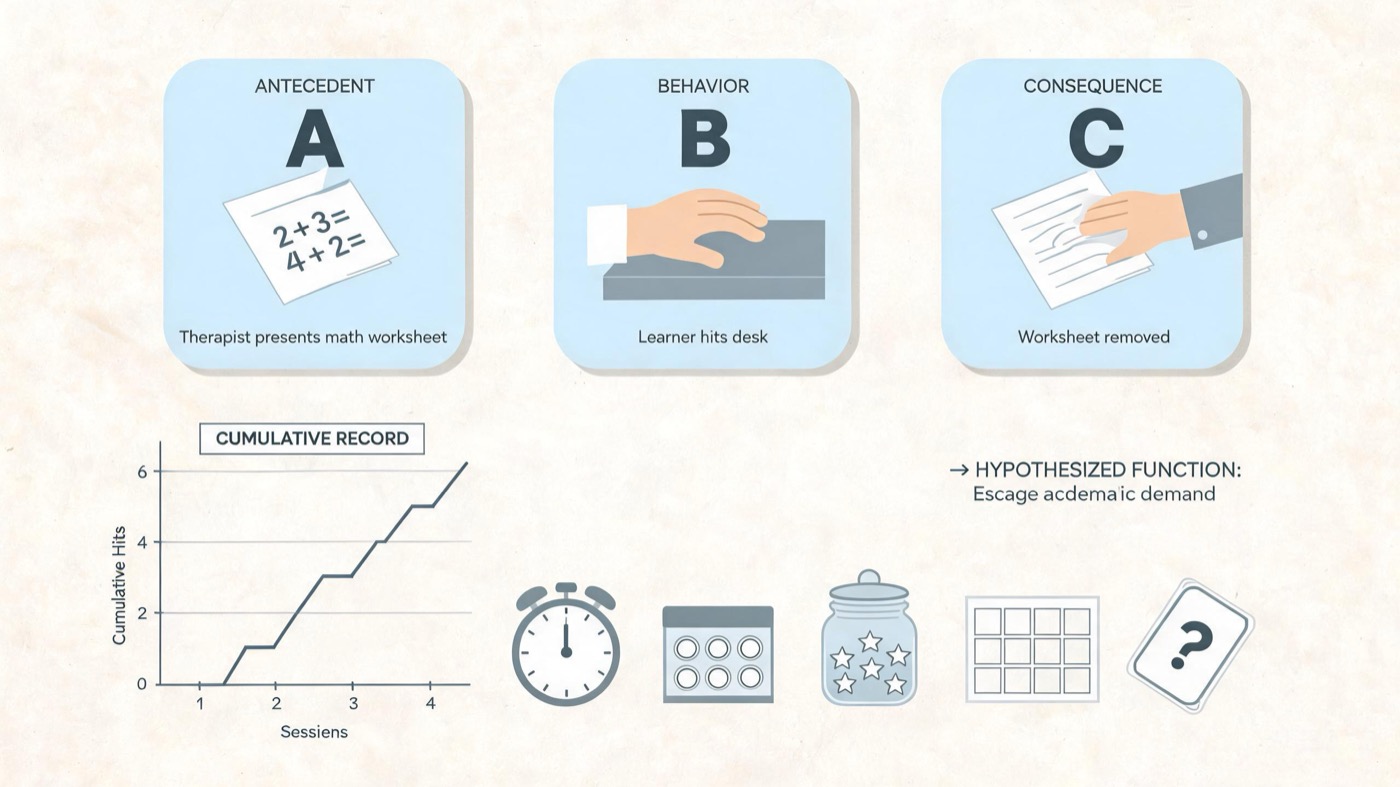
The following examples demonstrate how to interpret a cumulative record by linking the behavior to its antecedent, behavior, and consequence (ABC) and hypothesized function.
Example 1: Escape from Task Demands
Antecedent: Therapist presents a math worksheet. Behavior: Learner hits the desk. Consequence: Therapist removes the worksheet. The cumulative record shows a rapid increase in hits immediately after the worksheet is presented, then flattening when the worksheet is removed. This pattern suggests the behavior is maintained by negative reinforcement (escape).
Example 2: Attention-Maintained Protesting
Antecedent: Teacher ignores the learner for 2 minutes. Behavior: Learner whines loudly. Consequence: Teacher reprimands the learner. The cumulative record shows bursts of whining after periods of no attention, with steep slopes during those bursts. This pattern indicates the behavior is maintained by positive reinforcement (attention).
Example 3: Automatic Reinforcement (Sensory)
Antecedent: Learner is alone in a quiet room. Behavior: Hand flapping. Consequence: Sensory stimulation. The cumulative record shows a steady, moderate slope with no clear external antecedents. This pattern suggests the behavior is maintained by automatic reinforcement (sensory feedback).
Example 4: Access to Tangible Items
Antecedent: Preferred toy is placed out of reach. Behavior: Crying. Consequence: Parent gives the toy. The cumulative record shows crying episodes occurring primarily when the toy is visible but inaccessible, with steep slopes during those periods. The behavior is maintained by positive reinforcement (access to tangible).
BCBA Exam Tips: Reading Cumulative Records under Time Pressure
On the BCBA exam, you may be asked to interpret a cumulative record quickly. Here are key strategies and common traps to watch for.
Common Exam Traps
- Confusing cumulative with non-cumulative graphs: Remember that cumulative records only increase (or stay flat). A flat line does not mean zero response rate; it means zero new responses during that interval. In a non-cumulative graph, a flat line would mean constant responding per session.
- Misinterpreting a flat line: A flat segment could indicate extinction, but it could also mean the client had no opportunity to respond (e.g., break time). Always consider the context and scheduled reinforcement.
- Overlooking session length: A long session with a shallow slope may actually have a moderate overall rate if plotted per minute. Check the x-axis scale to avoid misjudging rate.
- Ignoring change points: Sudden changes in slope (e.g., after an intervention) are critical. A sharp increase may indicate improved effectiveness, but it could also reflect a confounding variable (e.g., different MO).
How to Quickly Interpret Slope Changes
- Draw a tangent line: Mentally approximate the slope at different points. Compare slopes across phases to assess intervention effects.
- Focus on relative change: Rather than memorizing absolute numbers, focus on whether the slope increases, decreases, or stays the same after a condition change.
- Use visual inspection: The cumulative record is ideal for visual analysis. Look for patterns like scallops (common in fixed-interval schedules) and break-and-run (common in fixed-ratio schedules).
Quick Checklist for Cumulative Record Mastery
- Review the definition: total responses over time, always increasing or flat.
- Practice identifying slope steepness: steep = high rate, flat = no responses.
- Distinguish cumulative from non-cumulative graphs in mock exam questions.
- Work through ABC examples to link function to pattern (e.g., escape, attention, automatic).
- Simulate exam conditions: view a cumulative record for 30 seconds and describe the pattern.
- Memorize common schedule effects: FR shows break-and-run, FI shows scallop, VR shows steady rate, VI shows steady rate with pauses.
- Double-check x-axis and y-axis labels before answering any question.
For additional practice, see our guide to visual analysis in ABA.
Summary
A cumulative record is a powerful tool in ABA for visualizing response rate and pattern over time. Key points to remember: the line always increases or stays flat; steepness indicates rate; flat segments indicate pauses or no opportunities. By linking cumulative record patterns to ABC data and hypothesized functions, you can identify whether behavior is maintained by escape, attention, automatic reinforcement, or tangible access. On the BCBA exam, avoid common traps such as confusing cumulative with non-cumulative graphs and misinterpreting flat lines. Use the quick checklist to solidify your understanding. For more exam-focused content, explore our BCBA exam prep resources.
For further reading on the science behind cumulative records, see Skinner’s original work on the cumulative recorder.
Complete BCBA Exam Prep
Turn this topic into exam-day practice
Practice concepts in context with five full-length 6th Edition mock exams, two bonus practice exams, a 6th Edition study guide, and key-term flashcards—all in one $120 USD package.
Get the $120 All-in-One Prep Pack
Review everything included on the product page before ordering. No pass guarantee is implied.



