

Autoclitic in ABA is a secondary verbal operant that modifies how a listener responds to the speaker’s other verbal behavior. It may qualify, describe, arrange, strengthen, or weaken the primary response. It is not simply a polite word or grammatical decoration; classify it by function.
Compare “The door is open” with “I think the door is open.” “I think” may change how the listener treats the statement. “Please open the door” may be a mand, while “I’m asking you to open the door” may arrange the request. Analyze function, not form.
What Is Autoclitic in ABA?
An autoclitic is verbal behavior about the speaker’s other verbal behavior. It changes the listener’s response by supplying information about strength, source, relation, order, or intended effect. It is secondary because other verbal behavior is present or arranged.
The primary response may be a mand, tact, intraverbal, or another verbal operant. An autoclitic does not replace it; it changes its effect for the listener by qualifying, emphasizing, combining, or directing interpretation.
| Element | Question | Illustrative example |
|---|---|---|
| Primary verbal behavior | What verbal response is already being emitted? | “The package arrived.” |
| Autoclitic behavior | What additional verbal behavior modifies that response? | “I’m sure the package arrived.” |
| Listener effect | How might the listener respond differently? | The listener may treat the statement as more strongly asserted. |
| Controlling variables | What speaker and listener history supports the modifier? | The speaker has learned that confidence cues change listener action. |
| Functional classification | What does the modifier do in this context? | It qualifies or arranges the listener’s response to the primary statement. |
The BACB BCBA Test Content Outline, 6th edition places autoclitic analysis within B.19 verbal operants and B.20 multiple control. Exam questions require more than recognizing “verbal.”
How an Autoclitic Modifies Primary Verbal Behavior
An autoclitic can add information about the speaker’s verbal behavior: certainty, uncertainty, estimation, source, correction, or request status. It can also arrange verbal responses to produce a particular listener reaction.
Ask: What does the added verbal behavior do to the listener’s response? “I saw” may indicate a source, “I think” may qualify a claim, and “please” may alter a request. None is automatically an autoclitic; history and function matter.

| Modifier effect | What it can communicate | Listener consequence |
|---|---|---|
| Qualifying | Strength, certainty, uncertainty, or negation of the primary verbal response. | The listener may accept, question, or adjust the response. |
| Descriptive | Information about the source or conditions under which the speaker’s verbal behavior occurred. | The listener may treat the statement as observed, remembered, or inferred. |
| Quantifying | Amount, frequency, or degree related to the verbal response. | The listener may change the size or urgency of the response. |
| Relational or arranging | Order, connection, or relation among verbal units. | The listener may combine the message in a particular way. |
| Manipulative | A verbal arrangement that increases the chance of a desired listener response. | The listener is more likely to provide the relevant action or consequence. |
These categories are study aids, not grammar rules. The same phrase can have different functions. Identify the primary response, added response, controlling variables, listener history, and consequence.
Autoclitic Versus Mand, Tact, and Intraverbal
Mand, tact, and intraverbal are primary operants. A mand is controlled by an MO and specifies a reinforcer; a tact by a nonverbal stimulus; an intraverbal by a verbal stimulus without point-to-point correspondence. An autoclitic modifies other verbal behavior.
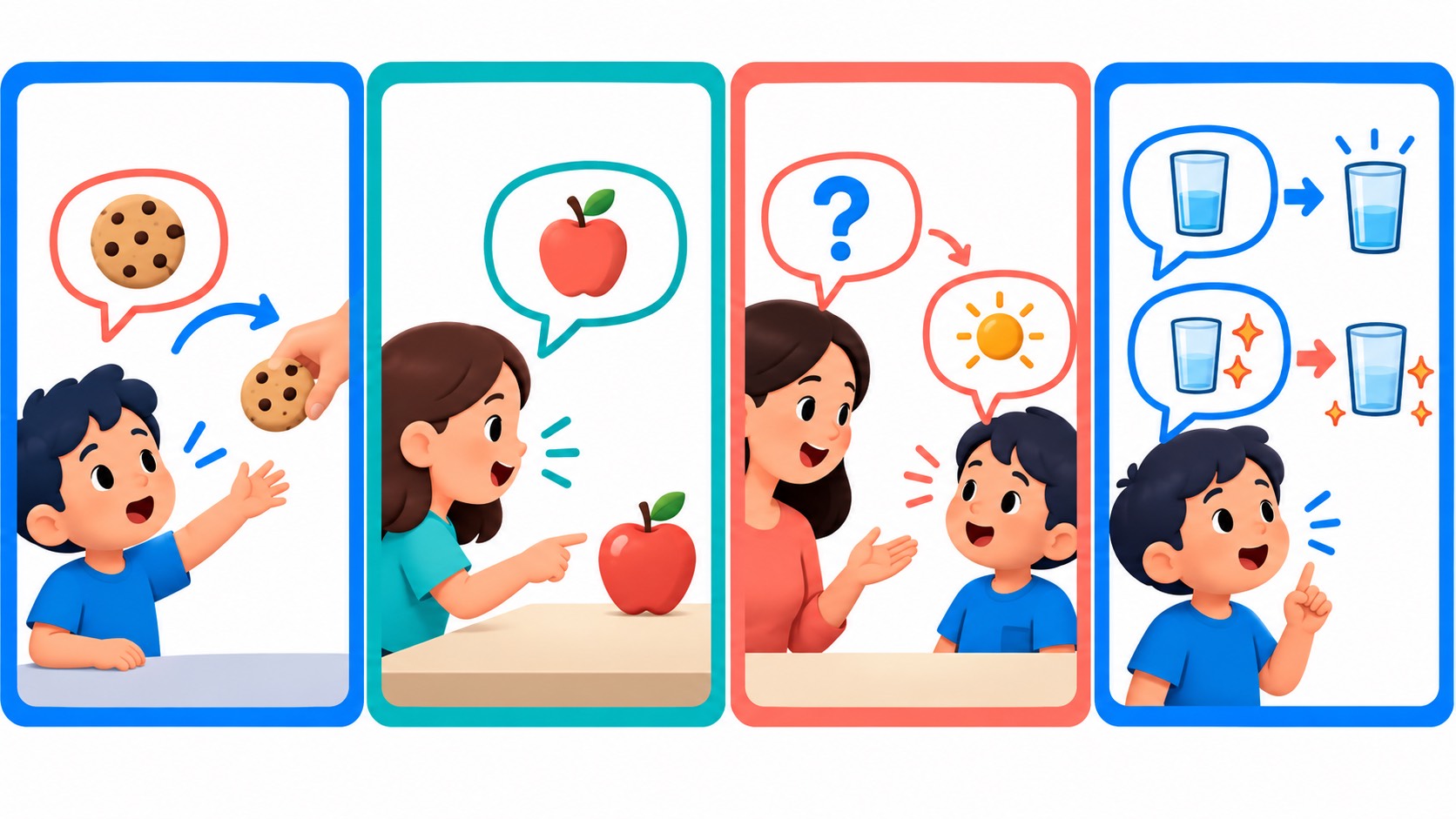
| Operant | Primary controlling relation | Exam question |
|---|---|---|
| Mand | Motivating operation and a characteristic reinforcer. | What does the speaker want, and what consequence is requested? |
| Tact | Nonverbal stimulus and generalized reinforcement. | What object, event, or property evokes the label? |
| Intraverbal | Verbal stimulus without point-to-point correspondence. | What verbal prompt evokes the response? |
| Autoclitic | Other verbal behavior that modifies the listener’s response to primary verbal behavior. | What does the modifier do to the message’s effect? |
| Multiple control | Two or more variables jointly influence one verbal response. | Which sources of control converge or diverge? |
See the verbal-operants, mand, tact, and intraverbal guides. Autoclitic questions depend on what is modified, not memorized sentence starters.
Common Autoclitic Functions and Examples
Everyday language often qualifies or arranges verbal behavior. These are study models: do not assume every “I think,” “please,” “maybe,” or “I saw” is an autoclitic.
| Utterance pattern | Primary verbal behavior | Possible autoclitic contribution |
|---|---|---|
| “I think the bus is late.” | A statement about the bus. | Qualifies the speaker’s confidence in the statement. |
| “I saw the keys on the table.” | A tact-like statement about the keys. | Describes the source or condition supporting the statement. |
| “Please give me the blue cup.” | A mand for a cup. | May alter the listener’s social response to the request, depending on history and context. |
| “No, the red card.” | A correction or selection response. | Qualifies or revises the preceding verbal behavior. |
| “First turn the page, then write your name.” | Instructional verbal behavior. | Arranges verbal units to influence the listener’s sequence of action. |
| “Maybe it is under the chair.” | A tact-like location statement. | Signals uncertainty and may change the listener’s search or follow-up. |
“Please give me the cup” may be controlled by an MO, the cup’s presence, social conventions, and listener history. “Please” does not erase the mand; it may add a secondary listener effect.
Autoclitic and Multiple Control
Multiple variables may control a response: MO, nonverbal stimulus, verbal prompt, audience, and listener history. The utterance can contain a primary operant plus an autoclitic arrangement that helps the listener respond.
Convergent multiple control combines variables to evoke one response; divergent control occurs when one variable influences several responses. Multiple control does not make every utterance part autoclitic. Separate primary control from the modifying verbal behavior.
| Analysis level | Question | Example |
|---|---|---|
| Primary response | What verbal operant would be identified without the modifier? | “Water” functions as a mand when a relevant MO and characteristic reinforcer are present. |
| Autoclitic layer | What verbal behavior changes how the listener responds to “water”? | “I really need” may arrange urgency or qualify the request, depending on history. |
| Nonverbal control | Is an object, event, or property also controlling the response? | The visible water bottle may contribute tact control. |
| Listener history | What has the listener learned to do after this arrangement? | The listener has reinforced clear requests with water access. |
| Competing control | What other variables could explain the response? | Prompting, audience, response effort, or a rule may also be relevant. |
See the site’s multiple-control guide when several antecedents appear. Map each variable to the response part it controls instead of calling the utterance one operant.
How to Analyze an Autoclitic Scenario
Use a layered analysis: remove the suspected modifier, identify the primary operant, add the modifier, ask how the listener changes, then identify consequence and learning history.
- Underline the primary verbal response.
- Mark the added verbal response that may modify it.
- Identify MO, nonverbal, verbal, or other control of the primary response.
- Describe the listener response made more or less likely.
- Check for mand, tact, intraverbal, prompt, rule, or ordinary grammar.
- Choose the narrowest classification supported by the stem.
| Scenario clue | Analysis question | Potential conclusion |
|---|---|---|
| The speaker adds a confidence qualifier. | Does the qualifier change how the listener treats the claim? | Possible qualifying autoclitic. |
| The speaker requests a specific item. | What MO and characteristic reinforcer control the request? | Primary mand, possibly with an autoclitic layer. |
| The speaker labels an object. | What nonverbal stimulus evokes the label? | Primary tact, possibly modified by source or certainty information. |
| The speaker answers a verbal question. | Does the response have point-to-point correspondence with the prompt? | Potential intraverbal; analyze any added modifier separately. |
| The listener changes action after the added phrase. | What feature of the message produced the listener change? | Evidence supporting an autoclitic function if the learning history fits. |
Avoid “the speaker wanted to sound smart.” State the observable verbal relation and listener consequence. A private event does not replace identifying controlling variables and behavior-consequence history.
Teaching and Measuring Autoclitic Behavior
Teaching autoclitic behavior begins with a functional communication goal, a primary repertoire to modify, and a listener who responds consistently. Use models, contrasts, prompts, role-play, natural conversations, and prompt fading; individualize the target.
Measure the response and effect, not a word alone. “I think” may be nonfunctional, while another form may qualify a message. Track independent use, listener discrimination, generalization, and modifier accuracy.
| Teaching component | Implementation example | Data option |
|---|---|---|
| Define the target | Specify the primary verbal response, modifier, context, and listener outcome. | Operational definition and examples/nonexamples. |
| Model contrast | Present the same primary message with and without a modifier. | Correct identification or use across trials. |
| Prompt and fade | Prompt the modifier, then transfer control to natural context. | Prompt level and independent percentage. |
| Listener response | Teach the listener to respond differently when the modifier changes the message. | Listener discrimination and follow-through. |
| Generalization | Vary people, topics, settings, and response forms. | Generalization probes and maintenance checks. |
Do not require uncertainty or politeness markers that mask communication needs. Preserve the learner’s ability to refuse, ask for help, correct an adult, and communicate safety concerns. Target effective communication, not superficial style compliance.
Generalization, Listener Effects, and Ethical Boundaries
Autoclitic behavior is relational because its value depends on listener response. A form learned with one person may not generalize, and a listener may reinforce a modifier that makes the primary message less clear. Program across people, topics, and settings.
Ethical teaching preserves the learner’s voice; “sounding confident” should not be required for credibility. Prioritize uncertainty, correction, disagreement, accessibility, cultural responsiveness, functional outcomes, and learner preferences.
| Boundary | Risk | Safer practice |
|---|---|---|
| Form over function | Teaching a phrase without confirming its listener effect. | Measure the functional distinction and listener response. |
| Compliance bias | Rewarding qualifiers only when they make the learner easier to manage. | Include requests, refusals, corrections, and self-advocacy. |
| Cultural mismatch | Treating one conversational style as universally correct. | Collaborate on socially valid communication goals. |
| Ambiguous listener | Different listeners respond inconsistently to the same modifier. | Train relevant communication partners and review natural outcomes. |
| Overprompting | The modifier becomes dependent on adult cues. | Fade prompts and test natural opportunities. |
One successful trial does not demonstrate generalization. Probe listeners, topics, settings, and support levels. If the message is understood without the modifier, it may be unnecessary; if it changes safety or support access, it may matter. Follow data and learner priorities.
BCBA Exam Traps for Autoclitic ABA
On the exam, the most common trap is treating the autoclitic as a primary verbal operant. The autoclitic modifies other verbal behavior; it is not simply the label for any verbal response that contains a qualifying word. Another trap is assuming that every occurrence of “please,” “I think,” or “maybe” has the same function across contexts.
| Exam wording | Likely concept | Reasoning move |
|---|---|---|
| “A verbal response changes the listener’s reaction to another verbal response.” | Autoclitic | Identify the secondary verbal behavior and its listener effect. |
| “The speaker requests a specific item when deprived.” | Mand | Identify the MO and characteristic reinforcer first. |
| “The learner labels a visible object.” | Tact | Identify the nonverbal stimulus controlling the response. |
| “The learner answers a question without point-to-point correspondence.” | Intraverbal | Identify the verbal stimulus and response relation. |
| “Several variables combine to evoke one verbal response.” | Convergent multiple control | Map each source of control instead of labeling the whole response autoclitic. |
| “A phrase sounds polite, but no listener consequence or history is described.” | Insufficient information | Do not classify from grammar alone. |
Use the site’s free BCBA mock exam after reviewing the verbal-operant distinctions. A strong answer explains what controls the primary verbal behavior, what the secondary verbal behavior modifies, and what the listener does differently because of that modification.
Autoclitic Checklist and FAQ
Use this checklist when analyzing an autoclitic ABA question or designing a communication target:
- Identify the primary verbal behavior before analyzing the modifier.
- Describe the modifier in observable terms.
- Identify what the modifier changes in the listener’s response.
- Separate mand, tact, intraverbal, and other primary control from the autoclitic layer.
- Check for convergent or divergent multiple control.
- Measure independent use, listener response, prompt level, and generalization.
- Preserve requests, refusals, corrections, and self-advocacy.
- Use the learner’s communication priorities and context to judge social validity.
| Question | Short answer |
|---|---|
| What is an autoclitic in ABA? | A secondary verbal operant that modifies the effect of other verbal behavior on a listener. |
| Is an autoclitic the same as a mand? | No. A mand is a primary verbal operant controlled by an MO and characteristic reinforcer; an autoclitic modifies other verbal behavior. |
| Can a mand contain an autoclitic? | Yes. A request may be primary mand behavior while additional verbal behavior changes how the listener responds. |
| Do specific words automatically make a response autoclitic? | No. Function, listener effect, and learning history matter more than the phrase’s form. |
| What does multiple control have to do with autoclitics? | Several variables may control the utterance, so the analyst must separate primary control from the modifying verbal layer. |
| How should autoclitic behavior be measured? | Track the target form, context, prompt level, listener discrimination, function, and generalization. |
In one sentence: an autoclitic is verbal behavior that helps shape how a listener responds to other verbal behavior. Start with the primary operant, identify the added verbal function, and verify the listener effect before choosing an answer.



